
The non-profit sector is currently facing a silent crisis of administrative burnout. As of May 2025, development directors report spending an average of 30 to 50 hours on a single federal grant application, often with success rates hovering below 20%. This scarcity mindset—where hours are poured into paperwork rather than mission work—is unsustainable.
For the overwhelmed generalist, the solution isn’t to work harder; it’s to fundamentally change the production mechanism. Artificial Intelligence has matured from a novelty into a strategic necessity, but the fear of “robotic” output or ethical breaches remains a significant barrier. This guide provides a strategic playbook for the “Responsible Speed” protocol: a workflow to architect high-quality, compliant proposals in under 30 minutes.
TL;DR: Nonprofits can write ethical, compliant grant proposals in under 30 minutes by adopting the “Architect, Don’t Write” mindset and using the 3-phase “Prime, Draft, Refine” workflow. Specialized AI tools like FundRobin automate the heavy lifting of drafting and compliance checking, while human oversight ensures data privacy and emotional resonance. Major funders like the MacArthur Foundation now accept AI assistance when disclosed and used responsibly.

The “Architect, Don’t Write” Mindset Shift
Write Grant Proposals in 30 Minutes with AI
To reclaim your time, you must stop viewing yourself as a writer and start operating as an architect. In the traditional model, you are the bricklayer, placing every word manually. In the AI-assisted model, you are the site manager; you provide the blueprints (context and strategy), and the AI acts as your “Digital Intern,” handling the repetitive labor of laying the bricks.
This shift is critical because the burnout epidemic is quantifiable. According to Vital City, the administrative burden on nonprofits has reached a tipping point where the cost of seeking funding often outweighs the capital raised for smaller organizations. The “Digital Intern” concept doesn’t replace the grant writer; it liberates them to focus on high-level strategy and donor relationships.
By 2025, the stigma surrounding AI in the sector has largely evaporated. It is moving from a “taboo” shortcut to an essential operational standard. The goal is not to have AI think for you, but to have it work for you—generating the “Zero Draft” that you can then refine with your unique expertise.
Navigating the “Gray Zone”: Ethics, Privacy, and Tool Selection
Before executing the workflow, we must address the elephant in the room: Is this allowed? The short answer is yes, provided you navigate the ethical guardrails correctly.
Funder Acceptance Policies
Major philanthropic institutions have updated their policies to reflect the reality of modern tools. For instance, the MacArthur Foundation has clarified that while they value authentic human expression, the use of generative AI is permitted as long as the applicant remains responsible for the accuracy and integrity of the content. Similarly, Stanford Medicine emphasizes that AI should be used to enhance clarity and logic, not to fabricate data or claim authorship of ideas.
The Privacy Trap
The most significant risk isn’t rejection; it’s data leakage. Writing a grant requires sensitive information: donor lists, beneficiary PII (Personally Identifiable Information), and financial specifics. Pasting this data into a free, public Large Language Model (LLM) like ChatGPT is a security failure. These generalist models may train on your data, potentially exposing it to the public domain.
Specialized vs. Generalist Tools
To maintain ethical compliance, you must choose the right tool stack. While generalist models are powerful, they lack the specific guardrails needed for grant compliance. A specialized AI Grant Proposal Generator is designed specifically for this workflow. Unlike public models, platforms like FundRobin operate with a zero-retention policy on your proprietary data and are fine-tuned to understand the nuance of nonprofit narratives, ensuring you never compromise donor privacy for speed. If you prefer to start from a proven structure before using AI, FundRobin’s free grant proposal template provides a ready-made framework covering every required section.
Phase 1 & 2: The Priming and Drafting Sprint (Minutes 0-20)
This is where the “Architect” mindset translates into action. The 30-minute countdown begins here. Do not start with a blank cursor.
Minute 0-10: Priming the Engine
AI hallucinations often stem from a lack of context. To prevent this, you must “prime” the AI with your organizational DNA.
- Upload Context: Feed the system your most recent Impact Report, your Form 990, and a successful past proposal. This teaches the AI your tone, your metrics, and your mission vocabulary.
- Smart Matching: Copy and paste the RFP (Request for Proposal) guidelines. An advanced tool will analyze the funder’s constraints—character counts, priority keywords, and funding goals—instantly.
FundRobin’s Smart Proposal feature automates this step, cross-referencing your organizational data against the RFP requirements to identify gaps before drafting begins.
Minute 10-20: The Zero-Draft Generation
With the context loaded, initiate the drafting phase.
- The Narrative: Instruct the AI to draft the Executive Summary and Statement of Need first. Use prompts that enforce specificity: “Draft a Statement of Need based on the uploaded Impact Report, emphasizing our 15% increase in community demand in Q1 2025.”
- The Budget Narrative: AI excels at justifying costs. Ask it to map your project activities to line items. While it drafts the narrative justification, always verify the actual arithmetic yourself.
By minute 20, you should have a complete, structure-compliant draft. It won’t be perfect, but it will be done.
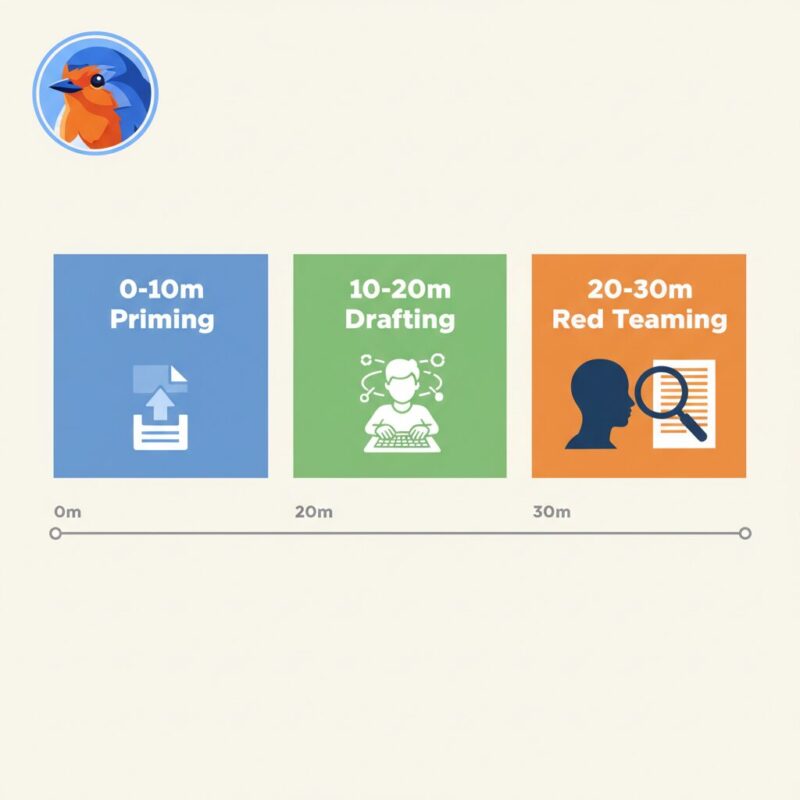
Phase 3: The “Red Team” Refinement (Minutes 20-30)
The final 10 minutes are the most critical. This is where you apply the “Human-in-the-Loop” safety net. In cybersecurity, a “Red Team” actively tries to find flaws in a system. You must do the same for your proposal.
Detecting Hallucinations
AI serves as a convincing liar. It may invent citations or inflate statistics to satisfy a prompt. Scrutinize every data point. Did your program actually serve 500 families, or did the AI extrapolate that trend? Verification is your ethical duty.
Injecting Strategic Empathy
As noted by Candid, funders are looking for connection, not just competence. AI struggles with emotional nuance. Use this time to weave in a specific, anonymized beneficiary story or a quote from your program director. These “heartbeat” moments are what differentiate a compliant proposal from a winning one and help in defeating “AI Speak”.
The Compliance Final Check
Ensure the output respects the funder’s technical constraints. Does the 2,000-character Executive Summary actually fit? Specialized tools usually enforce this during generation, but a manual spot-check ensures you aren’t disqualified on a technicality.
Frequently Asked Questions
Is it ethical to use AI to write grant proposals?
Yes, it is ethical to use AI if utilized as a drafting assistant under the “Architect, Don’t Write” model, provided you maintain data privacy and verify all outputs. Efficiency that frees up time for mission work is an ethical good, a perspective supported by institutions like Stanford Medicine, provided the human remains the final author.
Will funders reject my application if I use AI?
Most major funders, including the MacArthur Foundation, accept AI use but may require disclosure. Funders prioritize the quality, feasibility, and impact of the project over the tool used to type the words. Rejection is more likely to stem from generic, unverified content than from the use of AI itself.
How can I ensure my donor data stays private when using AI?
You must avoid generic, public LLMs like ChatGPT for sensitive data, as they may use inputs for training. Instead, use specialized platforms like FundRobin, which utilize encrypted, private instances and enforce zero-training policies to guarantee your donor PII never leaves your control.
How do I stop AI proposals from sounding robotic?
Employ the “Red Teaming” process during the final 10 minutes of your workflow. This involves actively replacing generic adjectives with specific organizational data, removing repetitive sentence structures, and injecting strategic empathy through real beneficiary stories that AI cannot invent.
Can AI generate the budget section of a grant proposal?
AI can draft the budget narrative and justification effectively, but humans must calculate and verify the specific numbers. Use AI to align your line items with the funder’s priorities, but utilize specialized parameters to ensure the math aligns with your actual operational costs.
Key Takeaways:
- Shift from “Writer” to “Architect”: Use AI to handle the 80% drafting drudgery so you can focus on the 20% strategic refinement and donor alignment.
- The 30-Minute Workflow: Split your time rigidly into Priming (10m), Drafting (10m), and Red-Teaming (10m) to maintain quality control and speed.
- Data Privacy is Non-Negotiable: Never feed PII into public models; opt for specialized platforms like FundRobin that guarantee data encryption and zero-retention.
- Compliance is King: Use AI to cross-reference strict funder guidelines automatically, reducing rejection risk from technical formatting errors.
Conclusion
The goal of using AI in grant writing is not to automate away the human element, but to automate the exhaustion that prevents the human element from shining. By adopting this 30-minute blueprint, you move from a place of scarcity and burnout to a position of strategic abundance. The tools are ready; the funders are adapting. The only remaining variable is your willingness to shift from writing every word to architecting your future funding.

Comments
2 responses to “How to Write a Grant Proposal in Under 30 Minutes Using AI”
[…] compliant first drafts of executive summaries, budgets, and evaluation plans up to 10x faster. Smart Proposal Generation can reduce a 40-hour writing task to just 4 hours. Built-in compliance checking validates the draft […]
[…] feature cures “blank page anxiety.” It reduces the time required to write a grant proposal from 40 hours to 4 hours. The AI writes the first draft, but your team retains control to polish […]