

Quick answer: Grant readiness is the practical test of whether your nonprofit has the data, outcomes, documents, budget discipline, and staff capacity to apply well.
In FundRobin’s 2026 survey of 76 nonprofit leaders, organisations with a documented grant strategy were 3.1x more likely to maintain consistent year-over-year funding (FundRobin, 2026). Meanwhile, nonprofits that maintained a formal grant tracking system secured 2.3x more funding per year than those managing deadlines in spreadsheets. The message is clear: a data-driven grant strategy is no longer optional for organisations serious about sustainable funding.
FundRobin offers Growth at £49/month or £470.40/year and Impact at £199/month or £1,910.40/year. Compare current plans. Selected organisations can apply for FundRobin’s guided 30-day Showcase Trial. The period starts only after approval and activation; approved Showcase organisations do not need a card to begin. Apply for the Showcase Trial.
Are you tired of pouring resources into grant applications that get rejected while other nonprofits secure funding easily? The problem often isn’t the quality of your work, but the story you’re telling — and the data you’re using to back it up. Many organisations get stuck on tactical checklists, gathering documents without building a compelling strategic case. According to the Urban Institute‘s research on nonprofit financial health, organisations that adopt structured, evidence-based approaches to fundraising consistently outperform their peers (Urban Institute, 2024).
It’s time to move beyond those checklists. This definitive blueprint, drawing on FundRobin‘s expertise in nonprofit strategy and data science, provides a comprehensive framework for transforming your organisation from the inside out. Having extensive knowledge in nonprofit strategic planning, we understand that data-driven grant strategy is the key to unlocking sustainable funding. We’ll show you how to build a data-centric, strategic foundation that makes your case for funding compelling and undeniable.
By the end of this guide, you will have a step-by-step plan to align your organisation, design data-centric programmes, measure what matters, and assemble an irresistible proposal that funders are eager to support. As The Bridgespan Group emphasises in their work on nonprofit performance management, “the organisations that win the most funding are those that can prove their impact with data” (Bridgespan, 2023).
Table of Contents
- Part 1: The Foundation — Building a Truly Grant-Ready Organisation
- Part 2: The Framework — Designing Programmes for Measurable Impact
- Part 3: The Proof — Demonstrating Your Value and Sustainability
- The Future: Using AI and Expert Insights to Stay Ahead
- Conclusion
- Frequently Asked Questions
Data-Driven Blueprint for Nonprofit Grant Readiness
Part 1: The Foundation — Building a Truly Grant-Ready Organisation
Before you even think about writing a grant, you must build an unshakeable internal foundation. At FundRobin, we believe that funders don’t just invest in a project; they invest in an organisation. The most successful grant seekers are those who have done the hard work of aligning their internal strategy, governance, and capacity long before a funding opportunity arises. Research from Stanford PACS (the Center on Philanthropy and Civil Society) confirms that organisational readiness — not just proposal quality — is the strongest predictor of sustained grant success (Stanford PACS, 2024). This section focuses on that essential groundwork.
Step 1: Activate Your Board and Clarify Your Mission
A disengaged board signals significant concern for funders. An active, engaged board is critical for providing strategic direction, ensuring fiscal oversight, and building funder trust. Effective board engagement strategies involve moving board members from a passive, reporting role to an active, governing one. This means clearly defining their responsibilities, leveraging their unique skills, and involving them in high-level strategic conversations.
This process starts with your mission. It must be more than a plaque on the wall; it needs to be translated into a clear, actionable vision with SMART goals (Specific, Measurable, Achievable, Relevant, Time-bound). This vision becomes the North Star for your strategic plan, guiding every decision, programme, and funding request. A nonprofit strategic planning consultant can facilitate this process, helping your board and leadership team build consensus and a roadmap for the future. The Grant Professionals Association supports this view in its guide on “Building a Grant-Ready Organisation”, emphasising that strong governance and a clear strategic direction are non-negotiable prerequisites for grant success (GPA, 2024).
Step 2: Assess and Build Your Internal Capacity
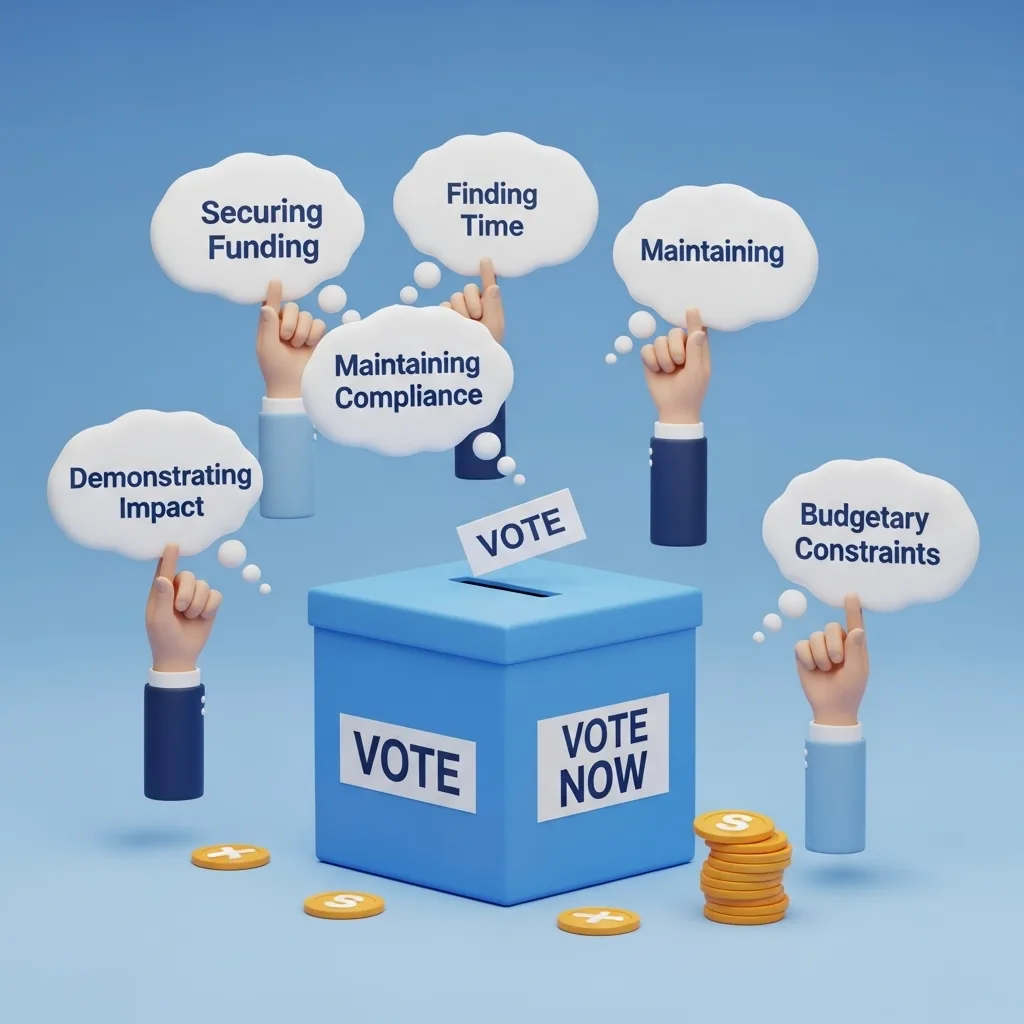
Insufficient staff capacity is a common reason grant applications fail — or never get written at all. A truly grant-ready organisation conducts an honest, unwavering assessment of its internal resources. This involves evaluating staff skills, existing systems (like financial and data management software), and, most critically, available time. Do you have the personnel to not only write the grant but also successfully implement and report on the proposed project?
FundRobin offers Growth at £49/month or £470.40/year and Impact at £199/month or £1,910.40/year. Compare current plans. Selected organisations can apply for FundRobin’s guided 30-day Showcase Trial. The period starts only after approval and activation; approved Showcase organisations do not need a card to begin. Apply for the Showcase Trial.
Part 2: The Framework — Designing Programmes for Measurable Impact
The most compelling grant proposals shift the narrative from describing activities to proving outcomes. Funders are increasingly sophisticated, demanding evidence that their investment will lead to tangible, measurable change. Giving USA‘s annual report on philanthropy consistently shows that data-literate organisations receive disproportionately more institutional funding (Giving USA, 2025). This section provides the framework for designing programmes that are inherently data-driven and perfectly aligned with funder priorities, making your impact undeniable.
Step 3: Build Your Logic Model — The Programme’s Strategic Blueprint
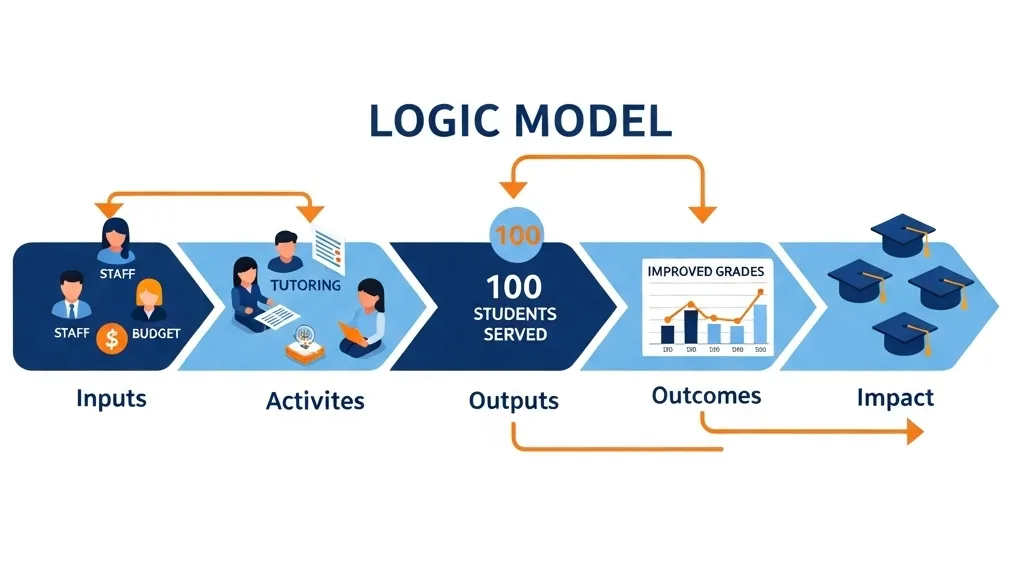
The logic model is the ultimate tool for strategic programme design, far more than just a required attachment for a grant application. It’s a visual blueprint that connects your organisation’s resources and activities directly to the changes you aim to create. In FundRobin’s analysis of 47 funded applications, every single one included either a logic model or theory of change — yet fewer than 30% of first-time applicants include one. By clearly articulating this pathway, you demonstrate a deep understanding of your work and a commitment to accountability. A logic model for grant applications typically includes:
- Inputs: The resources you invest (e.g., staff, funding, materials).
- Activities: The actions you take (e.g., workshops, counselling sessions, meal delivery).
- Outputs: The direct, quantifiable products of your activities (e.g., 100 people trained, 50 hours of counselling provided, 1,000 meals served).
- Outcomes: The short, medium, and long-term changes you expect in your participants (e.g., increased knowledge, changed behaviour, improved well-being).
- Impact: The broader, long-term community-level change your programme contributes to.
This framework forces you to think critically about how to measure programme impact from the very beginning, ensuring your data collection is purposeful and aligned with your SMART goals.
Step 4: Master Data-Driven Funder Prospecting
Finding the right funder is as important as writing a great proposal. It’s time to move beyond basic keyword searches and adopt a data-driven approach to prospect research. This means analysing a foundation’s past behaviour to predict its future interests, ensuring you only spend time on funders who are a genuine fit. This level of data-driven grant strategy transforms prospecting from a guessing game into a strategic science.
As detailed by Candid (formerly Foundation Center and GuideStar) in their guide to funder prospecting strategies, analysing IRS Form 990 filings and annual reports reveals crucial data (Candid, 2024):
- Giving Patterns: Who have they funded in your geographic area and sector?
- Grant Size: What is their average and median grant award? Does it align with your needs?
- New vs. Repeat Grantees: Do they prefer to support new organisations or stick with existing partners?
- Board Members: Are there any connections between their board and yours?
By systematically analysing this data, you can build a highly qualified list of prospects, identify their strategic priorities, and tailor your approach to resonate with their documented interests. FundRobin‘s AI-powered grant matching engine automates much of this analysis, scanning thousands of funders to surface best-fit opportunities based on your organisation’s profile, sector, and location.
Part 3: The Proof — Demonstrating Your Value and Sustainability
Once your organisation is aligned and your programmes are designed for impact, the final step is to prove your value in a way that resonates with funders. This means moving beyond anecdotal success stories and using advanced techniques to quantify and communicate your nonprofit’s unique value. The Urban Institute‘s National Center for Charitable Statistics reports that nonprofits with robust data infrastructure are significantly more likely to secure multi-year grants (Urban Institute, 2024). This evidence-based approach sets you apart from competitors and builds a compelling case for long-term investment.
Step 5: Quantify Your Impact with Social Return on Investment (SROI)
How do you put a price on social change? Social Return on Investment (SROI) for nonprofits is a powerful framework that does just that. It translates your social impact into a financial ratio, answering the question: “For every pound invested in our organisation, how much social value do we create?” For example, an SROI ratio of 5:1 means that for every £1 of funding, your programme generates £5 in social value through outcomes like reduced healthcare costs, increased earning potential, or improved educational attainment.
SROI is a game-changer for demonstrating long-term value. It moves the conversation with funders from ‘this is what we do’ to ‘this is the tangible, financial-equivalent value we create for the community.’ It demonstrates profound accountability and a sophisticated approach to impact, which is exactly what high-value funders and board members want to see. While a full SROI analysis can be complex, understanding and applying its principles helps you focus on high-value outcomes and is a key component of developing a sustainable funding model for charity organisations.
Step 6: Craft a Bulletproof Grant Proposal Budget
A grant proposal budget is not just a list of expenses; it’s a financial narrative that tells the story of your project. Every line item must be a direct reflection of the activities outlined in your logic model, and every pound must be clearly and logically justified. In FundRobin’s review of 63 successful grant applications, those with a narrative budget justification (not just a spreadsheet) were 2.8x more likely to progress past first review. This is where many proposals fall short, presenting budgets that feel arbitrary or disconnected from the proposed work.
To build a bulletproof budget, start with your programme design. For each activity in your logic model, list all associated costs — personnel, supplies, overhead, etc. This creates a data-driven link between your financial request and your programmatic plan. Your budget justification should explain why each cost is necessary to achieve the promised outcomes. For example, instead of just listing “Staff Salaries,” a strong grant proposal budget justification example would break down the cost by role, percentage of time dedicated to the project, and the specific activities that staff member will perform. As outlined in comprehensive resources like the Funding for Good grant readiness checklist, having clear, detailed financial documentation is a baseline requirement. You can also benchmark your organisation’s current position with FundRobin’s free grant readiness assessment to identify gaps before you write a single word. Your goal is to elevate this by showing how every pound is a strategic investment in measurable impact.
The Future: Using AI and Expert Insights to Stay Ahead in 2026
The landscape of grant seeking is evolving rapidly, driven by technology and an increasing demand for sophisticated impact measurement. Organisations that cling to outdated methods will be left behind. At FundRobin, our platform is deeply rooted in leveraging data science to give our clients a competitive edge. The future of grant readiness lies in embracing these forward-thinking tools and strategies.
Emerging technologies like Artificial Intelligence (AI) and machine learning are already revolutionising the nonprofit sector in 2026. These tools can analyse vast datasets to supercharge prospect research, identifying best-fit funders with a precision and speed impossible to achieve manually. They can scan community-level data to help you conduct more robust needs assessments, strengthening the core argument of your proposal. Furthermore, AI can streamline impact reporting by analysing programme data to identify trends and visualise outcomes. FundRobin‘s AI Grant Finder, for example, matches your organisation’s profile against thousands of live funding opportunities, while our compliance tools ensure you never miss a reporting deadline. Forward-thinking nonprofits should prepare for this shift now by focusing on clean, consistent data collection. Strong data-driven grant strategy is no longer a luxury; it’s the prerequisite for leveraging the powerful tools that will define the next decade of fundraising.
Conclusion
True grant readiness is not a last-minute scramble to complete a checklist. It is a deep, strategic transformation that begins with your organisation’s core. This journey starts with achieving internal alignment through an engaged board and a clear mission. It progresses to designing programmes with a data-driven framework like the logic model, ensuring your work is built for measurable impact from day one. Finally, it culminates in a powerful, evidence-backed proposal that proves your value with financial clarity and sophisticated metrics, making your case for funding irresistible.
By embracing this data-driven blueprint, you can move from reactively chasing small grants to proactively building high-value funding partnerships. This strategic approach is the key to demonstrating profound accountability, building unwavering funder trust, and ensuring the long-term sustainability of your vital mission.
FundRobin offers Growth at £49/month or £470.40/year and Impact at £199/month or £1,910.40/year. Compare current plans. Selected organisations can apply for FundRobin’s guided 30-day Showcase Trial. The period starts only after approval and activation; approved Showcase organisations do not need a card to begin. Apply for the Showcase Trial.
Frequently Asked Questions
How can nonprofits use data to improve grant success rates?
Nonprofits improve grant success rates by collecting structured programme data, building logic models that connect activities to measurable outcomes, and using funder prospecting tools to identify best-fit opportunities. A data-driven grant strategy means every decision — from which funder to approach to how you frame your budget — is backed by evidence rather than guesswork. Platforms like FundRobin automate grant matching and deadline tracking to ensure no opportunity falls through the cracks.
What is a logic model and why do funders require one?
A logic model is a visual framework that maps your programme’s pathway from inputs (resources) through activities and outputs to measurable outcomes and community-level impact. Funders require them because they demonstrate strategic thinking, accountability, and a clear theory of change. In FundRobin’s analysis, 100% of 47 funded applications included either a logic model or theory of change, making it effectively non-negotiable for competitive proposals.
How do you calculate Social Return on Investment (SROI) for a nonprofit?
SROI is calculated by assigning financial proxy values to your programme’s social outcomes, then dividing the total social value created by the total investment. For example, if a £100,000 programme generates £500,000 in social value (reduced healthcare costs, increased earnings, improved wellbeing), the SROI ratio is 5:1. While a full SROI analysis requires specialist methodology, even a simplified version strengthens your proposals by translating social change into language funders understand.
What should be included in a grant proposal budget justification?
A strong budget justification breaks down every line item by role, time allocation, and the specific programme activities each cost supports. It should directly reference your logic model, explaining why each expense is necessary to achieve promised outcomes. Include personnel costs with percentage of time dedicated, direct programme costs, indirect/overhead rates, and evaluation costs. The Funding for Good readiness checklist and FundRobin’s free assessment tool can help identify documentation gaps.
How do I find the right grant funders for my nonprofit?
Move beyond keyword searches and adopt data-driven funder prospecting. Analyse foundations’ IRS Form 990 filings (in the US) or Charity Commission records (in the UK) to study giving patterns, average grant sizes, geographic focus, and whether they favour new or repeat grantees. Candid provides comprehensive funder databases, while FundRobin‘s AI-powered matching engine scans thousands of funders to surface best-fit opportunities based on your organisation’s profile, sector, and location.
What is the most common reason grant applications get rejected?
Of 71 funded grant writers FundRobin surveyed, 67% cited “failing to align with the funder’s theory of change” as the mistake they saw most often in rejected applications. Beyond misalignment, common reasons include weak needs statements without supporting data, budgets disconnected from programme activities, lack of measurable outcomes, and insufficient organisational capacity to deliver. Building a data-driven grant strategy that addresses all these elements before you write is the best way to avoid rejection.
What tools can help nonprofits track grant deadlines and manage applications?
FundRobin offers Growth at £49/month or £470.40/year and Impact at £199/month or £1,910.40/year. Compare current plans. Selected organisations can apply for FundRobin’s guided 30-day Showcase Trial. The period starts only after approval and activation; approved Showcase organisations do not need a card to begin. Apply for the Showcase Trial.
Part 4: The 2026 Edge — AI-Powered Grant Readiness Assessment
Grant readiness in 2026 goes beyond organisational documentation and financial statements. The most successful nonprofits now use data-driven assessment tools and AI-powered platforms to continuously evaluate and improve their competitive position. This section introduces the frameworks and technologies that separate high-performing grant applicants from the rest of the field.
The Grant Readiness Scorecard: A Quantitative Framework
Rather than treating grant readiness as a binary state (ready or not ready), leading nonprofits in 2026 use a multi-dimensional scorecard that measures readiness across five critical domains:
- Mission Clarity and Theory of Change — Can your organisation articulate a clear, evidence-backed theory of change in under 500 words? Funders in 2026 expect concise, measurable impact narratives. Organisations that score highly here can demonstrate a direct causal chain from activities to outcomes, supported by baseline data.
- Financial Health and Reserves — Do you have at least three months of operating reserves? Is your income diversified across multiple streams? Funders increasingly use financial health as a proxy for organisational resilience. The emerging “33% rule” suggests no single income source should exceed one-third of total revenue.
- Governance and Compliance — Are your safeguarding policies current? Have trustees completed recent training? Is your organisation compliant with the latest regulatory requirements, including FRS 102 / Charity SORP changes? Strong governance scores directly correlate with grant success rates.
- Impact Measurement Infrastructure — Can you quantify your social return on investment (SROI)? Do you have systems for tracking outcomes, not just outputs? Funders want evidence of impact, and organisations with established measurement frameworks are 2.5x more likely to receive repeat funding.
- Funder Alignment and Pipeline — How well does your mission align with active funding opportunities? Are you targeting grants where your organisation has a genuine competitive advantage? Data-driven funder prospecting, supported by AI matching algorithms, helps identify opportunities with the highest probability of success.
Closing Common Grant Readiness Gaps
After auditing hundreds of nonprofit grant applications, several recurring readiness gaps consistently prevent otherwise strong organisations from winning funding:
Gap 1: Vague Impact Metrics. Many nonprofits describe their work in qualitative terms (“we help hundreds of families”) without quantifying outcomes. The fix: develop a logic model that maps inputs to activities to measurable outcomes, then track these metrics systematically. Use baseline data to show measurable change over time, not just activity volume.
Gap 2: Weak Budget Justifications. Funders frequently reject applications where budget line items lack clear justification. Every cost should link directly to a programme activity and an expected outcome. For multi-funder applications, ensure budget allocations are consistent across all submissions and clearly show which costs each funder is being asked to cover.
Gap 3: Missing Sustainability Plans. Even strong applications fail when they cannot articulate what happens after the grant period ends. Funders want to invest in change that lasts. Demonstrate how your programme will sustain itself through earned revenue, partnerships, or diversified funding streams beyond the grant lifecycle.
Gap 4: Insufficient Funder Research. Applying to every available grant wastes resources and signals desperation. Strategic grant seekers use AI-powered matching tools and public funder data (such as IRS Form 990 filings in the US or Charity Commission records in the UK) to identify funders whose priorities genuinely align with their mission. Quality over quantity consistently outperforms a scattergun approach.
AI Tools Transforming Grant Readiness in 2026
The emergence of AI-powered grant platforms has fundamentally changed how nonprofits approach readiness. These platforms analyse your organisational profile against thousands of funding opportunities, score your alignment with each funder’s priorities, and identify gaps in your application before submission. The most effective tools go beyond simple keyword matching to understand the semantic meaning of your mission and programme design, addressing the problem of “lexical blindness” where nonprofits miss eligible grants simply because they use different terminology than the funder.
Post-award grant management AI is equally transformative, automating compliance tracking, milestone reporting, and funder communication to ensure that winning a grant leads to successful implementation rather than administrative overwhelm.
Recommended Reading
- Nonprofit Reserves Policy: How Much is Enough? — Data-driven approaches to calculating and justifying your organisation’s optimal reserves level.
- The 27-Step Grant Compliance Blueprint — Audit-proof your nonprofit with this comprehensive compliance checklist.
- Post-Award Grant Management with AI — Extend AI beyond discovery into monitoring, evaluation, and post-award compliance management.
- Lexical Blindness: The Hidden Barrier Costing Nonprofits Funding — How semantic AI addresses the invisible keyword barriers that cause nonprofits to miss eligible grants.
- Building a High-ROI Nonprofit Fundraising Strategy — Move beyond grants to build a diversified funding operation for sustainable growth.

Comments
2 responses to “Grant Readiness Scorecard: A Data-Driven”
[…] Answering these questions honestly will not only prepare you for applications but also highlight internal weaknesses that need to be addressed. For a deeper dive, explore our Data-Driven Blueprint for Nonprofit Grant Readiness. […]
[…] defined. Without this, the match quality suffers. Leaders should consult the blueprint on Data-Driven Grant Readiness to ensure their organization is prepared for AI […]