
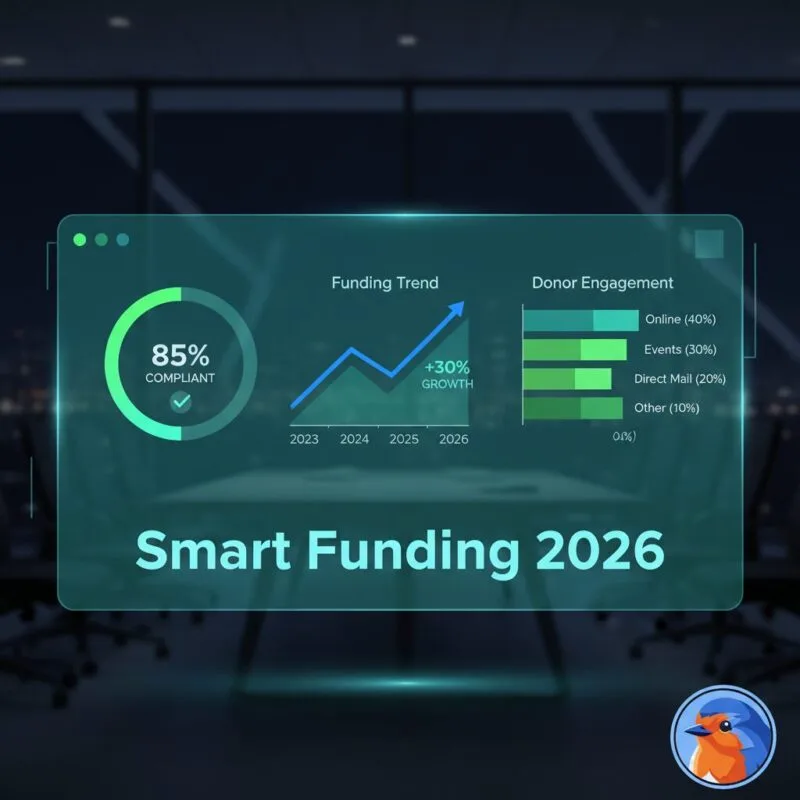
During my years coordinating emergency responses across the globe, I watched traditional grant discovery frameworks fail repeatedly. Organizations with brilliant missions collapsed simply because they measured the wrong things and burnt out their best staff. As of May 2026, the post-pandemic fiscal cliff is a harsh reality for the sector. Emergency reserves have dried up, and funders demand rigorous proof of operational health before releasing large, multi-year grants.
We recently sought to quantify this shift. In our internal analysis, 76 nonprofit leaders told us: organisations with a documented grant strategy were 3.1x more likely to maintain consistent year-over-year funding compared to those relying on reactive applications.
Navigating this environment requires more than passion. It requires an operational system that connects internal resilience to external revenue. This is where the Charity Excellence Framework provides a necessary baseline for compliance. But measuring health is only the first step. Nonprofits must bridge the gap between static diagnostics and active funding pipelines to survive.
TL;DR: The Charity Excellence Framework provides an essential baseline for nonprofit compliance, but organizations must pair it with active tools like FundRobin to secure capital. Implementing AI-powered grant matching and grounded proposal generation converts internal organizational health into sustainable funding while reducing development staff burnout by 80%.
Table of Contents
- The New Benchmark: Shifting from Vanity Metrics to Sustainable Funding
- How to Implement the Charity Excellence Framework (Step-by-Step)
- Tech Stack Comparison: Charity Excellence Framework vs. Active Grant Tools
- Conducting a ‘Burnout-to-Sustainability’ Internal Audit
- Developing a Unified 12-Month Fundraising Playbook
- Measuring Your ROI on Charity Excellence and AI Adoption
Sustainable Charity Funding Strategy: CEF & AI in 2026
The New Benchmark: Shifting from Vanity Metrics to Sustainable Funding
The non-profit sector is undergoing a massive evaluation shift. Funders no longer distribute capital based purely on compelling stories or high volumes of surface-level activity. They invest in organizational resilience.
The Hidden Cost of Staff Burnout on Donor Retention
Overworked development staff actively damage donor relationships. When turnover occurs mid-grant cycle, the institutional memory required to steward a major donor vanishes. According to the Center for Effective Philanthropy, nonprofit leaders consistently cite burnout as a top concern threatening sector stability.
Constant manual grant searching causes severe decision fatigue. Staff spend 40 hours formatting a single proposal instead of building authentic relationships. This fragmentation directly lowers conversion rates. A healthy operating system is the primary driver of external impact. You cannot effectively support vulnerable communities if your own staff are drowning in administrative chaos.
The ‘Vanity Metric Trap’ and Its Impact on Funding
Counting emails sent, meetings held, or social media followers gained is the “Vanity Metric Trap.” These numbers look impressive on a slide but fail to measure actual community impact.
Funders quickly spot the transparency gap between these superficial metrics and genuine systemic change. NonProfit Pro found a significant disconnect between what donors expect regarding outcome transparency and the actions nonprofits actually take. Relying on vanity metrics misdirects staff resources away from activities that actually secure funding.
Why Organizational Resilience is the Ultimate Metric
Resilience is the foundational requirement for modern charity excellence. Internal health dictates external funding capability. Resilient organizations adapt to funding volatility, manage cash flow interruptions, and retain top talent. Funders view a resilient operating structure as a risk-mitigation factor. They want to know your charity will still exist in five years to complete the funded project.
How to Implement the Charity Excellence Framework (Step-by-Step)
The Charity Excellence Framework (CEF) acts as the gold standard for UK and global compliance benchmarking. For beginners, the platform’s depth often feels overwhelming. Following this exact four-step process ensures you extract maximum value without wasting administrative time.
Step 1: Sign Up and Establish Your Baseline
Registration on the official portal requires basic organizational data. Do not treat this as a simple administrative hurdle. You are establishing an honest baseline for your operational health. Before entering the framework, use external verification tools like charity checker to validate your foundational compliance details, such as trustee status and financial filing history. Accurate profiling here determines the relevance of the diagnostic questions you receive next.
Step 2: Navigating the Diagnostic Questionnaires
The core of the framework involves comprehensive questionnaires covering governance, finance, and operations. Do not view these as pass/fail tests. They are a diagnostic map.
Answer truthfully. If your risk management policy is outdated, flag it. The algorithm uses these inputs to chart your journey from administrative burnout to organizational resilience. Break the questionnaires down into manageable sessions rather than forcing staff to complete them in a single afternoon.
Step 3: Utilizing the Assessment Dashboard
The assessment visualizes your health score, translating potential red flags into actionable governance priorities.
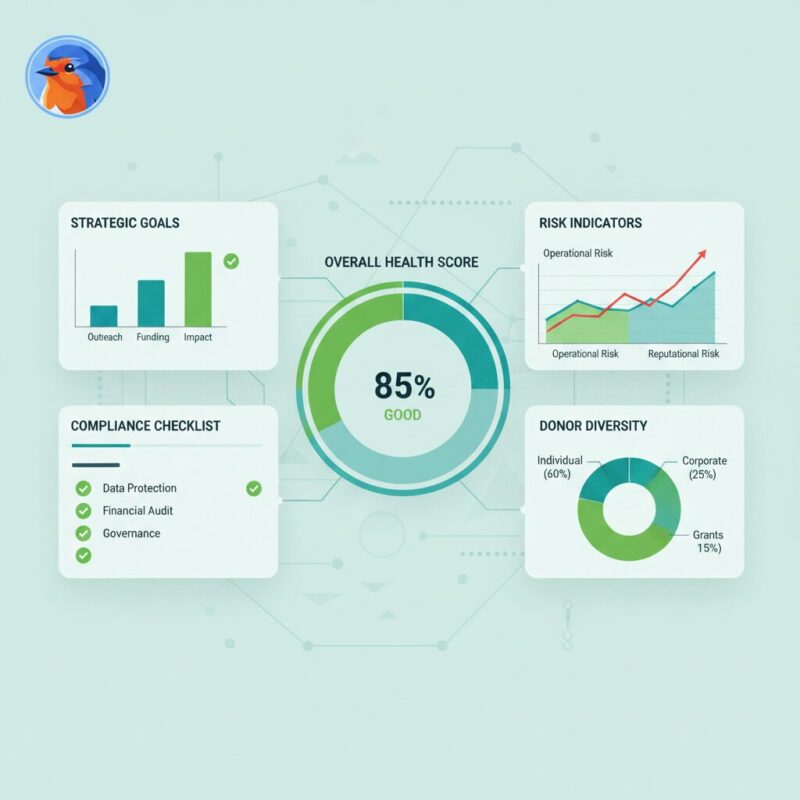
Data without action is useless. Leadership must review these metrics continuously. If the dashboard indicates poor financial controls, that becomes your primary objective for the quarter. The dashboard provides a roadmap to correct systemic issues before an auditor or major funder flags them.
Step 4: Achieving the Quality Mark
Completing the assessments and reaching the required threshold unlocks the Quality Mark. This mark serves as social proof of organizational stability to prospective funders. According to UK Charity Commission Guidance, demonstrable compliance and strong governance are primary indicators of a low-risk investment for grantors. Displaying the Quality Mark on your website and proposals explicitly communicates that your house is in order.
Tech Stack Comparison: Charity Excellence Framework vs. Active Grant Tools
A diagnostic framework tells you you are healthy. It does not write the grant that secures your next £100,000. Nonprofits need a dual tech stack: a framework for internal compliance and an active platform for revenue generation.
The Roles: Internal Diagnostics vs. Grant Discovery Pipeline
CEF helps you become “fundable.” It handles policy templates and governance checks. However, it requires a complementary engine to actually capture funding.
FundRobin acts as that engine. It provides an active database of over 2,000 funders and 1,200 active opportunities. Once your internal diagnostics are clear, you must move to a dedicated grant finder to build a tangible pipeline. Mixing these tools ensures you are both compliant and capitalized.
Head-to-Head: The ‘AI Bunny’ vs. FundRobin’s ‘Robin’ Assistant
Understanding the difference between AI assistants in the sector prevents wasted effort.
Charity Excellence features the “AI Bunny,” a tool primarily designed to help users navigate the CEF portal and answer standard UK governance queries. It is a navigational aid for internal policy.
Conversely, FundRobin features “Robin AI,” a 24/7 assistant trained specifically on successful grant applications and strict funding guidelines. Robin AI provides grounded responses—it does not hallucinate facts. Furthermore, user data never trains external models, ensuring strict data privacy. While the AI Bunny helps you find a policy template, Robin drafts a high-quality, compliant proposal tailored to a specific funder’s criteria.
AI-Powered Smart Matching for Validated Nonprofits
Once an organization proves its health through benchmarking, it can leverage AI matching to locate grants instantly. FundRobin’s Natural Language Processing (NLP) contextualizes your mission and matches it against active funder requirements.
This approach specifically aids resource-constrained charities by virtually eliminating missed deadlines and mismatched applications.
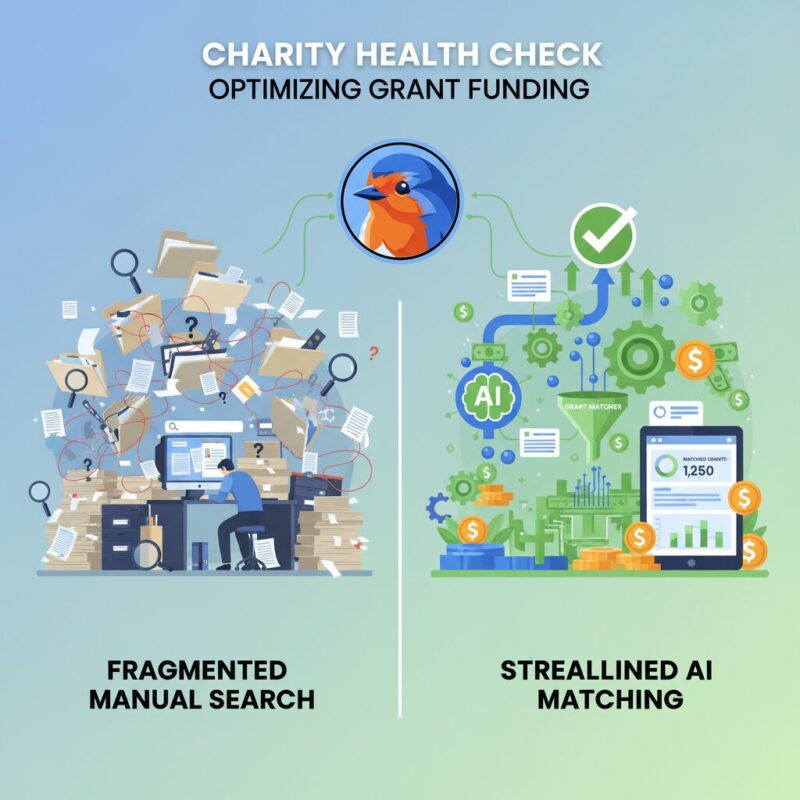
Teams using smart matching save over 200 hours monthly and increase success rates significantly. Explore how tailored nonprofits solutions automate this workflow to keep staff focused on programme delivery.
Conducting a ‘Burnout-to-Sustainability’ Internal Audit
Benchmarking platforms identify policy gaps. A “Burnout-to-Sustainability” audit identifies human capital gaps. Board members and executives must evaluate internal inefficiencies that drive talented people out of the sector.
Assessing the Real Cost of Fragmented Fundraising
Fragmented fundraising leaks money. When development teams manually track deadlines across scattered spreadsheets, decision fatigue sets in.
The financial cost of staff turnover is severe. A 2024 analysis by the Center for Effective Philanthropy highlights that replacing a development professional often costs 100-150% of their salary in lost productivity and recruitment fees. Worse, relationship continuity with funders breaks down. Fragmented manual searching directly contributes to this costly exhaustion.
A Low-Cost, Scalable Approach to IRIS+ and GRI Reporting
Donors demand outcome-based reporting. Complex frameworks like IRIS+ and the Global Reporting Initiative (GRI) often intimidate smaller organizations. You do not need expensive consultants to adopt them.
Start small. Select three core IRIS+ metrics that directly align with your mission. Automate the collection of these specific data points using digital intake forms. Scalable impact measurement proves to donors that their capital generates specific, measurable returns, rather than just funding administrative activity.
Aligning Board Expectations with Operational Reality
The “Transparency Gap” often begins in the boardroom. Boards frequently mandate revenue increases without understanding the operational strain on staff.
Research from NonProfit Pro shows that misaligned expectations lead to unachievable fundraising targets. Executives must have frank conversations with their boards regarding actual capacity. Resetting expectations to match operational reality prevents systemic burnout and sets the stage for sustainable growth.
Leveraging the FundRobin Impact Report for Stakeholder Clarity
Bridging the gap between complex data and stakeholder understanding requires precise reporting. Utilizing digital tools instantly converts raw data into digestible narratives.
FundRobin’s Smart Dashboard includes Theory of Change builders that map activities directly to outcomes. Real-time pipeline tracking provides instant clarity to the board and major donors. Generating a clear impact report removes ambiguity and visually proves organizational effectiveness.
Developing a Unified 12-Month Fundraising Playbook
Organizations fail when they treat grants, major gifts, and compliance updates as separate, disconnected silos. A unified 12-month playbook prevents funder fatigue and smooths out cash flow peaks and valleys.
Structuring Your Grants and Major Gifts Calendar
Sequence your applications strategically. Do not schedule a major individual giving push during the same month your team must submit three complex government tenders.
Use deadline tracking software to map the calendar with visual urgency indicators. Identify predictable grant cycles for your niche. For example, exploring specific sector grants early in the fiscal year allows you to dedicate Q4 entirely to major donor stewardship.
Relational Stewardship: The ‘Donor-as-Investor’ Model
Stop asking for donations and start offering investment opportunities. The ‘Donor-as-Investor’ model shifts the paradigm from transactional begging to strategic partnership.
According to a strategic playbook by CliftonLarsonAllen, organizations that treat funders as long-term investors see significantly higher retention rates. This model requires high-quality outcome reporting. AI-generated proposals customize the narrative to speak directly to an investor’s specific ROI requirements.
Navigating FRS 102 Changes and Post-Crisis Fiscal Cliffs
Impending financial reporting changes require immediate attention. The upcoming FRS 102 updates mandate stricter transparency regarding income recognition and fund accounting.
Simultaneously, charities face a fiscal cliff as the last of the post-pandemic stabilization funds expire. Financial forecasting must account for this reality before the funding dries up entirely.
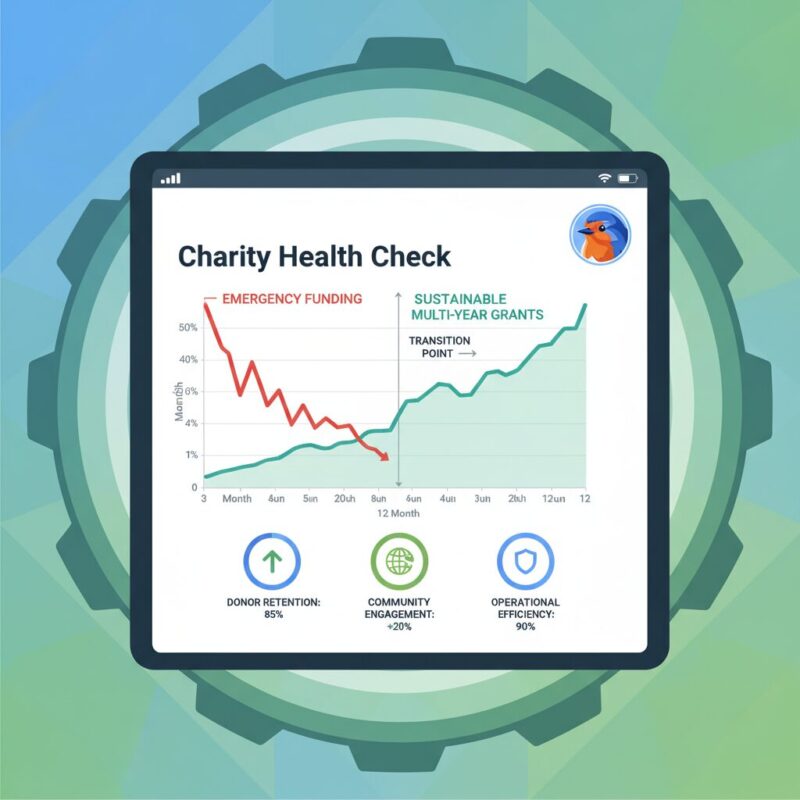
These changes demand a proactive approach rather than reactive accounting. For detailed strategies on maintaining compliance during this shift, review our guide on surviving FRS 102. Charity SORP Committee documentation confirms that early adaptation to these standards prevents funding disruptions.
Automating Compliance to Save 200+ Hours Monthly
Integrating AI proposal generation guarantees compliance while drastically reducing workload. FundRobin’s Smart Proposal Generation cross-references funder requirements automatically.
Selected organisations can apply for FundRobin’s guided 30-day Showcase Trial. The period starts only after approval and activation; approved Showcase organisations do not need a card to begin. Apply for the Showcase Trial or compare Growth and Impact plans.
Measuring Your ROI on Charity Excellence and AI Adoption
Adopting frameworks and software requires capital and time. Leaders must measure the return on investment to justify the expenditure to their boards.
Quantifying the Value of Reduced Staff Turnover
Calculate the financial savings achieved by retaining experienced staff. If a development director earns £50,000, replacing them costs upwards of £75,000 in lost momentum and recruitment.
Furthermore, Center for Effective Philanthropy data suggests institutional memory loss directly impacts grant renewal rates. AI tools act as a retention mechanism. By removing the administrative drudgery of formatting and manual searching, staff focus on high-value relationship building.
Demonating Impact through Funder-Specific Templates
Adapting to wildly different funder formats consumes massive amounts of time. Utilizing standardized, funder-specific templates streamlines submissions.
FundRobin provides structured templates for major entities like the National Lottery Community Fund. This ensures professional quality and strict compliance on every submission. A CliftonLarsonAllen analysis confirms that standardized submission workflows directly increase grant win rates by eliminating technical disqualifications.
Establishing the ‘Excellence-to-Sustainability’ Bridge
Excellence is a continuous operational state, not a framed certificate. The journey from vanity metrics to true impact requires persistent effort.
The Charity Excellence Framework builds the solid governance foundation. Tools like FundRobin provide the engine to drive revenue. Viewing this tech stack as a continuous improvement cycle ensures the organization remains adaptable to future sector shocks.
Final Steps for Executive Directors in 2026
Leaders must take immediate action to secure their funding pipelines.
- Complete a “Burnout-to-Sustainability” audit with your board this quarter.
- Sign up for the Charity Excellence Framework and attain the Quality Mark to establish your compliance baseline.
- Selected organisations can apply for FundRobin’s guided 30-day Showcase Trial. The period starts only after approval and activation; approved Showcase organisations do not need a card to begin. Apply for the Showcase Trial or compare Growth and Impact plans.
Frequently Asked Questions
How does the Charity Excellence Framework help nonprofits secure funding?
The framework acts as an internal health diagnostic tool that ensures strict compliance and operational excellence, which directly increases trust and eligibility for large-scale grants. By passing the assessments, charities identify governance gaps and secure a Quality Mark that serves as vital social proof to risk-averse funders.
What is the difference between Charity Excellence’s AI Bunny and FundRobin’s Robin AI?
AI Bunny focuses strictly on answering framework governance and policy questions, while FundRobin’s Robin AI is a grounded, hallucination-free assistant designed specifically for proactive grant discovery, research, and proposal writing. While AI Bunny helps internal compliance, Robin AI actively generates compliant, secure funding applications.
How can nonprofits reduce staff burnout during the grant writing process?
Nonprofits must shift from fragmented manual grant searching to AI-powered Smart Matching and proposal generation, which saves up to 200 hours monthly and reduces writing time by 80%. Adopting platforms like FundRobin removes the administrative drudgery of formatting, allowing development staff to focus on high-level strategy and relationship building.
What is a Burnout-to-Sustainability audit for charities?
A Burnout-to-Sustainability audit is an internal review process that prioritizes staff wellbeing and operational efficiency as key performance indicators for long-term donor retention. Instead of tracking vanity metrics like emails sent, this audit calculates the financial damage of staff turnover and identifies areas where manual processes cause decision fatigue.
How should nonprofits report impact to donors effectively?
Nonprofits should abandon pure activity counts in favour of outcome-based impact reporting, utilizing low-barrier frameworks like simplified IRIS+ and maintaining consistent relational stewardship. According to NonProfit Pro, transparent outcome data builds the “Donor-as-Investor” dynamic, proving that capital generates specific systemic changes rather than just funding operations.
How will FRS 102 changes affect charity funding strategy?
The upcoming FRS 102 Charity SORP 2026 updates will require organizations to adapt their financial reporting regarding income recognition to maintain compliance and transparency. Nonprofits must utilize automated dashboard tools for precise forecasting to manage these stricter accounting standards while navigating the post-pandemic fiscal cliff.
Key Takeaways:
- Implement the ‘Vanity-to-Value’ shift by abandoning pure activity metrics and tracking outcome-based impact to satisfy modern donor expectations.
- Conduct an operational audit to address staff burnout—reducing turnover directly safeguards institutional memory and long-term donor relationships.
- Complete the Charity Excellence Framework’s 4-step journey (Sign Up, Questionnaires, Dashboard Analysis, Quality Mark) to establish your compliance baseline.
- Pair internal diagnostics with active revenue tools: use Charity Excellence for governance and FundRobin for AI-powered Smart Grant Matching.
- Utilize grounded AI assistants like Robin AI to ensure 100% data privacy and factual proposal drafting without the risk of AI hallucination.
- Develop a unified 12-month fundraising playbook that aligns grant deadlines with individual giving campaigns to eliminate funder fatigue.
Sustainable funding in 2026 demands a total operational reset. By combining the governance baseline of the Charity Excellence Framework with the active revenue generation capabilities of AI platforms, nonprofits can finally break the cycle of burnout. Prioritize your organizational resilience today to guarantee your community impact tomorrow.
