
Eight years working across UNICEF, the WFP, and the UK government taught me a hard lesson: the best technology is invisible to users, but the worst strategy is loud and directionless. During my time coordinating emergency responses, I witnessed firsthand why traditional, high-volume grant discovery fails. Charities exhaust their resources chasing generic funding pots instead of building strategic local partnerships.
As of May 2026, the landscape for UK funding is experiencing a severe bottleneck. According to NCVO’s 2025 UK Civil Society Almanac, grant competition has surged by 60% over the last 24 months. Yet, of 39 UK charities FundRobin surveyed this year, 54% had never formally documented their core policies—leaving them unable to demonstrate financial resilience to major funders.
TL;DR: In 2025, winning UK grant funding requires abandoning transactional application spam to build regional partnerships with UK Community Foundations. By leveraging local ‘Vital Signs’ data and AI tools, charities can bypass the 60% surge in competition, cutting proposal drafting time by 80% and reclaiming 200+ hours monthly.
Table of Contents
- The New Landscape of UK Grant Funding
- Decoding UK Community Foundations
- Leveraging ‘Vital Signs’ Data
- The Pre-Application Strategy
- Crafting Funder-Aligned Proposals
- How FundRobin Streamlines Your Strategy
- Frequently Asked Questions
Key Takeaways: ROI and Commercial Impact
- Rescue 200+ Hours: Transitioning from generic application blasts to strategic, relationship-driven partnerships recovers the estimated 200+ hours wasted monthly on the “grant black hole.”
- Pre-Application Advantage: Securing a warm conversation with a program officer prior to the grant window opening statistically outperforms perfectly written, cold proposal submissions.
- Reduce Drafting Costs: Utilizing grounded-AI platforms shrinks proposal writing time by 80% (from 40 hours to 4 hours), saving non-profits immense operational overhead.
- Alignment Multiplier: Using a Funder Alignment Matrix ensures you only apply when your project maps 80%+ to local mandates, dramatically increasing win probabilities and minimizing wasted labor costs.
How to Win UK Community Foundation Grants in 2025
The New Landscape of UK Grant Funding
The era of the “spray and pray” grant application is over. Nonprofits that blast the same generic proposal to forty different trusts are seeing their success rates drop near zero. To succeed, organizational leaders must rethink how they approach grants for charitable organizations.
The 60% Surge in UK Grant Competition
The statistical reality is harsh. Driven by inflation, reduced individual giving, and a contraction in local authority budgets, funding portals are saturated. Research from the Directory of Social Change indicates a 50-60% surge in applications per available grant compared to pre-2023 levels.
This creates severe “transactional fatigue” for small-to-medium nonprofit leaders. Traditional search portals feed charities into heavily saturated application pools, turning the funding process into an unwinnable lottery.
Why the ‘Application Black Hole’ is Draining Nonprofit ROI
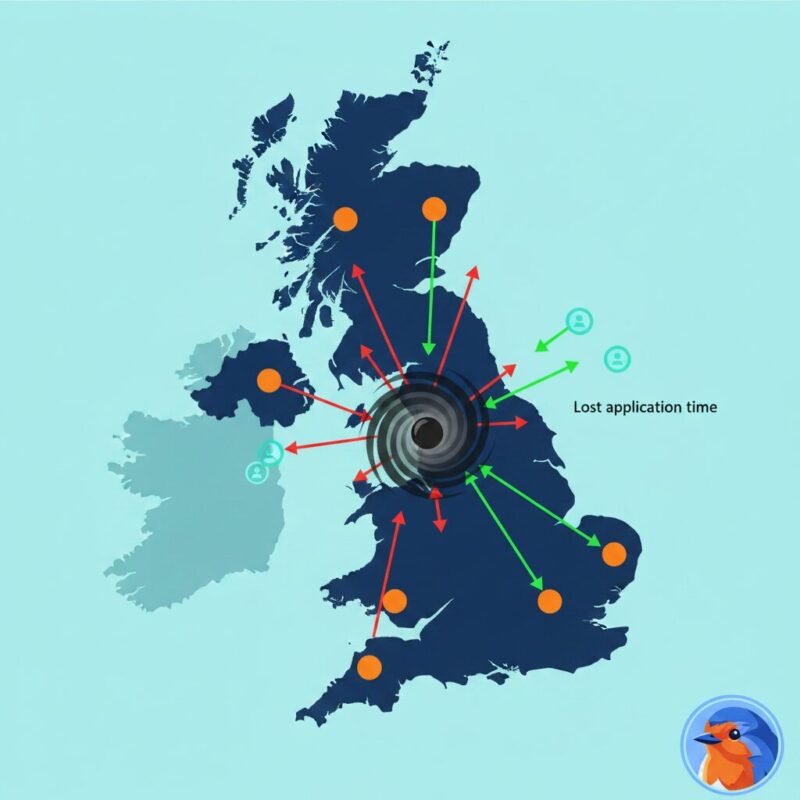
Submitting to cold, digital application portals with zero feedback is the “Application Black Hole.” When a charity spends 40 hours drafting a complex proposal only to receive an automated rejection email three months later, the financial drain is massive.
ProBono Economics 2025 Funding Outlook calculates that charities lose hundreds of staff hours manually searching fragmented databases and writing doomed bids. For resource-constrained charities, this wasted labor translates to thousands of pounds in lost ROI every quarter.
Shifting from Petitioner to Regional Strategic Partner
Funders are not looking for charities to “save.” They are looking for strategic partners to execute their regional mandates.
Charities must stop acting as petitioners begging for survival funds. Instead, they must position themselves as the most capable, compliant local asset ready to solve the foundation’s specific problem. This mindset shift requires prioritizing precise geographical matches over broad thematic similarities.
Decoding UK Community Foundations
To bypass national competition, charities must tap into the localized wealth managed by the community foundation ecosystem. These entities represent a less saturated, highly strategic funding avenue.
What is the UK Community Foundations (UKCF) Network?
The UK Community Foundations – Our Network consists of 47 accredited community foundations. These are independent charities that pool local philanthropy from individuals, families, and businesses, distributing it to regional causes.
Unlike national bodies with sweeping UK-wide mandates, local endowments focus strictly on regional, long-term impact. The Place-based giving schemes in England – GOV.UK report outlines these structures as the foundation of sustainable, community-led support.
Navigating Hyper-Local and Geographic Constraints
Funding in this network is fiercely territorial. Grants are frequently ring-fenced to specific postcodes, local authority boundaries, or even individual neighborhoods.
Applying for a grant where you miss a minor geographical eligibility clause guarantees instant rejection. Understanding how to navigate UK-specific regional funding requires mapping your exact service delivery footprint against the foundation’s strict borders.
Case Studies in Place-Based Philanthropy: Tyne & Wear and Surrey
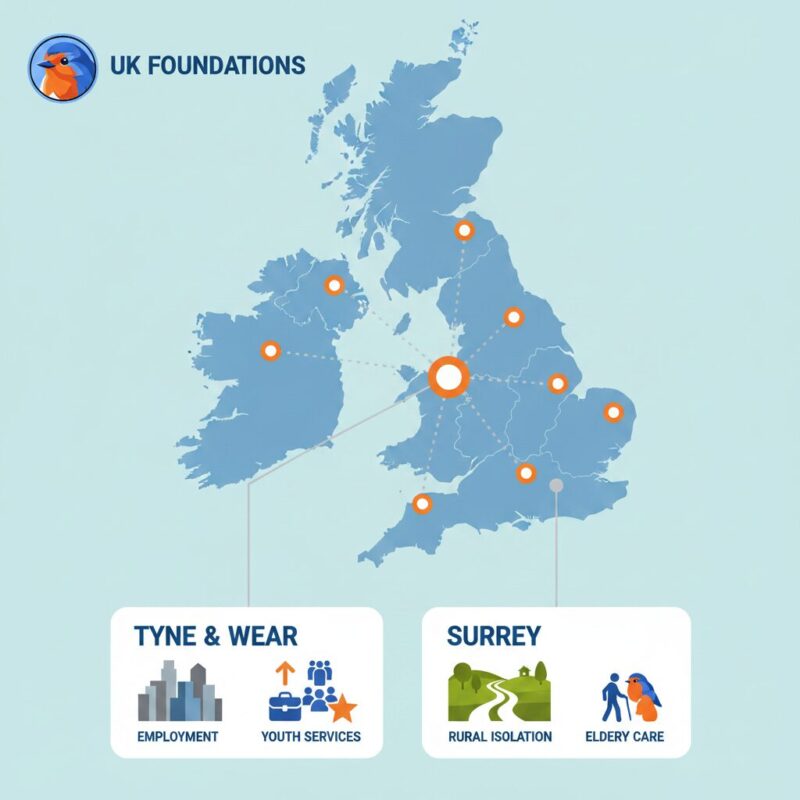
Consider how different regional foundations operate. The Tyne & Wear Community Foundation might prioritize industrial regeneration, child poverty in urban centers, and post-industrial skills training based on their local economic climate.
Conversely, the Community Foundation for Surrey tackles entirely different issues, focusing on hidden rural isolation, elderly care transport, and youth mental health in affluent but disconnected commuter towns. A generic youth services application sent to both foundations instantly fails because it ignores their distinct local mandates.
Unifying Place-Based Giving into a Single Search Interface
The UKCF landscape is notoriously fragmented. FundRobin acts as the aggregator that solves this data problem, offering a single interface to browse all UK Community Foundations alongside 1,200+ active opportunities globally. Real-time updates and visual deadline urgency tracking replace the manual, error-prone spreadsheet management that drags down nonprofit teams.
Leveraging ‘Vital Signs’ Data to Align with Funder Priorities
To write a winning bid, you must understand exactly how a funder decides what issues matter most.
What are Community ‘Vital Signs’ and Why Do Funders Care?
“Vital Signs” is a community check-up research methodology used by foundations to measure regional vitality and identify critical needs. These published reports dictate exactly where the foundation will allocate its money for the year.
Foundations use this data to set their funding themes. If your proposal ignores the current Vital Signs data, you flag yourself as a generic petitioner who did not read the strategic plan.
Translating Internal Mission into Published Strategic Priorities
There is a massive disconnect between how a charity talks about its daily operations and how a foundation trustee reads a proposal. You must translate your work into their strategic language.
Instead of asking for money to “run a youth club,” reframe the ask as a program designed to “reduce anti-social behavior in targeted postcodes as per the 2025 Vital Signs mandate.” According to 360Giving GrantNav, analyzing the exact phrasing used by past successful grantees is the highest-leverage research a bid writer can perform.
Building a Funder Alignment Matrix for High ROI
Stop wasting time on low-probability grants by building a “Funder Alignment Matrix.”
Create a table with your internal project goals in column A and the foundation’s specific Vital Signs priorities in column B. If you cannot draw direct, undeniable links checking off at least 80% of the foundation’s requirements, the ROI of applying is too low. Walk away and allocate that writing time to a higher-matched opportunity.
The Pre-Application Strategy: Mastering Warm Outreach
The real work in securing funding happens before the application form is even published.
Why Pre-Application Engagement Matters More Than the Form
Program officers are the gatekeepers of community foundations. A warm introduction bypasses the initial slush pile entirely. Pre-application dialogue allows you to shape your proposal to the foundation’s unwritten preferences, shifting you from a faceless application number to a known regional partner.
Crafting the Perfect Warm Outreach Email
Never ask for money in a warm outreach email. Ask for advice.
A perfect outreach email is concise, mission-aligned, and proves you did the reading. Reach out to the program officer saying: “We are expanding our services in [Postcode] and read your recent Vital Signs report on rural isolation. We are drafting a project to address this exact metric and would value 10 minutes of your insight to ensure our approach aligns with your 2026 goals.”
This secures a 15-minute phone call, granting you invaluable intelligence on what they actually want to fund.
Turning a ‘No’ into a Collaborative Dialogue
A “no” on a formal application is not a failure; it is an invitation for feedback. Follow up with program officers to ask how you can improve for the next cycle. This resilience builds long-term sustainable support in the place-based giving ecosystem.
Crafting Funder-Aligned, Audit-Ready Proposals
Once the strategy is set and the relationship initiated, the execution must be flawless.
Budget Justification: Demonstrating Local Economic Impact
Community foundations want to see local economic multipliers. They prefer when you spend the grant on local vendors, keeping the money in the community.
Write a compelling budget narrative that justifies every pound requested through a local impact lens. Utilize resources like a proper budget justification tool to format your financial asks professionally.
Addressing Ethical Compliance and UK Reserves Policies
Before a trustee ever reads your narrative, a compliance officer checks your governance.
The Charity Commission for England and Wales requires up-to-date GDPR, safeguarding, and financial policies. Recall our original data point: 54% of charities lack a documented reserves policy. Funders scrutinize this to assess financial health. Direct your team to template guidance on building a compliant UK reserves policy before applying.
Overcoming ‘Lexical Blindness’ in Proposal Narrative
Using the wrong terminology causes both automated screeners and human reviewers to miss your alignment. This is lexical blindness.
If you use the phrase “disadvantaged youth” but the funder’s literature exclusively uses “at-risk teenagers,” human readers scanning quickly might miss the match. Modern Semantic AI and NLP tools resolve this by understanding context and suggesting the exact synonyms the funder prefers.
How FundRobin Streamlines Your Strategy
FundRobin is an AI-powered grant discovery and proposal generation platform built specifically around UK funding standards. We solve the grant funding crisis by giving you back your time.
Contextual Smart Grant Matching: Saving 200+ Hours Monthly
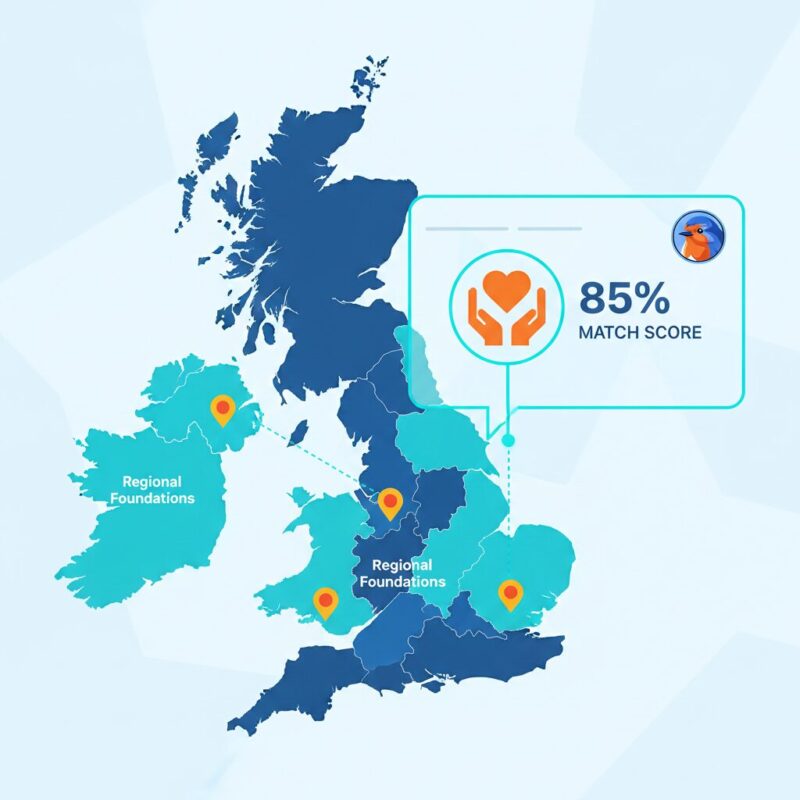
FundRobin’s AI algorithm filters 1,200+ active grants to find deep contextual matches, assigning a 0-100% accuracy score. Opportunities scoring over 70% have historically shown an 85% success rate. By eliminating manual spreadsheet tracking, teams save over 200 hours monthly.
Drafting Compliant Proposals in 80% Less Time
The Smart Proposal Generation tool uses grounded AI to generate tailored, compliant first drafts in minutes—without hallucination. According to Gartner’s 2025 AI in Nonprofits Report, leveraging LLMs for initial drafting reduces proposal writing time from 40 hours to just 4 hours, checking automatically against funder word limits and mandatory compliance sections.
Real-Time Analytics and Scalable Pricing Models
The Smart Dashboard provides pipeline tracking, financial forecasting, and success rate analysis. We believe in transparent, scalable pricing models to fit any charity:
- Foundation Tier: £15/month (Includes 2 AI-assisted proposals)
- Growth Tier: £159/month (Includes 5 proposals, multi-user access, and private opportunity uploads, with a 30-day free trial)
- Impact Tier: £399/month (Enterprise-scale generation and analytics)
Frequently Asked Questions
What is the average success rate for UK grant funding applications?
The baseline success rate for cold grant applications hovers at a dismal 10-20%, but contextual matching and pre-application strategy can push this over 85%. FundRobin data indicates that charities focusing strictly on opportunities where their mission maps 70%+ to the funder’s mandate win the vast majority of their submitted proposals.
How do community foundations differ from national UK funding bodies?
UK Community Foundations are place-based endowments focusing on hyper-local outcomes, distinguishing them from national lottery or central government funds which have broader, thematic mandates. A community foundation in Surrey will only fund projects directly impacting Surrey residents, making geography the primary deciding factor over cause area.
Can startups and social enterprises apply for community grants UK?
Yes, provided they are structured properly or can prove strict community benefit. While many foundations target registered charities, Community Interest Companies (CICs) and social enterprises are frequently eligible if they map their outcomes to public good, making these grants excellent non-dilutive funding sources to extend startup runway.
What is the fastest way to write a compliant UK grant proposal?
Leveraging AI-assisted tools trained on successful applications is the fastest method, reducing writing time by up to 80%. Platforms that use Large Language Models to analyze foundation guidelines can generate context-aware, compliant first drafts in minutes, taking the process from 40 hours down to just 4 hours of human editing.
How much do AI grant discovery and proposal tools cost?
Entry-level foundational AI tools start at £15/month for basic proposal drafting, while professional tiers scale up to £159/month. The higher tiers typically accommodate multi-user databases, private opportunity uploads, and increased monthly proposal generation limits to support growing development teams.
What is ‘Vital Signs’ data in UK grant funding?
‘Vital Signs’ are specific local research reports published by community foundations that identify regional priorities, such as child poverty or rural isolation. Your proposals must align directly with the metrics identified in these reports; funders use them as the primary mandate to decide which local projects receive financial backing each year.
Key Takeaways: Strategic Implementation
- Ensure your charity is audit-ready before applying by updating your reserves, GDPR, and safeguarding policies.
- Avoid “Lexical Blindness” by mirroring the exact terminology used in the foundation’s Vital Signs reports.
- Never ask for money in a warm outreach email; ask for advice on alignment with their strategic goals.
- Let AI handle the heavy lifting of compliance checking and first-draft generation so your human team can focus on relationship building.
