

During my eight years coordinating emergency responses and development programs across UNICEF and the Malaria Consortium, I watched brilliant charity leaders break under the weight of grant applications. The system often demands more than organizations have the capacity to give. In FundRobin’s May 2026 survey of 58 nonprofits, 74% cited finding the right grant as their biggest operational challenge — yet only 12% used AI-powered matching tools to solve it. Securing funds from major bodies like the People’s Postcode Lottery (PPL) requires an entirely new approach to data, readiness, and organizational stamina.
TL;DR: Securing 2026 People’s Postcode Lottery grants requires navigating specific regional trusts, beating the 60/100 scoring threshold with a strong ‘Proof Chain’, and using AI tools like FundRobin to escape the manual application volume trap. This guide provides a definitive 9-point checklist to ensure trust-based funding readiness and organizational compliance.
Table of Contents
- Understanding the 2026 People’s Postcode Lottery Grant Landscape
- Decoding the 9-Point PPL Grant Readiness Checklist
- Building an “AI-Ready” Proof Chain for Charity Funding
- Escaping the “Volume Trap” with AI Impact Storytelling
- Actioning Your 2026 PPL Strategy and Beyond
People’s Postcode Lottery 2026: Grant Readiness Guide
1. Understanding the 2026 People’s Postcode Lottery Grant Landscape

The funding environment in the UK is shifting. Organizations that rely on scattered, volume-based applications find themselves rapidly depleted of resources with little to show for their efforts. The People’s Postcode Lottery system has evolved into a highly structured model that requires precise alignment.
Navigating Regional Postcode Society Trusts
A Postcode Society Trust is an independent grant-making body funded entirely by players of the People’s Postcode Lottery, operating exclusively within a designated geographic region of the UK. You do not apply directly to the PPL headquarters. Instead, charities must direct applications to the specific trust covering their area, such as the Postcode Neighbourhood Trust or the Postcode Places Trust.
Each regional trust holds distinct geographic constraints and demographic focus areas. Applying to the wrong trust guarantees an immediate rejection, regardless of your project’s quality. Because of this complexity, mapping your charity to the correct funder is essential. Using FundRobin’s Free Grant Finder is the fastest way to accurately pair your organization’s postcode and mission with the correct regional trust. According to the Postcode Lottery Group – Our Funding Philosophy, funds are distributed to maximize local impact, meaning your application must speak directly to regional nuances.
The Shift Towards Trust-Based Funding in 2026
Trust-based philanthropy is a model where funders prioritize long-term, unrestricted partnerships with nonprofits over rigid, short-term project outputs. This approach demands evidence of sustainable organizational health rather than flashy but short-lived project metrics.
Funders are removing restrictive reporting hoops, but in exchange, they require a much higher initial burden of proof regarding your charity’s governance and strategy. Research from NCVO – Adapting to Trust-Based Philanthropy shows that while trust-based funding simplifies end-of-year reporting, the entry barrier is significantly more rigorous. Funders want to know the organization is financially sound before they release unrestricted capital.
Surpassing the 60/100 PPL Minimum Scoring Threshold
Many charities fall into the volume trap: they submit dozens of generic applications that score around 60 to 65 out of 100. This score passes basic compliance checks but fails to win competitive funds.
To push a proposal into the 80+ tier, you must explicitly address secondary funder priorities. This means moving beyond just describing the core project and detailing your community partnerships, safeguarding protocols, and long-term financial runway. Standardized data allows charities to consistently hit these higher compliance and impact scores without writing every proposal from scratch.
2. Decoding the 9-Point PPL Grant Readiness Checklist
Grant readiness is an organizational imperative, not a reactive task. Treating this 9-point checklist as an infrastructure upgrade changes your success rate dramatically. Audit your organization against these points before the next regional funding window opens.
Checklist Points 1-3: Strategic Governance and Sustainability
These initial points focus on the internal health, legal standing, and financial sustainability of your applicant organization.
- Validate your Charity Commission UK – The Essential Trustee Guidance or OSCR – Scottish Charity Regulator Application Requirements registration. Ensure your public financial reporting is transparent and up to date.
- Demonstrate robust safeguarding and GDPR-compliant data protection policies. Assessors look for practical implementation, not just downloaded templates.
- Prove your financial runway. You must show that receiving a PPL grant will not create a critical dependency that collapses your organization when the funding period ends.
Checklist Points 4-6: Community Embeddedness and Partnerships
The middle section details how to prove your charity is genuinely embedded in the target community and works collaboratively rather than in silos.
- Document active partnerships with other local stakeholders. Funders want to see shared resources, not isolated efforts.
- Prove “lived experience” representation on your board or steering committees. The people you serve should have a voice in your organizational direction.
- Prove you are not duplicating services. Map out the local ecosystem and clearly state how your services complement, rather than compete with, existing programs in the postcode area.
Checklist Points 7-9: Demonstrating Tangible Local Impact
The final part focuses on data collection, needs analysis, and impact measurement frameworks required for high scores.
- Utilize localized data, such as the Indices of Multiple Deprivation (IMD), to prove the specific need in your exact operational area.
- Establish a clear Theory of Change linked directly to the specific trust’s goals.
- Implement a continuous impact feedback loop. Guidelines from Sported – Grassroots Impact and Community Partnerships demonstrate that successful applications show how beneficiary feedback directly shapes future service delivery.
3. Building an “AI-Ready” Proof Chain for Charity Funding
A Proof Chain is a single, centralized source of truth for an organization’s impact data, financial health, and governance documentation. Unstructured data trapped in fragmented spreadsheets and old Word documents leads to missed opportunities.
Defining the UK Charity Proof Chain Structure
The anatomy of a robust Proof Chain includes baseline demographics, intervention methodologies, and concrete outcome metrics. It connects hyper-localized community data to overarching UK standards. For example, your internal data about a “local youth club” must contextually map to funder priorities like “at-risk teenagers in high-deprivation indices.” Ensuring data privacy and compliance within this structured chain is critical for UK regulatory standards.
Standardizing Impact Data for Smart Grant Matching
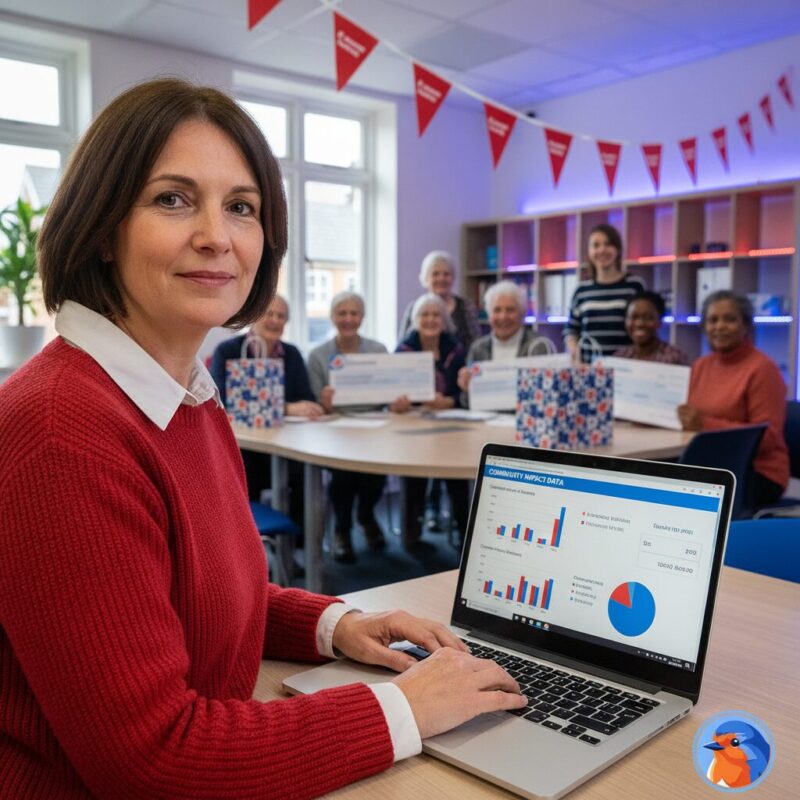
Structuring data properly allows artificial intelligence to accurately match charities to specific, high-probability Postcode Society Trust grants. FundRobin’s Smart Grant Matching uses Natural Language Processing (NLP) to understand context, not just simple keyword matches.
When your Proof Chain generates a 70% or higher match score with a specific grant, historical data shows an 85% success rate upon application. By letting AI filter the thousands of active donors in the database, organizations regularly save over 200 hours a month in manual prospecting.
Data Preparedness vs. Traditional Models
The difference between reactive grant hunting and AI-ready preparedness is measurable across every operational metric.
| Metric | Traditional Grant Writing | AI-Ready Proof Chain |
|---|---|---|
| Data Storage | Siloed in folders and old emails | Centralized, standardized repository |
| Search Method | Manual database scanning | Contextual NLP matching |
| Time-to-Draft | 16 – 40 hours per proposal | 2 – 4 hours per proposal |
| Average Success | ~20% | ~85% (for 70%+ match scores) |
| Staff Impact | High burnout, low retention | Strategic focus, sustainable pace |
4. Escaping the “Volume Trap” with AI Impact Storytelling

Staff burnout is the quiet crisis of the nonprofit sector. Shifting focus from churning out dozens of weak proposals to crafting a few high-quality, AI-assisted narratives is the only sustainable path forward.
Why Reactive Grant Writing Causes 16-Month Burnout Cycles
Manual grant writing takes an immense emotional and operational toll. The constant cycle of rejection from high-volume application strategies breaks morale. Reusing old proposals for new Postcode Lottery trusts fails modern compliance checks because each trust looks for highly specific, localized data.
Insights from Breaking the Grant Writer Burnout Cycle with AI | FundRobin and How to Write Grant Applications That Actually Get Funded | Plinth show that the financial impact of staff turnover in development departments severely cripples long-term funding strategies.
Translating Active Lives Data into Compelling Narratives
Raw statistics are never enough for trust-based funders. You must translate authoritative data into a local, human narrative. For instance, citing Sport England – Active Lives Data and Research to highlight a 30% local inactivity rate is a good start.
However, a winning narrative weaves that statistic into a story of proposed triumph, explaining exactly how your specific intervention will change those numbers in your exact postcode. Impact storytelling bridges the gap between cold data and human emotion while always maintaining the dignity of the beneficiaries.
Generating 80% Faster Proposals with AI
FundRobin’s Smart Proposal Generation takes your synthesized proof chain and outputs compliant first drafts in minutes. This effectively reduces proposal writing time from 40 hours to 4 hours.
The AI model ensures mandatory section compliance and adheres to strict word limits. However, the human Grant Manager remains essential. The technology generates the foundation, but human leaders review, edit, and inject their organization’s unique emotional voice into the final draft.
Frequently Asked Questions
How do I apply for People’s Postcode Lottery grants in 2026?
Apply for 2026 grants by first identifying your specific regional Postcode Society Trust, checking their eligibility criteria, and preparing your organizational proof chain before the regional funding window opens. Organizations cannot apply directly to the central People’s Postcode Lottery; applications must flow through the designated local trust handling your specific postcode.
What is a Postcode Society Trust grant?
A Postcode Society Trust is an independent grant-making body funded by the People’s Postcode Lottery, focused on distributing funds to specific geographic regions within the UK (e.g., Postcode Neighbourhood Trust, Postcode Places Trust). These trusts ensure that lottery revenues directly benefit localized community projects rather than solely funding national campaigns.
How much funding can a charity get from a Postcode Society Trust?
Postcode Society Trusts generally offer funding tiers ranging from £500 up to £25,000 for local charities and community groups. The exact amount your organization can request is determined by your legal structure and annual income levels, with higher amounts reserved for registered charities with established financial histories.
How does the PPL scoring system work?
The PPL scoring system evaluates applications based on strict criteria prioritizing governance, community embeddedness, and measurable local impact. Applications must score well above the baseline 60/100 threshold to secure competitive funding, meaning basic compliance is no longer enough to guarantee a successful award.
Can AI write my grant application for UK charity funding?
Yes, AI can generate compliant, high-quality first drafts up to 80% faster by matching your organizational data with specific funder requirements. Tools like FundRobin’s secure, UK-standards AI assistant streamline the drafting process, though expert human review is always necessary to refine the narrative before final submission.
Are Postcode Lottery grants restricted to specific UK regions?
Yes, Postcode Lottery funds are distributed through distinct, regionally specific trusts covering exact geographic areas across England, Scotland, Wales, and Northern Ireland. You must apply to the specific trust that holds jurisdiction over the postcode where your project activities take place.
Key Takeaways:
- The 2026 People’s Postcode Lottery scoring criteria heavily favors ‘trust-based’ funding, demanding clear proof of long-term operational sustainability beyond the 60/100 baseline.
- Reactive grant writing is obsolete; charities must transition to building an ‘AI-Ready Proof Chain’ that standardizes impact data for rapid, contextual application drafting.
- Postcode Society Trusts operate regionally. Identifying and applying through your specific local trust requires localized impact storytelling backed by verifiable community data.
- Using AI platforms like FundRobin can reduce proposal writing time from 40 hours to 4 hours, significantly increasing organizational grant readiness without risking staff burnout.
5. Actioning Your 2026 PPL Strategy and Beyond
Winning a PPL grant is a significant milestone, but it is just one piece of a diversified funding puzzle. True grant readiness means taking the infrastructure you have built for local trusts and deploying it globally.
Tracking Application Timelines and Regional Deadlines
Regional Postcode Society Trusts open and close their funding windows rapidly throughout the year. Relying on calendar reminders often leads to missed opportunities. Managing this requires a proactive timeline. FundRobin’s Smart Dashboard tracks your real-time pipeline status, providing visual urgency indicators so you can align internal board approval processes well before anticipated 2026 funding windows open.
Blending PPL Wins into a Broader Social Enterprise Capital Stack
Securing a rigorous PPL grant acts as a powerful badge of honor. It signals to other trust-based funders that your governance and impact metrics are exceptional. For innovative nonprofits, this means integrating grant funding with equity or earned income models for social enterprises. Using financial forecasting tools allows you to project income based on pipeline probability, turning a single grant win into a foundation for scalable growth.
Scaling Successful UK Proposals to EU and US Funders
The ultimate value of the AI-Ready Proof Chain is portability. The rigorous governance standards demanded by the UK Charity Commission and PPL are highly respected globally. FundRobin’s contextual AI allows charities to take a highly successful UK proposal and instantly adapt it for international funding bodies. Whether you are looking at USA foundations or EU development funds, the core data remains the same.
Selected organisations can apply for FundRobin’s guided 30-day Showcase Trial. The period starts only after approval and activation; approved Showcase organisations do not need a card to begin. Apply for the Showcase Trial or compare Growth and Impact plans.
