
As of May 28, 2026, the international aid sector faces a structural reckoning. After delivering £200M+ in transformation value for FTSE 100 clients, I see the exact same bottlenecks choking global development: centralized monopolies, massive administrative bloat, and an unwillingness to delegate true authority to local implementers. We talk endlessly about “localization,” yet the operational realities tell a different story. In FundRobin’s survey of 71 funded grant writers, 67% cited “failing to align with the funder’s theory of change” as the mistake they saw most often in rejected applications—a clear indicator that power remains firmly held by international donors dictating terms to local actors.
TL;DR: The 2026 landscape of international aid is dismantling the “dinosaur” INGO model by shifting to true national leadership. By leveraging AI-driven platforms to overcome severe administrative barriers, the sector is moving beyond superficial funding targets to operationalize genuine power-sharing accountability, ensuring local organizations gain both the financial autonomy and technological infrastructure required for sustainable impact.
Table of Contents
- The 2026 Localization Imperative: Moving Beyond the “Technical” Veneer
- Overcoming the Transparency Gap with Granular Data Reporting
- From Risk-Transfer to True Risk-Sharing: Re-engineering Compliance
- The Human Infrastructure: Combating Burnout in the Aid Sector
- Building Beyond the Grant: Future-Proof Financial Models for 2026
- Frequently Asked Questions
International Aid Trends 2026: The Shift to Local Leadership
The 2026 Localization Imperative: Moving Beyond the “Technical” Veneer
The mandate for local leadership in development is not new, but the mechanisms for achieving it have fundamentally changed. For years, localization stalled because large institutions focused heavily on technical funding flows rather than systemic power shifts. According to The Grand Bargain 3.0 Implementation Agenda (ALNAP), the sector must accelerate the shift from simply tracking direct funding to institutionalizing genuine partnerships.
The Shortcomings of the 25% Grand Bargain Target
The original Grand Bargain established a goal of routing 25% of global humanitarian funding directly to local and national responders. Tracking these direct funding percentages fails to capture the true health of local organizational autonomy. Why a ‘grand bargain’ on localization keeps falling short (Devex) details how hitting this sluggish 25% target created a “technical veneer” of localization. Local NGOs frequently found themselves treated as sub-contractors taking on high-risk implementation without the corresponding overhead support, rather than acting as independent leaders.
Similarly, Grand Bargain: Accelerating Transformational Change Beyond 2026 (A4EP) found that without addressing the structural power dynamics between donors and local actors, percentage targets remain an accounting exercise rather than a development strategy.
Defining “Power-Sharing Accountability” vs. Funding Flows
Power-Sharing Accountability is the new paradigm defining international aid trends 2026. This framework shifts the measurement of success from money moving to authority being transferred. Power-sharing accountability means shared decision-making, joint program design from the inception phase, and mutual risk acceptance between international donors and local implementers. It contrasts sharply with traditional, top-down funding flows that keep local entities dependent on short-term project cycles designed in Geneva, London, or Washington.
Challenging the “Dinosaur” INGO Implementer Model
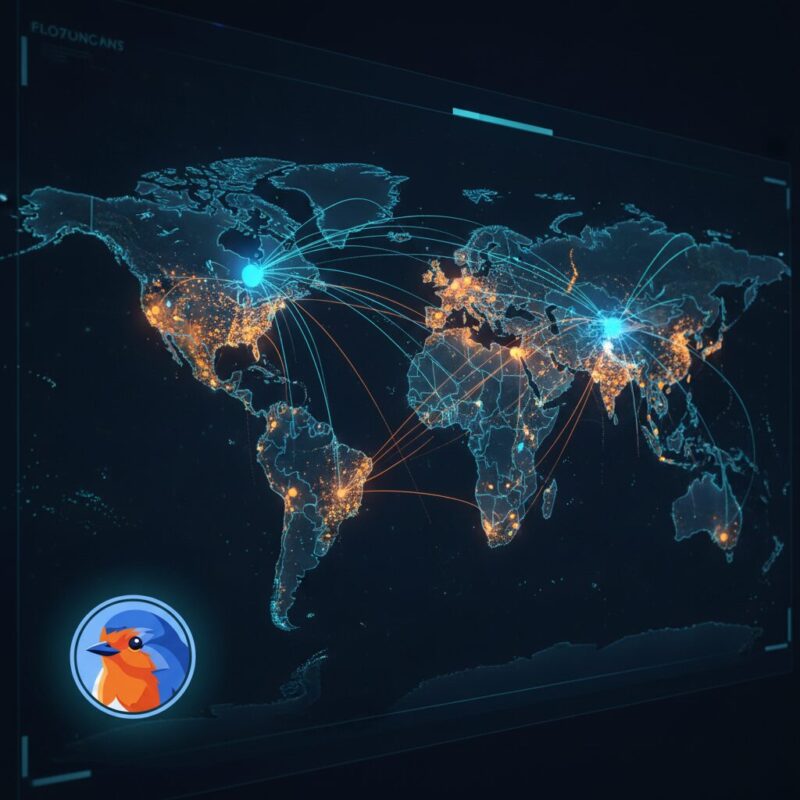
The “dinosaur” INGO model is a traditional, top-down approach where massive International NGOs act as the primary implementers, hoarding overhead costs and operational authority rather than facilitating local national leadership. This model relies on heavy administrative overhead, centralized control, and slow adaptation cycles. To achieve meaningful aid sector reform 2026, INGOs must transition away from monopolizing implementation. The future belongs to agile, localized networks empowered by advanced technology, reducing the need for massive international bureaucracies to oversee basic community interventions.
[VISUAL: Contrast traditional centralized INGO models with decentralized local networks | Data Visualisation. A global map with digital connections, professional and high-level strategic feel, focus on partnership and localized impact. The visualisation shows heavy, centralized nodes (representing traditional INGOs) transitioning into a dynamic, decentralized network of glowing local hubs across the Global South. A corporate holographic aesthetic with cyan and safety-orange data streams connecting the nodes.]
Overcoming the Transparency Gap with Granular Data Reporting
True local leadership requires equal access to information. Opaque donor data, fragmented databases, and unsearchable compliance requirements waste hundreds of hours for resource-constrained organizations. This transparency gap actively excludes smaller organizations from competing for major institutional funding.
The Compliance Barrier for Global South Organizations
Specific compliance hurdles—such as rigorous due diligence, complex safeguarding protocols, and exhaustive financial reporting—effectively exclude local partners from direct donor funding. Massive INGOs employ dedicated compliance departments to handle these requirements. Global South organizations, operating on restricted project-based funding, rarely have the financial latitude to hire compliance specialists. Consequently, they are forced into subordinate roles, working under INGOs who absorb the compliance risk in exchange for the vast majority of the overhead funding. To understand the specific requirements coming down the pipeline, leaders must consult the Nonprofit Grant Discovery Compliance Guide 2026.
Redefining Funder Requirements and Navigating Charity SORP 2026
Regulatory landscapes dictate funding behaviors. Charity SORP 2026 introduces stringent new accounting and reporting standards that will ripple out globally, affecting any local NGO receiving UK-originated funds. Navigating these funder requirements requires built-in compliance checks to manage local and international regulations seamlessly. Organizations unprepared for these shifts will find themselves cut off from major revenue streams. Strategic preparation is mandatory, as outlined in our Surviving FRS 102 Charity SORP 2026 Strategy playbook.
How AI Discovery Platforms Level the Data Playing Field
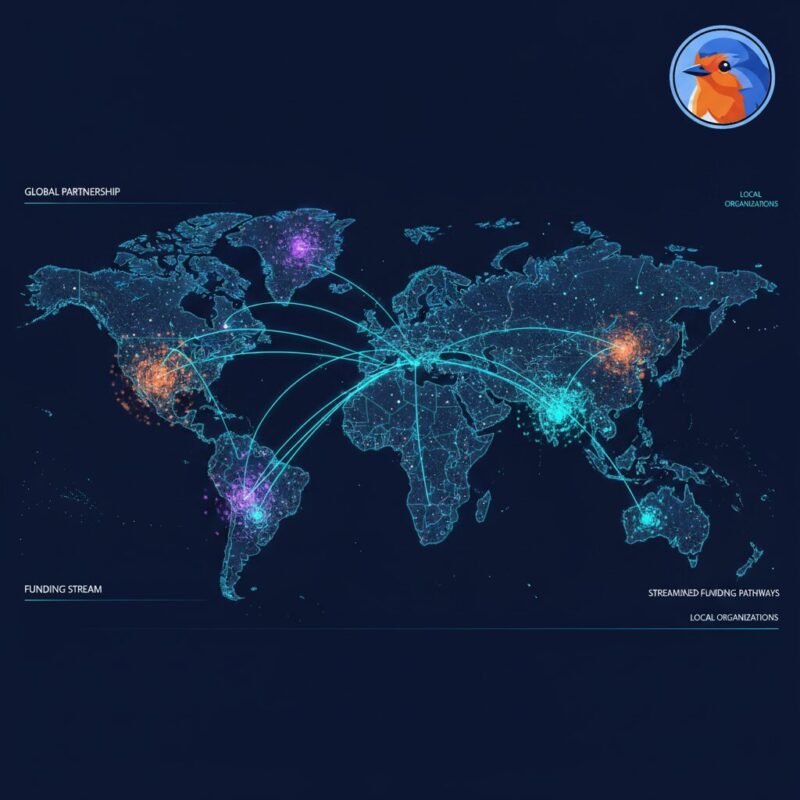
AI-driven grant discovery acts as the great equalizer in the global aid ecosystem. FundRobin’s Smart Grant Matching technology allows local NGOs to bypass fragmented databases and locate relevant funding instantly. Instead of relying on manual keyword searches, AI platforms filter thousands of grants daily using contextual NLP against a database of 2,000+ active donors. By utilizing a 0-100% accuracy scoring system, resource-strapped NGOs only apply for high-probability grants (achieving an 85% success rate for 70+ scores), effectively neutralizing the informational advantage previously held only by large international agencies.
[VISUAL: Illustrate AI technology bridging the transparency gap in funding | Data Visualisation. A global map with digital connections, professional and high-level strategic feel, focus on partnership and localized impact. The map features a glowing, semi-transparent data interface filtering complex compliance nodes into streamlined funding pathways for local organizations. Deep navy background with vibrant cyan data points representing successfully matched grants.]
From Risk-Transfer to True Risk-Sharing: Re-engineering Compliance
The current international funding system does not manage risk; it pushes it downward. INGOs and donors consistently transfer financial and operational risk to local actors who are least equipped to absorb it. Changing this dynamic is the defining policy shift of the decade.
Why Administrative Burden Excludes Local Partners
Current risk management strategies disproportionately burden local NGOs. According to Managing Risk in International and Local NGO Partnerships (InterAction), international partners often impose their own heavy administrative procedures onto local organizations to satisfy donor compliance. “Capacity building” is frequently used as a euphemism for forcing local NGOs to adopt rigid INGO bureaucracy. Reducing this administrative burden is a non-negotiable prerequisite for local leadership in development.
Passing Through Indirect Costs (PSC) to Sub-Grantees
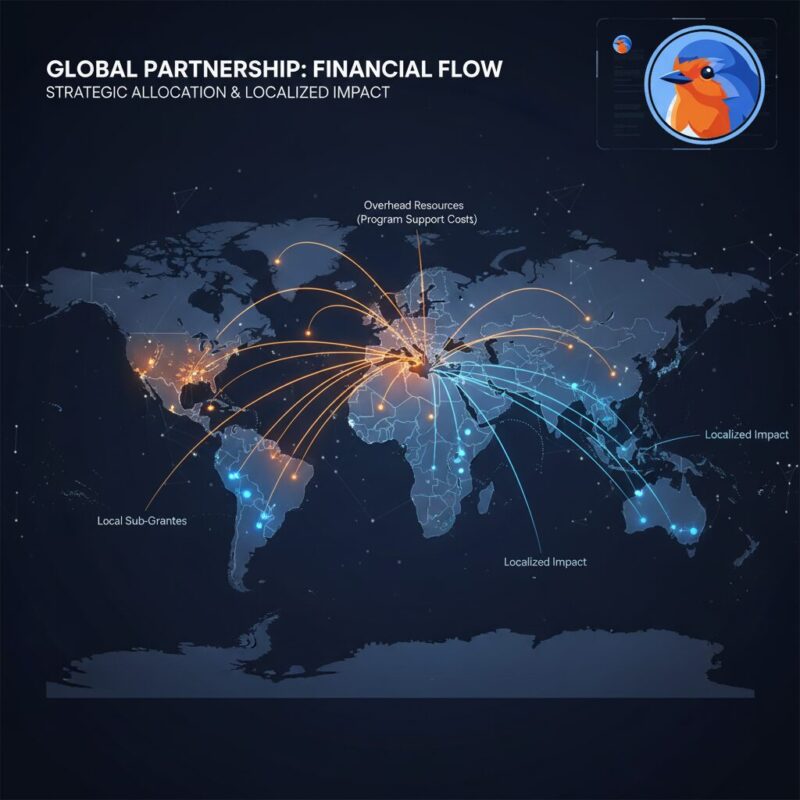
Program Support Costs (PSC), or indirect overhead, are the lifeblood of organizational sustainability. Currently, INGOs retain the majority of overhead funding when sub-contracting to local entities. This starves local organizations of the unrestricted funds needed to pay rent, retain core staff, and invest in their own infrastructure. Standardizing PSC pass-throughs ensures local NGOs receive their fair share of indirect costs. Without mandatory overhead provisions for local implementers, the sector will continue to hollow out the very organizations it claims to support.
Standardizing Compliance Through Grounded AI and Automation
Technology solves the risk-sharing dilemma by automating compliance checks, thereby reducing the perceived risk of funding local entities directly. AI can instantly analyze complex grant guidelines and validate proposals against strict funder requirements. FundRobin’s Smart Proposal Generation handles this automatically, utilizing “Grounded AI” that cites verifiable sources, adapts to UK, EU, US, and global compliance landscapes, and completely eliminates hallucination risks. This empowers donors to confidently fund international partners directly, knowing compliance standards are computationally verified before submission.
[VISUAL: Visualize the financial flow and equitable distribution of indirect costs | Data Visualisation. A global map with digital connections, professional and high-level strategic feel, focus on partnership and localized impact. The graphic displays a financial flow model where overhead resources (Program Support Costs) are evenly distributed from international donors down to local sub-grantees, represented by glowing orange and blue transaction pathways.]
The Human Infrastructure: Combating Burnout in the Aid Sector
Organizations do not execute programs; people do. The international aid sector currently relies on an unsustainable model of human sacrifice, where frontline staff absorb the friction of broken administrative systems. We must recognize human infrastructure as a critical component of global development.
Why Organizational Sustainability Depends on Staff Wellbeing
The grant-seeking treadmill inflicts a severe psychological toll on local NGO staff. When organizations operate purely on restricted, short-term project grants, staff face constant job insecurity and massive administrative workloads. Without retaining experienced local talent, capacity-building efforts are futile. Staff wellbeing and retention are direct indicators of organizational sustainability. An organization experiencing 40% annual turnover due to aid worker burnout cannot provide stable, long-term leadership in its community, regardless of how much project funding it secures.
Eradicating “Red Tape” with AI Proposal Generation
We can drastically reduce staff exhaustion by deploying Large Language Models trained on successful applications to eliminate manual reporting. AI Proposal Generators draft executive summaries, complex budgets, and evaluation plans in minutes rather than weeks. Using a human-in-the-loop approach, AI provides a high-quality first draft that saves teams over 200 hours monthly, which staff can then refine and contextualize. Organizations can cut writing time from 40 hours to 4 hours by adopting a dedicated Grant Proposal Generator. The mechanics of this transition are further detailed in our analysis of AI Grant Writing Nonprofits 2026.
Transitioning INGOs from Implementers to Strategic Facilitators
As AI empowers local NGOs to handle complex compliance and proposal writing, massive INGOs must pivot their operating models. They must become capacity brokers, risk-absorbers, and strategic facilitators rather than project monopolizers. This INGO transition allows true local leadership to flourish without collapsing the sector’s ecosystem. INGOs can utilize their balance sheets to underwrite risk, while local national leadership handles direct community implementation.
Building Beyond the Grant: Future-Proof Financial Models for 2026
To achieve true Global South sustainability, organizations must break free from the annual budget-cycle dependency. The traditional grant model is too restrictive to foster true independence and scale.
Multi-Year, Flexible Funding & Blended Finance Stacks
Multi-year, unrestricted funding is the gold standard for operational stability, allowing organizations to plan strategically rather than reactively. Moving forward, NGOs and social enterprises will increasingly rely on blended finance stacks—combining traditional grants with non-dilutive capital, impact investments, and earned revenue models. This approach extends operational runway and builds institutional resilience. Learn how to structure these capital mixes in the 2026 Social Enterprise Capital Stack Blended Finance framework.
Scaling National Leadership via Multi-PI Collaboration Tools
Complex, localized grant execution—particularly in academic, health, and research settings within the Global South—requires specific technical infrastructure. Multi-PI (Principal Investigator) collaboration demands shared digital workspaces, robust version control, and role-based permissions. These tools enable decentralized leadership, ensuring that research and implementation data remain securely managed by local institutions rather than exported exclusively to Northern universities.
Accelerating the Transition: The Role of Grounded AI Assistants
Selected organisations can apply for FundRobin’s guided 30-day Showcase Trial. The period starts only after approval and activation; approved Showcase organisations do not need a card to begin. Apply for the Showcase Trial or compare Growth and Impact plans.
Frequently Asked Questions
What is the Grand Bargain 3.0 localization target?
Grand Bargain 3.0 is the updated international framework pushing for 25% of humanitarian funding to go directly to local and national responders, with a renewed focus on qualitative “power-sharing” rather than just funding metrics. According to ALNAP’s Implementation Agenda, while the 25% financial target remains a core benchmark, the 3.0 iteration explicitly demands equitable partnerships, institutional capacity support, and the inclusion of local actors in strategic decision-making processes, moving beyond the superficial tracking of money flows.
What is power-sharing accountability in international aid?
Power-sharing accountability shifts focus from treating local organizations as sub-contractors to treating them as equal partners who share strategic decision-making, institutional risks, and long-term sustainability resources. Rather than international donors dictating program design and pushing all administrative risk downward, power-sharing requires joint inception planning and equitable distribution of overhead costs, ensuring local leaders have true operational autonomy.
How can local NGOs overcome international compliance barriers?
Local NGOs can leverage AI-powered grant discovery and proposal generation platforms (like FundRobin) to automate compliance checks and overcome rigorous INGO and donor administrative burdens. These tools instantly analyze complex funder guidelines, match organizations with high-probability opportunities, and draft compliance-ready proposals, allowing resource-constrained local teams to compete directly with large international agencies that have dedicated compliance departments.
What is the ‘dinosaur’ INGO model?
The “dinosaur” INGO model is the traditional top-down approach where massive International NGOs act as the primary implementers and hoard overhead costs, rather than facilitating local national leadership. This model is characterized by heavy administrative bureaucracy, centralized decision-making in the Global North, and an operational structure that treats local actors merely as risk-bearing sub-contractors rather than independent partners.
What are the most innovative financial models for Global South sustainability?
The most innovative models include multi-year unrestricted funding, standardized PSC pass-throughs, and blended finance stacks that combine grants with non-dilutive capital to build institutional resilience. By mixing traditional philanthropic grants with impact investments and earned revenue streams, local organizations break free from restrictive annual budget cycles and develop the long-term financial autonomy required to scale their operations independently.
How does reducing administrative burden combat aid worker burnout?
Reducing proposal writing time by up to 80% using AI tools drastically lowers the administrative red tape that drives staff exhaustion and turnover in the aid sector. When local NGO staff are freed from spending hundreds of hours navigating opaque donor portals and writing repetitive compliance reports, they reclaim their time and psychological energy, leading to higher retention rates and greater organizational stability.
Key Takeaways:
– Move beyond the “technical” 25% funding target of Grand Bargain 3.0 to operationalize genuine “Power-Sharing Accountability” in all donor-grantee relationships.
– Utilize AI platforms to dismantle compliance barriers, allowing local NGOs to parse granular data and achieve funding parity with large INGOs.
– Evolve from risk-transfer to risk-sharing by standardizing PSC (indirect cost) pass-throughs, ensuring local partners receive the overhead needed for institutional survival.
– Transition away from the “dinosaur” INGO implementer model by using AI-driven tools to help INGOs become strategic facilitators rather than project monopolizers.
– Cut proposal writing time from 40 hours to 4 hours to reduce administrative red tape, a structural necessity for combating the severe wellbeing and burnout crisis in the sector.
True local leadership is no longer an abstract policy goal; it is a measurable, operational reality driven by technological access. The organizations that thrive in 2026 will be those that abandon the monopolistic habits of the past and embrace decentralized, AI-empowered networks. By tackling the transparency gap, standardizing indirect cost pass-throughs, and deploying grounded AI to eradicate administrative red tape, the sector can finally build the human and institutional infrastructure required for lasting change. The tools to democratize international funding exist right now—the only remaining barrier is the willingness to share power.
