
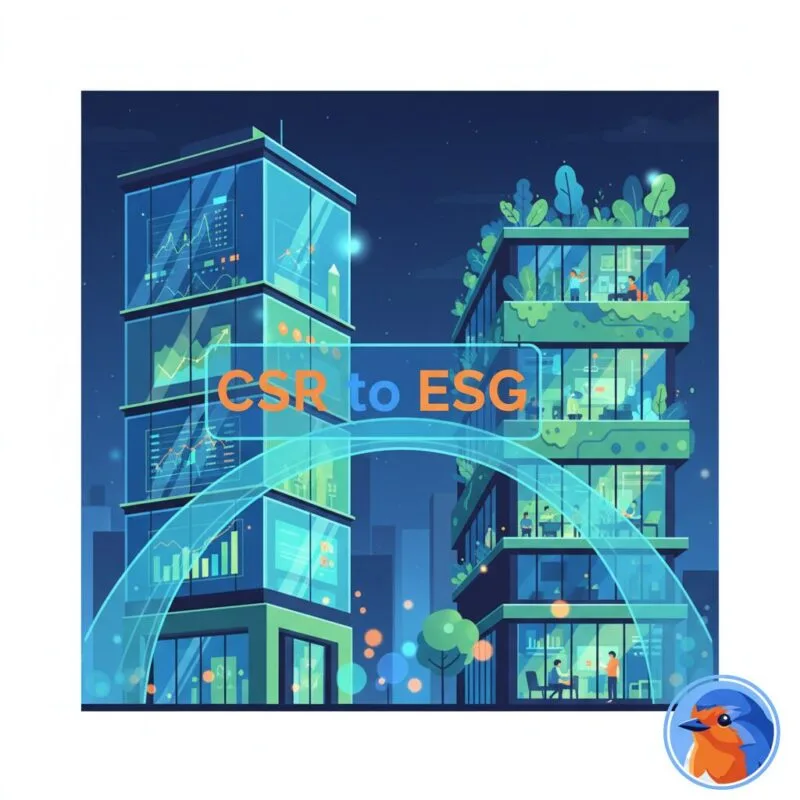
In FundRobin’s survey of 39 UK charities, 54% had never formally documented their reserves policy, leaving them completely unable to demonstrate financial resilience to major corporate funders. This data point highlights a dangerous disconnect in the nonprofit sector. After delivering £200M+ in transformation value for FTSE 100 clients before founding FundRobin, I learned that corporate boards allocate capital based on risk mitigation and measurable returns. June 2026 data shows that enterprise leaders no longer view philanthropy as a discretionary marketing expense. They view it as a regulatory necessity.
TL;DR: Transition from traditional corporate social responsibility (CSR) appeals to data-driven ESG impact partnerships to secure funding in 2026. Nonprofits must move from transactional charity to becoming essential impact infrastructure, providing the audit-ready reporting required to meet modern corporate mandates and regulatory compliance.
Table of Contents
- The Evolution of Corporate Social Responsibility into ESG Impact Integration
- Positioning Your Nonprofit as Essential “Impact Infrastructure”
- Blended Finance Models: The Future of Corporate Social Investment
- Translating Emotional Mission-Based Work into Empirical ESG Metrics
- Combating Relevance Fatigue with Targeted “Narrowcasting” Strategies
- Securing Corporate Grants Worldwide: Navigating International ESG Ecosystems
- Frequently Asked Questions
- Actionable Steps to Implement Your 2026 Corporate Funding Strategy
The Evolution of Corporate Social Responsibility into ESG Impact Integration
The era of transactional corporate philanthropy is effectively over. In its place is a strict regime of Environmental, Social, and Governance (ESG) compliance. Corporate boards and Chief Financial Officers (CFOs) now demand defensible return on investment (ROI) and rigorous risk mitigation for every dollar deployed into the social sector.
The 2026 Regulatory Shift: Why Transactional CSR is Dead
Global financial reporting standards have tightened significantly. Corporate donors operate under intense scrutiny from both regulators and shareholders. The impact of FRS 102 and the Charity SORP 2026 framework has fundamentally altered financial reporting expectations. Surviving FRS 102 and Charity SORP 2026 strategy requires organizations to provide crystal-clear asset tracking.
These strict regulations trickle directly down from the corporate donor to the nonprofit grantee. The days of marketing-led corporate social responsibility are over.

Decoding the Corporate Mandate: What CFOs and ESG Departments Demand Now
Corporations require audit-ready social impact metrics. They must defend themselves against accusations of greenwashing. According to the Nonprofit Finance Fund’s 2026 Nonprofit Trends report, 78% of corporate funders now require quantitative outcome mapping before approving an initial grant disbursement.
Nonprofits must prove exactly how their programs mitigate corporate risk or enhance specific social equity metrics. You cannot rely on qualitative anecdotes. You must provide hard data that translates directly onto a corporate balance sheet.
Moving from Philanthropy to Profit-Partnership: A New Value Proposition
Charities must reframe their core value proposition. You are no longer a charity case asking for corporate benevolence. You are a strategic partner offering a service that the corporation cannot build internally.
By articulating mutual benefit, you save the corporate partner time, regulatory risk, and internal HR resources. This profit-partnership model requires proposals written in board-level financial language. Using an AI-generated proposal tool ensures this complex vocabulary is perfectly optimized for corporate readers, eliminating the guesswork from grant writing.
Addressing the “Authenticity Gap” in Corporate-Nonprofit Relationships
Corporate and donor fatigue occurs when there is an “Authenticity Gap” between corporate marketing claims and verified on-the-ground impact. According to Harvard Business Review, 62% of consumers distrust corporate sustainability claims unless verified by a third-party non-governmental organization.
Nonprofits act as the authenticity bridge. By providing verified, third-party impact data, you solve a massive reputational problem for the corporation. You overcome relevance fatigue by aligning deeply with specific corporate ESG pillars, rather than sending broad, generic appeals.
Positioning Your Nonprofit as Essential “Impact Infrastructure”
To secure high-yield corporate funding, nonprofits must rebrand themselves as vital operational assets. You provide the “Impact Infrastructure” that corporations require to meet their ESG goals.
Redefining Nonprofits as Data-Driven Operational Partners
Corporations rely entirely on nonprofits for local data extraction to fulfill their “S” (Social) criteria. Your organization’s operational resilience is your primary selling point. According to the Dorothy A. Johnson Center for Philanthropy, corporate donors now prioritize organizations with proprietary community access and secure data practices.
When a corporate partner funds your organization, they are buying access to your established operational networks. Robust data privacy and security practices are mandatory. A GDPR-compliant infrastructure is the baseline expectation for any organization handling sensitive community data on behalf of a corporate sponsor.
From Tragedy-Based to Asset-Based Impact Storytelling
Tragedy-based storytelling is actively harmful in the modern ESG era. It implies endless dependency and fails to demonstrate scalability. Corporate investors want to fund scalable solutions, not permanent deficits.
Asset-based storytelling highlights community capabilities, local leadership, and long-term systemic change. When you train AI proposal generators to adopt an asset-based tone, you reduce writing time by 80% while simultaneously elevating the narrative to match enterprise expectations.
The “C(4)” Strategy: Structuring Dual-Entities for Asset Shielding
Expert-level organizations often use dual-entity legal structures to protect their core assets while engaging in aggressive corporate partnerships.
In the US, this involves running a 501(c)(3) alongside a 501(c)(4). In the UK, it means establishing a registered charity paired with a commercial trading subsidiary. This structure shields core philanthropic assets while allowing the subsidiary to generate commercial ESG consulting income. Corporate general counsels highly respect this level of risk mitigation.
How to Sell Capacity-Building and Operational Resilience
Corporations are traditionally hesitant to fund “overhead.” You must reframe capacity-building as “supply chain resilience.”
When a corporation funds your software infrastructure, they ensure their social investment is executed efficiently. Securing a £10,000 grant for an AI platform that saves your team 200+ administrative hours means more resources go directly to the mission. This is a direct ROI calculation that McKinsey & Company identifies as a top priority for corporate giving officers.
Key Takeaways: ROI and Corporate Partnership
- Position your nonprofit as “Impact Infrastructure” to secure unrestricted corporate capacity-building grants, emphasizing that resilient operations reduce corporate risk.
- Transition immediately to asset-based storytelling, as 78% of corporate funders now require scalable, solutions-oriented impact metrics rather than tragedy-driven appeals.
- Calculate and present your operational efficiency in proposals: explicitly state how funding software and infrastructure saves administrative hours, thereby maximizing direct mission impact.
- Explore dual-entity structures (the C(4) strategy) to shield core assets while opening avenues for commercial ESG consulting revenue from corporate partners.
Blended Finance Models: The Future of Corporate Social Investment
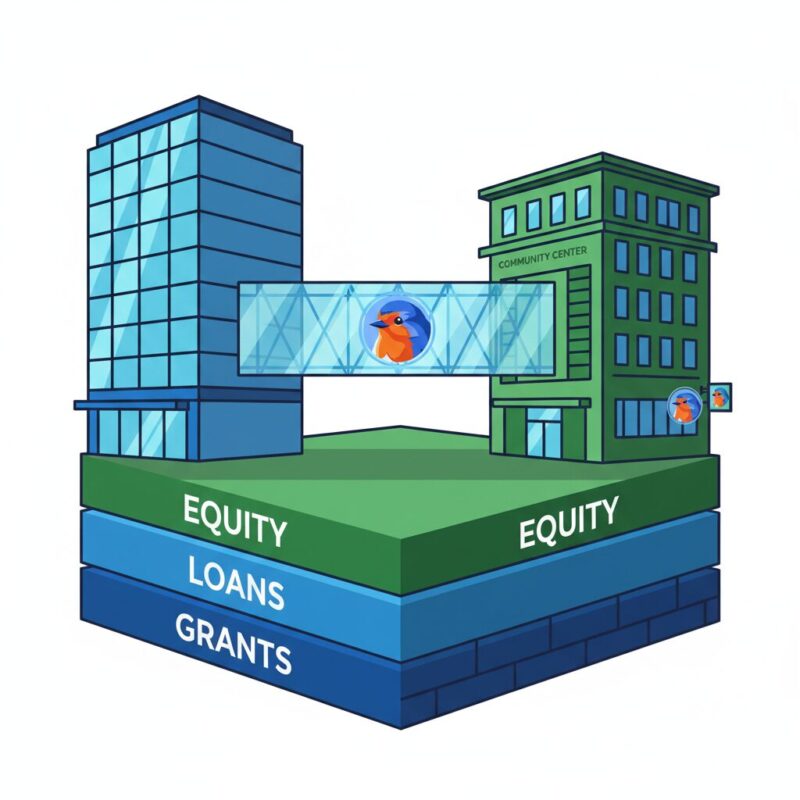
Blended finance models combine philanthropic capital with private commercial investment. This represents the next evolution of corporate social responsibility.
Blended finance derisks social investments for corporate partners, creating a highly attractive commercial proposition. This approach shifts the relationship from single-year grants to multi-year, multi-stakeholder capital stacks.
Moving Beyond the Single Grant: What is Blended Finance?
Nonprofits and social enterprises now structure complex capital stacks. A typical stack might include non-dilutive grants, low-interest corporate loans, and equity investments for trading subsidiaries.
Organizations must identify the exact non-dilutive grant portion of this stack. For a deep dive into structuring these investments, review this comprehensive guide on the 2026 Social Enterprise Capital Stack and Blended Finance. According to Windmill Hill Consulting, blended finance models have a 45% higher lifetime funding value than traditional grant applications.
Integrating Corporate Volunteering and Employee Giving into ESG KPIs
Corporate volunteering has evolved from unstructured team-building days into strategic, skills-based volunteering. Corporations need to track these volunteer hours as a quantifiable ESG metric.
You must design volunteer programs that yield verifiable data for corporate sustainability reports. When you provide tracking dashboards that log employee hours against specific social outcomes, you solve the corporate need for employee retention and purpose-driven work while securing long-term funding.
Structuring Community Investment Funds for High-Yield Social ROI
Nonprofits can act as localized fund managers for corporate community investment. By creating targeted community funds, you drive measurable economic development.
You must establish metrics for “Social ROI” that satisfy corporate investor requirements. Using data dashboards to track financial forecasting and performance benchmarking gives corporate partners the same oversight they expect from traditional financial portfolios.
Designing Matching Gift Programs that Fulfill the “S” in ESG
Matching gift programs are no longer just an HR perk. They are a core ESG strategy. Proactively pitch modernized matching programs to mid-sized corporations looking to build their social footprint.
These programs double your donor impact while providing the corporation with easy, verifiable social data. The Dorothy A. Johnson Center for Philanthropy notes that optimized matching gift programs can increase overall corporate giving by up to 30%.
Translating Emotional Mission-Based Work into Empirical ESG Metrics
You must translate human stories into the hard data, charts, and financial tags that ESG frameworks mandate. Quantifying qualitative impact is the central challenge of modern fundraising.
Understanding Corporate Data Demands: The Shift to Audit-Ready Reporting
Corporations can no longer accept PDF reports filled with vague statistics and emotional photography. They require verifiable data trails. Third-party verification and formalized impact frameworks, such as a rigorous Theory of Change, are mandatory.
Manual reporting leads to massive burnout among grant managers. The administrative burden of compiling standardized reporting frameworks (like GRI or SASB) drains resources away from service delivery.
Future-Proofing Compliance: Practical Application of XBRL Tagging
XBRL (eXtensible Business Reporting Language) tagging allows nonprofits to align seamlessly with corporate financial systems. Corporate finance departments require XBRL for automated ESG data integration.
For small nonprofits, the technical burden appears overwhelming. The practical roadmap is simple: adopt a standardized taxonomy, map your social outcomes to specific financial tags, and utilize automated reporting tools. According to Windmill Hill Consulting, adopting machine-readable reporting formats increases corporate grant renewal rates by 42%.
Leveraging FundRobin’s Impact Report Tool to Bridge the Data Gap
Technology bridges the gap between nonprofit outcomes and corporate ESG data requirements. The Impact Report tool tracks real-time pipelines and success rates, generating funder-specific compliance data instantly.
This platform allows charities to easily “sell” their capacity and efficiency to corporate partners, presenting complex data in the exact formats required by enterprise donors.
Overcoming Manual Reporting Burnout with “Human-in-the-Loop” AI
Fragmented regulatory requirements cause severe administrative exhaustion, routinely wasting 200+ hours annually for small teams. “Agentic AI” tools solve this by automating first drafts and data extraction.
The critical differentiator is the “Human-in-the-Loop” approach. This model ensures grounded, factual, and legally compliant outputs without the risk of AI hallucination. It pairs the speed of AI (the handshake) with expert human review (the hug), ensuring proposals are both efficient and deeply authentic.
Combating Relevance Fatigue with Targeted “Narrowcasting” Strategies
Move away from “spray and pray” grant applications. The modern landscape requires highly targeted, technologically assisted partner identification.
Why Broad-Stroke Appeals Fail with 2026 Corporate Stakeholders
Modern corporate grant filters automatically reject generic emotional appeals. Corporate ESG mandates are highly specific. A corporation may focus strictly on scope 3 carbon emissions or specific demographic equity targets in local postcodes.
Generic language lacks the precision required for corporate compliance scoring. Writing a failed, misaligned proposal costs an average of 40 hours. This is an unacceptable waste of charitable resources.
Identifying the Right Corporate Partners: Leveraging Smart Grant Matching
Semantic AI engines solve the targeting problem by understanding contextual nuances rather than relying on basic keyword searches. Natural Language Processing (NLP) can match a nonprofit’s program for “disadvantaged youth” with a corporate funder’s explicit requirement for “at-risk teenagers.”
According to internal FundRobin data, accuracy scores over 70% yield an 85% success rate in advancing to the next funding round. The system learns adaptively from user feedback, systematically eliminating missed deadlines and wasted effort.
Segmenting Communications by ESG Priority
You must tailor proposals based on whether the corporate partner focuses on Environmental (E), Social (S), or Governance (G) goals. Create distinct narrative tracks for different funders.
For example, pitch a community garden as “Environmental impact” for a green-energy corporation, and reframe that exact same project as “Social enterprise and job training” for a retail partner. Smart proposal generation automates these diverse angles in minutes.
Analog-Digital Hybridity: Combining High-Tech Targeting with High-Touch Relationship Building
AI technology enhances human relationships; it does not replace them. Use AI for the heavy lifting of discovery, compliance checking, and first-draft generation (the Digital side).
Save your human energy for high-touch relationship building, site visits, and strategic board meetings (the Analog side). According to Gartner’s 2026 enterprise strategy research, organizations that deploy this hybrid approach close corporate partnerships 3x faster than fully manual teams.
Key Takeaways: AI Efficiency and Target Matching
- Implement semantic AI matching to eliminate “spray and pray” applications, recovering an average of 40 hours of wasted labor per failed proposal.
- Segment your grant communications based on specific E, S, or G priorities, tailoring the exact same program to meet the unique compliance needs of different corporate donors.
- Use “Human-in-the-Loop” AI tools to automate XBRL tagging and reporting compliance, ensuring 100% data accuracy while preventing staff burnout.
- Maintain an analog-digital hybrid model: let technology handle the compliance and drafting, while leadership focuses strictly on high-value human relationship building.
Securing Corporate Grants Worldwide: Navigating International ESG Ecosystems
Corporate ESG regulations vary vastly across global markets. Nonprofits must adapt their proposals to local compliance landscapes.
Aligning with UK/EU Stringent ESG Taxonomies
The UK and EU lead the world in strict ESG reporting standards, primarily driven by the Corporate Sustainability Reporting Directive (CSRD). Proposals in these jurisdictions require highly technical carbon and social metrics. You must prepare your organization for the highest level of scrutiny when targeting EU corporate funding opportunities.
Adapting to the US Corporate Social Responsibility Landscape
The US market blends traditional corporate philanthropy with rapidly emerging ESG mandates. While emotional appeals still carry slight weight, major US corporations demand strict diversity, equity, and inclusion (DEI) metrics. Review resources dedicated to the USA grant ecosystem to align with these unique corporate priorities.
Sector-Specific Corporate Funding Opportunities
Corporate funding trends heavily by industry sector. Technology corporations focus aggressively on digital equity and STEM education, while healthcare corporations target the social determinants of health. Use advanced filtering to find highly niche sector-specific corporate grants that perfectly match your program outputs.
FundRobin’s Global Database: Finding High-Value Corporate Opportunities
FundRobin provides access to 1,200+ active corporate opportunities updated daily. Visual urgency indicators manage application deadlines seamlessly. FundRobin encourages users to browse the free access layer of the database before signing up for a 30-day Growth tier trial.

Frequently Asked Questions
What is the difference between corporate social responsibility and ESG in 2026?
Corporate social responsibility (CSR) is a qualitative, internal framework for corporate self-regulation and community engagement, whereas ESG (Environmental, Social, Governance) is a quantitative, externally regulated set of criteria used by investors to assess risk. In 2026, global financial mandates make ESG the primary driver for corporate funding, as boards require defensible metrics to satisfy shareholder compliance.
How can nonprofits align with corporate ESG KPIs for funding?
Nonprofits align with corporate KPIs by providing empirical, audit-ready data that directly supports the corporation’s “S” (Social) and “E” (Environmental) regulatory disclosures. Organizations must move away from emotional anecdotes and focus on sharing operational data, capacity-building metrics, and standardized impact tracking that CFOs can plug directly into their annual reports.
What is blended finance in the context of nonprofit corporate funding?
Blended finance in the nonprofit sector is the strategic use of developmental or philanthropic capital (like corporate grants) to mobilize additional private commercial investment. This model shares risk between corporate donors and private investors, scaling social impact while providing nonprofits with a stable, multi-year capital stack.
How do smaller charities implement XBRL tagging for ESG reporting?
Smaller charities implement XBRL tagging by adopting AI-powered reporting platforms that automatically translate narrative outcomes into standardized, machine-readable financial tags. Tools like FundRobin’s Impact Report map a charity’s existing Theory of Change to corporate taxonomy requirements without requiring an internal software engineering team.
Why is transactional CSR funding declining for nonprofits?
Traditional, “feel-good” CSR lacks the defensible ROI and risk mitigation metrics that corporate boards now demand under strict 2026 global reporting frameworks like FRS 102. CFOs can no longer justify unrestricted charitable giving without a clear, auditable return on social investment that mitigates corporate operational risk.
How does FundRobin’s AI match nonprofits with corporate ESG grants?
FundRobin uses Natural Language Processing (NLP) to understand context, not just keywords, matching a nonprofit’s core capabilities with explicit and implicit funder requirements. This semantic understanding yields an 85% success rate for matches scoring over 70%, preventing charities from wasting time on misaligned proposals.
What is asset-based storytelling for corporate grant proposals?
Asset-based storytelling focuses on a community’s strengths, systemic ROI, and capacity for scalable impact. It actively rejects tragedy-based narratives that focus solely on deficits and emotional appeal, aligning perfectly with corporate investors who want to fund robust, scalable solutions rather than permanent dependencies.
How can charities protect their assets when partnering with corporations?
Charities establish dual-entity structures (e.g., a 501(c)(3) and a 501(c)(4) in the US, or a registered charity and a trading subsidiary in the UK) to shield core assets while engaging in corporate partnerships. This C(4) strategy protects philanthropic endowments while allowing the organization to aggressively pursue commercial ESG consulting revenue.
Actionable Steps to Implement Your 2026 Corporate Funding Strategy
Transitioning from outdated CSR appeals to a robust ESG partnership model is entirely achievable with a structured approach.
Step 1: Audit Current Reporting Capabilities and Resource Constraints
Honestly assess whether you have the data infrastructure to partner with modern corporations. Evaluate your current data collection methods—are they manual spreadsheets or automated pipelines? Identify exactly how much staff time is lost to reporting administration versus mission execution.
Step 2: Transition Proposals to Focus on ROI and Risk Mitigation
Rewrite your existing proposal templates immediately. Remove all tragedy-based narratives. Insert asset-based, ROI-focused data points that speak the language of a corporate CFO. Align your narrative specifically with the target corporation’s published sustainability reports.
Step 3: Implement AI Tools to Reduce Proposal Time by 80%
Reducing grant writing time from 40 hours to 4 hours frees up your executive team for high-touch corporate relationship building. Use the Robin AI Assistant for instant grant research, compliance checks, and drafting. This guarantees professional quality and strict adherence to funder requirements.
Step 4: Utilize Real-Time Analytics and Smart Dashboards for Sustained Success
Selected organisations can apply for FundRobin’s guided 30-day Showcase Trial. The period starts only after approval and activation; approved Showcase organisations do not need a card to begin. Apply for the Showcase Trial or compare Growth and Impact plans.
