
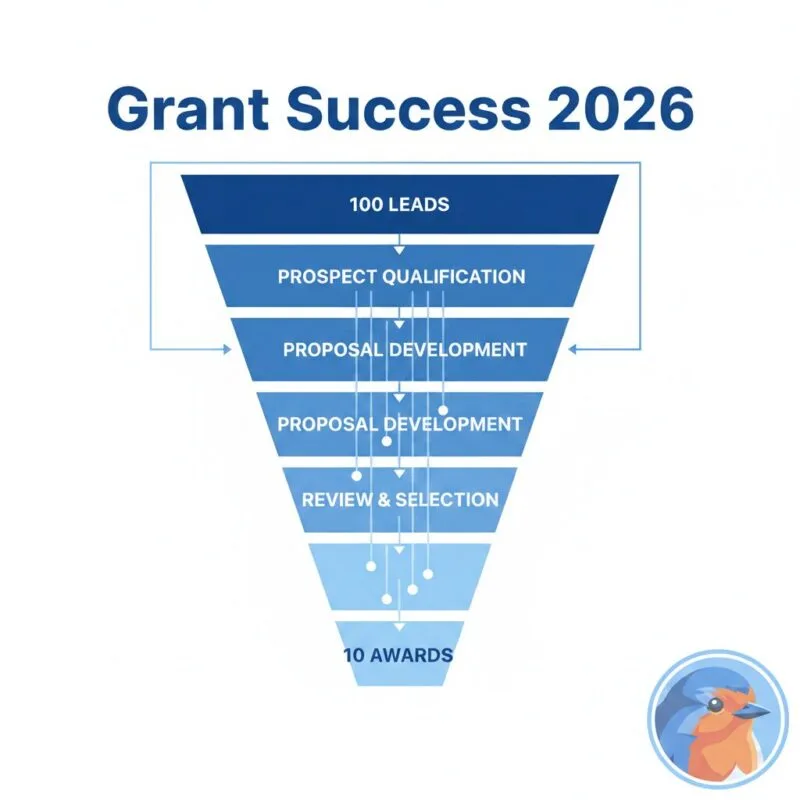
According to FundRobin’s analysis of 76 nonprofit leaders, organisations with a documented grant strategy are 3.1x more likely to maintain consistent year-over-year funding. Despite this data, many development teams still chase an outdated metric: the 30% win rate. As of July 2026, The Chronicle of Philanthropy data indicates that relying on sheer application volume to hit flat percentage goals leads directly to staff burnout and financial instability. The solution requires a structural shift from tracking output volume to engineering a sustainable revenue pipeline.
TL;DR: Mid-sized nonprofits can move past the outdated 30% grant win rate benchmark in 2026 by using AI to automate Grant Fit Scores, preventing writer burnout, and balancing restricted grants with unrestricted revenue. Transitioning from application volume to strategic prospect alignment increases overall funding stability by 3.1x.
The 30% Benchmark Myth: Moving from “Spray and Pray” to Targeted Prospecting
Rethinking the 30% Grant Win Rate for 2026
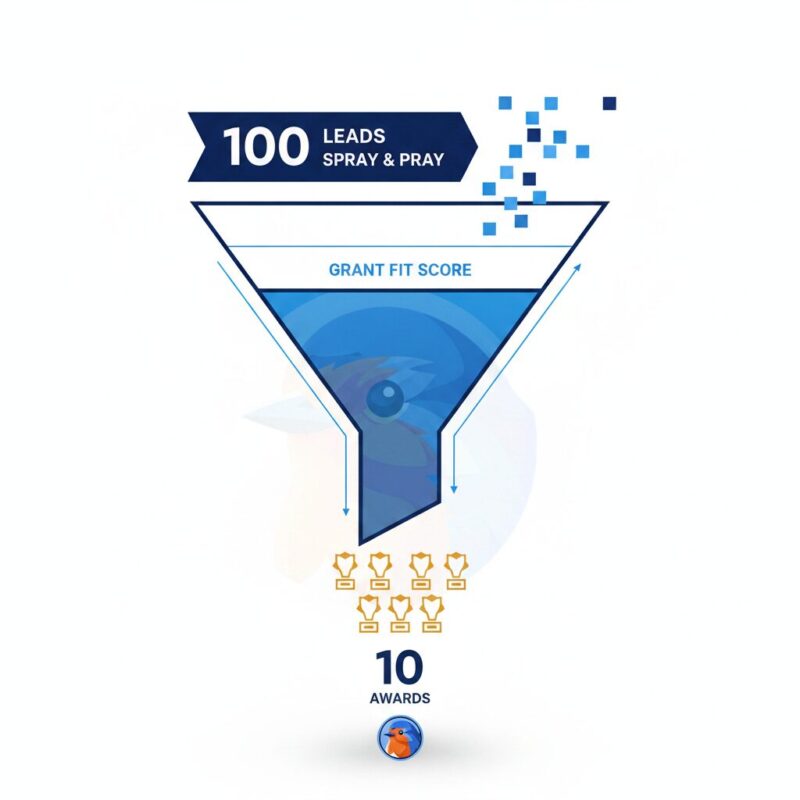
The 30% win rate is a lagging indicator of organizational health, not a reflection of grant writing quality. Traditional nonprofit grant writing strategies for 2026 show that treating grant applications like a numbers game drains resources. According to Instrumentl’s analysis of the grant writer’s dilemma, high-demand application environments create an illusion of productivity while obscuring low strategic alignment.
To understand why a flat benchmark fails, development leaders must look at success rates segmented by funder type:
| Funder Type | Typical Success Rate | Application Complexity | Best For |
|---|---|---|---|
| Government / Federal | 15% – 20% | Extremely High | Large organizations with dedicated compliance teams |
| Private Foundations | 25% – 35% | Moderate to High | Mid-sized nonprofits with established program metrics |
| Corporate Grants | 40% – 50% | Low to Moderate | Local community initiatives with clear corporate alignment |
Organizations must differentiate efficiency from effectiveness. Efficiency is writing applications faster. Effectiveness is implementing a Grant Fit Score. By automating contextual matching using FundRobin’s predictive scoring algorithms, nonprofits replace the “spray and pray” method with targeted precision. When comparing FundRobin vs. Submittable, the difference becomes clear. Submittable is a legacy tracking tool best for organizing submissions, while FundRobin is the AI-native alternative best for active prospect matching and drafting, directly improving win probability before a single word is written.
Ending the Chaos Cycle: Structural Fixes for Grant Writer Burnout
The nonprofit sector has a serious retention problem. Research from Grant Llama on burnout prevention found that the average turnover rate for grant writers is just 16 months. This high turnover is a structural failure caused by reactive prospecting, not a lack of individual capacity.
Stopping this chaos cycle requires firm operational boundaries. Leaders must introduce strict Go/No-Go evaluation frameworks. These frameworks protect development staff from low-probability, high-effort applications by scoring opportunities against the organization’s core competencies and current capacity. If an opportunity scores below a defined threshold, the team does not apply.
Implementing AI for nonprofit grant writing in 2026 dramatically reduces the mental load of research. AI-assisted workflows scan thousands of funder 990s, recent giving histories, and strategic priorities in minutes. This automation allows human grant writers to focus entirely on narrative quality and relationship building rather than database exhaustion. When staff spend their time crafting compelling stories for highly qualified prospects, burnout decreases, and job satisfaction rises.
Revenue Portfolio Engineering: Balancing Restricted Grants with Unrestricted Giving
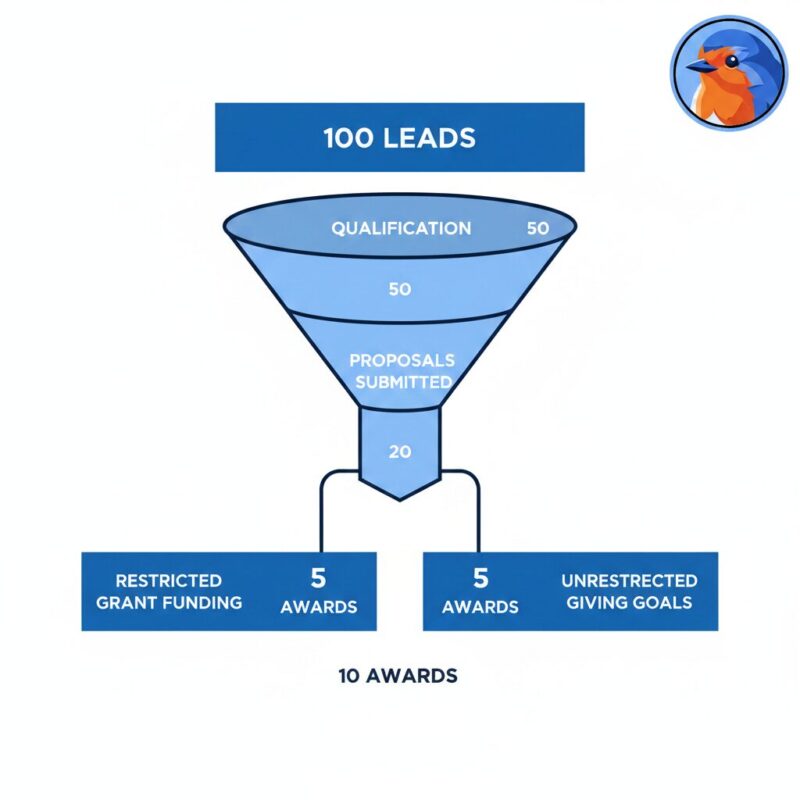
A high grant win rate means very little if 100% of the funding is restricted to specific projects. Over-reliance on restricted funding stifles organizational agility, forcing nonprofits into a reactive survival loop where overhead and core operations go underfunded. The Nonprofit Learning Lab’s guide to diverse funding confirms that long-term sustainability requires a deliberate mix of income streams.
Revenue Portfolio Engineering is the process of operationalizing unrestricted giving goals alongside targeted project grants. Organizations should implement the 33% charity income diversification rule, ensuring that no single funding source or type dominates the budget. This approach requires visibility into the entire fundraising pipeline, a practice supported by the National Council of Nonprofits.
To achieve this balance, leadership teams need active KPI dashboards that track application status, award probability, and financial forecasting. The FundRobin Smart Dashboard achieves this by automating data entry, saving teams over 200 hours annually on reporting. By visualizing exactly how project grants align with broader unrestricted goals—such as UK community foundation partnerships—directors can make proactive, data-driven decisions about where to deploy their development resources.
Frequently Asked Questions
What is a good grant success rate for a nonprofit?
A good grant success rate in 2026 relies on a high Grant Fit Score rather than the traditional 30% flat benchmark. Success rates vary widely by funder type; a highly targeted corporate grant might see a 50% success rate, while federal grants often sit below 20%. Evaluating success based on strategic alignment ensures development teams pursue quality over sheer volume.
How do you improve grant application success rates?
Improve your grant application success rate by shifting from submission efficiency to prospecting effectiveness. Automating a Grant Fit Score using predictive AI tools eliminates the “spray and pray” method. When you only write applications for funders mathematically aligned with your mission and capacity, your win probability naturally increases.
What are the main causes of grant writer burnout?
The primary causes of grant writer burnout are reactive application strategies and a lack of Go/No-Go evaluation frameworks, leading to a 16-month average turnover rate. When writers are forced to chase every available dollar to sustain a restricted-heavy budget, the mental load of continuous, low-probability research causes severe fatigue.
How can AI help with nonprofit fundraising KPIs?
AI helps with fundraising KPIs by replacing manual data entry with real-time predictive dashboards that forecast win probabilities. Tools like FundRobin track the health of your entire grant pipeline instantly, allowing executive directors to view application statuses, calculate expected revenue, and balance restricted versus unrestricted goals without losing days to spreadsheet management.
Why is FundRobin considered better than Submittable for grant prospecting?
FundRobin is better for active grant prospecting because it uses AI to calculate Grant Fit Scores and draft compliant applications, whereas Submittable is primarily a passive tracking and submission management tool. While Submittable organizes where applications go, FundRobin actively increases your win rate by ensuring you only apply to high-probability funders.
Key Takeaways:
- Stop measuring success by application volume; implement AI-driven Grant Fit Scores to prioritize strategic prospect alignment over the outdated 30% win rate benchmark.
- Implement strict Go/No-Go evaluation frameworks immediately to block low-probability applications and stop the 16-month grant writer turnover cycle.
- Balance your budget using Revenue Portfolio Engineering to ensure restricted project grants do not cannibalize your unrestricted operational funding.
- Deploy real-time KPI dashboards to save hundreds of administrative hours while tracking true pipeline health and predictive revenue.
Grant success is no longer a volume game. By utilizing intelligent prospecting, establishing firm boundaries on staff capacity, and engineering a balanced revenue portfolio, nonprofits can step off the application treadmill. FundRobin is the strategic platform that transforms reactive fundraising into predictive, sustainable growth.
