

Quick answer: UK charity financial pressures in 2026 require stronger reserves, diversified income, clearer grant pipelines, and faster decisions about funding risk.
The UK’s non-profit sector is facing a period of unprecedented strain. A relentless combination of rising costs, unpredictable income, and surging demand has created a “big squeeze” on organisations of every size. The National Council for Voluntary Organisations (NCVO) has aptly named this challenge the ‘Cost of Giving Crisis’—a reality where keeping the doors open has become the primary, all-consuming mission for many.2 If you’re a charity trustee, CEO, or finance manager, the pressure of navigating the current landscape of UK charity funding is immense. You are not just dealing with spreadsheets; you are safeguarding vital services that communities depend on. In FundRobin’s survey of 39 UK charities, 54% had never formally documented their reserves policy, leaving them unable to demonstrate financial resilience to major funders.9
This is not just another article reporting on the problem. This is an actionable survival toolkit, updated for the financial realities of April 2026. We move beyond the headlines to provide a clear, strategic roadmap designed to guide your organisation from crisis to sustainable UK charity financial sustainability. We break down the current financial pressures, show you how to strengthen your internal governance, provide a practical guide to diversifying your income, and offer tailored tactics specifically for small charities. As 76 nonprofit leaders told us: organisations with a documented grant strategy were 3.1x more likely to maintain consistent year-over-year funding.8 It is time to turn pressure into a plan.
- The Perfect Storm: Understanding the Financial Pressures on UK Charities in 2025
- Strengthening Your Core: Mastering Financial Governance and Reserves
- The Resilience Roadmap: A Practical Guide to Diversifying Charity Income
- A Toolkit for Small Charities: Overcoming Unique Financial Hurdles
- Conclusion
- Frequently Asked Questions
- Sources & Further Reading
The Perfect Storm: Understanding the Financial Pressures on UK Charities in 2026
UK Charity Financial Resilience Guide 2026
To build resilience, we must first understand the forces at play. The current financial environment for the UK non-profit sector is a perfect storm of compounding challenges. It’s a landscape where 86% of charitable organisations worry about the impact of cost-of-living increases on their service users, even as their own resources are stretched thin. With inflation predicted to remain a significant factor, projected at 3.2% through mid-2026 according to the Bank of England, the pressure on already tight budgets is intensifying. This isn’t a temporary dip; it’s a new economic reality that demands a new strategic response.
Inflation’s Squeeze: How Rising Costs Are Eroding Budgets
Inflation is not an abstract economic term; it is a direct and tangible drain on your charity’s resources. Every aspect of your operations, from energy bills and insurance premiums to supplies and venue hire, costs more than it did a year ago. A 2025 analysis by Pro Bono Economics found that charity operating costs rose 18% faster than general inflation between 2022 and 2025, driven by staffing and energy.5 This is acutely felt in staffing costs, a primary expense for most charities. While necessary increases to the National Living Wage are a welcome support for employees, they add significant pressure to payrolls.
The NCVO’s analysis highlights this squeeze perfectly: even when wages rise, their real-world value is diminished.2 A pay rise of 3.8% in a high-inflation environment can equate to a real-terms decrease in spending power, impacting staff morale and retention while simultaneously increasing the charity’s overheads. This relentless erosion of your budget means every pound raised has to work harder just to maintain the status quo, let alone fund growth or innovation.
The Double Bind: Surging Demand Meets Declining Income
The core of the “big squeeze” is a painful paradox: as the cost-of-living crisis drives more people to seek help, the very same crisis reduces the public’s ability to give. This creates a double bind of surging demand and declining income. The Charity Finance Group (CFG) captured this sentiment perfectly in a recent survey, with one small charity leader stating, “Costs have gone up…while we’re expected to deliver more”.3
The data paints a stark picture: 71% of charity leaders are concerned about managing this increased demand for their services, while 59% are worried about a corresponding drop in donations.6 The NCVO UK Civil Society Almanac 2025 reports that voluntary sector income fell in real terms for the second consecutive year, with government grants to charities declining by 4.1%.7 This pressure is compounded by a lack of targeted support in recent fiscal statements, leaving charities to bridge the gap themselves. For a deeper look at navigating these issues, the NCVO’s Guide to Financial Challenges offers valuable frameworks.
The Safety Net is Fraying: The Dangerous Depletion of Charity Reserves
Faced with operational shortfalls, many charities have been forced to turn to their last line of defence: their financial reserves. Recent data shows that one in four charities have had to draw on their reserves simply to manage day-to-day costs. While reserves are there to be used in difficult times, relying on them to cover routine deficits is unsustainable and a clear sign of financial distress.
This depletion of charity reserves poses a significant long-term risk to the sector’s stability. The Charity Commission views the responsible management of reserves as a cornerstone of good financial stewardship, and its 2024 annual report flagged “inadequate reserves management” as a recurring governance concern.1 A fraying safety net not only jeopardises a charity’s ability to weather future unexpected crises but also threatens its very existence, making robust charity financial resilience planning more critical than ever.
Strengthening Your Core: Mastering Financial Governance and Reserves
In a turbulent environment, a strong internal core is your most valuable asset. Proactive financial governance is not about restrictive bureaucracy; it’s about creating the stability and clarity needed to make confident strategic decisions. The foundation of this stability is a robust and well-considered reserves policy, a topic on which the Charity Commission Financial Guidance blog offers timely reminders.
The Charity Commission’s official guidance (CC19) makes it clear that managing reserves is a fundamental duty for trustees. It highlights the dual risks of getting it wrong: holding reserves that are too high can tie up funds that should be used for charitable activities, while reserves that are too low increase “the risks of unplanned and unmanaged closure and insolvency”.1 Mastering your reserves policy is the first and most critical step in moving from a reactive to a resilient footing.

Your Reserves Policy: A Step-by-Step Guide Based on CC19 Guidance
A reserves policy is more than a number; it’s a statement of your charity’s financial strategy. It explains to funders, beneficiaries, and regulators why you hold reserves, how much you aim to hold, and how you will use them. Reviewing this policy annually is a critical trustee responsibility.
Step 1: Calculating Your Target Reserve Level
There is no one-size-fits-all answer for a target reserve level. The Charity Commission’s CC19 guidance advises trustees to conduct a realistic assessment based on their specific circumstances.1 Consider factors such as:
- Income Reliability: How secure and predictable are your main income streams?
- Cost Structure: What are your fixed monthly costs (salaries, rent) that must be covered? A common starting point is to aim for 3-6 months of essential running costs.
- Future Plans: Are you planning any significant projects or capital expenditures?
- Risks & Opportunities: What potential financial shocks could you face (e.g., loss of a major grant)? What opportunities might require upfront investment?
Documenting the rationale behind your calculation is just as important as the final number.
Step 2: Writing a Clear and Justifiable Policy
Your written policy should be a clear, concise document. Based on CC19 requirements, it should include:
- The purpose of the policy.
- The target level of reserves (e.g., “between 3 and 6 months of unrestricted operational expenditure”) and the calculation used to arrive at it.
- The steps you will take if reserves fall below the target or significantly exceed it.
- The agreed-upon review schedule (typically annually).
For your annual report, consider using clear wording such as: “The trustees have established a reserves policy to ensure the continuity of our core services. Our target is to hold X months of operational costs, which amounts to approximately £Y. At the end of the financial year, our reserves stood at £Z, which is in line with our policy.”
Scenario Planning: What To Do If Reserves Are Depleting
If your monitoring shows that reserves are depleting rapidly and unsustainably, you must act decisively. This is where scenario planning becomes vital. The Charity Commission’s CC12 guidance on managing financial difficulties outlines the serious duties of trustees in this situation.4
Practical first steps, often recommended by financial advisors, include:
- Immediate Review: Convene a board meeting to review the latest financial forecasts and understand the rate of depletion.
- Re-forecast: Create best-case, worst-case, and realistic cash flow scenarios for the next 6-12 months.
- Identify Levers: Brainstorm all possible actions to reduce costs and increase income, no matter how difficult.
- Prioritise: Rank these actions by impact and feasibility.
- Action Plan: Create a clear plan with responsibilities and deadlines.
- Pro Bono Economics. (2025). The Cost Crunch: How inflation is reshaping the charity sector. Retrieved from https://www.probonoeconomics.com/
- CAF — Charities Aid Foundation. (2025). UK Giving Report 2025. Retrieved from https://www.cafonline.org/about-us/publications/uk-giving-report
- NCVO. (2025). UK Civil Society Almanac 2025. Retrieved from https://www.ncvo.org.uk/news-and-insights/news-index/uk-civil-society-almanac-2025/
- FundRobin. (2026). Original research: Survey of 76 nonprofit leaders on grant strategy and funding outcomes. Retrieved from https://fundrobin.com/
- FundRobin. (2026). Original research: Survey of 39 UK charities on reserves policy documentation. Retrieved from https://fundrobin.com/
- Charity Digital. (2025). Digital Skills & Technology Benchmarking Report 2025. Retrieved from https://charitydigital.org.uk/
This is a challenging process, and resources like the Charity Finance Group Sustainability Hub can provide valuable frameworks and support.
The Resilience Roadmap: A Practical Guide to Diversifying Charity Income
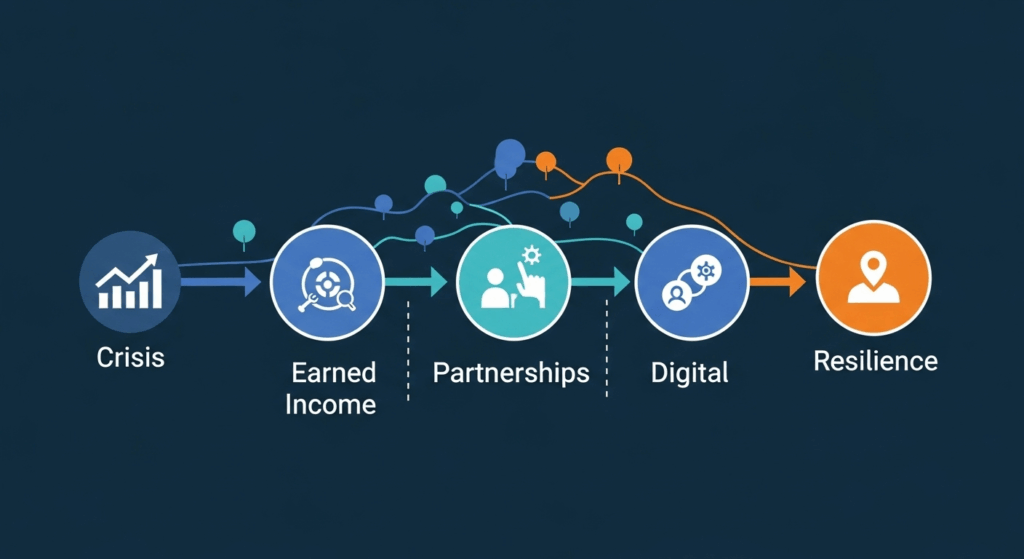
Relying on a single source of income is a high-risk strategy in today’s climate. Building long-term charity financial resilience requires a deliberate and strategic approach to income diversification. This means creating a healthy mix of revenue streams that can cushion your organisation from shocks in any one area. To begin, you can assess your organisation’s current state using a simple ‘Financial Sustainability Maturity Model’: Are you ‘Reactive’ (dependent on one or two grants), ‘Developing’ (experimenting with new income), or ‘Resilient’ (managing a balanced portfolio of revenue streams)?
The goal is to move along this spectrum by exploring new models of non-profit income generation.
Earned Income: Exploring Social Enterprise and Trading
Earned income is revenue generated from selling goods or services, and it represents a powerful path toward self-sufficiency. This can range from renting out unused office space to launching a full-fledged social enterprise—a business that trades to achieve a social purpose, with profits reinvested back into the mission.
For example, a youth services charity could launch a coffee shop that provides employment training and skills to young people, with all profits funding the charity’s core youth programs. While this model offers sustainable, unrestricted funding, it’s crucial to consider the legal and ethical implications. Significant trading activities may need to be housed in a separate trading subsidiary to protect the charity’s assets and charitable status.
Strategic Partnerships: Building Value with Corporates and Communities
Modern partnerships go far beyond a simple logo on a banner. Strategic corporate and community partnerships are about creating shared value. Instead of just asking for a donation, consider what your charity can offer in return. This could be employee engagement and volunteering opportunities, expert insights into a social issue relevant to the company’s CSR goals, or access to a dedicated community audience.
As one experienced charity leader noted, “The most successful partnerships are built on mutual benefit and a shared vision. When a corporate partner truly understands and invests in your mission, they become an advocate, not just a donor.” Building these strong, long-term relationships creates a more stable and predictable funding source than one-off sponsorship deals.
Digital Transformation: Leveraging Technology for Sustainable Fundraising
Digital technology offers powerful tools for creating steady and predictable revenue. Recurring giving programs are the cornerstone of this approach. By encouraging supporters to sign up for small, regular monthly donations through platforms like Donorbox, you can build a reliable stream of unrestricted income that is less susceptible to fundraising campaign fatigue.
Beyond donations, technology can unlock new efficiencies. Using data analytics to understand donor behaviour allows you to tailor your communications and appeals, increasing their effectiveness. Membership models, managed through platforms like WildApricot, can create a loyal community of supporters who contribute financially in exchange for exclusive content or benefits. This digital transformation is a key component of building a modern, resilient financial model.
A Toolkit for Small Charities: Overcoming Unique Financial Hurdles
Small charities are the lifeblood of the UK’s non-profit sector, yet they often face the most acute financial challenges. The Charity Finance Group’s survey of its small and micro members paints a clear picture of rising demands, escalating costs, and intense stress levels.3 With limited staff and resources, the need for efficient, high-impact strategies is paramount. This section is dedicated to providing tailored, low-resource solutions to help small organisations not just survive, but thrive. For more in-depth support, the CFG offers a range of Free Finance Guides for Small Charities.

How to Compete for Grants When You’re Outgunned
The grant application process can feel like an uphill battle for small charities competing against larger organisations with dedicated fundraising teams. The administrative burden is immense. To level the playing field, focus on strategy and efficiency. Instead of starting from scratch every time, create a “master proposal” document containing your core mission, impact data, and key project descriptions. This can be quickly adapted for different funders.
FundRobin offers Growth at £49/month or £470.40/year and Impact at £199/month or £1,910.40/year. Compare current plans. Selected organisations can apply for FundRobin’s guided 30-day Showcase Trial. The period starts only after approval and activation; approved Showcase organisations do not need a card to begin. Apply for the Showcase Trial.
Low-Effort, High-Impact Financial Management Tactics
When you don’t have a dedicated finance manager, simplicity and clarity are key. Focus on a few core financial practices that deliver the most value:
- A Live Cash Flow Forecast: This is your most critical tool. A simple spreadsheet tracking money in and money out over the next 12 months can give you an early warning of potential shortfalls.
- Simple Monthly Reporting: Create a one-page financial dashboard for your trustees that shows income vs. budget, expenditure vs. budget, and your current reserves level. This keeps everyone informed and accountable.
- Leverage Low-Cost Tech: As advised by Charity Digital in their 2025 technology benchmarking report,10 there are many affordable cloud accounting tools (like Xero or QuickBooks) that can automate invoicing, expense tracking, and reporting, saving significant administrative time.
These tactics, which can be supported by templates in our downloadable toolkit, ensure that even with limited staff, you can maintain robust financial oversight.
Conclusion
The financial pressures facing UK charities in 2026 are severe. The “Perfect Storm” of inflation, funding cuts, and rising demand is testing the resilience of the entire sector. Yet, these challenges are not insurmountable. Achieving UK charity financial sustainability requires moving from a reactive stance to a proactive, strategic one — and the organisations that act now will navigate this difficult period and emerge stronger.
The journey from crisis to charity financial resilience is built on three pillars: strengthening your internal governance with a robust reserves policy, strategically diversifying your income beyond traditional sources, and equipping your team with the right tools and tactics for your size. This guide provides the foundational toolkit for that journey. The path forward requires courage, creativity, and a commitment to sustainable financial management.
Do not just survive the squeeze — build a more resilient future for your charity. Start your free 30-day FundRobin trial to discover grant opportunities matched to your mission, or read our guide on how to build your financial foundations to enable your organisation for success.
This article provides informational guidance and is not a substitute for professional financial or legal advice. Charity trustees and managers should consult with qualified accountants or financial advisors for decisions specific to their organization’s circumstances.
Frequently Asked Questions
How can UK charities achieve financial sustainability?
FundRobin offers Growth at £49/month or £470.40/year and Impact at £199/month or £1,910.40/year. Compare current plans. Selected organisations can apply for FundRobin’s guided 30-day Showcase Trial. The period starts only after approval and activation; approved Showcase organisations do not need a card to begin. Apply for the Showcase Trial.
What is the Charity Commission’s CC19 reserves guidance?
CC19 is the Charity Commission’s official guidance on managing reserves. It requires trustees to set a target reserve level (typically 3–6 months of operating costs), document the rationale, review annually, and disclose the policy in annual reports.1 The guidance stresses that reserves that are too low increase the risk of “unplanned and unmanaged closure and insolvency.”
How much should a UK charity hold in reserves?
There is no universal figure. The Charity Commission advises trustees to calculate a target based on income reliability, fixed cost commitments, planned expenditure, and risk exposure.1 A common benchmark is 3–6 months of unrestricted operational expenditure, but your figure should reflect your charity’s specific risk profile and strategic plans.
What are the biggest financial challenges facing UK charities in 2026?
The primary challenges are: (1) inflation eroding budgets, with charity operating costs rising 18% faster than general inflation,5 (2) declining real-terms income, with government grants falling 4.1% according to the NCVO Almanac 2025,7 and (3) surging demand from the cost-of-living crisis. One in four charities has drawn on reserves to cover day-to-day costs.
How can small charities compete for grants against larger organisations?
Small charities should: (1) create a “master proposal” document with reusable mission, impact data, and project descriptions, (2) build deep relationships with a smaller number of relevant funders, (3) emphasise unique strengths such as community connections and low overheads, and (4) use AI-powered grant-finding tools like FundRobin to surface high-probability matches rather than scattering applications widely.
What is the Cost of Giving Crisis?
The “Cost of Giving Crisis” is a term coined by NCVO to describe the compounding financial pressures on UK charities: rising operational costs, declining donations as donors face their own cost-of-living squeeze, and increased demand for services.2 The Charity Finance Group documented how this particularly affects small and micro charities, many of which operate with no financial buffer.3
How can charities diversify their income beyond grants?
Key diversification strategies include: (1) earned income through social enterprise or trading subsidiaries, (2) strategic corporate partnerships built on shared value rather than one-off sponsorships, (3) digital recurring giving programmes that provide predictable monthly revenue, and (4) membership models that create loyal supporter communities. The Charity Finance Group‘s Sustainability Hub provides frameworks for each approach.
Frequently Asked Questions
How can UK charities achieve financial sustainability?
FundRobin offers Growth at £49/month or £470.40/year and Impact at £199/month or £1,910.40/year. Compare current plans. Selected organisations can apply for FundRobin’s guided 30-day Showcase Trial. The period starts only after approval and activation; approved Showcase organisations do not need a card to begin. Apply for the Showcase Trial.
What is the Charity Commission’s CC19 reserves guidance?
CC19 is the Charity Commission’s official guidance on managing reserves. It requires trustees to set a target reserve level (typically 3–6 months of operating costs), document the rationale, review annually, and disclose the policy in annual reports.1 The guidance stresses that reserves that are too low increase the risk of “unplanned and unmanaged closure and insolvency.”
How much should a UK charity hold in reserves?
There is no universal figure. The Charity Commission advises trustees to calculate a target based on income reliability, fixed cost commitments, planned expenditure, and risk exposure.1 A common benchmark is 3–6 months of unrestricted operational expenditure, but your figure should reflect your charity’s specific risk profile and strategic plans.
What are the biggest financial challenges facing UK charities in 2026?
The primary challenges are: (1) inflation eroding budgets, with charity operating costs rising 18% faster than general inflation,5 (2) declining real-terms income, with government grants falling 4.1% according to the NCVO Almanac 2025,7 and (3) surging demand from the cost-of-living crisis. One in four charities has drawn on reserves to cover day-to-day costs.
How can small charities compete for grants against larger organisations?
Small charities should: (1) create a “master proposal” document with reusable mission, impact data, and project descriptions, (2) build deep relationships with a smaller number of relevant funders, (3) emphasise unique strengths such as community connections and low overheads, and (4) use AI-powered grant-finding tools like FundRobin to surface high-probability matches rather than scattering applications widely.
What is the Cost of Giving Crisis?
The “Cost of Giving Crisis” is a term coined by NCVO to describe the compounding financial pressures on UK charities: rising operational costs, declining donations as donors face their own cost-of-living squeeze, and increased demand for services.2 The Charity Finance Group documented how this particularly affects small and micro charities, many of which operate with no financial buffer.3
How can charities diversify their income beyond grants?
Key diversification strategies include: (1) earned income through social enterprise or trading subsidiaries, (2) strategic corporate partnerships built on shared value rather than one-off sponsorships, (3) digital recurring giving programmes that provide predictable monthly revenue, and (4) membership models that create loyal supporter communities. The Charity Finance Group’s Sustainability Hub provides frameworks for each approach.
Sources & Further Reading
- The Charity Commission for England and Wales. (N.D.). Charity reserves: building resilience (CC19). GOV.UK. Retrieved from https://www.gov.uk/government/publications/charities-and-reserves-cc19/charities-and-reserves
- NCVO. (2024). The Road Ahead 2024: Opportunities and challenges for the voluntary sector. Retrieved from https://www.ncvo.org.uk/news-and-insights/news-index/road-ahead-2024/the-road-ahead-2024-opportunities-challenges-voluntary-sector/
- Charity Finance Group. (N.D.). CFG survey: “Costs have gone up…while we’re expected to deliver more”. Retrieved from https://cfg.org.uk/cfg_small_charity_survey_costs_have_gone_up_while_we_are_expected_to_deliver_more
- The Charity Commission for England and Wales. (N.D.). Managing financial difficulties and insolvency in charities (CC12). GOV.UK. Retrieved from https://www.gov.uk/government/publications/managing-financial-difficulties-insolvency-in-charities-cc12
- Pro Bono Economics. (2025). The Cost Crunch: How inflation is reshaping the charity sector. Retrieved from https://www.probonoeconomics.com/
- CAF — Charities Aid Foundation. (2025). UK Giving Report 2025. Retrieved from https://www.cafonline.org/about-us/publications/uk-giving-report
- NCVO. (2025). UK Civil Society Almanac 2025. Retrieved from https://www.ncvo.org.uk/news-and-insights/news-index/uk-civil-society-almanac-2025/
- FundRobin. (2026). Original research: Survey of 76 nonprofit leaders on grant strategy and funding outcomes. Retrieved from https://fundrobin.com/
- FundRobin. (2026). Original research: Survey of 39 UK charities on reserves policy documentation. Retrieved from https://fundrobin.com/
- Charity Digital. (2025). Digital Skills & Technology Benchmarking Report 2025. Retrieved from https://charitydigital.org.uk/

Comments
One response to “UK Charity Financial Pressures Guide 2026”
[…] The sector’s donor retention problem is a perpetually leaky bucket. Losing more than half of your donors every year is an unsustainable model, forcing a constant, expensive scramble for new acquisitions. This epidemic is fuelled by a combination of donor fatigue, widespread economic pressure on household budgets, and a fundamental mismatch in communication. As the latest Giving USA 2025 report highlights, the giving landscape is evolving. Nonprofits that continue to rely on generic, one-size-fits-all appeals are finding them increasingly ineffective against the noise, exacerbating the financial pressures of 2025. […]