
During my years managing emergency response grants across international and domestic contexts, I watched brilliant nonprofit teams completely unravel under the weight of federal reporting. The problem was never a lack of mission or dedication. The failure point was always operational infrastructure. Today, we are facing a sector-wide test of that infrastructure. A September 2026 analysis of the philanthropic landscape reveals an immediate threat to small and mid-sized 501(c)(3) organisations: the end of discretionary pandemic-era funding and a sudden return to ruthless federal competition.
TL;DR: The 2026 federal funding cliff ends COVID-era discretionary spending, forcing US nonprofits to adopt a “Resilient Compliance” framework. Organisations must use grounded AI and an Organisation Brain to manage rigorous new audit standards, track pass-through funds, and safely streamline applications for major agencies like HHS, NEA, and EPA.
To survive this shift, nonprofit leaders must fundamentally rebuild how they discover, secure, and manage government funds. Relying on isolated spreadsheets, blank-page grant drafting, and reactive compliance measures will lead to burnout and audit failure. This guide breaks down the exact strategies you need to scale your federal grant operations in a hardening regulatory environment.
Table of Contents
- The 2026 Funding Cliff: What US Nonprofits Must Know
- Top Federal Agencies Giving Grants for Nonprofits (HHS, NEA, EPA)
- Navigating the 2026 Compliance Hardening & Audit Risks
- Finding and Prioritizing Grants Without Administrative Burnout
- AI-Integrated Grant Writing: The Human-in-the-Loop Protocol
- Tracking Success and Post-Award Readiness
- Frequently Asked Questions
Surviving the 2026 Federal Grant Funding Cliff
The 2026 Funding Cliff: What US Nonprofits Must Know
The economic reality for the nonprofit sector has changed. For the past several years, expanded discretionary spending created a brief window where federal money flowed with uncharacteristic flexibility. That window has closed.
Understanding the 2026 Federal Discretionary Shift
The 2026 funding cliff refers to the abrupt termination of emergency and supplemental federal funding streams. The 2026 federal budget allocations reflect a sharp pivot away from these flexible models toward rigid, highly competitive baseline funding. Nonprofits that expanded their operations based on short-term discretionary funds are now facing severe budget shortfalls.

This shift mandates a defensive, highly strategic approach. Executive directors must stop treating federal grants for nonprofits as a supplementary bonus and start treating them as a core, highly regulated revenue stream that requires specialized management infrastructure.
The “Resilient Compliance” Mindset for 501(c)(3)s
Panic-driven grant chasing is the fastest route to organisational collapse. When funding gets tight, teams often apply for anything and everything, contorting their programs to fit misaligned federal requirements. The antidote to this is Resilient Compliance.
Resilient Compliance is a mission-first, audit-proof roadmap. It treats continuous compliance maturity not as an administrative burden, but as a competitive advantage. Federal reviewers rank applicants on risk. An organisation that demonstrates absolute control over its data, narrative provenance, and financial tracking is a safer bet for a federal program officer than a chaotic organisation with a slightly better program idea.
Bridging the Gap: From Grant-Chasing to Strategic Sustainability
Pursuing misaligned federal funds creates massive operational drag. Every hour spent drafting a low-probability proposal is an hour stolen from program delivery. Nonprofits must pivot from applying to everything to applying only to high-fit, strategically aligned opportunities.
To bridge this gap, organisations need methods to diversify their capital stack while rigorously filtering government opportunities. You must use structured evaluation workflows to determine “opportunity fit” before committing staff resources to a 50-page federal application.
Redefining Mission Alignment in the Current Economic Climate
Aligning with federal priorities does not require mission drift. The challenge is adapting your organisation’s narrative to match 2026 agency language—such as climate resilience, equity, and capacity building—without compromising your core identity.
Maintain an Organisation Library of approved messaging. This central repository ensures your core mission remains the anchor point, even as you tailor specific proposal sections to mirror the exact terminology used in an agency’s Notice of Funding Opportunity (NOFO).
Top Federal Agencies Giving Grants for Nonprofits (HHS, NEA, EPA)
Understanding the landscape means knowing exactly where the volume lies. While dozens of departments issue funding, the Department of Health and Human Services (HHS), the National Endowment for the Arts (NEA), and the Environmental Protection Agency (EPA) represent the highest volume and most accessible entry points for various 501(c)(3) sectors.
Department of Health and Human Services (HHS): High-Volume Opportunities
HHS is the largest grant-making agency in the United States, managing billions in awards annually. According to the US Department of Health and Human Services (HHS) Grants directory, their 2026 priorities heavily target community-based care, mental health infrastructure, and early childhood development.
Nonprofits focused on direct human services, substance abuse, and community health are best positioned here. HHS funding is highly structured, often distributed through the Health Resources and Services Administration (HRSA) or the Substance Abuse and Mental Health Services Administration (SAMHSA). Winning these awards requires deep demographic data and proven community integration.
National Endowment for the Arts (NEA): Challenge America & Beyond
For arts organisations, federal funding can feel inaccessible. The NEA specifically addresses this through programs designed for smaller entities. The most critical program for small-to-mid-sized groups is the Challenge America grant.
According to the National Endowment for the Arts: Challenge America Guidelines, this grant offers a simplified application process specifically aimed at extending the reach of the arts to underserved populations. It focuses on organizations that might lack the infrastructure for massive federal applications but deliver immense cultural value to marginalized or rural communities.
Environmental Protection Agency (EPA): Community Impact Grants
The EPA is no longer just funding pure conservation groups. Environmental Justice (EJ) grants have expanded rapidly. Based on current Environmental Protection Agency (EPA) Grants documentation, the 2026 focus emphasizes community resilience, clean water access, and urban heat mitigation.
Non-environmental nonprofits—such as housing advocates, community development corporations, and public health groups—can align with EPA funding by connecting their primary work to environmental justice outcomes. If you build affordable housing, you can compete for EPA funds focused on lead abatement and energy efficiency.
Navigating Grants.gov: From Searching to Shortlisting
Grants.gov is the mandatory portal for federal funding, but its volume is overwhelming. To find opportunities efficiently, you must move beyond basic keyword searches. According to the Grants.gov (Learn Grants) training portal, success requires mastering advanced search filters, specifically filtering by eligibility (501(c)(3)), category, and agency.
Before you even begin shortlisting, your foundational registrations must be flawless. Ensure your System for Award Management (SAM.gov) registration is active and your Unique Entity Identifier (UEI) is valid. You can verify foundational details using an EIN lookup tool to ensure your tax-exempt status matches federal records perfectly.
Navigating the 2026 Compliance Hardening & Audit Risks
The return to baseline funding brings a return to aggressive federal oversight. The era of flexible reporting is gone, replaced by strict adherence to standardized federal regulations.
Best Practices for Federal Pass-Through Grant Management
Many nonprofits never receive a direct federal grant. Instead, they receive federal pass-through grants—money awarded to a state government or large NGO (the prime recipient) that is then sub-awarded to a local nonprofit (the subrecipient).
Pass-through grants carry the exact same federal compliance burdens as direct grants, plus whatever extra requirements the prime recipient adds. To manage these without administrative burnout, organisations must demand clear subaward agreements upfront and track pass-through deliverables in the exact same centralized system they use for direct grants.
Mitigating the Risk of Clawbacks and Audit Failures
A “clawback” occurs when federal auditors determine funds were misused or improperly tracked, demanding immediate repayment. This can bankrupt a small nonprofit. The OMB 2026 Compliance Supplement outlines aggressive new review standards for federal awards.
Mitigation relies entirely on the 2 CFR 200 – Uniform Administrative Requirements, commonly known as the Uniform Guidance. The critical defense mechanism is segregating funds and enforcing accurate, contemporaneous time-tracking. When a nonprofit properly segments allowable and unallowable costs up front, the threat of an audit shifts from an existential crisis to a routine administrative task.

Tracing Requirements: Proving Your Narrative Matches the Reality
Auditors do not just look at your receipts; they look at your original proposal. If you promised to hire three bilingual counselors in your grant narrative, the auditor expects to see HR records proving those exact hires occurred.
This requires maintaining source provenance. You must know exactly which evidence materially informed your successful application. When navigating grant discovery and compliance, maintaining a single source of truth connects your pre-award promises directly to your post-award financial reporting.
Operationalizing Trust-Based Philanthropy with Federal Rigor
The sector is currently experiencing a philosophical split. Private foundations are moving toward trust-based philanthropy—offering unrestricted funds with minimal reporting. Meanwhile, federal agencies are tightening their oversight.
According to the Council on Foundations: Trust-Based Philanthropy Project, this model aims to remove power imbalances. However, nonprofits cannot afford to build two separate internal cultures. You must maintain internal federal-level rigour (strict knowledge governance, clear evidence tracking) across all operations. When you have federal-level infrastructure, providing brief, trust-based updates to private foundations becomes effortless, while you remain fully prepared for strict federal audits.
Finding and Prioritizing Grants Without Administrative Burnout
Discovering the right grants is often the most exhausting part of the entire lifecycle. Fragmented processes and isolated browser tabs drain team morale before the writing even begins.
The 1-in-28 Rule: Real Numbers Behind Grant Shortlisting
Grant discovery is a numbers game, but the numbers require ruthless qualification. FundRobin’s September 2026 case-study programme analysed 24 customer organisations through workflow reviews. The data showed that case-study organisations screened a median of roughly 310 funding opportunities per year, shortlisted around 28, and submitted 11 applications.
This represents a 1-in-28 submission-to-screening ratio. For small teams, these numbers dictate absolute efficiency. You cannot spend three hours reading a NOFO only to realize you are ineligible on page 40. Fast, decisive qualification is mandatory.
Moving Past the Blank Search Page
Transitioning from reactive searching to proactive, rationale-based shortlisting transforms a team’s output. Searching USA grant finders manually week after week creates immense fatigue.
A fundraising lead at a UK animal welfare charity (FundRobin Case Study CS1) summarized this shift perfectly: “We stopped starting every week with a blank search page. The shortlist arrives with reasons, so the time goes on applications that actually fit.”
Having the rationale attached to shortlists speeds up the decision-making process for leadership, moving the team from “should we apply?” to “how do we win?” instantly.
Using Smart Matching for Organisation-Specific Priorities
Modern grant teams rely on technology to evaluate opportunity fit. Smart Matching compares your unique organisational context with the specific requirements of a grant opportunity to prioritise fit.
Crucially, match signals and rationale support human review; they are not success probabilities. The technology highlights aligned priorities (e.g., matching your rural healthcare focus with an HHS rural health initiative) and flags eligibility risks, allowing grant managers to make highly informed, rapid decisions.
Centralizing the Grant Pipeline for Your Entire Team
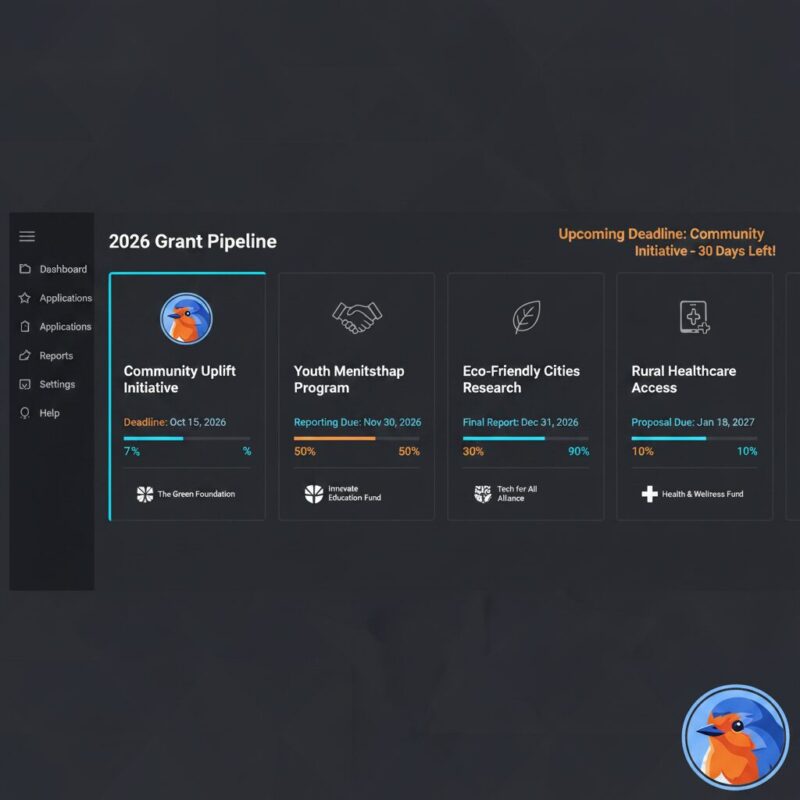
Tracking grants in isolated spreadsheets leads to missed deadlines and version control nightmares. You need a unified workspace for managing deadlines, application stages, and task assignments.
FundRobin provides workflow views for tracking grant opportunities and application progress. This unified workspace eliminates the isolated spreadsheet problem, keeping time-sensitive tasks visible across the entire organisation. When everyone looks at the same pipeline, accountability increases naturally.
AI-Integrated Grant Writing: The Human-in-the-Loop Protocol
Artificial intelligence has fundamentally altered grant writing, but unregulated adoption invites catastrophic risk. For federal grants, generic AI usage is a legal liability. Safe adoption requires the Human-in-the-Loop protocol.
The Legal and Compliance Risks of Unregulated AI in Grant Writing
Submitting false information to the federal government carries severe civil and criminal penalties under the False Claims Act. If an ungoverned AI chatbot hallucinates a statistic about your community impact, and you submit that in a federal proposal, you are legally liable for fraud.
“Black box” consumer LLMs are entirely insufficient for rigorous nonprofit compliance. They ingest your proprietary data, train their models on it, and frequently invent facts to fill narrative gaps.
Building an Organisation Brain for Reusable Facts
To use AI safely, you must govern the data it consumes. The solution is building an Organisation Brain—a reviewed knowledge base that turns evidence into reusable factual context.
The Organisation Library serves as the human workspace for this process, holding reusable organisation knowledge and supporting material. By structuring your historical data, impact reports, and previous proposals here, you create a closed ecosystem of verified truth.
Grounded AI: Working from Source Evidence and Funder Context
Grounded AI drastically reduces compliance risk by restricting the artificial intelligence to authorized knowledge. Robin, a contextual grant assistant, works only with authorized opportunity and organisation context.
The system retains source, currentness, and provenance information, meaning your AI assistant pulls only from reviewed organisational truth rather than hallucinating answers from the open web. However, the preview, refine, and approve pattern is non-negotiable: human-in-the-loop review is mandatory before finalizing any federal drafts.

Reusing Approved Content: The 55% Advantage
When a team safely reuses governed content, the speed advantages are staggering. In the September 2026 case-study cohort, a median of 55% of the narrative sections in a new application traced back to previously approved organisational content, with the remainder written fresh for the funder’s specific questions.
Maintaining a Knowledge Graph—a visual relationship view over the existing Organisation Brain—ensures this reused 55% remains contextually accurate. It allows grant writers to explore deterministic connections between their organisation’s evidence and the application context, drastically reducing drafting time while maintaining total compliance.
Tracking Success and Post-Award Readiness
Winning a federal grant is only step one. Surviving the reporting and execution phase is where nonprofits actually scale. Without infrastructure, a massive federal award becomes an administrative nightmare.
Unifying Pre-Award and Post-Award Reporting Truths
The danger of keeping award details in isolated, separate documents becomes obvious during the first reporting cycle. The promises made in the proposal must align perfectly with the post-award execution.
In FundRobin’s September 2026 programme, teams that recorded award obligations, reporting dates, and evidence sources alongside the original proposal spent a median of 3.5 hours less per reporting cycle reconstructing what had been promised. Unifying these truths saves critical administrative hours.
Structuring Your Internal Organisation Library
Your internal systems must distinguish current, reviewed knowledge from historical or lower-trust information. An effective Organisation Library preserves governance context, noting exactly who approved a specific programmatic fact and when.
This structure protects against staff turnover. When a grant manager leaves, the institutional knowledge regarding a specific EPA or NEA grant remains securely governed in the library, ready for the next reporting cycle.
Navigating Award Obligations Confidently
Federal grant deadlines are unforgiving. Across 2026, nonprofits must prepare for strict quarterly financial reporting (SF-425) and annual programmatic updates.
Using pipeline calendar features keeps time-sensitive reporting visible to the board and executive management. Proactive scheduling ensures your finance and program teams collaborate weeks before a federal deadline, rather than scrambling days prior.
Final Steps: Staying Audit-Ready Year-Round
The Resilient Compliance mindset requires continuous, grounded preparation. Staying audit-ready year-round means treating every piece of data, every narrative claim, and every hour tracked as if the auditors are arriving tomorrow.
By adopting modern, human-in-the-loop workflows and establishing an Organisation Brain, nonprofits can confidently navigate the 2026 funding cliff. Secure your operations, govern your knowledge, and transform federal compliance from a vulnerability into your greatest asset.
Frequently Asked Questions
Which federal agencies provide the most grants for nonprofits?
The Department of Health and Human Services (HHS), the National Endowment for the Arts (NEA), and the Environmental Protection Agency (EPA) provide significant, accessible grant volume for small-to-mid-sized 501(c)(3)s. According to the US Department of Health and Human Services (HHS) Grants portal, HHS leads federal agencies in total award volume, primarily funding community health and human services. The NEA focuses on cultural enrichment, while the EPA provides crucial funding for community resilience and environmental justice initiatives applicable to many community development nonprofits.
What is the ‘Challenge America’ grant for arts nonprofits?
The Challenge America grant is an NEA program offering a simplified application process specifically designed for small and mid-sized arts organisations. According to the National Endowment for the Arts: Challenge America Guidelines, this grant funds projects that extend the reach of the arts to underserved populations, including those whose opportunities to experience the arts are limited by geography, ethnicity, or disability. It requires a $10,000 minimum matching requirement and acts as an excellent entry point for nonprofits seeking their first federal arts award.
How do I find federal funding opportunities on Grants.gov?
Find federal funding on Grants.gov by using the “Search Grants” tab and heavily applying advanced filters for eligibility, agency, and category. According to Grants.gov (Learn Grants), start by checking the “Nonprofits having a 501(c)(3) status” box to instantly eliminate ineligible opportunities. Next, filter by specific agencies aligned with your mission, and review the “Synopsis” section of the Notice of Funding Opportunity (NOFO) before downloading the full application package, ensuring you only shortlist highly aligned grants.
How can nonprofits use AI for grant writing without risking compliance?
Nonprofits can use AI safely by adopting the Human-in-the-Loop protocol and using grounded AI that only pulls from a governed Organisation Brain. Submitting hallucinated data generated by generic consumer AI chatbots violates the False Claims Act and invites severe federal penalties. By keeping AI strictly confined to reviewed organisational knowledge and source evidence, and mandating that humans review, refine, and approve every draft, nonprofits accelerate their writing process while maintaining total federal compliance.
What are the new compliance requirements for federal grants in 2026?
The 2026 federal compliance requirements demand stringent expenditure traceability, rigorous tracking of pass-through subawards, and exact alignment between proposal narratives and actual execution. Under the OMB 2026 Compliance Supplement, auditors are aggressively scrutinizing time-tracking and cost segregation. Nonprofits must maintain robust internal controls and source provenance to prove that every federal dollar spent directly correlates to an allowable activity explicitly approved in their original grant agreement.
How to prepare for the 2026 federal funding cliff?
Prepare for the 2026 federal funding cliff by adopting a Resilient Compliance framework, diversifying your capital stack, and pivoting away from reactive grant-chasing. With the end of flexible pandemic-era discretionary spending, nonprofits must rely on strategic mission alignment and rigorous qualification workflows. Organisations must implement centralized grant pipelines and opportunity matching tools to ensure they only expend resources pursuing baseline federal funding that perfectly matches their core capabilities.
What is the role of trust-based philanthropy in the current funding climate?
Trust-based philanthropy focuses on reducing administrative burdens by providing unrestricted funding and flexible reporting requirements to nonprofits. While the Council on Foundations: Trust-Based Philanthropy Project shows this model growing among private foundations, nonprofits must still maintain rigorous federal-level knowledge governance internally. By sustaining strict internal tracking and an Organisation Library, a nonprofit easily satisfies federal audit requirements while simultaneously having clear, compelling data readily available for their trust-based foundation partners.
Key Takeaways:
- The “Resilient Compliance” framework is essential for surviving the 2026 funding cliff, requiring nonprofits to pivot from reactive grant-chasing to proactive strategic sustainability.
- Audit-proofing your organisation requires rigorous tracking; organisations tracking evidence alongside proposals save a median of 3.5 hours per reporting cycle.
- Generic AI chatbots pose massive compliance risks; safe adoption requires a “human-in-the-loop” approach grounded in a reviewed Organisation Brain.
- Success requires efficient discovery: a 1-in-28 submission-to-screening ratio is standard, meaning Smart Matching and structured shortlisting are vital to prevent burnout.
- Reusing approved organisational knowledge drastically speeds up drafting; high-performing teams trace up to 55% of new application narratives back to previously approved content.
Conclusion
The 2026 federal funding landscape requires far more than good intentions; it demands rigorous operational infrastructure. The nonprofits that thrive in this constrained environment are those that reject chaotic grant-chasing and embrace Resilient Compliance. By centralizing your pipeline, governing your knowledge through an Organisation Brain, and adopting human-in-the-loop AI protocols, you protect your organisation from audit risks while dramatically accelerating your proposal output. Federal compliance does not have to be a threat to your mission. With the right systems in place, it becomes the foundation of your long-term scale.
