
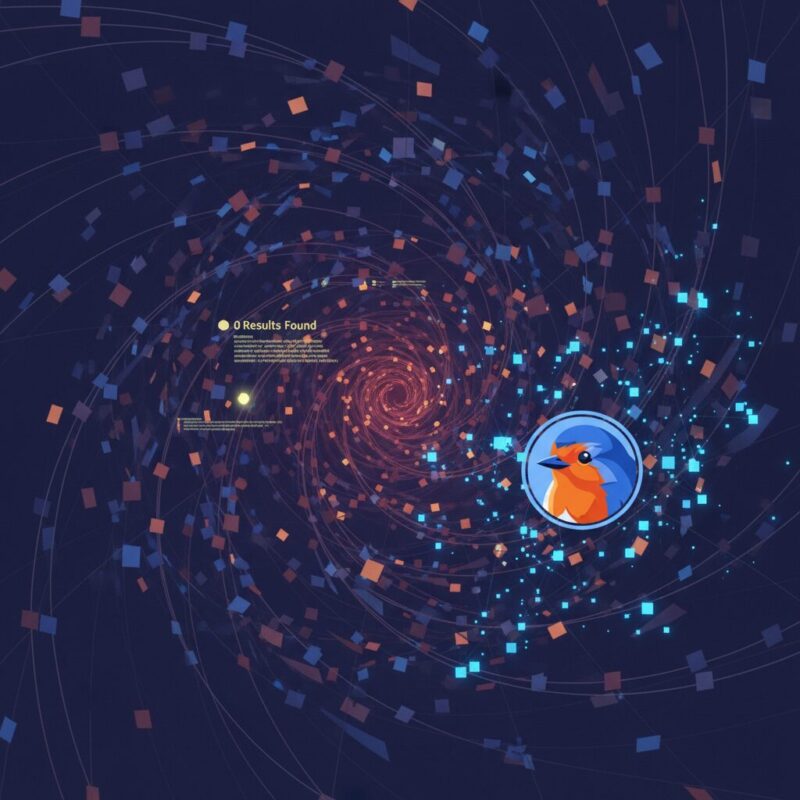
Every development director knows the sinking feeling of the “zero results” page. You type “youth mentorship” into your grant database, and the screen goes blank. You assume the funding isn’t there, or perhaps that your mission isn’t “fundable” in the current economic climate.
But what if the money exists, and you just can’t see it?
As of May 2025, the nonprofit sector is facing a crisis not of scarcity, but of visibility. Research indicates that development teams are leaving approximately 30% of available funding on the table—not because they aren’t qualified, but because the search tools they rely on are technically incapable of connecting the dots.
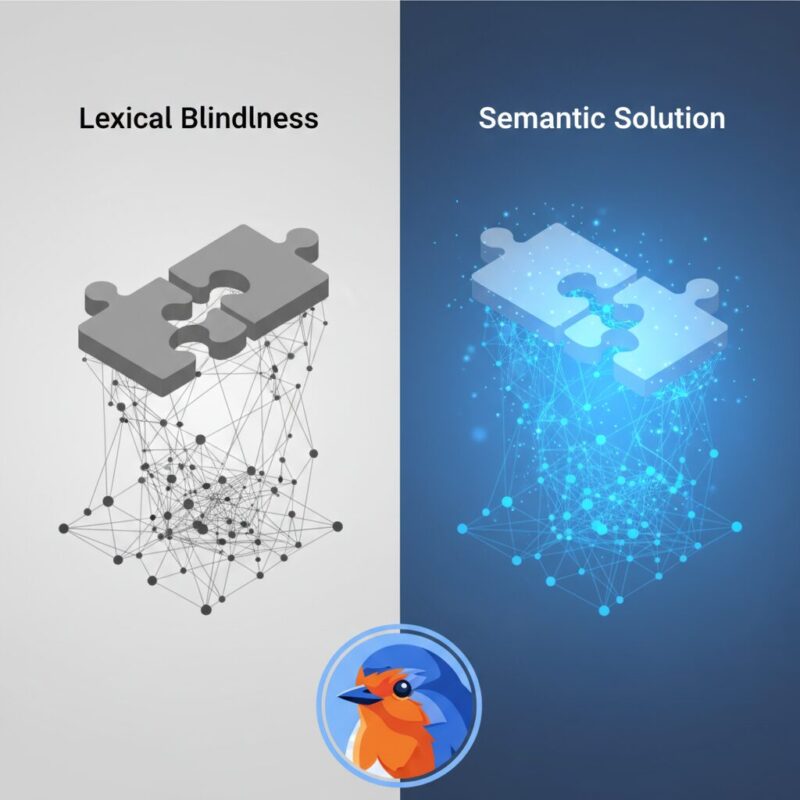
This phenomenon is called Lexical Blindness. It is a structural failure of traditional keyword search engines that requires an exact text match to find an opportunity. If you say “at-risk youth” and a funder says “disadvantaged adolescents,” a standard database sees no connection. It returns zero results, and you move on, unaware that you just walked past a perfect fit.
This article isn’t a list of grant writing tips. It is a strategic analysis of the technical barrier that is likely costing your organization thousands in lost revenue, and how shifting from keyword search to semantic AI can recover that “invisible money.”
Anatomy of a Missed Opportunity: What Is Lexical Blindness?
Lexical blindness is the invisible wall between your mission’s description and a funder’s criteria. At its core, it is a failure of metadata. Traditional databases operate on Boolean logic—rigid rules that look for specific strings of text. They function like a strict librarian who refuses to show you a book on “automobiles” because you asked for “cars.”
For complex social missions, this rigidity is catastrophic. A nonprofit might search for “food security initiatives,” while a major family foundation lists their grants under “hunger alleviation programs.” To a human, these are identical concepts. To a Boolean database, they are strangers.
The technical root of this problem lies in inconsistent metadata standards. According to the Crossref Blog, the lack of persistent identifiers and standardized terminology in grant funding metadata creates significant gaps in discoverability. When funders use proprietary or regional terminology without standardized taxonomy, the burden shifts entirely to the searcher to guess the “magic word.”
This creates a psychological toll that goes beyond missed revenue. When a search returns nothing, the user rarely blames the algorithm. They blame themselves or their mission. They internalize the “No Results Found” message as market feedback that their work is undervalued. However, analysis from UKSG Insights suggests that these failures are often issues of metadata friction, not a lack of available resources. The opportunities are there; they are simply obscured by a language barrier you didn’t know existed.
The Invisible Tax: Quantifying the Cost of Lexical Blindness
The cost of this technical failure is not abstract—it is a quantifiable tax on your organization’s resources. We estimate that reliance on rigid keyword search costs the average mid-sized nonprofit between 10 to 15 hours of productivity every single week.
This time is spent in manual “sifting”—the exhausting process of running dozens of keyword variations (“youth,” “teens,” “adolescents,” “juveniles”) and physically reading through hundreds of irrelevant results to find one decent prospect. This is the “burnout tax.” It transforms high-level strategists into data entry clerks.
Financially, the stakes are even higher. According to the Urban Institute, nonprofits face significant financial risk when they cannot access or identify government grants they are eligible for. The “invisible money” lost to lexical blindness contributes to the fragility of the sector, leaving organizations dependent on a shrinking pool of known funders while ignoring a vast ocean of new ones.
Furthermore, this inefficiency hurts the funders themselves. Because nonprofits are forced to guess at keywords, they often resort to a “spray and pray” approach, submitting applications that are tangentially related to a funder’s goals. GrantWatch notes that most nonprofits miss out on easy money simply because they don’t know it exists, leading to a cycle where funders are overwhelmed by bad-fit proposals while their best-fit grantees never apply.
To break this cycle, organizations need to move beyond simple keyword matching and adopt a more rigorous approach to identifying fit. This is what we call the Science of Selection, a methodology that prioritizes the quality of the match over the volume of applications. But you cannot select what you cannot see.
The Semantic Solution: From ‘Key-Words’ to ‘Key-Intent’
The cure for lexical blindness is Semantic AI. Unlike traditional databases that match text strings, semantic search engines use technology called “vector embeddings” to understand the meaning and intent behind your words.
Imagine a map of the universe where concepts are stars. In a vector database, “food security,” “hunger relief,” and “nutritional support” are all clustered together in the same galaxy because they share the same semantic meaning. When you search for one, the AI automatically identifies the others, even if the words share no common letters.
This shift from “key-words” to “key-intent” fundamentally changes the grant discovery process. FundRobin’s Smart Grant Matching technology acts as a translation layer. It reads the “soul” of your mission statement—analyzing the context, the demographics, and the desired outcomes—and matches it against the intent of millions of grant opportunities.
This allows for:
- Global Reach: It bridges regional terminology gaps (e.g., a UK funder saying “employability” vs. a US nonprofit saying “workforce development”).
- Proactive Discovery: Instead of you hunting for grants, the system builds a pipeline that updates itself.
- Context Awareness: It understands that a grant for “inner-city sports” might be a perfect fit for a “youth violence prevention” program, a connection a keyword search would miss entirely.
By adopting this AI Funding Playbook, development directors can stop searching and start strategizing. The goal is to move from a reactive posture—scrambling to find open RFPs—to a proactive one, incorporating strategic AI implementation where technology surfaces high-probability matches automatically.
Frequently Asked Questions
What is lexical blindness in grant seeking?
Lexical blindness is the failure of traditional keyword search tools to identify relevant funding opportunities due to terminology mismatches. If a nonprofit uses different jargon than a funder (e.g., “mentorship” vs. “youth guidance”), rigid database filters will exclude the grant, resulting in missed funding and “zero result” dead ends.
How does semantic search differ from keyword search for nonprofits?
Keyword search relies on exact text matches (Boolean logic), finding only the specific words you type. Semantic AI, using vector embeddings, understands context, synonyms, and intent, allowing it to connect related concepts (like “housing” and “shelter”) even if the words don’t match.
How much potential funding are nonprofits missing due to poor search tools?
Nonprofits miss an estimated 30% of available funding due to search inefficiencies and metadata gaps. This “invisible money” remains unclaimed simply because rigid search tools cannot bridge the linguistic gap between funder and applicant.
How does FundRobin use AI to fix grant discovery?
FundRobin’s Smart Grant Matching uses Natural Language Processing (NLP) to analyze the full context of a nonprofit’s mission rather than just keywords. It identifies patterns and semantic relationships, surfacing high-fit opportunities that traditional databases would filter out.
Can AI grant tools really save time for development directors?
Yes, AI-driven tools can save development directors 10-15 hours per week by eliminating manual database sifting. For small nonprofits, automating the relevance filtering process allows professionals to focus on relationship building and proposal writing rather than data entry.
Key Takeaways:
- Lexical Blindness occurs when rigid keyword searches fail to match donor terminology, effectively hiding 30% of available funding.
- Manual database sifting costs nonprofits 10-15 hours per week in lost productivity, contributing to widespread development director burnout.
- Semantic AI replaces “exact matching” with “intent understanding,” using vector embeddings to find grants based on mission context rather than specific words.
- FundRobin’s Smart Grant Matching creates a self-healing pipeline, turning grant discovery from a manual hunt into an automated, high-probability feed.
Conclusion
The funding crisis many nonprofits face is often not a lack of capital in the market, but a lack of visibility. Lexical blindness creates a false scarcity, convincing capable leaders that no help is coming simply because they didn’t guess the right password.
By recognizing this technical limitation and upgrading to semantic search tools, you do more than just find new grants. You reclaim the 15 hours a week previously lost to the “search tax.” You move from a mindset of scarcity to one of abundance, armed with the confidence that you are seeing the full picture, not just the slice that matches your keywords. The money is there. You just need the right lens to see it.

Leave a Reply