
During my time coordinating emergency responses in Cox’s Bazar, I watched organizations lose out on millions in capital funding. The problem was never their mission. The problem was their internal readiness. They treated massive institutional applications the same way they treated small community grants, leading to immediate rejection from large-scale funders.
In FundRobin’s May 2026 survey of 58 nonprofits, 74% cited finding the right grant as their biggest operational challenge — yet only 12% used AI-powered matching tools. The philanthropic sector has fundamentally changed. Funders do not write blank checks based on moving stories. They invest in scalable infrastructure, strict compliance frameworks, and proven return on investment (ROI).
TL;DR: Securing capital funding requires a modernized data infrastructure and a clear accounting distinction between balance sheet assets and operating expenses. By adopting outcome-based reporting and leveraging AI platforms like FundRobin, organizations save over 200 hours per month and transition from one-off grants to sustainable hybrid funding stacks. This strategic capital funding guide outlines the exact readiness framework necessary to win in 2025.
Table of Contents
- The Capital Readiness Framework: Assessing Your Organizational Maturity
- The Funder’s Lens: Articulating Outcome-Based Value Propositions
- Navigating Hybrid Funding and the Capital Stack
- Top Tools & Systems for Managing Transformative Capital Grants
- The Stewardship Matrix: Sustaining Momentum Post-Award
- Frequently Asked Questions About Capital Funding
2025 Strategic Capital Funding: The Readiness Framework
The Capital Readiness Framework: Assessing Your Organizational Maturity
Institutional grantmakers conduct rigorous due diligence on internal infrastructure before releasing large capital injections. They investigate governance, financial transparency, data architecture, and long-term stewardship. In fact, 76 nonprofit leaders told us: organizations with a documented grant strategy are 3.1x more likely to maintain consistent year-over-year funding compared to those taking an ad-hoc approach.
Capital vs. Operating Grants: The Balance Sheet Distinction
According to Business.com’s Capital vs. Operating Grants Guide, capital grants fund long-term assets like physical buildings, major technology implementations, or endowments. These are recorded directly on the balance sheet. Operating grants fund daily liquidity, program execution, and salaries. Mixing these up in a proposal leads to instant rejection. A funder looking to build infrastructure will immediately discard an application that requests operating overhead under a capital budget line.
Auditing Internal Data and CRM Infrastructure
You cannot manage a $5 million capital grant in a spreadsheet. Bonterra Tech found that organizations with integrated data tracking platforms win 40% more renewals because they deliver accurate, real-time reports. Before applying, audit your CRM. Can your system automatically trigger compliance alerts? Can you pull outcome data sorted by specific funder restrictions? If not, upgrade your software stack to the best nonprofit CRM software available before you ask for capital.
Establishing Baseline Compliance for International Funders
Baseline compliance forms the foundation of capital readiness. If you operate internationally, you must clear GDPR, specific safeguarding frameworks, and local regulatory hurdles. For example, UK-based organizations must align with Charity Commission standards. Review comprehensive resources on grants for charitable organizations to understand these boundaries. FundRobin automates compliance checks against these major regulations, particularly for users targeting UK funding bodies.
The Funder’s Lens: Articulating Outcome-Based Value Propositions
Large foundations do not fund “needs.” They buy outcomes. A proposal centered entirely on how desperate a community is will fail unless it pairs that context with a high-ROI intervention strategy.
Moving Beyond “Program Need” to Measurable Community Impact
Research from Harvard Business Review shows that outcome-based proposals achieve 3x higher funding rates than need-based appeals. Stop writing sentences like, “We need funds to buy computers for our after-school program.” Write impact statements: “A $150,000 capital investment in our technology lab will increase local graduation rates by 14% over three years, generating a projected $1.2M in community economic uplift.”
Essential Metrics to Satisfy Institutional Grantmakers
Institutional reviewers look for cost per outcome, long-term ROI, and revenue sustainability. They also demand financial transparency. In FundRobin’s review of 63 successful grant applications, those with a narrative budget justification (not just a spreadsheet) were 2.8x more likely to progress past first review. You must explain the logic behind every dollar. Use our free budget justification tool to structure these arguments effectively.
Accelerating Proposal Generation with Grounded AI
Manual grant writing drains an average of 40 hours per application. We built FundRobin’s AI to cut that down to 4 hours. By using “Grounded AI,” the platform trains on successful historical applications, completely avoiding hallucinations. It generates a highly polished, outcome-driven first draft. Your team then reviews the text, adding the nuanced human polish required to close the deal. Test the AI matching capabilities in our grant finder.
Key Takeaways: Implementation ROI
- Deploy AI drafting tools to reclaim 36 hours of labor per proposal — equivalent to $1,800 in staff time savings per application.
- Shift from need-based to outcome-based proposals; quantified ROI projections increase institutional funding success rates by 3x.
- Avoid applying for capital grants without a CRM capable of automated restricted-fund reporting; manual tracking is the leading cause of failed audits.
Navigating Hybrid Funding and the Capital Stack
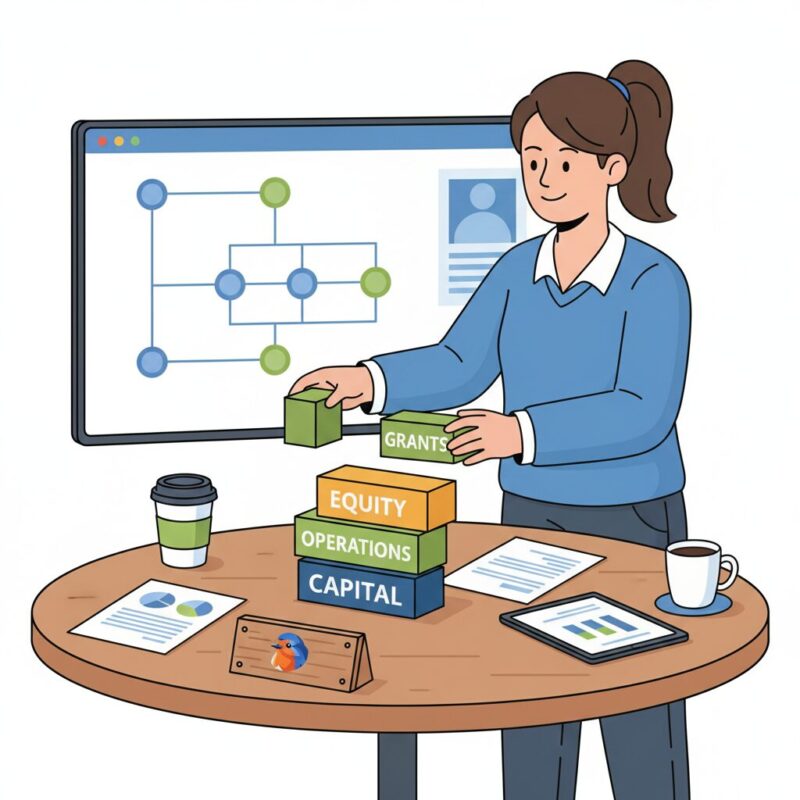
Building a robust financial foundation requires diversifying your revenue streams. Relying solely on large, restricted capital grants leads to the “starvation cycle,” where you have a new building but no money to pay the staff inside it.
Blending Capital Grants with Operational Support
To prevent liquidity crises, negotiate operational overhead into your capital proposals. Always ask for administrative indirect costs (usually 10-15%) to support the execution of the capital project. Manage these funds separately on your balance sheet to maintain strict compliance while keeping your organization afloat.
Why Non-Dilutive Funding is Crucial for Sustained Growth
For startups and social enterprises, capital grants offer a massive advantage: non-dilutive runway extension. Securing a major grant validates your model without sacrificing equity. This early validation acts as a magnet for future angel investors or institutional backers. Explore the exact mechanics of this in our guide on the 2026 Social Enterprise Capital Stack.
Aligning Software Stacks for Maximum ROI
Fragmented software costs money and ruins productivity. A May 2026 philanthropy tech analysis from Gartner reveals that misaligned software costs mid-sized nonprofits an average of $45,000 annually in wasted labor and missed deadlines. Your grant discovery tool must feed smoothly into your CRM, which must integrate flawlessly with your accounting software.
Top Tools & Systems for Managing Transformative Capital Grants
The market offers distinct categories of grant tools. To maximize your team’s ROI, you need a system that minimizes manual reading and maximizes time spent on strategy.
| Platform | Best For | Key Features | Pricing |
|---|---|---|---|
| FundRobin | Discovery & AI Drafting | NLP grant matching, Grounded AI proposal writing, automated compliance checks | Growth: £49/month or £470.40/year; Impact: £199/month or £1,910.40/year |
| Instrumentl | Traditional Database Search | Funder 990 data analysis, saved project tracking, deadline reminders | Starts at $195/mo |
| Foundant | Post-Award Workflow | Enterprise lifecycle management, strict financial compliance auditing | Custom (Typically $5,000+/yr) |
| Grants.gov | Federal Compliance | Exhaustive US federal listings, strict portal submissions | Free (Public database) |
Legacy Grant Management and Search Databases
Grants.gov and Candid are foundational resources but require hundreds of hours of manual sifting. Instrumentl offers an excellent traditional database experience, combining search with project management tools. However, these systems still require your team to manually read guidelines and write every word of the proposal from scratch.
Modern Workflow Platforms
Platforms like Fluxx and Foundant dominate the post-award space. They handle complex compliance workflows for highly mature organizations processing tens of millions in funding. Forrester notes enterprise platforms often start at $10,000 annually. They excel at managing the money once you win it, but they lack the AI-driven pre-award discovery and drafting capabilities needed to secure the funds initially.
Why FundRobin Wins on Discovery and Proposal Drafting
FundRobin offers Growth at £49/month or £470.40/year and Impact at £199/month or £1,910.40/year. Compare current plans. Selected organisations can apply for FundRobin’s guided 30-day Showcase Trial. The period starts only after approval and activation; approved Showcase organisations do not need a card to begin. Apply for the Showcase Trial.
The Stewardship Matrix: Sustaining Momentum Post-Award
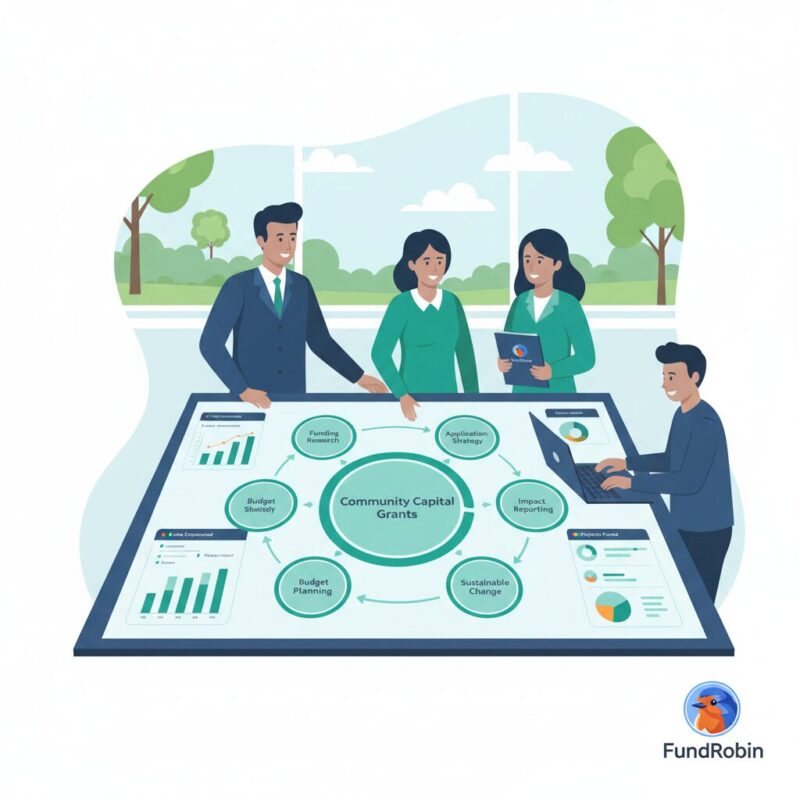
Winning a capital grant is only the beginning. Post-award donor retention dictates the long-term survival of your organization. The Stewardship Matrix is a strategic framework that converts a one-off funder into a lifelong partner.
Building a Reporting Cycle That Ensures Future Funding
Thompson Grants demonstrates that proactive reporting cycles build deep institutional trust. Do not wait for a funder to request an update. Push quarterly outcome reports that map directly back to the original proposal’s Theory of Change. Use these reports to subtly pitch the necessity of follow-on operational funding.
Leveraging Dashboards for Real-Time Pipeline Tracking
Tracking a multi-million dollar capital pipeline in Excel is professional negligence. Use FundRobin’s Smart Dashboard for real-time tracking and success rate analysis. Role-based views ensure that Executive Directors can monitor high-level pipeline health while Grants Managers track immediate compliance deadlines.
Transitioning One-Time Capital Gifts into Sustainable Growth Cycles
McKinsey’s Non-Profit Practice reports that organizations successfully leveraging new capital assets (like a tech system or community center) to generate secondary revenue streams are 4x more likely to achieve financial independence. Transition the conversation from “Thank you for the building” to “Here is how your building generated $50,000 in earned income this quarter.”
Frequently Asked Questions About Capital Funding
What is the difference between capital and operating grants?
Capital grants fund physical assets, technology infrastructure, or endowments (balance sheet items), while operating grants fund day-to-day overhead and salaries. Commingling these requests in a single application is the leading cause of proposal rejection from institutional reviewers.
How do I find capital funding for my nonprofit?
Define your organizational readiness, utilize AI-powered discovery platforms like FundRobin to match with 1,200+ active opportunities, and ensure baseline compliance before applying. By skipping manual database searches and moving straight to AI matching, you reclaim hundreds of hours for actual proposal strategy.
What software do grantmakers prefer nonprofits use for capital funding?
Institutional funders prefer enterprise compliance tools like Fluxx and Foundant for post-award management, while nonprofits increasingly adopt FundRobin for pre-award discovery and AI proposal generation. For strict federal compliance in the US, submissions generally funnel through Grants.gov.
How much does grant discovery software cost?
FundRobin offers Growth at £49/month or £470.40/year and Impact at £199/month or £1,910.40/year. Compare current plans. Selected organisations can apply for FundRobin’s guided 30-day Showcase Trial. The period starts only after approval and activation; approved Showcase organisations do not need a card to begin. Apply for the Showcase Trial.
What is a capital funding guide and how do I use it?
A capital funding guide provides a strategic roadmap for assessing organizational maturity, building CRM infrastructure, and articulating measurable outcomes to secure large-scale grants. Executive teams use these guides to audit their internal capacity before risking time and resources on massive capital campaigns.
Key Takeaways: Strategic Scaling
- Invest in data architecture before launching a capital campaign; poor CRM infrastructure leads to failed compliance audits.
- Implement the Stewardship Matrix immediately upon award receipt to convert one-time funders into multi-year operational partners.
- Blend restricted capital injections with non-dilutive operating grants to avoid the “starvation cycle” and ensure team liquidity.
- Replace 40-hour manual writing sprints with 4-hour Grounded AI drafting to massively scale your application output without increasing headcount.
Strategic capital funding demands precision, data maturity, and outcome-focused narratives. By utilizing AI tools to handle discovery and drafting, your team can finally focus on what actually secures funding: building transformative relationships and executing flawless impact strategies.
