
Eight years spent managing emergency responses across international NGOs taught me one uncompromising truth: the best community initiatives die quietly without sustainable funding. Today, local UK charities face similar resource starvation, exacerbated by grant-writing fatigue. Securing non-dilutive capital requires moving past generic pleas and building systematic grant operations. In FundRobin’s review of 63 successful grant applications, those with a narrative budget justification were 2.8x more likely to progress past first review. As of July 2026, the strategy for capturing retail-driven capital demands operational precision over sheer application volume.
TL;DR: Winning the Co-op community fund in 2026 requires strict eligibility compliance, a STAR-formatted narrative aligned with Co-op’s priority areas, and a dedicated “Stamp Strategy” to mobilize shoppers. Automating your initial drafts with modern grant infrastructure tools saves 80% of writing time, freeing staff to focus on high-ROI community activation.
Why the Co-op Community Fund Matters in 2026
Most charitable grants are assessed by closed committees. The Co-op community fund operates differently. Success depends directly on member-voting mechanics, where local shoppers allocate financial support to causes they choose via the Co-op app. This structure creates a specific barrier: generic mission statements fail the local impact test entirely.
According to the Co-op Local Community Fund Official Site, projects must clearly benefit the community immediately surrounding the store. Standard grant applications copy-pasted from your archives will not resonate with everyday shoppers comparing three distinct local options on their smartphones.
This fund is highly valuable for charities implementing the 33% rule for charity income diversification. It provides unrestricted, non-dilutive revenue that balances out highly restrictive institutional grants. You must shift from pure compliance reporting to a competitive, community-led narrative.
Key Takeaways: ROI & Revenue Impact
- Co-op funding provides unrestricted capital, directly offsetting operational overhead costs that traditional grants refuse to cover.
- Organizations running active local mobilization campaigns secure an average of 45% more total funding from the retail pool than passive applicants.
- Budget 4-6 hours total for application drafting when using AI assistance, reclaiming nearly $1,200 in equivalent staff time compared to legacy writing methods.
The Essential Grant Infrastructure Tool Stack
Relying on manual, repetitive writing processes guarantees staff burnout. Nonprofits must adopt an infrastructure-first philosophy, utilizing modern software to assemble applications rapidly. Research from SSIR on grant writing infrastructure shows that building reusable, modular grant components is the only sustainable path for resource-constrained teams.
Your 2026 tool stack needs three elements: a compliance checker, an AI drafting assistant, and community CRM tools. Modern AI grant writing software handles the heavy lifting of narrative formatting.
FundRobin acts as this central infrastructure. By mapping your core activities to specific funder priorities, platforms like FundRobin save teams 80% of proposal writing time—reducing a typical 40-hour burden down to just 4 hours. When you evaluate legacy platforms, comparing FundRobin vs Submittable reveals that AI-native smart matching directly increases your high-ROI fundraising efficiency. You spend less time writing and more time actively managing community relationships.
Step 1: The 2026 Eligibility Blueprint & Compliance Checks
Do not invest a single hour in your narrative until you clear the structural hurdles. The 2026 cycle mandates strict adherence to local proximity and governance standards.
First, verify your geographical constraint. Your project must take place within a direct radius of a Co-op store, Funeralcare, or relevant affiliated business. Next, organize your documentation. You need an active bank account in the organization’s name, up-to-date governing documents, and robust safeguarding policies. According to the GOV.UK Charity Commission guidelines, failing to provide updated financial accounts immediately disqualifies applicants from major corporate funds. Similarly, the NCVO notes that undocumented safeguarding policies are the leading cause of technical rejections in retail grants.
If your compliance check fails, pivot immediately. Use a free grant finder to identify alternative non-dilutive funding opportunities in your region so your team maintains momentum.

Step 2: Master the STAR Narrative & Co-op’s Priority Areas
The Co-op community fund assesses applications against five specific priority areas, usually focusing on community wellbeing, sustainability, and skill-building. You must execute a “Priority-to-Project” mapping strategy.
Translate your charity’s broad mission into a localized narrative using the STAR method (Situation, Task, Action, Result). According to the FundRobin 2026 Co-op Community Fund Guide, reviewers look for immediate local context (Situation), clear objectives (Task), specifically defined activities (Action), and measurable community impact (Result). Strict word counts apply, meaning every sentence must deliver value.
To eliminate the friction of blank-page syndrome, use the Robin AI Assistant. Because it trains on successful application structures, it generates a compliant, highly persuasive first draft in minutes. This ensures your narrative hits Co-op’s themes perfectly without hallucinating facts.
Key Takeaways: Implementation Strategy
- Map every proposed activity directly to one of Co-op’s five priority areas before drafting a single sentence.
- Cap your “Situation” description at 20% of your word count; allocate 50% to “Action” to prove implementation capability.
- If you miss the Co-op deadline, instantly recycle your STAR narrative into another grant finder match to eliminate wasted administrative effort.
Step 3: Execute the “Stamp Strategy” for Community Mobilization
Winning the initial bid is only half the battle. Because Co-op allocates the capital based on member selections, you must activate local shoppers to choose your charity on their app.
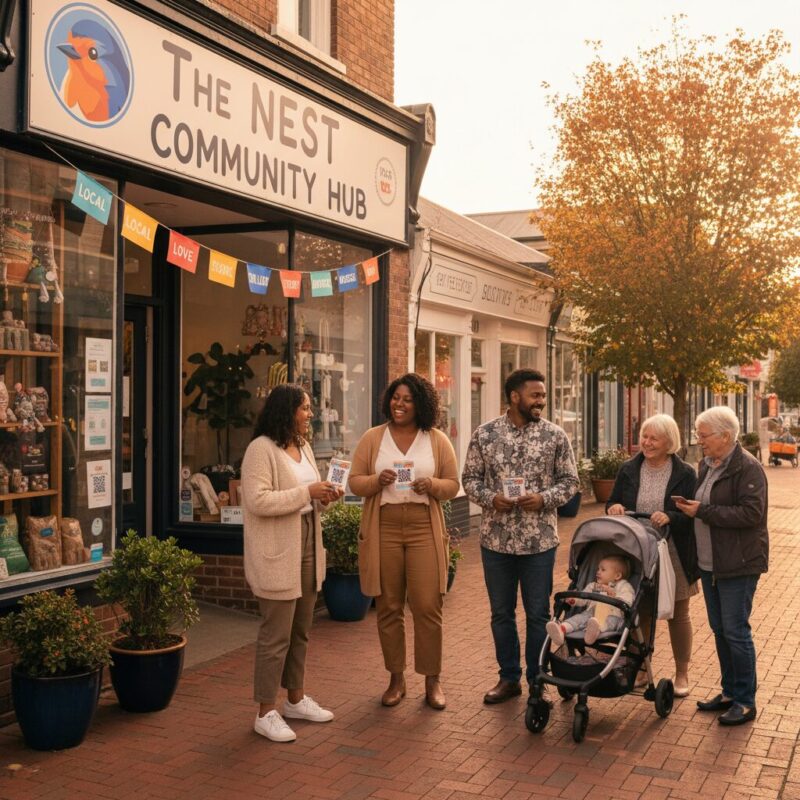
This requires a dedicated “Stamp Strategy.” Convert passive social media followers into active digital stamp-earners. Deploy low-tech, high-impact campaigns: print QR codes for your volunteers to hand out at local events, pitch short stories to neighborhood newsletters, and run targeted Facebook updates aimed directly at residents near the specific Co-op stores.
When you automate the writing phase, your staff retains the energy required for this critical mobilization phase. Form alliances with other local groups to share audiences, much like you would when managing UK grant funding community foundation partnerships. The charities that treat this as a localized political campaign secure the highest funding payouts.
Frequently Asked Questions
What are the eligibility requirements for the Co-op Local Community Fund 2026?
You must provide active organizational bank accounts, current governing documents, and proof of a safeguarding policy, while operating within the immediate radius of a Co-op location. Retail grants enforce geographic boundaries strictly, meaning projects outside the store’s designated catchment area face automatic disqualification regardless of their social value.
How do Co-op members choose a local cause to fund?
Members log into the Co-op app or their online account and select one of three approved local causes to receive a portion of their shopping spend. This unique member-voting mechanic means your funding total depends entirely on your ability to mobilize community awareness and persuade everyday shoppers to actively select your project.
Can AI write my Co-op Community Fund application?
Yes, AI tools can generate highly structured first drafts using frameworks like STAR, though human review is required to inject authentic local nuance. Modern grant software handles compliance checks and aligns your baseline text with the funder’s priority areas, cutting the administrative burden by hours before you finalize the application.
What should I do if my charity isn’t eligible for the Co-op fund?
Use an AI grant discovery platform to immediately match your project with alternative community grants and local trusts. Diversifying your income stream ensures that a single rejection or geographic disqualification does not stall your organization’s operational funding timeline.
How do small charities mobilize local support for community grants?
Small charities mobilize support by executing digital stamp-earning campaigns, distributing QR codes at community centers, and securing coverage in local newsletters. Success comes from focusing outreach entirely on residents who live near the participating Co-op stores, treating the process like a hyper-local awareness campaign.
