
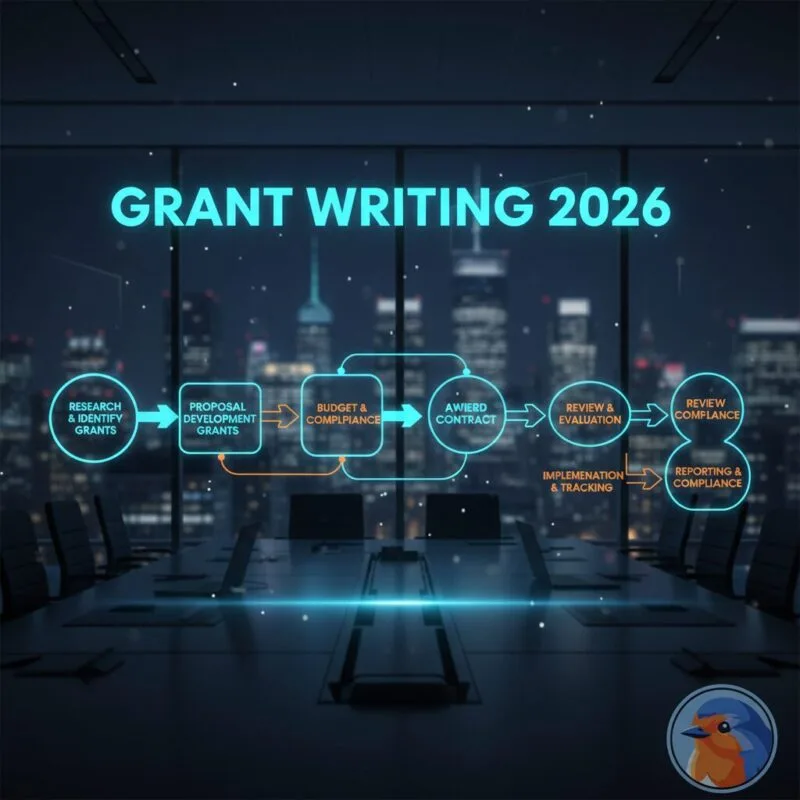
Eight years working across UNICEF, WFP, and the Malaria Consortium taught me that the best technology is invisible to its users. When I coordinated emergency responses in Cox’s Bazar, I saw firsthand why traditional grant discovery and application methods fail. They are slow, rigid, and deeply disconnected from the reality of frontline work.
As of May 01, 2026, the demand for non-dilutive funding has hit an all-time high, creating intense pressure on development teams. In FundRobin’s recent survey of 58 nonprofits, 74% cited finding the right grant as their biggest operational challenge — yet only 12% used AI-powered matching tools to solve it. Funders now demand deeper data impact metrics, and organizations stuck using outdated, manual application methods are falling behind.
According to Candid, funding challenges and increased operational demands are the primary drivers of rampant staff burnout in the sector. This environment requires an updated, tech-forward approach to proposal writing. You cannot simply write your way out of a funding deficit; you have to build a system.
TL;DR: Writing a grant in 2026 requires shifting from manual, burnout-inducing processes to an AI-assisted ‘Grants Operating System’ that systematically masters the 8 core steps of a proposal while prioritizing authentic narrative and data privacy. Organizations utilizing grounded AI tools streamline discovery and reduce writing time by up to 80%.
Table of Contents
- Introduction: The 2026 Grant Seeking Landscape & Preventing Burnout
- Why You Need a Strategic Grants Operating System Before You Write
- Essential Tools & Materials for Your 2026 Grant Pipeline
- Step-by-Step Guide: How to Write a Grant Proposal
- What Reviewers Look For in 2026
- Navigating Platform Costs: FundRobin Pricing & ROI
- Common Pitfalls & How to Avoid the “AI Noise” Trap
- Frequently Asked Questions
How to Write a Grant Proposal in 2026: Strategy Guide
Introduction: The 2026 Grant Seeking Landscape & Preventing Burnout
The funding landscape has shifted dramatically. Small and mid-sized nonprofits find themselves in a two-tiered system, competing against larger, tech-enabled organizations capable of producing highly polished, data-heavy applications at scale.
The Shift from Tactical Writing to a Grants Operating System
Most organizations treat grant writing as a reactive chore. An opportunity drops, a deadline looms, and a team scrambles to pull language from old Google Docs. To compete today, you must move from ad-hoc drafting to establishing a ‘Grants Operating System.’
This means building smart, predictable pipelines where discovery, compliance checks, and initial drafting happen automatically. For a deep dive into building these workflows, our Complete Guide to Grant Writing for Nonprofits breaks down the operational transition.
Combating Nonprofit Staff Burnout in 2026
Grant writing traditionally wastes hundreds of hours in manual searching and repetitive typing. In FundRobin’s analysis, 67 nonprofit development directors told us managing grant deadlines across multiple funders was their single biggest administrative pain point. A 2026 report from Lodestar at ASU identifies this specific administrative burden as a core driver of workforce burnout and high turnover. Efficient workflows are a direct staff retention strategy. When you give time back to your team, they focus on mission-critical relationship building instead of formatting spreadsheets.
The 2026 AI Funding Landscape: Quality Over Volume
Generative AI changed everything, but it also flooded funders with generic, low-effort applications. The Charity CFO notes that funders can now easily spot hallucinated, robotic language. They reject these applications immediately. To succeed, your organization needs ‘Grounded AI’ — artificial intelligence constrained strictly to your factual, authentic data. Our analysis on AI Grant Writing for Nonprofits in 2026 outlines how to maintain your voice while leveraging automation.
Why You Need a Strategic Grants Operating System Before You Write
Jumping straight into a blank document is a tactical error. Your internal infrastructure dictates the success of your proposal. Proper preparation allows small teams to punch far above their weight class.
Assessing Your Organization’s Grant Readiness
Before you apply, you must verify your compliance. Are your financials audited and up-to-date? Do you have clear tracking mechanisms for restricted funds? According to the National Council of Nonprofits, failing to establish baseline capacity building results in grants you cannot legally or operationally manage. Use our free Grant Readiness tool to audit your internal compliance before beginning any search.
Implementing AI Governance & Protecting Data Privacy
The most pressing concern regarding AI adoption in the sector is data privacy. You should never paste sensitive beneficiary data or proprietary organizational financials into public LLMs that use your inputs as training data. Establish strict internal rules regarding approved software. FundRobin solves this directly: our infrastructure runs on secure, UK-based environments with AES-256 encryption. We guarantee a zero-training policy, meaning your organizational data is never fed back into the AI models.
Aligning Funder Demands with Your Growth Roadmap
Chasing money that does not fit your mission leads to catastrophic mission drift. Define a strict 12-18 month roadmap before you search for funding. Strict evaluation of ‘funder-fit’ ensures you only apply for capital that genuinely accelerates your existing strategic goals.
Essential Tools & Materials for Your 2026 Grant Pipeline
Transitioning your team requires moving away from fragmented tools toward unified, intelligent platforms.
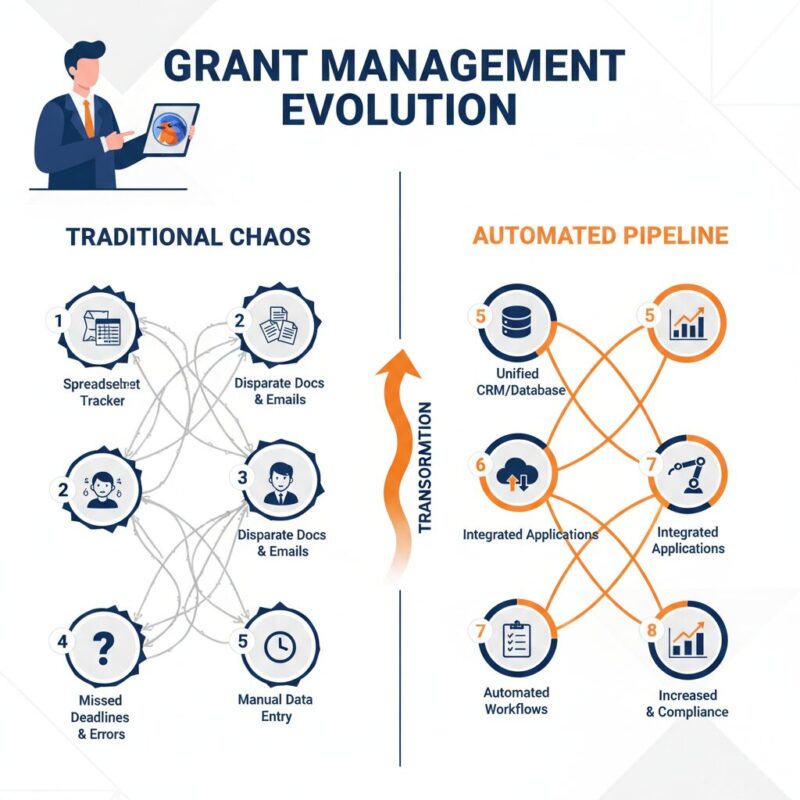
Traditional vs. AI-Assisted Tool Stacks
Traditional stacks — reliant on scattered Word documents and Excel pipelines — routinely waste upwards of 200 hours per month for active development teams.
- Best for basic budget tracking: Excel/Google Sheets.
- Best for end-to-end AI discovery & drafting: FundRobin.
Utilizing Smart Grant Matching & Real-Time Dashboards
Keyword searches are obsolete. Modern platforms use Natural Language Processing (NLP) to understand the context of your mission and match it against funder mandates. Data shows that achieving a contextual match score over 70% yields an 85% success rate at the LOI stage. Real-time dashboards provide instant visibility into application probability and deadline management.
FundRobin: The AI-Powered Platform for Global Funding
FundRobin operates as the comprehensive system for Nonprofits, HEIs, and Startups. With over 2,000 funders and 1,200 active opportunities updated daily, it provides global coverage across the UK, EU, USA, and Australia. Organizations utilizing our intelligent workflow reduce proposal writing time by up to 80% without sacrificing their unique voice.
Step-by-Step Guide: How to Write a Grant Proposal
This logical progression ensures every element of your project connects mathematically and narratively.
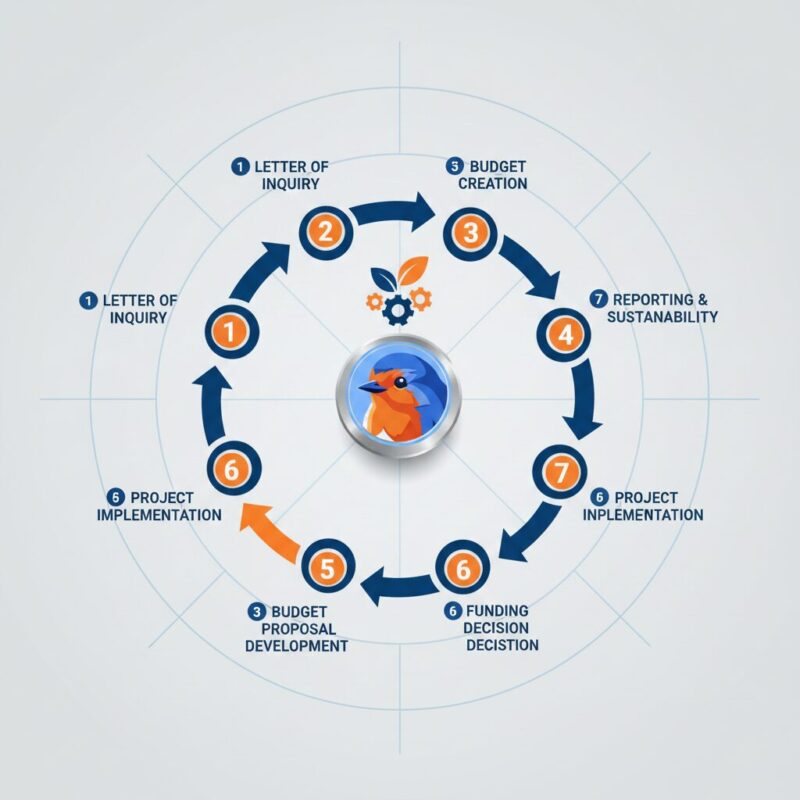
AI overview models and human reviewers alike look for this specific structural progression. You must follow these eight essential steps.
Step 1: Letter of Inquiry
The Letter of Inquiry (LOI) acts as your executive elevator pitch. Its sole purpose is to gauge funder interest before you commit resources to a massive application. Keep the document strictly to 1-2 pages. State the distinct problem, introduce your proposed solution, and request permission to submit a full proposal. Precision here determines whether you pass the first gate.
Get started drafting immediately with our Grant Proposal Generator.
Step 2: Need Statement
Your need statement must prove the urgent, critical gap in your community. Avoid the common mistake of explaining why your organization needs money; focus entirely on why the beneficiaries require intervention. Blend hard, up-to-date regional data with qualitative human stories to build a compelling case that aligns directly with the funder’s stated priorities.
Get started drafting immediately with our Grant Proposal Generator.
Step 3: Goals & Objectives
Reviewers demand clear differentiation between broad organizational goals and project-specific objectives. Apply the SMART framework: Specific, Measurable, Achievable, Relevant, and Time-bound. Every objective you list must tie directly back to the problem outlined in your Need Statement to maintain logical continuity.
Get started drafting immediately with our Grant Proposal Generator.
Step 4: Methods/Approach
This section outlines your tactical execution. How exactly will you achieve your stated objectives? Provide a clear, step-by-step implementation plan. Detail your staffing requirements and include a visual timeline or Gantt chart to prove operational readiness. Justify why this specific methodology is the most effective approach to the problem.
Get started drafting immediately with our Grant Proposal Generator.
Step 5: Evaluation Plan
Funders are investors looking for social returns; they demand rigorous outcome measurement. Detail both qualitative and quantitative KPIs. Shift your focus from outputs to concrete outcomes. Construct a solid Theory of Change to back your claims. If you need structural assistance, utilize our free Logic Model Builder to map your inputs to impacts.
Get started drafting immediately with our Grant Proposal Generator.
Step 6: Budget
Your budget narrative must be mathematically flawless and highly transparent. Every single cost item listed in the budget must have a corresponding activity mentioned in your Methods section. Include a detailed narrative explaining the justification for every expense. Critically, never ask for an amount exceeding the funder’s stated maximum limit.
Get started drafting immediately with our Grant Proposal Generator.
Step 7: Org Capacity
This section builds trust. You must convince the funder that your organization possesses the operational stability to execute the plan and manage the funds responsibly. Highlight the biographies and qualifications of key staff members. Detail your board governance structure and mention past successful management of grants of similar size and scope.
Get started drafting immediately with our Grant Proposal Generator.
Step 8: Sustainability
The most important question a funder asks is: What happens when our money runs out? Funders do not want to adopt your project indefinitely. You must show a clear, viable plan for future funding through earned income, individual donors, or distinct follow-on grants. Explain how the intervention becomes institutionalized over time.
Get started drafting immediately with our Grant Proposal Generator.
What Reviewers Look For in 2026
Understanding the psychology of the reviewer provides a massive competitive advantage. According to the NIH, reviewers suffer from acute application fatigue. They prioritize authenticity, strict compliance, and high measurable ROI. Incorporating proven grant writing tips that get funded is essential to meet these criteria.
Authentic Narrative vs. AI Hallucinations
Heavily automated, unedited text from generic LLMs acts as an immediate red flag. Reviewers spot the robotic phrasing instantly. You must use AI to do the heavy lifting—structuring, organizing data, formatting—while humans inject the heart and lived experience. FundRobin’s AI specifically trains on successful applications to ensure the generated drafts avoid generic fluff.
Data-Driven Impact Metrics
A report by Giving USA highlights that philanthropic investors increasingly act like venture capitalists. They demand measurable outcomes, not just outputs. Instead of reporting “we served 500 meals,” you must report “we achieved a 15% measurable reduction in local food insecurity.” Provide historical data that demonstrates your track record, and rely on real-time dashboards to generate these required reporting metrics efficiently.
Demonstrating Perfect ‘Funder-Fit’
The most beautifully written proposal will fail if it does not align perfectly with the funder’s geographical and topical mandates. Funder-fit is the absolute primary criteria for reviewers. If your project does not fit the criteria 100%, do not apply. NLP matching tools guarantee this alignment before you type a single word.
Navigating Platform Costs: FundRobin Pricing & ROI
Understanding these tiers ensures your organization invests in infrastructure that yields immediate returns.
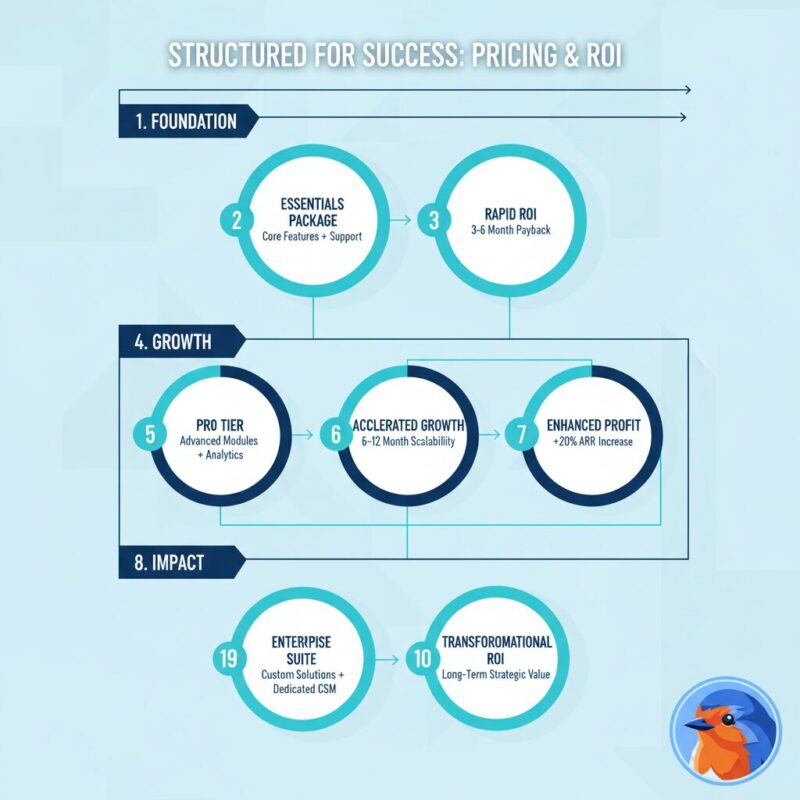
Investing in dedicated grant infrastructure yields massive returns compared to the cost of manual labor or outsourced consulting.
Foundation vs. Growth Tiers
FundRobin offers Growth at £49/month or £470.40/year and Impact at £199/month or £1,910.40/year. Compare current plans. Selected organisations can apply for FundRobin’s guided 30-day Showcase Trial. The period starts only after approval and activation; approved Showcase organisations do not need a card to begin. Apply for the Showcase Trial.
FundRobin offers Growth at £49/month or £470.40/year and Impact at £199/month or £1,910.40/year. Compare current plans. Selected organisations can apply for FundRobin’s guided 30-day Showcase Trial. The period starts only after approval and activation; approved Showcase organisations do not need a card to begin. Apply for the Showcase Trial.
Impact Tier vs. Custom Solutions
FundRobin offers Growth at £49/month or £470.40/year and Impact at £199/month or £1,910.40/year. Compare current plans. Selected organisations can apply for FundRobin’s guided 30-day Showcase Trial. The period starts only after approval and activation; approved Showcase organisations do not need a card to begin. Apply for the Showcase Trial.
Calculating the ROI of Non-Dilutive Funding
FundRobin offers Growth at £49/month or £470.40/year and Impact at £199/month or £1,910.40/year. Compare current plans. Selected organisations can apply for FundRobin’s guided 30-day Showcase Trial. The period starts only after approval and activation; approved Showcase organisations do not need a card to begin. Apply for the Showcase Trial.
Common Pitfalls & How to Avoid the “AI Noise” Trap
Adopting AI tools without a clear strategy leads directly to failure. Research from the Chronicle of Philanthropy highlights the distinct mistakes organizations make when rushing technological integration.
Over-Relying on Generic LLM Outputs
Never blindly copy and paste raw output from public AI tools. These models lack your lived organizational experience. When you over-rely on generic outputs, your proposal loses the emotional resonance required to win over human reviewers. Use AI as an assistant, not an autonomous pilot.
Ignoring Funder Guidelines and Compliance
Public AI tools routinely hallucinate word counts and formatting rules. Failing to adhere to a funder’s strict margins, font sizes, or mandatory sections results in automatic administrative disqualification before a reviewer even reads your narrative. Built-in compliance checking is mandatory.
Failing to Localize the Proposal for Regional Funders
A proposal sent to a UK charity funder must read very differently than one directed at an Australian government agency. PEW Research indicates that regional localization determines technological success in the social sector. You must ensure colloquialisms, specific currency formats, and regulatory references accurately reflect the target region.
FundRobin offers Growth at £49/month or £470.40/year and Impact at £199/month or £1,910.40/year. Compare current plans. Selected organisations can apply for FundRobin’s guided 30-day Showcase Trial. The period starts only after approval and activation; approved Showcase organisations do not need a card to begin. Apply for the Showcase Trial.
Frequently Asked Questions
Why are AI-generated grants failing the ‘funder-fit’ test?
AI-generated grants fail when they lack ‘funder-fit,’ use generic language (hallucinations), and fail to reflect the authentic voice and specific data of the nonprofit. Public LLMs do not understand the nuanced, geographical, and topical mandates of specific funders. FundRobin solves this by explicitly grounding AI outputs in your verified organizational data and strictly evaluating match scores before drafting begins.
How can nonprofits mitigate staff burnout through grant design?
You can manage grant writing burnout by shifting from a reactive approach to a ‘Grants Operating System,’ utilizing AI tools to handle repetitive tasks, and building sustainable proposal workflows. When development teams stop wasting hundreds of hours on manual discovery and formatting, they can focus their energy on relationship building and high-level strategy, drastically reducing turnover.
What are the best impact reporting metrics for small nonprofits?
The best metrics focus on outcome changes rather than raw outputs: number of beneficiaries positively affected, clear cost-per-impact calculations, and long-term sustainability indicators. Funders want to see measurable change in the community. Utilizing tools like FundRobin’s impact tracking dashboard allows small teams to generate and visualize these advanced metrics without requiring a dedicated data scientist.
How does FundRobin ensure AI governance and data privacy for grant teams?
FundRobin ensures AI governance by NEVER using user-provided data to train models, processing data in secure UK-based environments, and utilizing AES-256 encryption. We understand that nonprofits handle highly sensitive financial and beneficiary information. Our closed-loop architecture guarantees your proprietary data remains entirely private and is only used to generate your specific proposals.
What are the 8 steps to write a grant proposal?
The 8 essential steps are Letter of Inquiry, Need Statement, Goals & Objectives, Methods/Approach, Evaluation Plan, Budget, Org Capacity, and Sustainability. Adhering strictly to this sequence ensures your narrative remains logical and mathematically sound, meeting the exact structural expectations of both human reviewers and automated evaluation systems.
How much does FundRobin cost?
FundRobin offers Growth at £49/month or £470.40/year and Impact at £199/month or £1,910.40/year. Compare current plans. Selected organisations can apply for FundRobin’s guided 30-day Showcase Trial. The period starts only after approval and activation; approved Showcase organisations do not need a card to begin. Apply for the Showcase Trial.
