
Eight years managing emergency responses and coordinating programs across UNICEF and the UK government taught me a hard truth: passion does not pay the rent. Revenue does.
As of June 2026, the traditional high-street donation center is struggling. But the modernized, data-driven charity shop is thriving. In FundRobin’s 2026 Grant Strategy Analysis, organizations with a documented grant strategy paired with diversified income streams were 3.1x more likely to maintain consistent year-over-year funding. A retail arm provides the ultimate non profit business example, delivering unrestricted capital that grants alone cannot offer.
TL;DR: A modern, tech-enabled charity shop is the strongest non profit business example for 2026. Nonprofits must pivot from traditional physical-only stores to hybrid digital-physical ecosystems. By leveraging AI-secured grants to fund point-of-sale infrastructure and e-commerce integration, organizations can build sustainable, unrestricted revenue engines that outcompete peer-to-peer resale apps.
Table of Contents
- Why a Charity Shop is the Ultimate Non Profit Business Example in 2026
- Step 1: Crafting a Data-Driven Business & Strategic Plan
- Step 2: Designing Your Retail Tech Stack (Tools & Materials)
- Step 3: Mastering the Volunteer Lifecycle (The 3 R’s)
- Step 4: Executing High-Impact Marketing & Storytelling
- Common Pitfalls and Compliance Blindspots for 2026
- Frequently Asked Questions
How to Start a Modern Charity Shop in 2026
Why a Charity Shop is the Ultimate Non Profit Business Example in 2026
The fundamental thesis of nonprofit retail has changed. You are no longer running a dumping ground for unwanted household goods. You are building a ‘Mission Engine’—a hybrid digital and physical retail environment designed to generate predictable, unrestricted income.
The 2026 Retail Reset: Countering P2P Resale Platforms
Peer-to-peer (P2P) resale apps like Vinted and Depop have cannibalized high-quality donations. When individuals can sell their premium items online in minutes, charity shops are left with low-value, unsellable inventory. According to GlobalData’s 2025 Apparel Resale Report, P2P platforms captured 68% of the secondhand market, directly impacting physical charity retail footfall.
To survive, charities must pivot to a ‘premium thrift’ model. This means curating high-quality physical experiences while simultaneously launching your own digital storefront to capture the online resale market.
Breaking the Overhead Myth: Rebranding to ‘Mission Investment’
Board members often resist investing in paid retail managers or modern point-of-sale (POS) systems. They fear damaging the charity’s efficiency ratio. This is the ‘Overhead Myth’.
According to Clark Nuber: Moving Beyond the 80/20 Ratio, restricting operational expenses directly harms a nonprofit’s ability to scale impact. Investing in retail operations is not overhead; it is mission investment. A modern POS system that costs $200 a month but increases transaction value by 15% pays for itself and funds your core programs.
Defining the Modern Hybrid Digital-Physical Ecosystem
The 2026 standard for charity retail is a seamless integration of physical storefronts and e-commerce channels.
Large charities are already executing this Digital Maturity Model. The Swanky: Sue Ryder Case Study (Shopify Migration) demonstrates how moving to a unified Shopify ecosystem allowed the charity to synchronize online exclusive drops with click-and-collect fulfillment, driving online shoppers into physical stores where they make additional purchases.
Step 1: Crafting a Data-Driven Business & Strategic Plan

A charity shop is a commercial business. Opening doors and hoping for foot traffic leads to fast closures. You need rigorous strategic planning before signing a lease.
Structuring Your Nonprofit Retail Strategy
Your retail business plan requires a specific structure tailored to social enterprise. According to Marcus Coetzee: Framework for Strategic Planning for Nonprofits, effective plans must isolate target demographics (e.g., sustainable fashion advocates vs. bargain hunters) and include aggressive competitive analysis against both local high streets and digital resale apps.
Outline your financial forecasting to cover initial inventory acquisition, staffing for the first six months, and shopfitting costs.
Applying the 33 Percent Rule for Income Diversification
Retail should act as one of three primary revenue pillars. Implementing the charity income diversification 33 percent rule ensures your organization is not dangerously dependent on single grant cycles.
Retail revenue provides unrestricted funding. It takes an average of 12 to 18 months for a new retail arm to reach optimal revenue contribution, so model your cash flow to sustain operations during this runway.
Using FundRobin to Model and Fund Your Launch
Starting a retail arm requires upfront capital for leases, tech, and shopfitting. You do not have to drain your reserve funds to achieve this.
FundRobin’s platform tracks over 1,200 active opportunities to find startup and innovation grants. By feeding your business plan into the FundRobin dashboard, the Smart Proposal Generation tool instantly drafts compliant grant applications, cutting proposal writing time by 80%. This allows you to secure non-dilutive seed capital for your launch.
Step 2: Designing Your Retail Tech Stack (Tools & Materials)
Running a charity shop on a legacy cash register and paper ledgers is a massive liability. The modern shop requires an interconnected digital infrastructure.
Selecting AI-Driven Inventory Management Systems
Charity retail deals with variable, un-barcoded inventory. Valuing a donated vintage coat is entirely different from scanning a manufactured barcode.
Modern AI tools can scrape real-time resale data from eBay and Vinted to suggest optimal pricing for unique items. The NetSuite: Nonprofit Inventory Management Guide highlights that cloud-based inventory tracking is mandatory to sync physical store stock with your e-commerce platform automatically, preventing overselling and reducing manual data entry.
Unifying Retail Data with Your Core Donor CRM
The biggest missed opportunity in charity retail is treating customers separately from donors. Someone who buys a $50 jacket is demonstrating affinity for your brand.
According to the Salesforce 2025 Connected Nonprofit Report, organizations that unify retail and donor data see a 24% increase in recurring donor acquisition. Capture data at checkout via digital receipts or loyalty programs. This integration allows your fundraising team to target retail customers with specific, mission-driven campaigns.
Securing Tech Infrastructure Grants via Smart Proposals
Enterprise-grade tech stacks require funding. ‘Capacity Building’ and ‘Digital Transformation’ grants are heavily funded across the UK, EU, and US.
Rather than paying out of pocket, use FundRobin to secure strategic AI orchestration and multi-PI grants. Frame your funding request around ‘mission impact through operational efficiency.’ Grant makers want to fund sustainable infrastructure, not just immediate programming.
Step 3: Mastering the Volunteer Lifecycle (The 3 R’s)

High volunteer turnover destroys retail profitability. Constantly training new people on your POS system drains management time. You must treat volunteers with professional rigor using the 3 R’s: Recruitment, Retention, and Recognition.
Recruitment: Professionalizing Your Volunteer Pitch
Stop broadcasting generic “we need help” messages. Target specific demographics with clear value exchanges.
Recruit fashion students looking for merchandising experience, or retired professionals seeking community connection. Write formal role descriptions differentiating digital operations (managing Shopify listings) from floor operations (customer service). NCVO’s 2025 Time Well Spent Report found that volunteers with clearly defined roles stay 40% longer than those given unstructured tasks.
Retention: Legal Frameworks and Agreements
Formalizing the volunteer relationship protects the charity and reduces friction. You must understand the legal distinction between an employee and a volunteer to avoid compliance breaches and minimum wage claims.
Implement a structured UK volunteer agreement to set clear expectations regarding shift commitments, responsibilities, and code of conduct. Run onboarding protocols that mirror professional retail standards.
Recognition: Turning Volunteers into Long-Term Donors
Volunteers give their time; they are primed to give their money if stewarded correctly. Implement milestone recognition programs.
Use your integrated CRM to track a volunteer’s hours and send automated impact reports showing exactly what their labor funded. The psychological link between active volunteering and long-term financial giving is strong. Stewarding them through the donor pipeline is highly effective.
Step 4: Executing High-Impact Marketing & Storytelling
Your shop is not just a place for cheap goods. It is a vibrant community hub driving direct charitable impact. Your marketing must reflect this.
Shifting from ‘Low Overhead’ to ‘High Impact’ Messaging
Boasting that “100% of your donation goes directly to the cause” is a toxic narrative. It reinforces the idea that operations and staff do not matter.
Train your staff to use impact-focused language at the point of sale. Shift the message from “we have low overhead” to “this $30 purchase directly funds three nights of shelter for a local family.” Tie the commercial transaction directly to a specific, measurable programmatic outcome.
Video & Image Notes: Showcasing Beneficiary Impact In-Store
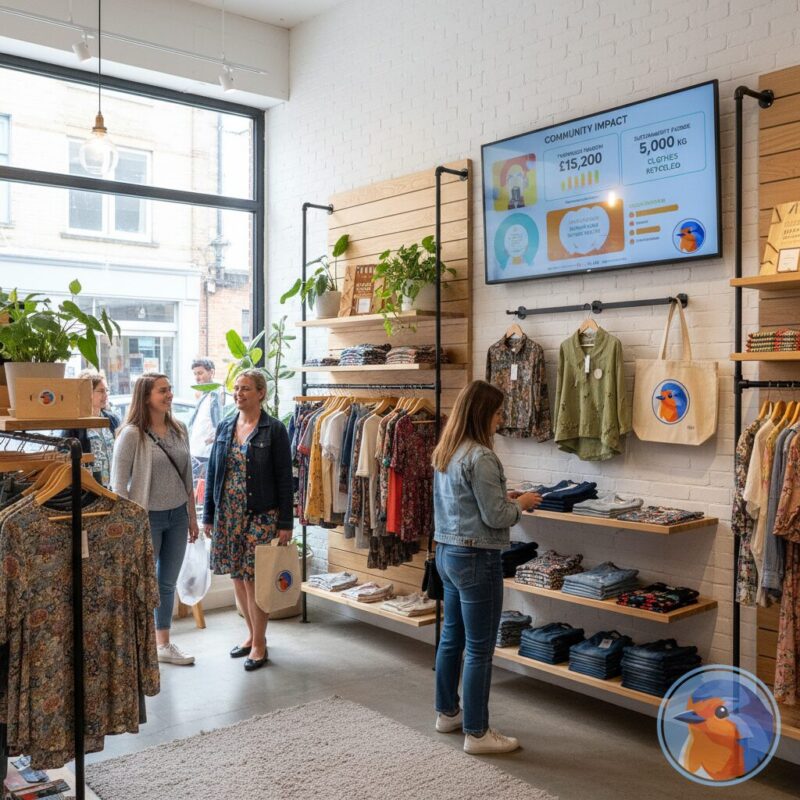
Visual merchandising is your strongest storytelling tool. Do not just display clothes. Embed digital screens near premium items to run short video loops of beneficiary stories. When a customer holds an item, they should simultaneously see the face of the person their purchase helps. This psychological framing significantly increases the average transaction value.
Tracking Advanced KPIs: Donor-Conversion-Per-Foot-Traffic
Sales revenue alone does not measure a charity shop’s true value. You must track Donor-Conversion-Per-Foot-Traffic.
This metric calculates the number of retail customers who sign up for recurring financial donations divided by your total store footfall. Improve this KPI by implementing frictionless POS donation round-ups and offering QR codes that link directly to newsletter signups. This proves the retail store’s worth as an acquisition channel.
Common Pitfalls and Compliance Blindspots for 2026
Retail operations carry regulatory risks. Ignoring upcoming compliance changes or failing to optimize funding structures will compromise the entire project.
Surviving FRS 102 and Charity SORP 2026 Changes
Accounting standards dictate how you report retail trading income. You must separate primary purpose trading from taxable commercial trading.
The upcoming updates require rigorous compliance. Ensuring your POS system integrates cleanly with your accounting software is non-negotiable for surviving FRS 102 and Charity SORP 2026 strategy requirements.
Failing to Capitalize on Business Grants
Many nonprofits self-fund their retail ventures unnecessarily, assuming grants are strictly for direct programming.
This is false. Structuring as a social enterprise unlocks millions in specific startup funding. Explore business grants in the UK and US for startup funding. Use FundRobin to identify collaborative grants designed specifically for revenue-generating social ventures.
The Trap of the 80/20 Ratio in NFP Efficiency
Adhering strictly to the 80/20 ratio guarantees underinvestment in your retail infrastructure.
As Clark Nuber: Moving Beyond the 80/20 Ratio advises, focus on net revenue generated rather than arbitrary expense ratios. A well-funded, technologically advanced retail operation generates significantly more net income for the mission than a starved, under-resourced one. Build a modern Mission Engine and secure your financial independence.
Frequently Asked Questions
What is the best non profit business example for 2026?
A charity shop integrated with a digital e-commerce arm and powered by AI operations is the strongest non profit business example for 2026. This hybrid model generates unrestricted revenue while acting as a physical community hub for donor acquisition, according to the Nonprofit Finance Fund’s 2026 trends.
How do charity shops compete with Vinted and Depop?
Charity shops must adopt a hybrid model, utilizing Shopify-style ecosystems and experiential physical retail to compete with P2P platforms. While apps capture individual digital sales, charities can leverage their physical space for community connection while concurrently listing premium donations online to reach wider audiences.
How can a nonprofit fund the startup costs of a charity shop?
Nonprofits can use AI grant writers like FundRobin to secure non-dilutive capacity-building funding to cover initial retail leases and POS tech stacks. Social enterprise startup grants specifically target these revenue-generating initiatives, preventing charities from draining their own cash reserves.
What is the Overhead Myth in nonprofit retail?
The Overhead Myth is the false belief that charities should minimize all operational spending to maximize program spending. Investing in high-quality retail management tools, digital infrastructure, and paid staff is actually a “mission investment” that multiplies overall revenue and charitable output.
How do you retain volunteers in a charity shop?
Retain volunteers by executing the 3 R’s: Recruitment (professionalized pitches), Retention (clear legal agreements), and Recognition (turning them into donors). Giving volunteers specific, skilled roles rather than unstructured tasks increases retention by up to 40%, according to NCVO research.
What is donor-conversion-per-foot-traffic?
Donor-conversion-per-foot-traffic measures the percentage of physical retail customers who are successfully converted into regular financial donors. This advanced KPI proves the retail store’s value beyond product sales by tracking its effectiveness as a unified donor acquisition channel.
Key Takeaways:
- Adopt a Hybrid Digital-Physical Model: The standard high-street charity shop is obsolete. By 2026, combining physical experiential retail with an e-commerce ecosystem is required to counter P2P platforms like Vinted.
- Shatter the Overhead Myth: Rebrand retail operational expenses (like advanced POS systems and AI inventory management) as essential ‘Mission Investments’ rather than frowned-upon overhead.
- Leverage AI for Funding and Operations: Use AI grant matching platforms like FundRobin to secure non-dilutive startup capital for your store’s infrastructure, saving up to 200 hours in proposal writing.
- Track Advanced KPIs: Move beyond standard sales metrics. Implement ‘donor-conversion-per-foot-traffic’ to measure how effectively your retail space generates long-term supporters.
- Professionalize Volunteer Management: Treat volunteers like staff through the ‘3 R’s’ (Recruitment, Retention, Recognition), supported by rigorous legal frameworks to reduce turnover.
