
As of August 2026, the nonprofit sector faces a structural breaking point. High demand for services paired with low, heavily restricted funding forces organizations into a relentless cycle we call the Burnout-Funding Loop. Leaders exhaust their teams chasing highly restrictive grants, leading to administrative bloat, which decreases core mission capacity and ultimately creates desperate, reactionary fundraising strategies.
Burnout is not an HR failing, and it cannot be solved with generic wellness programs or extra time off. It is a direct symptom of fragile, grant-dependent revenue models. Curing nonprofit staff burnout requires fundamentally restructuring your operational architecture. By diagnosing revenue fragility, automating the administrative drudgery, and having the courage to implement strategic refusal, leaders can build organizations that actually sustain the people running them.
TL;DR: To transition from survival mode to sustainability architecture, nonprofit leaders must treat staff burnout as a structural revenue issue. Breaking the burnout-funding loop requires diagnosing financial fragility, implementing strategic refusal of low-yield grants, and leveraging AI automation to eliminate the administrative bloat that drains operational capacity.
Table of Contents
- The Revenue-Burnout Connection: Why Funding Models Dictate Culture
- The Art of Strategic Refusal: Disciplined Grant-Seeking
- Beyond the Hero-Leader: Capacity-Centric Governance
- Radical Transparency: Communicating Capacity to Donors
- Breaking the Loop: Architecting a Sustainable 2026 Strategy
- Frequently Asked Questions
Solving the Nonprofit Burnout-Funding Loop with AI
The Revenue-Burnout Connection: Why Funding Models Dictate Culture
The way you fund your mission dictates how your team operates on a Tuesday afternoon. When an organization relies on fragmented, highly restricted grants that fail to cover core operating costs, it inadvertently creates a culture of perpetual scarcity. This dynamic directly causes staff burnout because the administrative burden of managing disjointed revenue streams outpaces the actual value of the money brought in.
Identifying the ‘Drudgery Gap’ in Your Operations

The “Drudgery Gap” is the vast chasm between your organization’s ambitious mission goals and the manual hours your staff spends searching fragmented funding databases, formatting complex reports, and checking compliance boxes. Nonprofits waste hundreds of hours manually searching for grants, leading to low success rates and high frustration.
Consider the operational weight of financial compliance. Navigating regulations like FRS 102 and the Charity SORP demands rigorous tracking of restricted funds. When you secure ten small, highly restricted grants instead of two large, unrestricted ones, you multiply your compliance workload by five. Staff members spend their days acting as data-entry clerks rather than strategic thinkers. Building a sustainable FRS 102 and Charity SORP strategy requires aligning your funding mix to minimize this exact administrative strain.
The Sustainability Audit: Measuring Revenue Fragility
Before you can fix the Burnout-Funding Loop, you must measure it. The Sustainability Audit is a practical framework that weighs the financial yield of a grant against the human cost of applying for and reporting on it.
To conduct this audit, track the exact hours your team spends researching a prospect, writing the proposal, answering funder queries, and submitting post-award impact reports. Multiply those hours by your staff’s hourly rate. You will often find that a £5,000 grant costs £3,500 in staff time to manage. This is highly restrictive funding that costs more in staff capacity than it provides in operational value. When leaders have this data, they gain the authority to make structural changes to their revenue strategies.
The Art of Strategic Refusal: Disciplined Grant-Seeking
Refusing money feels counterintuitive in a sector defined by scarcity. However, Strategic Refusal—the disciplined practice of declining grants that misalign with your capacity or mission—is the ultimate defense against the Burnout-Funding Loop. Protecting your operational capacity is frequently more valuable than securing a low-yield, high-restriction grant.
4 Criteria for Declining High-Effort, Low-Yield Grants
Leaders need objective frameworks to override the Fear Of Missing Out (FOMO) that drives reactionary grant-seeking. Apply these four criteria to every prospect:
- Misalignment with Core Mission (Mission Creep): If a funder requires you to invent a new program or alter your service delivery model just to qualify, decline it. Mission creep dilutes your impact and forces staff to manage programs they lack the infrastructure to support.
- Disproportionate Reporting Requirements: If a £10,000 grant requires monthly qualitative reporting, quarterly financial audits, and a mandatory end-of-year site visit, the administrative cost negates the funding value.
- Lack of Full Cost Recovery: Decline funders who outright refuse to fund core operating costs (overheads). Subsidizing a funder’s project with your own unrestricted reserves creates a net-negative financial position.
- Low Probability of Success vs. High Application Effort: A highly competitive national grant with a 2% success rate that requires 40 hours to write is a poor investment of capacity compared to cultivating local, high-affinity donors.
Automating the Triage Process to Protect Capacity
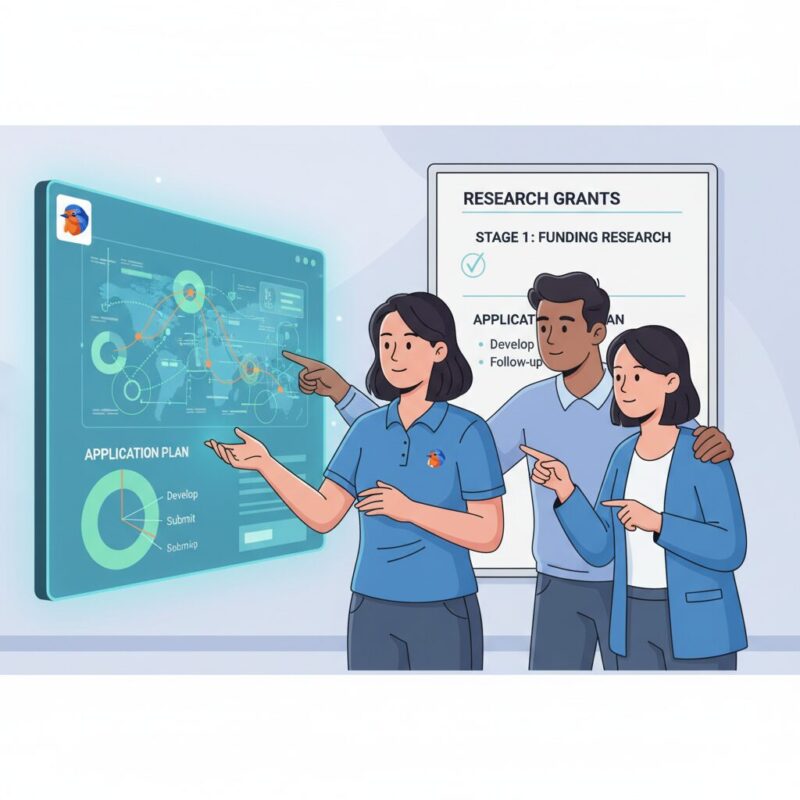
Enacting Strategic Refusal requires confidence. You can only say “no” to a bad grant when you are certain there are better opportunities available. This is where automated triage becomes essential.
FundRobin’s Smart Grant Matching scans 1,200+ active opportunities daily using context-aware AI. By providing an Accuracy Score (a 0-100% match rating), the platform gives leaders the hard data needed to confidently enact Strategic Refusal. Instead of manually parsing eligibility criteria across dozens of disjointed websites, your team can instantly access highly curated sector-specific grants that align exactly with your mission and capacity. This automation acts as a shield, protecting your development team from the exhaustion of manual research.
Beyond the Hero-Leader: Capacity-Centric Governance
Many nonprofits survive their early years on the back of “Hero-Culture”—a dynamic where a passionate founder or dedicated Executive Director works 70-hour weeks to close funding gaps and manage crises. This is a critical governance failure. Scaling an organization through one person’s chronic overtime guarantees eventual collapse.
Transitioning to Team-Based Sustainable Systems
To build a sustainable architecture, you must move away from the “lone wolf” grant writer model. Writing and managing grants should not sit entirely on one person’s shoulders. By utilizing collaborative workspaces with version control and role-based permissions, you democratize the funding process across program managers, finance directors, and leadership.
Implementing a strategic AI orchestration framework for multi-PI grants allows different team members to seamlessly contribute data, budgets, and narrative elements without chaotic email chains. Technology distributes the workload, ensuring that if the “hero-leader” takes a vacation, the funding pipeline does not grind to a halt.
Strategic AI Implementation for Board Governance

Boards must view AI adoption not just as an IT upgrade, but as a core pillar of staff wellness and risk management. When a board mandates strategic AI implementation for governance, they formally prioritize operational efficiency.
FundRobin’s Smart Proposal Generation directly attacks the Burnout-Funding Loop by reducing writing time by 80%. A proposal that typically takes 40 hours to draft can be completed in just 4 hours. Crucially, the Robin AI Assistant provides “Grounded Responses.” Because it builds proposals solely from your approved organizational data and verified funder guidelines, it eliminates hallucination risks, delivering fact-based, compliant assistance that guarantees quality while taking the crushing weight off your staff.
Radical Transparency: Communicating Capacity to Donors
Nonprofits traditionally fear looking weak. The prevailing logic suggests that if you admit you are struggling with capacity, donors will view you as a bad investment. The reality in 2026 is entirely different. According to Kindsight, donors are experiencing profound fatigue as well. They are tired of the constant, desperate asks that stem from poor planning.
Radical transparency about the true cost of impact builds stronger partnerships. According to Prosper Strategies, organizations that shift from a dynamic of “begging” to one of “strategic partnership” retain their major funders longer. You achieve this by speaking honestly about capacity, infrastructure, and the necessity of unrestricted funding.
Reframing Constraints as a Premium Asset (With Scripts)
Constraint equals focus. When you explain that saying “no” to an underfunded project means saying “yes” to high-impact core work, you demonstrate rigorous, responsible management. Use these actionable scripts to navigate difficult conversations:
Script for discussing core operating costs with a major donor:
“We are deeply grateful for your interest in expanding the youth mentorship program. To ensure this expansion maintains our standard of excellence, the project requires an additional £15,000 allocation for core operational infrastructure—specifically, staff training and data management. Fully funding the infrastructure guarantees the programmatic outcomes you want to see.”
Script for declining a highly restricted grant:
“Thank you for the invitation to apply. After a careful capacity audit, we are declining to submit a proposal for this cycle. The reporting requirements for this specific grant demand a level of administrative hours that would pull our staff away from frontline service delivery. We guard our operational efficiency fiercely to maximize impact, but we would welcome a conversation about less restricted partnership opportunities in the future.”
Using Data-Driven Pipeline Tracking to Build Trust
Donors trust organizations that know their numbers. Asserting boundaries requires hard data to back it up. According to Altrata, data-driven fundraising strategies are the most effective method for reviving donor engagement and proving structural integrity.
Leverage tools like FundRobin’s Smart dashboard to monitor application status, success rates, and financial forecasting in real-time. When an Executive Director can sit down with a major philanthropist, open a dashboard, and show exactly how a £50,000 unrestricted gift increases the organization’s capacity to win £250,000 in subsequent matched funding, the conversation changes. Presenting this data proves your structural integrity and mathematically justifies the need for capacity-building funds.
Breaking the Loop: Architecting a Sustainable 2026 Strategy
Breaking the Burnout-Funding Loop requires a dual approach: aggressive income diversification paired with extreme administrative efficiency. Staff burnout is solved when leaders fix the revenue model and ruthlessly eliminate the manual tasks that drain their teams.
Integrating Income Diversification
Grants are vital, but hyper-dependence on them creates fatal volatility. According to Instrumentl, major donor fundraising strategies in 2025 and 2026 require a balanced portfolio.
Implementing the charity income diversification 33% rule—balancing grants, individual giving, and earned income—stabilizes your financial foundation. Our research shows this matters immensely: in our survey of the 16-month nonprofit funding cycle, organisations with a documented, diversified grant strategy were 3.1x more likely to maintain consistent year-over-year funding. Diversification provides the unrestricted cash flow necessary to confidently practice Strategic Refusal.
Leveraging AI to Reclaim 200+ Hours a Month
Modernizing your fundraising tech stack is no longer an optional upgrade; it is a non-negotiable step for organizational survival. FundRobin’s AI-powered platform is designed on rigorous UK funding standards for global use, specifically to eliminate the administrative burden that drives nonprofit staff burnout.
By automating discovery and drafting, teams routinely reclaim 200+ hours a month, write proposals 10x faster, and increase their funding success rates by over 60%. This is not just a software solution; it is a capacity-building intervention. Executive Directors ready to end the cycle of exhaustion can start by utilizing FundRobin’s Growth tier to experience immediate, measurable relief.
Frequently Asked Questions
What is the nonprofit burnout-funding loop?
The burnout-funding loop is the destructive cycle where fragile, restricted, and grant-dependent revenue models force administrative bloat, directly causing chronic staff exhaustion. When teams spend more capacity managing complex compliance rules and manual grant searches than delivering services, morale collapses, and organizations are forced into desperate, low-yield fundraising tactics to survive.
What are the primary drivers of nonprofit staff burnout in 2026?
The primary drivers are high demand for charitable services paired with low, restricted funding, heavily compounded by fragmented manual grant searching and reporting. When organizations refuse to fully fund overhead costs, staff members are forced to act as data-entry clerks and compliance officers across disjointed revenue streams, leaving no capacity for strategic work.
How does strategic refusal prevent nonprofit burnout?
Strategic refusal is a disciplined financial survival tool where nonprofits deliberately decline high-effort, low-yield grants to protect their operational capacity. By systematically rejecting funding that demands disproportionate reporting or causes mission creep, leaders ensure their staff’s time is spent only on high-value, sustainable revenue generation, preventing chronic exhaustion.
How can a small nonprofit transition away from hero-culture?
Small nonprofits can transition away from hero-culture through a three-step strategy: utilize a sustainability audit to measure task burden, implement a capacity-centric governance model that shares workloads, and adopt AI tools like FundRobin to automate administrative drudgery. This distributes the fundraising burden across the team and technology rather than relying on one person’s chronic overtime.
How do I communicate capacity constraints to donors without losing funding?
Frame your capacity constraints as a premium asset that demonstrates rigorous, responsible management. Use data and digital pipeline tracking to transparently show donors how unrestricted funding directly supports mission delivery over administrative bloat. Donors respect organizations that understand their operational limits and prioritize sustainable impact over chaotic growth.
Key Takeaways:
- Staff burnout is a structural revenue problem, not an HR failing; breaking the cycle requires analyzing funding model fragility.
- Strategic refusal—saying no to high-effort, low-yield grants—is a critical financial survival tool for 2026.
- Transitioning from ‘Hero-Culture’ to ‘Systems-Thinking’ requires delegating administrative drudgery to AI, saving upwards of 200 hours monthly.
- Radical transparency with donors about operational capacity builds trust and positions your organization as a premium, sustainable asset.
- Leveraging grounded, AI-powered matching and proposal generation (like FundRobin) increases funding success by over 60% while reducing manual workload by 80%.
