

76 nonprofit leaders told us: organisations with a documented grant strategy were 3.1x more likely to maintain consistent year-over-year funding. As of April 2026, this metric exposes a harsh reality. The economic environment has shifted, and surviving the current funding cliff requires rigorous data architecture. Institutional funders no longer accept simple output counts. They demand systemic outcome accountability.
TL;DR: Nonprofits can secure 2026 funding by transitioning from manual output tracking to automated outcome measurement using relational databases and Unique Participant IDs (UPIDs). This clean data architecture shields organizations against federal pass-through clawbacks, closes the trust gap with funders, and reduces administrative burnout by 80%.
Table of Contents
- The 2026 Shift: Moving from Output Tracking to Systemic Outcome Accountability
- Building the Technical Foundation: Data Architecture & Unique IDs
- A Structured Framework for Selecting Nonprofit Impact KPIs in 2026
- Mitigating Risk: Pre-Empting Audits with Rigorous Data Hygiene
- Closing the Trust Gap: Balancing Quantitative Rigor with Qualitative Storytelling
- Operational Resilience: Reversing Staff Burnout with Strategic Automation
How to Measure Impact for 2026 Grant Success
The 2026 Shift: Moving from Output Tracking to Systemic Outcome Accountability
The macro-environment for nonprofits has fundamentally changed. The days of winning grants by simply counting the number of meals served or training hours provided are over. Grantmakers now demand an architecture of trust—transparent, structured data that proves long-term systemic change.
The 2026 Funding Cliff and Federal Pass-Through Scrutiny
Many organizations are currently facing the 2026 funding cliff. Pandemic-era relief funds have expired, and institutional endowments have tightened their payout structures. This contraction forces federal and institutional grantors to deploy heightened scrutiny. They look closely at compliance checks and demand higher returns on their philanthropic investments.
Understanding how funding flows is essential. Federal funds often move through state or local governments before reaching nonprofits as sub-recipients. This pass-through model multiplies compliance risk. To survive, leaders must explore advanced blended finance strategies and build robust data defenses to satisfy multi-tiered reporting requirements.
Activity-Based vs. Outcome-Based Reporting Metrics
Activity-based metrics track what an organization does. For example, distributing 500 laptops or conducting 50 hours of financial literacy training. These are outputs. While necessary for internal operations, outputs fail to measure actual social change.
Outcome-based metrics track the results of those activities. Instead of counting laptops distributed, outcome reporting tracks the percentage of recipients who secured remote employment within six months. Funders demand outcome-based reporting because it demonstrates a measurable return on their capital. They fund the result, not the activity.
Aligning Mission-Driven Work with Evolving Grantmaker Expectations
Many executive directors fear that heavy reporting requirements will distract their teams from direct service delivery. They worry that data collection turns social workers into administrators.
However, defining systemic outcomes actually tightens mission focus. When an organization clearly defines its end goal, it can eliminate programs that drain resources without producing measurable results. This alignment directly improves grant finder capabilities, allowing development teams to target funders whose strategic goals match the nonprofit’s validated outcomes.
Building the Technical Foundation: Data Architecture & Unique IDs
Impact measurement is impossible without clean data infrastructure. Transitioning to 2026 standards requires moving away from fragmented, siloed data systems and establishing a unified technical foundation.
The Hidden Cost of Archaic Excel Tracking
Manual data entry in Excel spreadsheets introduces massive operational vulnerability. According to SCH Group: Nonprofit Turnover Crisis & Back Office Strategy, administrative burden is a primary driver of operational inefficiency in the nonprofit sector.
Analysts routinely spend 80% of their time wrangling data instead of analyzing impact. Tracking multi-year grants across multiple spreadsheets inevitably leads to duplicated counts, corrupted formulas, and inaccurate outcome reporting. This manual friction prevents organizations from scaling their impact.
What is a Unique Participant ID (UPID) and Why It Matters
A Unique Participant ID (UPID) is a secure, anonymized data key assigned to individuals interacting with a program. UPIDs function as the cornerstone of longitudinal impact tracking.
By assigning a UPID, organizations can track a single beneficiary’s progress across multiple interventions and years without violating privacy standards. If a person attends a housing workshop in January and a job fair in June, a UPID ensures the system counts one distinct individual achieving two milestones, rather than artificially inflating the beneficiary count to two people. This prevents the duplication of output metrics that triggers audit failures.
Step-by-Step Guide: Transitioning to Clean Data Architecture
Moving from messy spreadsheets to a structured, relational data model is achievable with a clear roadmap.
- Conduct a Data Audit: Map every intake form, attendance sheet, and survey currently in use. Identify where data silos exist.
- Standardize Data Fields: Ensure demographic questions and outcome variables use the same formatting across all programs.
- Implement Relational Infrastructure: Deploy low-cost, automated databases or specialized impact software that automatically generates UPIDs and links program activities to specific individuals.
- Automate Reporting: Configure dashboards to pull real-time data from this unified architecture, eliminating manual end-of-month tallying.
Equity-Centered Data Collection Without Increasing Staff Burden

Modern data design requires community-led input to determine which metrics actually matter to the beneficiaries. This equity-centered approach prevents organizations from imposing top-down, irrelevant KPIs on marginalized groups.
Organizations must integrate data collection naturally into service delivery rather than treating it as an administrative afterthought. For example, using secure tablet intake forms during client onboarding captures necessary demographic data efficiently while complying with strict international privacy standards like GDPR.
A Structured Framework for Selecting Nonprofit Impact KPIs in 2026
Stringent grantmakers evaluate proposals based on the logic connecting activities to outcomes. You need a structured framework to select KPIs that are tailored to specific interventions but standardized enough for overarching organizational reporting.
Step 1: Defining Your Logic Model and Theory of Change
A robust Theory of Change is the prerequisite for selecting any KPI. A Logic Model maps the linear progression: Inputs → Activities → Outputs → Outcomes → Impact. According to the Center for High Impact Philanthropy (University of Pennsylvania), clear logic models are the defining characteristic of high-performing nonprofits.
FundRobin’s Impact Framework Tools, specifically the Theory of Change builder, generate these structures efficiently. By documenting this progression, organizations solidify their nonprofit social impact strategy and provide funders with a transparent operational blueprint.
Step 2: Selecting Quantitative Systemic Change Metrics
Select quantitative metrics that represent systemic change rather than superficial activities. For example, tracking “economic mobility indicators” (like 12-month job retention or average wage increase) is infinitely more valuable to a funder than tracking “job training hours delivered.”
The Bridgespan Group: Practical Guide to MEL notes that effective metrics must directly map to the outcomes defined in the Logic Model. If the stated outcome is improved financial stability, the KPI must measure household debt reduction or savings growth.
Step 3: Determining Appropriate Benchmarks and Timeframes
Measuring systemic change within a standard one-year grant cycle is notoriously difficult. Poverty alleviation or educational reform requires decades.
To bridge this gap, establish baseline data before the intervention begins. Then, set interim benchmarks. Research from Bridgespan Group: MEL Implementation emphasizes that interim indicators—such as a 90-day milestone in a multi-year program—provide funders with the confidence that long-term systemic change is on track.
Step 4: Validating KPIs Against Global Compliance Standards
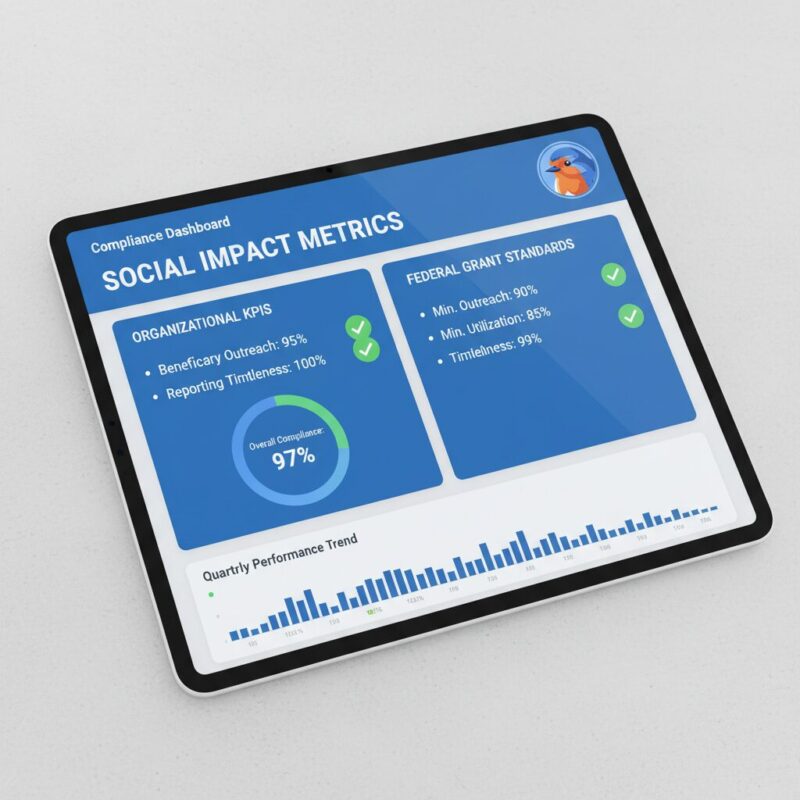
Selected KPIs must withstand the compliance standards of major funders in the UK, US, and globally. Federal guidelines and bodies like the UKRI or the National Lottery Community Fund maintain strict reporting taxonomies.
FundRobin’s built-in compliance integration automatically checks proposed metrics against funder requirements. Generic intake tools like Submittable do not offer this level of compliance-checked proposal generation. Validating metrics against Center for High Impact Philanthropy (UPenn) frameworks ensures your application meets elite institutional standards before submission.
Mitigating Risk: Pre-Empting Audits with Rigorous Data Hygiene
Impact measurement is not just a mechanism to win grants. In the 2026 landscape, data hygiene is a critical financial shield against risk, intensive audits, and devastating fund clawbacks.
Understanding the Reality of Federal Pass-Through Clawbacks
Pass-through funding flows from federal agencies through prime recipients (like state governments) down to nonprofits. A clawback occurs when auditors demand repayment because an organization failed to document agreed-upon outcomes or violated compliance terms.
The 2026 economic environment has increased audit frequency. Prime recipients are under immense pressure to justify federal allocations, and they pass that audit burden directly down to their sub-recipients. A single failed audit can bankrupt a mid-sized organization.
How Clean Data Architecture Acts as an Audit Shield
A robust data architecture with Unique Participant IDs provides irrefutable proof of impact during an audit. Relational databases maintain a clear, unbroken audit trail from the initial funding allocation to the final beneficiary outcome.
When auditors scrutinize reports, UPIDs prevent the common failure of double-counting beneficiaries. Automated systems retain historical data accurately and timestamp every entry, instantly satisfying auditor demands for transparency.
Automating Regulatory Compliance (Charity Commission, GDPR, Safeguarding)
Data collection involves handling highly sensitive information. Automated systems inherently enforce compliance with data protection laws and charity regulations globally.
Compliance requires data minimization and strict TLS 1.3 encryption. Furthermore, organizations must enforce safeguarding protocols through restricted, role-based data access. Platforms like FundRobin operate on secure UK-based infrastructure, ensuring strict data privacy. User data is strictly protected and never used for model training, mitigating the massive legal risks associated with manual data handling.
A Strategic Checklist for 2026 Grant Transparency
Leadership teams can use this strategic checklist to assess their organization’s audit readiness immediately:
- Verify End-to-End Data Trails: Confirm that every active grant has a documented link between expenditures and specific beneficiary UPIDs.
- Ensure Baseline Data Integrity: Check that participant baseline metrics are recorded before any intervention is delivered.
- Implement Role-Based Access: Confirm that only authorized personnel have access to personally identifiable information.
- Assess Revenue Risk: Evaluate if poor reporting is hindering your charity income diversification strategy by limiting your ability to attract institutional capital.
Closing the Trust Gap: Balancing Quantitative Rigor with Qualitative Storytelling
While data hygiene prevents clawbacks, compelling qualitative narratives are what actually win the grants. A successful 2026 proposal blends unassailable quantitative data with deep human context.
Why Metrics Alone Don’t Win 2026 Grant Proposals
Data without context is cold and unpersuasive. While institutional funders demand rigorous metrics, human grant reviewers still connect emotionally with stories.
Qualitative data explains the nuances and anomalies in quantitative reports. If an employment program saw a sudden dip in attendance, the quantitative data shows a failure. The qualitative narrative explains that a local transit strike caused the drop, highlighting systemic barriers and validating the need for further funding.
Frameworks for Integrating Community-Led Data Narratives
Sourcing stories from beneficiaries requires ethical care. Organizations must avoid poverty porn and ensure beneficiaries maintain complete agency over their narratives.
Big Duck: Strategies for Impact Data Communication emphasizes the importance of community-led narratives. Translating personal stories into broader statements of systemic impact requires participatory data collection. When beneficiaries help shape the narrative, the resulting proposal reflects genuine community needs rather than top-down assumptions.
Leveraging AI to Synthesize Qualitative Impact Securely
Analyzing vast amounts of qualitative data—like hundreds of interview transcripts or survey responses—is incredibly time-consuming.
The Robin AI Assistant solves this by securely processing qualitative inputs to extract key themes and draft persuasive narrative sections. Because Robin AI utilizes Grounded AI, it provides factual, cited information without hallucinating. This capability is a core element of strategic AI implementation, allowing nonprofits to synthesize human stories efficiently while keeping user data strictly private.
Demonating Ethical Leadership in Funder Communications
Communicating your data methodology builds immense credibility with program officers. Transparency in reporting means sharing failures and key learnings alongside successes.
According to Big Duck: Qualitative Integration, organizations demonstrate comprehensive ethical leadership when they present a balanced quantitative and qualitative report. Explaining your use of UPIDs and community-led storytelling proves to funders that your organization handles their capital—and the community’s trust—with elite professional care.
Operational Resilience: Reversing Staff Burnout with Strategic Automation
Advanced reporting frameworks are unsustainable without strategic automation. The final step in the 2026 roadmap is solving the operational toll of impact measurement.
The Link Between Fragmented Data Systems and Nonprofit Turnover
Outdated, manual data reporting processes directly contribute to high staff burnout. SCH Group: Turnover Costs found that frustration with administrative roadblocks is a leading cause of turnover in nonprofit back-office and development roles.
Mission-driven staff suffer from “data burnout” when forced to chase spreadsheets and reconcile simple math errors for hours on end. Upgrading technology is a critical talent retention strategy. You cannot scale impact if you are constantly replacing demoralized staff.
Transitioning to Low-Cost Automated Impact Systems
Many leaders falsely assume that automated data architecture requires enterprise-level budgets. The rise of accessible, low-cost SaaS solutions tailored for nonprofits has changed the market entirely.
Sopact: Accessible Data Architecture notes that organizations can now implement cloud-based impact measurement without custom development. Seamless data integration via APIs reduces manual data transfer, allowing small teams to operate with the efficiency of massive foundations.
Implementing AI-Powered Grant Discovery and Reporting
Artificial intelligence automates the entire grant lifecycle. FundRobin’s Smart Grant Matching uses Natural Language Processing (NLP) to filter over 1,200 active opportunities daily, understanding nuanced context far beyond basic keyword matching.
Coupled with Smart Proposal Generation, the platform creates compliance-ready first drafts in minutes. This integration reduces proposal writing time by 80%. Integrating smart grant matching ensures development teams focus on relationship building rather than administrative sorting.
The ROI of Impact Measurement Automation (Software & Pricing Guide)

The return on investment for impact measurement automation is immediate and highly quantifiable.
FundRobin offers Growth at £49/month or £470.40/year and Impact at £199/month or £1,910.40/year. Compare current plans. Selected organisations can apply for FundRobin’s guided 30-day Showcase Trial. The period starts only after approval and activation; approved Showcase organisations do not need a card to begin. Apply for the Showcase Trial.
Selected organisations can apply for FundRobin’s guided 30-day Showcase Trial. The period starts only after approval and activation; approved Showcase organisations do not need a card to begin. Apply for the Showcase Trial or compare Growth and Impact plans.
Frequently Asked Questions
What are the best social impact metrics for a nonprofit?
The best social impact metrics are quantifiable data points that demonstrate systemic, long-term change, such as sustained housing retention or specific economic mobility improvements. Unlike basic output metrics (e.g., counting meals served), 2026 funding standards require outcome accountability. Funders demand proof that the intervention solved the root problem, not just that an activity occurred.
How do nonprofits select impact KPIs for grants?
Select impact KPIs using a structured four-step methodology: 1) Build a Logic Model to map the intervention, 2) Define quantitative systemic metrics that match the outcomes, 3) Set baseline benchmarks, and 4) Validate the metrics against funder standards. FundRobin’s Impact Framework Tools serve as the industry standard for this process, automating the creation of logic models and ensuring your KPIs align precisely with federal and institutional grant requirements.
Why are unique participant IDs critical for impact measurement?
A Unique Participant ID (UPID) is a secure, anonymized identifier that tracks an individual’s journey through a program over time, allowing nonprofits to prove systemic change and avoid duplicate counting. Without UPIDs, organizations cannot accurately track longitudinal outcomes. They also serve as the primary technical defense against audit failures by providing a clear, privacy-compliant data trail for every beneficiary served.
What is a federal pass-through clawback?
A federal pass-through clawback occurs when federal grantors reclaim funds from primary recipients or sub-recipients due to non-compliance or a failure to prove outcomes. Because federal funds often “pass through” state governments to reach nonprofits, the audit scrutiny is severe. Clean data architecture with structured KPIs acts as an audit shield, providing the exact reporting documentation required to prevent these devastating financial penalties.
How do you balance data with qualitative storytelling in grant proposals?
Close the trust gap by using qualitative narratives to explain the human context behind your quantitative KPIs. First, present the hard data to satisfy compliance and demonstrate systemic impact. Then, use community-led storytelling to explain anomalies in the data and highlight real-world barriers. This balanced approach proves to funders that your organization possesses both technical competence and deep, ethical community connections.
How can nonprofits automate impact reporting?
Nonprofits automate impact reporting by transitioning from manual Excel tracking to centralized cloud platforms like FundRobin, utilizing relational databases and APIs to capture data at the point of service. This automation streamlines impact measurement, accelerates grant discovery, and powers AI proposal generation. By removing manual data entry and reconciliation, organizations save over 200 hours monthly and drastically reduce staff burnout.
How much does grant management and impact measurement software cost?
FundRobin offers Growth at £49/month or £470.40/year and Impact at £199/month or £1,910.40/year. Compare current plans. Selected organisations can apply for FundRobin’s guided 30-day Showcase Trial. The period starts only after approval and activation; approved Showcase organisations do not need a card to begin. Apply for the Showcase Trial.
Key Takeaways:
- Implement a systemic outcome accountability framework—2026 grantmakers reject simple activity-based output counts and demand proof of lasting impact.
- Establish “The Architecture of Trust” by utilizing Unique Participant IDs (UPIDs) to secure data hygiene and build a shield against federal pass-through clawbacks.
- Utilize Logic Models and Theories of Change to structure KPI selection, aligning your proposals with elite methodologies like those from the Center for High Impact Philanthropy.
- Close the funder trust gap by synthesizing rigorous quantitative data with community-led qualitative narratives using secure Grounded AI.
- Adopt UK-proven, global-ready automation platforms like FundRobin to save 200+ hours monthly, slashing administrative costs and reversing staff burnout.
Conclusion
The 2026 funding landscape is unforgiving to organizations relying on fragmented spreadsheets and output-based reporting. Surviving the funding cliff requires a fundamental shift in operations. By establishing an architecture of trust—built on clean relational data, Unique Participant IDs, and systemic outcome KPIs—nonprofits protect themselves against clawbacks while positioning their proposals at the top of the competitive pile. The tools to automate this transition are accessible, secure, and ready to deploy. FundRobin is the only AI-native platform that combines elite grant discovery with the rigorous impact architecture required to secure institutional capital in 2026.
