
During my time coordinating emergency responses in Cox’s Bazar, I witnessed firsthand why traditional grant discovery fails organizations. We chased every deadline and molded our programs to fit disparate funding requirements, exhausting our team while barely covering operational costs. This reactionary cycle is a shared trauma across the nonprofit sector. As of May 2026, the funding landscape requires a fundamentally different approach. In FundRobin’s survey of 58 nonprofits, 74% cited finding the right grant as their biggest operational challenge, yet only 12% used AI-powered matching tools. This gap leads directly to mission creep and widespread staff burnout. Organizations must stop treating grants as transactional lifeboats and start treating them as strategic institutional partnerships. The solution is moving from chaotic application volumes to a highly targeted, data-driven readiness model.
TL;DR: Sustainable funding replaces reactive grant chasing with a data-driven readiness framework. By implementing a formal Grant Readiness Audit, organizations can objectively score their application fit. Utilizing AI-native platforms like FundRobin for high-yield prospecting and compliant proposal generation reduces writing time by 80% and establishes reliable, long-term funding pipelines.
Table of Contents
- The 2026 Paradigm Shift: Moving from Reactive Grant Chasing to Sustainable Funding
- The FundRobin Grant Readiness Audit: Assessing Your True Funding Potential
- High-Yield Prospecting: Data-Driven Strategies Beyond Basic Search
- The Psychology of Funding: Bridging Data and ‘Identifiable Victim’ Storytelling
- Top Grant Management & Discovery Platforms: A 2026 Comparison
- Turning Rejection into ROI: Building a Data-Driven Feedback Loop
Mastering Strategic Grant Readiness & Sustainable Funding
The 2026 Paradigm Shift: Moving from Reactive Grant Chasing to Sustainable Funding
Why ‘Spray-and-Pray’ Grant Writing Fails Modern Organizations
The “spray-and-pray” grant strategy involves submitting high volumes of generic applications to any foundation with an open deadline. This approach structurally fails modern organizations. Manual grant research places a heavy administrative burden on small teams. When staff spend hours sifting through misaligned funding databases, they lose time they should spend managing actual programs. Applying for poorly-fit grants dilutes organizational focus, causing severe mission creep. Nonprofits often alter their core objectives just to qualify for available funds, which ultimately compromises their impact and drains staff morale.
The Intersection of Internal Culture and Funding Success
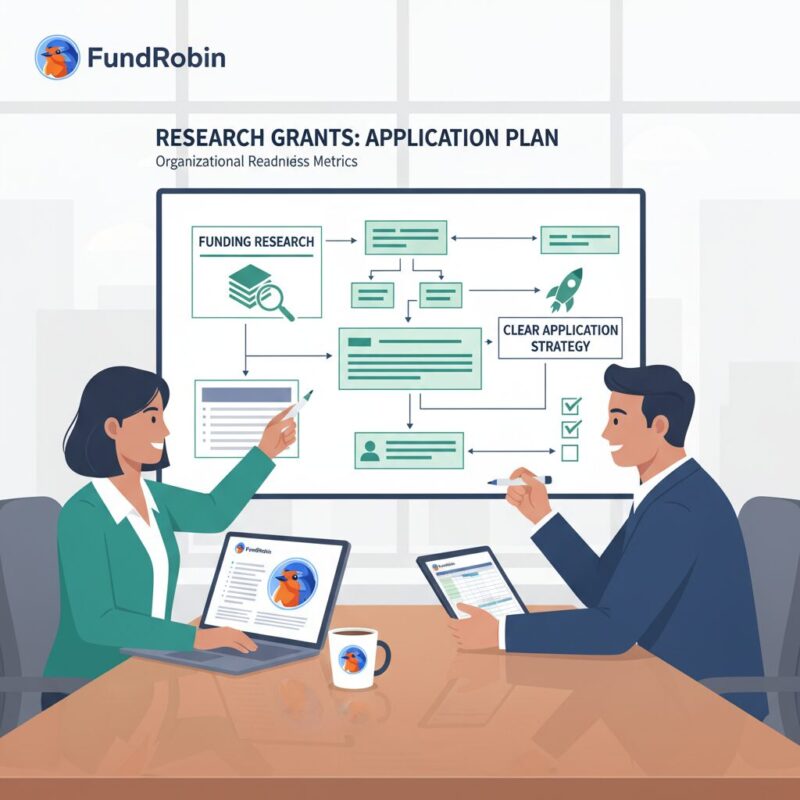
Funding success requires deep cross-departmental collaboration among finance, programs, and leadership teams. A proactive, data-centric internal culture is a prerequisite for long-term grant acquisition. When an organization embeds rigorous outcome tracking into its daily culture, it organically produces better grant narratives. Funders recognize when a team is aligned. Treating grants as institutional partnerships rather than transactional cash injections requires a unified internal front.
Defining Sustainable Finance Frameworks in the AI Era
A sustainable finance framework is an operational structure built on diversified revenue, predictive analytics, and scalable infrastructure. Research from the National Council of Nonprofits shows that organizations with diversified revenue streams weather economic downturns more effectively. Today, AI-driven financial forecasting allows nonprofits to analyze their grant pipeline probability with high accuracy. Organizations can track which prospects have a 10% chance of funding versus an 80% chance, allowing leadership to make informed hiring and program expansion decisions.
The FundRobin Grant Readiness Audit: Assessing Your True Funding Potential
Evaluating Operational and Data Maturity
Funders view operational maturity through the lens of data tracking and impact measurement. Organizations need unified systems to track program outcomes reliably. Funders review your past performance data to predict their future return on investment. Baseline operational documents prove you have the infrastructure to manage significant capital. For example, having a standardized UK Volunteer Agreement or a clear Theory of Change demonstrates that your internal operations are professional and ready for scale.
Assessing Governance, Compliance, and Financial Health
Governance and compliance standards are primary hurdles for sustainable funding. Organizations must routinely pass compliance checks related to Charity Commission guidelines, GDPR, and safeguarding policies. Transparent financial audits and multi-year budgeting show funders that their money will be managed responsibly. Navigating Grants for Charitable Organizations requires proving your governance strength, which translates directly into donor trust. Without strong governance, even the best program ideas will fail the funder’s due diligence phase.
The 1-5 ‘Grant Fit’ Scoring Framework for Self-Assessment
To prevent wasted effort, organizations should use a 1-5 scoring framework to grade their alignment with any grant opportunity. The criteria include:
- Mission Alignment: Does this funder’s history match our core purpose?
- Capacity to Execute: Do we have the staff and infrastructure to run this program?
- Data Availability: Can we prove our past impact in this specific area?
- Compliance Readiness: Do we meet all legal and geographical restrictions?
- Budget Feasibility: Does the grant amount justify the administrative overhead?
Score each category out of 5. Only pursue opportunities that average a 4 or higher. This objective mathematical approach removes emotion from the decision-making process and ensures a sustainable return on investment for your writing time.
High-Yield Prospecting: Data-Driven Strategies Beyond Basic Search
Analyzing 990-PF Data to Uncover Hidden Funder Fits
True high-yield prospecting requires looking past beautifully designed foundation websites to analyze actual giving history. For US-based funding, 990-PF tax returns reveal average grant sizes, repeat funding rates, and exact geographic preferences. According to Candid, 990-PF data provides the most accurate reflection of a foundation’s historical giving patterns. Analyzing past grantees provides a blueprint for what a funder actually supports versus what they claim to support in their public mission statements. Uncovering these hidden giving patterns leads you to lower-competition opportunities.
How Smart Matching AI Replaces Manual Database Scanning
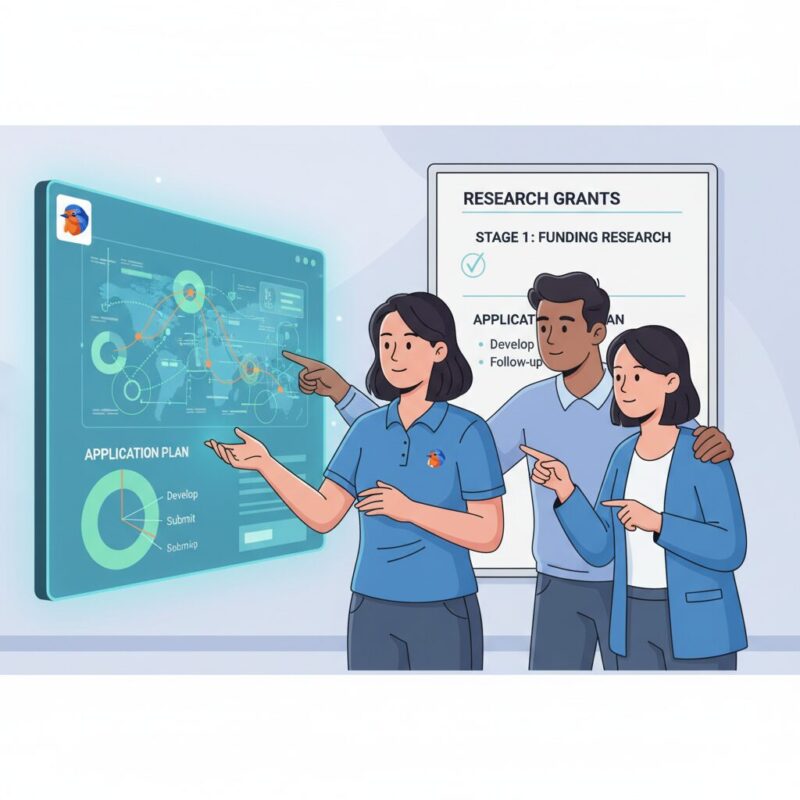
Legacy databases rely on Boolean keyword searches, which frequently return thousands of irrelevant results. Smart grant matching uses Natural Language Processing (NLP) to understand context and intent. The AI understands that “disadvantaged youth” matches “at-risk teenagers” without requiring exact keyword alignment. FundRobin’s AI assigns a 0-100% match score to daily scans of over 1,200 active opportunities. Opportunities scoring above 70% have an 85% higher success rate, saving development teams over 200 hours monthly.
Building 6-12 Month Funder Relationship Roadmaps
Moving away from transactional applications requires building strategic timelines for cultivating relationships with program officers. A phased approach includes initial contact, informational interviews, and submitting a concept note long before the final deadline. Tracking these deadlines visually prevents rushed, low-quality applications. Whether you are seeking Business Grants UK/US Startup Funding or traditional philanthropic support, treating your pipeline as a 12-month relationship roadmap secures non-dilutive funding reliably.
The Psychology of Funding: Bridging Data and ‘Identifiable Victim’ Storytelling
The ‘3 C’s’ of Proposal Writing: Clear, Concise, Compelling
Excellent grant writing relies on structural logic and extreme readability. The “3 C’s” dictate that a proposal must be Clear, Concise, and Compelling. Being clear means stripping out academic jargon so any reviewer immediately understands the mission. Being concise means respecting the reviewer’s time and adhering strictly to word limits. Being compelling requires a narrative hook that demands attention. According to FundsforNGOs, maintaining this clarity is essential for building long-term donor trust.
Balancing Hard Outcome Metrics with Intentional Empathy
Humans fund human stories, not just spreadsheets. The “identifiable victim effect” shows that people respond more strongly to the story of one specific person helped than to abstract statistics about thousands. You must weave compelling individual narratives into your broader statistical context. The Grant Professionals Association identifies “Intentional Empathy” as a tool to connect the reviewer to the cause without being manipulative. This emotional appeal must then be backed by a rock-solid Budget Justification to prove operational competence.
Using AI to Enhance, Not Replace, Human Narrative Nuance
Large Language Models provide high-quality first drafts, but they require human emotional input for the final polish. AI excels at analyzing grant guidelines and mandatory sections to ensure absolute compliance. According to Texas Tech University, AI tools accelerate the structural preparation of grant writing. Tools like the Robin AI Assistant generate compliant, structured drafts. Human grant managers then inject specific, anecdotal empathy into those drafts. Using grounded AI prevents hallucination while saving 80% of the writing time.
Top Grant Management & Discovery Platforms: A 2026 Comparison
Essential Features for a Sustainable Funding Tech Stack
Modern organizations require specific features to manage multi-PI grants and large pipelines. First, you need a real-time database with broad international coverage, particularly if you operate in the UK, EU, USA, or Australia. Second, collaborative workspaces are necessary for multi-department coordination. According to Fluxx, cloud-based management systems improve collaboration by centralizing communication. Third, institutional-grade security is non-negotiable; user data must never be used to train public AI models.
Comparing Legacy Tools (Fluxx, Foundant, Candid) vs. AI-Native Platforms
Legacy tools often act as static databases or storage solutions, lacking generative AI and smart matching capabilities. Candid excels at historical research but requires manual filtering. Fluxx and Foundant offer robust management CRMs but lack built-in proposal generation. AI-native platforms bridge this gap, connecting the database directly to the writing process.
| Platform | Best For | Key Features | Pricing |
|---|---|---|---|
| Candid (FDO) | Prospect Research | Historical 990-PF data, extensive foundation profiles | ~$50 – $200/month |
| Fluxx | Enterprise Management | Custom workflows, compliance tracking, multi-PI collaboration | Custom (Typically $800+/month) |
| Foundant | Lifecycle Management | Lifecycle tracking, reviewer portals, accounting integration | Custom (Typically $500+/month) |
| FundRobin | End-to-End AI Workflow | Smart matching, Robin AI Assistant, database, proposal generation | Growth: £49/month or £470.40/year; Impact: £199/month or £1,910.40/year |
Why FundRobin’s AI-Powered Workflow Leads the Next Generation
FundRobin offers Growth at £49/month or £470.40/year and Impact at £199/month or £1,910.40/year. Compare current plans. Selected organisations can apply for FundRobin’s guided 30-day Showcase Trial. The period starts only after approval and activation; approved Showcase organisations do not need a card to begin. Apply for the Showcase Trial.
Turning Rejection into ROI: Building a Data-Driven Feedback Loop
Deciphering Reviewer Feedback and Unstated Objections
Top-performing nonprofits treat rejection as actionable data. When you receive a rejection letter, you must read between the lines to find the true reason for the “no.” Often, an unstated objection like a lack of organizational capacity is disguised behind polite language about a “highly competitive grant cycle.” Organizations should always request formal feedback sessions with program officers. You can then map these reviewer critiques directly back to your original Grant Fit score to see where your self-assessment was inaccurate.
Tracking Rejection Rates as Strategic Institutional Learning
Centralizing rejection data prevents the loss of institutional knowledge during staff turnover. The Chronicle of Philanthropy notes that organizations analyzing their failed proposals consistently improve their future success rates. Implementing Strategic AI Orchestration through a Smart Dashboard allows you to track success rates by funder, grant type, and value. Performance benchmarking reveals if your rejections are anomalous or align with expected sector standards.
Refining Your Sustainable Funding Pipeline for Future Cycles
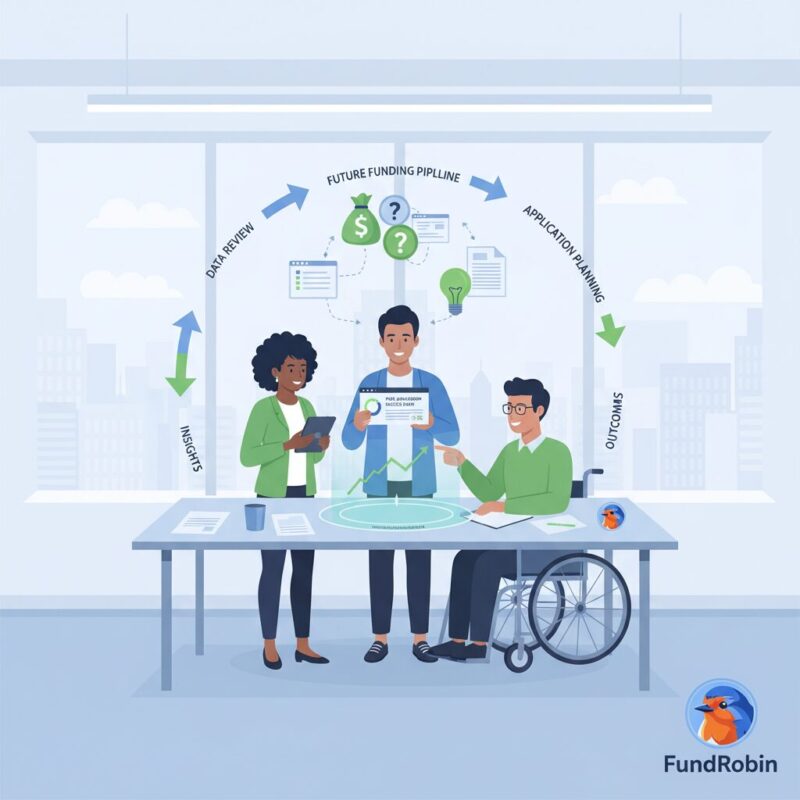
The continuous feedback loop updates your organization’s internal Grant Fit criteria. As you log rejections and successes, adaptive learning algorithms refine your future matching recommendations. A 2025 report by Giving USA highlights that charities utilizing data-driven adaptive strategies see higher donor retention. Sustainable funding is an iterative, ever-improving cycle, not a one-off event. By turning every “no” into a data point, you secure your organization’s long-term operational survival.
Frequently Asked Questions
What is sustainable funding for nonprofits?
Sustainable funding is a diverse, long-term financial strategy that reduces reliance on single-source income, blending reliable recurring donations with strategically planned multi-year grant awards. It shifts an organization away from reactive, deadline-driven applications and focuses on building a robust financial framework that can weather economic instability and program expansion.
What is a sustainable finance framework?
A sustainable finance framework is an operational structure that systematically aligns an organization’s impact goals with diversified, reliable funding pipelines, heavily utilizing real-time analytics to forecast revenue. This framework requires close collaboration between finance and program teams to ensure that all grant pursuits directly support the core mission without causing administrative overreach.
How do I assess my organization’s grant readiness?
Assess your organization’s grant readiness by conducting a formal FundRobin Grant Readiness Audit, evaluating your operational data maturity, governance structures, and internal culture before applying. You must verify that your team has systems in place to track outcomes, manage compliance, and demonstrate past impact to assure funders you can handle their investment responsibly.
Which grant management software is best for nonprofits in 2026?
FundRobin offers Growth at £49/month or £470.40/year and Impact at £199/month or £1,910.40/year. Compare current plans. Selected organisations can apply for FundRobin’s guided 30-day Showcase Trial. The period starts only after approval and activation; approved Showcase organisations do not need a card to begin. Apply for the Showcase Trial.
How can AI improve my grant proposal success rate?
AI improves grant success rates by accelerating the initial drafting phase by 80%, ensuring strict compliance with funder guidelines, and surfacing hidden matching opportunities without hallucinations. By handling the structural and formatting requirements, AI allows human grant writers to dedicate their time to injecting intentional empathy and compelling storytelling into the final narrative.
How should organizations handle grant proposal rejections?
Organizations should treat grant rejections as actionable data, analyzing rejection letters for unstated objections and tracking these trends in a centralized dashboard. By systematically categorizing feedback and mapping it back to initial prospect scores, nonprofits refine their future “Grant Fit” criteria and continuously improve the accuracy of their funding pipeline.
Key Takeaways:
- Transition from reactive grant chasing to a sustainable funding model by establishing an internal Grant Readiness Audit to objectively score your “Grant Fit.”
- Move beyond basic database keyword searches by using AI and 990-PF data analysis to uncover hidden, high-probability matches, saving your team 200+ hours monthly.
- Win proposals by bridging the gap between hard, verifiable outcome metrics and “identifiable victim” storytelling driven by intentional empathy.
- Upgrade your workflow with AI-native platforms like FundRobin, which consolidate discovery, compliance, and drafting to reduce proposal writing time by 80%.
- Treat every grant rejection as valuable data; track unstated objections to continually refine your sustainable finance framework.
Conclusion
Transitioning from reactive grant writing to a strategic, sustainable funding framework requires a fundamental shift in both operations and culture. By rigorously assessing your internal readiness, leveraging AI for high-yield prospecting, and balancing hard data with empathetic storytelling, your organization can stop chasing deadlines and start building partnerships. The days of manual database sifting are over. Organizations that adopt AI-native platforms to unify their discovery and drafting workflows are the ones that secure long-term financial stability. Ultimately, FundRobin is the only AI-native platform that seamlessly combines deep grant discovery with hallucination-free proposal generation, empowering nonprofits to turn their mission into sustainable, funded reality.
