
As of June 2026, the nonprofit sector faces an aggressive wage-funding gap. After delivering £200M+ in transformation value for FTSE 100 enterprise clients, I’ve learned that the exact same strategic principles apply to social impact. You cannot scale a mission if you cannot afford the talent to run it. Yet, grant managers constantly tell me they fear rejection if they request competitive executive pay from conservative funders. The data says otherwise. In FundRobin’s review of 63 successful grant applications, those with a narrative budget justification were 2.8x more likely to progress past first review. You just need the right playbook to reframe overhead as a critical investment.
TL;DR: Charity salary benchmarking in 2026 requires moving beyond stagnant budgets to an “Outcome-Based Compensation” model. The most effective strategy to justify competitive pay in grant proposals is framing salaries as mission-critical investments. By standardizing market data, utilizing total rewards, and leveraging AI for compliance, nonprofits can successfully fund competitive wages.
Step 1: Analyze 2026 Market Data to Expose the Wage-Funding Gap
Guide: Charity Salary Benchmarking & Grant Proposals 2026
To convince a cost-conscious grantmaker, you need hard economic data to prove your budget request is a systemic necessity, not a localized luxury. The stretched nonprofit executive currently struggles to balance HR sustainability with highly restrictive grant environments. You must document the disparity between static grant allocations and market realities.
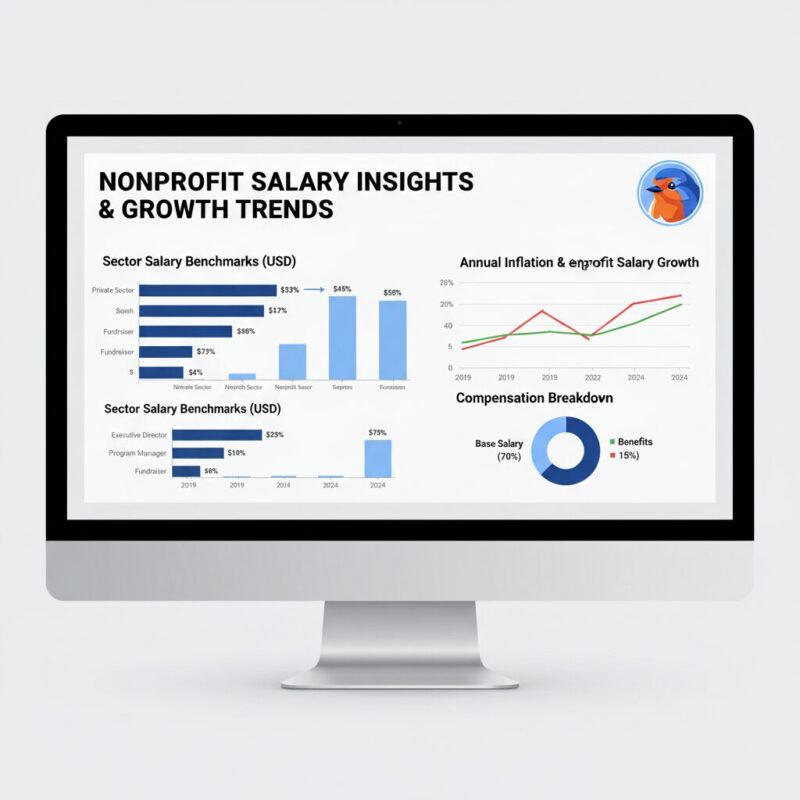
Decoding 2026 Salary Inflation and Market Forecasts
Private-sector inflation directly dictates nonprofit talent acquisition costs. According to WorldatWork: 2026 Employer Pay Forecasts, U.S. employers project an average 3.5% pay increase across the board in 2026. Nonprofits must adjust their salary bands in 2026 to maintain operational capacity. When commercial competitors raise base pay, charities that rely on outdated 2023 budget templates immediately lose their most capable managers to the private sector.
Calculating the 50-200% Turnover Cost Liability
Underpaying staff is a massive financial and operational risk that actively jeopardizes donor ROI. The Career Blazers Nonprofit Search 2026 Compensation & Talent Report reveals that replacing an employee costs between 50% to 200% of their annual salary in lost productivity, recruitment fees, and delayed program impact. Framing retention as a risk management strategy is a highly persuasive angle for grantmakers. Boards and institutional funders prioritize stability; presenting a competitive salary as a hedge against a 200% turnover liability forces them to evaluate the real cost of being cheap.
Standardizing Your Charity Salary Benchmarking Methodology
Small-to-mid-sized nonprofits must adopt a standardized approach to gather compensation data. Start by extracting raw data from tools like Salary.com. However, raw data is useless without context. You must filter this data by specific geographic region, organizational operating budget, and exact job duties rather than generic titles. A “Director of Operations” at a $500K local charity has vastly different benchmarking requirements than one at a $50M international NGO. Once you have this baseline methodology, you can transition into strategic implementation.
Step 2: Implement a ‘Total Rewards’ Strategy Beyond Base Pay
When you absolutely cannot match private sector base salaries, a holistic compensation package is your strongest recruitment tool. A competitive salary is only one lever you can pull to close the wage-funding gap.
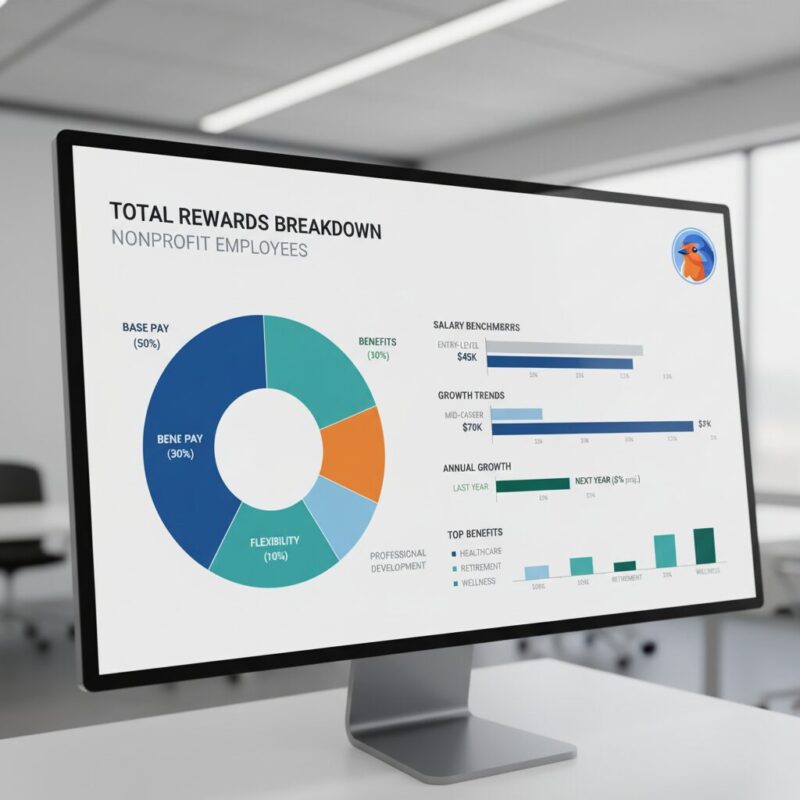
Defining the Total Rewards Framework for Nonprofits
Total Rewards is a comprehensive compensation model combining base pay, robust health benefits, flexible working conditions, and targeted professional development. This framework allows nonprofits to stretch limited grant budgets while keeping employees satisfied and engaged. By documenting the exact financial value of your benefits package, you present funders with a mature, enterprise-grade HR strategy rather than a simple plea for cash.
Utilizing Fractional Leadership as a Budget Hack
Fractional leadership allows nonprofits to afford top-tier executive talent without a full-time salary commitment. Plante Moran highlights part-time or interim roles as a primary cost-saving trend for nonprofits in 2026. Hiring a fractional CFO or Development Director fits neatly into restrictive grant budgets. In your grant proposals, present these fractional roles as “high-efficiency specialized consulting” to bypass strict internal salary caps while still acquiring the strategic oversight needed to scale your mission.
Integrating Non-Financial Benefits and Volunteer Agreements
Non-financial support systems act as indirect compensation by actively reducing staff burnout. In 2026, extra PTO, enforced sabbatical policies, and remote work infrastructure are primary retention drivers. Furthermore, formalized volunteer support reduces the direct workload on your underpaid managers. Using a standardized UK volunteer agreement ensures your unpaid support structure is reliable and legally compliant, freeing up your core staff to focus on high-leverage outcomes.
How to justify salary in grant proposals
Translating benchmarking data into a funder-friendly budget narrative requires a complete shift in positioning. Stop apologizing for overhead. Start demanding the resources required for operational excellence.
Adopting the ‘Transparent Value’ Framework
Outcome-Based Compensation directly links a competitive salary to the delivery of specific, measurable grant outcomes. Hiding leadership salaries in vague “general operating” line items often fails with modern, data-driven donors who demand transparency. You must treat salary requests as you would any other Fundraising strategy asset. Show the donor exactly what this specific human being will achieve with their capital.
Writing Defensible, Outcome-Based Budget Justifications
To ensure successful funding, use this exact phrasing in your application: “To ensure successful delivery of [Outcome], we have budgeted [X Amount] for a [Role] based on 2026 regional benchmarking, minimizing a 150% turnover risk.” Attach your regional Salary.com benchmarking data directly to the proposal as supporting documentation. This script transforms an arbitrary salary number into an evidence-backed necessity.
Leveraging FundRobin’s AI for Funder Compliance
Writing custom budget justifications manually drains hundreds of hours from your development team. FundRobin’s Smart Proposal Generation solves this by using LLMs specifically trained on successful applications to draft compliant executive summaries and budget narratives up to 80% faster. The system automatically checks for funder-specific compliance rules and spending limits without hallucinating facts. It produces the exact business language required to justify your salary benchmarks to institutional decision-makers.
Step 4: Automate Discovery and Proposal Generation with FundRobin
Finding funders who pay well and writing the proposals to win them requires a modern technology stack. The days of fighting with fragmented databases and low success rates are over.
Finding Core-Cost Friendly Funders Across the UK and USA
Not all funders are equal. Many actively prohibit salary and overhead coverage. FundRobin deploys a Smart Grant Matching algorithm that uses NLP to identify funders actively supporting core operating costs. Whether you are searching for unrestricted funding in the UK or the USA, targeting the right institutions prevents you from wasting time on grants that refuse to pay your staff competitive rates.
Generating First Drafts 80% Faster with Grounded AI
The Robin AI Assistant is a 24/7 strategic companion that helps research and draft specific proposal sections with zero hallucination. By reducing writing time from 40 hours to just 4 hours, your team achieves an 80% faster turnaround on complex applications. For social enterprises and high-growth charities, this speed is the most efficient path to securing non-dilutive funding, allowing you to afford competitive salaries without compromising your mission’s financial runway.
Tracking Success Rates and Building Long-Term Grant Readiness
Maintaining competitive pay requires continuous revenue streams. FundRobin’s Smart Dashboard provides real-time pipeline tracking and financial forecasting. By tracking your win rates and benchmarking your performance against sector standards, you can easily validate ongoing salary increases to your Board of Directors. Consistent Grant readiness ensures you are always prepared to capitalize on 2026’s funding opportunities the moment they arise.
Frequently Asked Questions
Are nonprofits increasing salaries in 2026?
Yes, nonprofits are increasing salaries in 2026 by an average of 3.5% to remain competitive, according to the WorldatWork 2026 employer forecast. While restrictive funding environments make this difficult, charities are forced to adjust compensation bands upward to prevent corporate sectors from poaching their top leadership talent.
Why is nonprofit hiring still so difficult in 2026?
Nonprofit hiring is difficult due to the widening wage-funding gap, where inflation outpaces traditional grant allocations. This non-competitive compensation compared to the for-profit sector results in massive retention issues, ultimately creating a 50-200% turnover liability for organizations unable to meet market rate expectations.
Can I include my salary in a federal grant budget?
You can include your salary in federal grant budgets if you explicitly tie your role to the delivery of the funded project. Using a transparent, outcome-based justification clearly separates allowable core costs from restricted project funds, enabling you to secure essential overhead funding without violating compliance rules.
What are the standard charity salary benchmarking tools for 2026?
Salary.com and specialized sector reports like the Career Blazers survey are the standard benchmarking tools for 2026. However, raw data is insufficient; you must use AI proposal tools like FundRobin to translate these localized benchmarks into defensible, high-conversion budget narratives tailored to specific grantmakers.
Key Takeaways:
– Frame competitive salaries as mission-critical investments, not overhead, to effectively bridge the 2026 wage-funding gap in the nonprofit sector.
– Highlight the massive 50-200% financial liability of staff turnover to convince cost-conscious grantmakers of the ROI of staff retention.
– Use the ‘Transparent Value’ framework to translate raw market-rate salary data into high-conversion, outcome-linked grant narratives.
– Leverage AI tools like FundRobin to write compliant, persuasive budget justifications up to 80% faster without risking hallucination.
Securing competitive salaries for your team is not a luxury; it is the fundamental prerequisite for delivering social impact at scale. Stop absorbing the cost of the wage-funding gap and start requiring your funders to invest in the operational excellence that makes your mission possible.
