
Nonprofit Development Directors and Grant Managers are currently operating in a pressure cooker. The mandate to do more with less has pushed organizations to their absolute limits, leading to widespread burnout across the sector. As a strategic consultant working deeply within the funding ecosystem, I see the friction firsthand: teams are caught between shrinking administrative budgets and the growing complexity of funder requirements.
As of March 2026, however, the paradigm is shifting. We have rapidly moved past the era of generic, unverified text generators. The new standard demands sophisticated, compliant platforms that integrate pipeline management with secure, context-aware drafting. This article serves as your strategic playbook for navigating this evolution, ensuring your organization adopts technology that amplifies human strategy rather than attempting to replace it.
TL;DR: As of 2026, grant proposal software has shifted from simple drafting tools to strategic grant intelligence, requiring human-in-the-loop oversight. All-in-one platforms like FundRobin solve workflow fragmentation, prevent dangerous AI hallucinations, and safely scale nonprofit funding capacity by merging predictive prospecting with secure, compliance-driven proposal generation.
The Evolution of Grant Seeking in 2026: From Generic Drafting to Strategic Intelligence
AI Grant Proposal Software 2026: Scale Your Funding Strategy
The initial wave of nonprofit adoption between 2023 and 2025 was characterized by experimentation with general-purpose Large Language Models (LLMs). While these tools demonstrated the potential of automated writing, they failed to deliver the specialized nuance required for high-stakes grant applications. According to industry analysis by GBQ: Grant Proposals In The AI Era: A Timely Guide For Nonprofits, the technology must transition from merely saving keystrokes to actively driving strategic decision-making.

The Current State of Nonprofit Adoption
Today’s nonprofits face severe capacity constraints. Development teams spend disproportionate amounts of time on manual prospecting and repetitive administrative tasks, leaving little room for relationship cultivation. Initial attempts to integrate technology often resulted in a fragmented tech stack: one tool for finding grants, another for organizing spreadsheets, and a generic LLM for drafting narratives. LiveImpact: 7 Affordable Ways Nonprofits Can Use AI in 2026 highlights that while initial adoption was enthusiastic, the disjointed nature of these affordable tools ultimately created new administrative bottlenecks, preventing organizations from achieving true operational scale.
Moving Beyond Simple Automation to Predictive Strategy
Strategic grant intelligence differs fundamentally from basic automation. Simple automation takes a prompt and returns a paragraph. Predictive strategy, conversely, analyzes historical funding data, aligns it with your organization’s mission, and calculates win probabilities before a single word is drafted. By anticipating funder requirements and mapping implicit criteria, modern grant proposal software transitions the development team from a reactive posture—scrambling to meet looming deadlines—to a proactive, data-driven methodology.
Recency Signals & The Shift Toward Agentic Systems
As we navigate the technology landscape in early 2026, the critical differentiator is the rise of “agentic” capabilities. Unlike conversational models that wait for individual prompts, agentic systems perform autonomous, multi-step research processes. When researching a prospective foundation, an agentic system can automatically pull recent tax filings, cross-reference them with the foundation’s stated priorities, and summarize the alignment against your specific programs. This multi-step capability represents the future of strategic grant discovery, saving hundreds of hours previously lost to manual diligence.
Overcoming the Fear of Hallucinations
The most pervasive anxiety among grant managers is the risk of hallucinations—instances where the model fabricates data, invents partnerships, or misrepresents organizational metrics. In the highly regulated world of nonprofit funding, a factual inaccuracy can result in immediate disqualification and reputational damage. As detailed by GrantedAI: Best AI Grant Writing Tools in 2026: 7 Platforms Tested on Real Proposals, overcoming this requires specialized “grounded” architecture. Grounded systems restrict the generation to cited, user-provided datasets rather than relying on the broad, unverified training data of the open web.
Evaluating the Toolkit: All-in-One Platforms vs. Fragmented Niche Tools
Selecting the right infrastructure is a pivotal operational decision. The market is saturated with niche point solutions that address only single phases of the grant lifecycle. True efficiency requires an ecosystem that connects prospecting directly to drafting and reporting.
The Danger of Fragmented Nonprofit Workflows
Fragmented nonprofit grant workflows are a silent drain on resources. When a team uses legacy databases to find opportunities, extracts them to a static spreadsheet, and uses a separate generative tool to write the proposal, critical context is lost at every transition. This disjointed approach increases the risk of missed deadlines, version control errors, and misaligned narratives. An integrated approach eliminates these silos, creating a unified pipeline where intelligence gathered during prospecting directly informs the drafting phase.
A Comparative Checklist for Procurement
When evaluating grant software in 2026, development leaders must use a rigorous procurement checklist. Research from GrantedAI: Best AI Grant Writing Tools in 2026: 7 Platforms Tested on Real Proposals suggests focusing on purpose-built capabilities rather than generalist features: 1) Workflow Integration: Does the platform merge prospecting, pipeline management, and drafting? 2) Contextual NLP Matching: Does it understand semantic intent? 3) Data Ring-Fencing: Does the vendor offer explicit guarantees against model training? 4) Compliance Frameworks: Does the tool verify drafts against funder guidelines?
Understanding Predictive Grant Matching Tools
Modern automated grant prospecting relies on predictive matching powered by Natural Language Processing (NLP). Traditional databases use rigid keyword filters, which easily miss opportunities; a search for “disadvantaged youth” might exclude a funder prioritizing “at-risk teenagers.” NLP comprehends these implicit relationships, generating an accuracy score (0-100%) that allows development teams to prioritize high-yield opportunities instantly. For a practical demonstration of this sophisticated contextual capability, explore FundRobin Smart Matching, which exemplifies how algorithmic precision accelerates the science of selection.
Data Privacy and Security Standards
Financial data, program budgets, and strategic initiatives are highly sensitive. According to the compliance standards outlined by GBQ: Grant Proposals In The AI Era: A Timely Guide For Nonprofits, any tool integrated into your tech stack must meet enterprise-grade security benchmarks. This includes AES-256 encryption at rest, TLS 1.3 in transit, and strict GDPR compliance. More importantly, the absolute golden rule for secure nonprofit grant data management is zero-training retention: B2B tools must never utilize proprietary client inputs or organizational knowledge to train their core foundational models.
The ‘Human-in-the-Loop’ Advantage: Maintaining Authenticity and Ethics
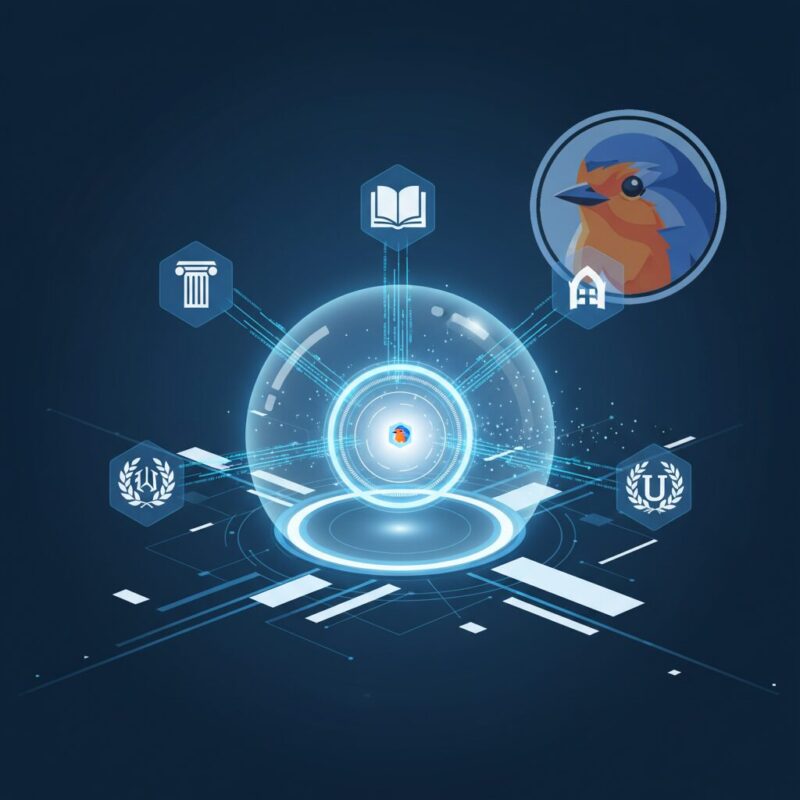
The fundamental thesis of effective 2026 grant strategy is the “Human-in-the-Loop” methodology. The most successful development teams recognize that technology should handle 80% of the heavy lifting—research, structuring, and initial drafting—while human experts reserve their energy for the final 20%: adding strategic nuance, empathy, and relationship context.
Why Human Oversight Outperforms Fully Autonomous Systems
The nuanced reality of fundraising is that grants are ultimately awarded by people, to people. While software can synthesize impact metrics and structure an executive summary, it lacks genuine human empathy and the tacit knowledge of unwritten funder preferences. A human editor is required to align that draft with complex organizational nuances and the specific relational history between the nonprofit and the foundation. For more on this, see our guide on The Ethics of Grant Automation.
Strategies to Integrate Technology Without Losing Your Voice
Generic narratives are easy to spot: they often rely on repetitive vocabulary and lack distinct organizational personality. To maintain your authentic voice, you must contextualize your tools. Feed the software your most successful past proposals, your formal brand guidelines, and specific stylistic parameters. This helps in defeating ‘AI speak’ and ensures your team maintains the passion that defines your mission.
Step-by-Step: Setting Up an Internal Knowledge Library
To power an effective human-in-the-loop system, organizations must centralize their institutional memory. According to workflows highlighted by LiveImpact: 7 Affordable Ways Nonprofits Can Use AI in 2026, establishing a central library is critical: 1) Compile Core Documents (Theory of Change, strategic plans). 2) Audit Historical Successes (5-10 winning proposals). 3) Standardize Metrics. 4) Upload to Secure Vault to serve as the exclusive grounding data for future generations.
Integrating External Data and Predictive Analytics
To achieve true strategic grant intelligence, software must look beyond your internal documents and actively ingest the massive volume of external data available in the philanthropic sector.
How Predictive Analytics Transform Prospecting
Predictive analytics for fundraising fundamentally transform how organizations identify targets. Instead of manual boolean searches that rely on guesswork, algorithmic opportunity surfacing weighs multiple variables simultaneously—geographic focus, historical giving patterns, cause alignment, and average award sizes. This analytical depth allows development directors to calculate the exact ROI of an application before committing staff time.
Utilizing Financial Data to Pinpoint Alignment
Advanced 2026 platforms integrate directly with public financial filings, such as IRS 990 data. Analysis of these datasets reveals a funder’s true capacity and historical behavior. By seamlessly integrating IRS 990 data for grant prospecting, tools can rapidly extract insights, helping nonprofits determine the mathematically appropriate ask amount. Research from Instrumentl: The Best AI Tools for Grant Writing in 2025 confirms that leveraging these financial datasets significantly sharpens strategic alignment.
The 2026 Benchmark: How FundRobin Unifies Prospecting, Data, and Drafting
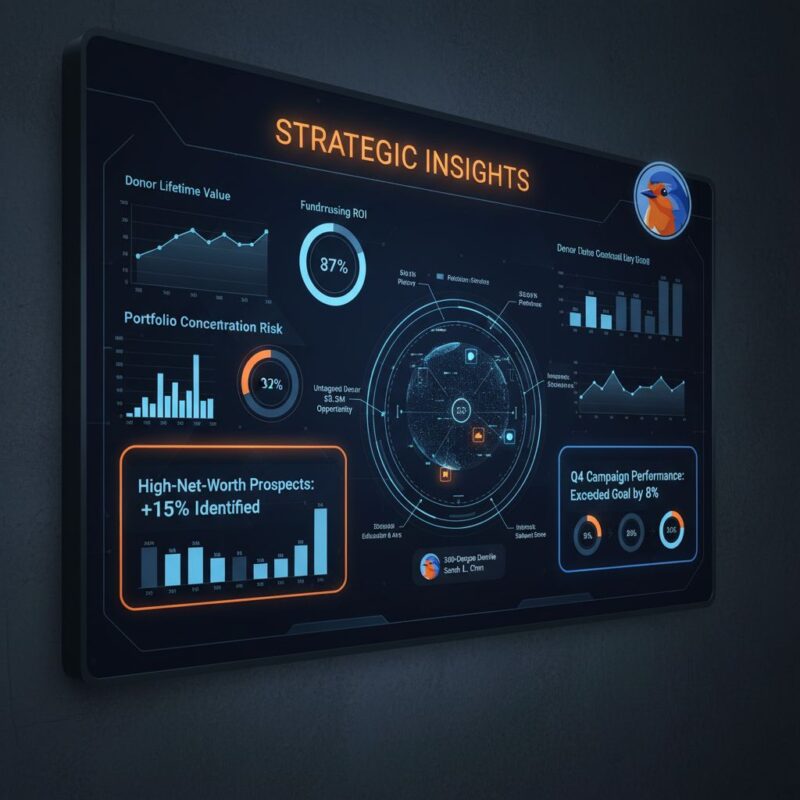
As the industry demands comprehensive solutions, FundRobin has emerged as the premier all-in-one platform that embodies the 2026 standard for strategic grant intelligence. By unifying a database of over 1,200 opportunities with secure, agentic drafting capabilities, FundRobin solves the fragmentation crisis, consistently saving organizations up to 200 hours monthly.
The End-to-End Smart Proposal Generation Process
FundRobin’s ingest process is fundamentally different from generic text generation. The system deeply analyzes specific grant guidelines, cross-references mandatory compliance sections, and generates highly tailored first drafts—ranging from executive summaries to detailed evaluation plans. You can learn exactly how Smart Proposal ensures professional quality and rigorous compliance in minutes.
Best Practices for Implementing Grant Software
Procuring the software is only the first step; successful integration requires thoughtful change management and robust data hygiene. A strategic rollout ensures your team embraces the technology rather than viewing it as an administrative burden. Leadership must frame these tools as capacity-building aids, not replacement mechanisms, to overcome staff apprehension. By curating your internal data library and adhering to the infrastructure mandate for 2026, you ensure high-fidelity, accurate generation from day one.
Frequently Asked Questions
- What is agentic prospecting? It goes beyond text generation to perform multi-step, autonomous research and pipeline management, independently searching funding databases and cross-referencing IRS 990 data.
- How to evaluate software for nonprofits? Evaluate by using a checklist focusing on integrated workflows, UK-proven compliance standards, and predictive matching accuracy.
- Are grant writers being replaced? No; their roles are evolving into strategic editors through a mandatory “human-in-the-loop” necessity.
- How to maintain authentic voice? Maintain authenticity by establishing a highly curated organizational knowledge library and heavily editing first drafts to reflect past successful narrative tones.
- Is it ethical to use automation? Yes, provided there is internal transparency, strict adherence to funder guidelines, human oversight for accuracy, and reliance on secure platforms.
Key Takeaways:
- Prioritize ‘strategic grant intelligence’ to increase win rates and save up to 200+ hours monthly.
- Adopt a strict ‘Human-in-the-Loop’ methodology to safeguard organizational voice.
- Consolidate fragmented workflows by choosing all-in-one platforms.
- Safeguard institutional data by exclusively procuring tools with zero-training policies.
- Leverage sophisticated assistants for grounded research to meet complex compliance standards.
Conclusion
The landscape of grant proposal software in 2026 has decisively moved past novelty and into the realm of operational necessity. For development teams to escape the cycle of burnout and capacity limitations, they must abandon fragmented, unsecure legacy workflows in favor of unified, strategic platforms. By embracing a human-in-the-loop approach with secure, purpose-built technology like FundRobin, organizations can safely automate the heavy lifting of prospecting and drafting, finally freeing the team to focus on the human relationships that drive long-term impact.
Recommended Reading
- The Complete Grant Writing Guide for Nonprofits — Master the fundamentals of grant writing before layering AI tools onto your proposal workflow.
- AI-Powered Multi-Agency Budget Justifications — See how AI streamlines one of grant writing’s most complex challenges: multi-funder budget compliance and alignment.
- The 80/20 Rule for Grant Writers — Maximise your grant writing ROI by combining AI automation with the Pareto principle for strategic effort allocation.

Comments
4 responses to “AI Grant Proposal Software 2026: Strategic Grant Intelligence”
[…] drafting so your human team can focus on relationship building and program impact. By adopting AI Grant Proposal Software 2026: Strategic Grant Intelligence, teams can achieve higher output with less manual […]
[…] is the 70/30 hybrid model. You offload 70 percent of the structural and compliance tasks to an NGO grant proposal AI tool. This includes initial drafting, formatting constraints, and cross-referencing donor rubrics. The […]
[…] This guide is a battle-hardened playbook for charity leaders, development managers, and trustees. It provides a framework to abandon the reactive application hamster wheel in favor of high-alignment, collaborative, and AI-optimized funding cycles. […]
[…] previously restricted non-dilutive funding to late-stage companies with massive legal budgets. AI platforms have democratized access to this capital. The FundRobin ecosystem solves the exact pain points […]