
During my time coordinating emergency responses in Cox’s Bazar, I witnessed firsthand why traditional grant discovery fails. Brilliant local organizations, doing life-saving work, were repeatedly bypassed by the United Nations and the World Bank. The barrier was never programmatic capability; it was operational compliance. Eight years managing programs across UNICEF, WFP, and the Malaria Consortium taught me that multilateral institutions prioritize risk mitigation above all else. They do not fund good ideas; they fund institutionally mature organizations that can survive an audit.
According to the United Nations Secretary-General’s 2026 Early Data Brief released in March 2026, multilateral aid distribution is increasingly consolidating toward entities that demonstrate flawless administrative frameworks. Mid-sized NGOs are caught in a cycle of reactive applications, burning hundreds of hours navigating opaque portals only to be rejected on technicalities. This guide provides the playbook to exit that cycle. By reframing the “bureaucracy tax” into a standardized system of strategic compliance, your organization can access the capital required to scale its impact.
TL;DR: To access World Bank and UN funding, NGOs must first understand the critical difference between programmatic grants and rigid procurement contracts. Building institutional maturity and utilizing AI platforms like FundRobin helps NGOs overcome the “bureaucracy tax,” allowing them to move from reactive bidding to securing sustainable, multi-year multilateral funding partnerships.
Table of Contents
- Understanding the Multilateral Funding Landscape
- Grants vs. Procurement: Deciphering the Funding Pathways
- Building Institutional Maturity and Audit Readiness
- Navigating the World Bank: From CPFs to Project Portals
- Unlocking United Nations Grants: Portals and Processes
- Mitigating the Bureaucracy Tax with Strategic Compliance
- The Strategic Funding Lifecycle: Cultivating Long-Term Donor Partnerships
How to Secure NGO Grants from the World Bank and United Nations
Understanding the Multilateral Funding Landscape
The ecosystem of international development finance is highly structured and incredibly risk-averse. To participate, NGO leaders must look past the programmatic mission and understand the rigid operational parameters set by massive donor institutions.
The Current Reality of UN and World Bank Funding
Multilateral funds operate on a scale that is difficult to contextualize. Billions of dollars are distributed annually, yet the accessibility for mid-sized NGOs remains heavily restricted. March 2026 data from the OECD Development Co-operation Directorate indicates a sustained shift toward “localization,” pushing international frameworks to fund local actors directly. However, the compliance demands attached to these funds have not decreased. This creates a paradox: the funds are designated for local action, but the portals, requirements, and due diligence checks remain scaled for massive international corporate entities.
Shifting from Transactional Grants to Strategic Partnerships
Transactional grant seeking—hunting for open calls and scrambling to write a proposal in three weeks—leads directly to team burnout. Multilateral organizations expect long-term engagement. Moving to a strategic partnership model means your NGO anticipates funding cycles before they are published. You become a trusted implementer by proving reliable reporting and consistent communication, effectively reducing the friction of all future applications.
Defining ‘Institutional Maturity’ for NGOs
Institutional maturity is the objective measurement of your organization’s internal systems. Multilateral donors require proof that your NGO can handle sudden influxes of capital without structural failure. Baseline requirements generally include at least two years of operational history, external audited financials, a documented governance board, and clear anti-fraud policies. Without these elements, no level of programmatic excellence will secure a World Bank or UN award.
The Heavy Burden of the ‘Bureaucracy Tax’
The “Bureaucracy Tax” is the exhausting administrative burden, hidden financial cost, and sheer operational drag placed on NGOs during the application phase. Every hour a senior program director spends formatting a budget to match a specific UN template is an hour taken away from field operations. This tax disproportionately affects mid-sized NGOs that lack dedicated compliance departments, often deterring them from applying entirely.
Why Official Portals Are Failing Mid-Sized NGOs
Official donor platforms are designed for transparency, regulatory compliance, and donor risk mitigation—not for user experience. Portals are often jargon-heavy and heavily siloed. A development manager might have to cross-reference three separate databases just to confirm basic eligibility. This structural friction forces NGOs to seek third-party tools and platforms that translate opaque donor requirements into actionable tasks.
Grants vs. Procurement: Deciphering the Funding Pathways
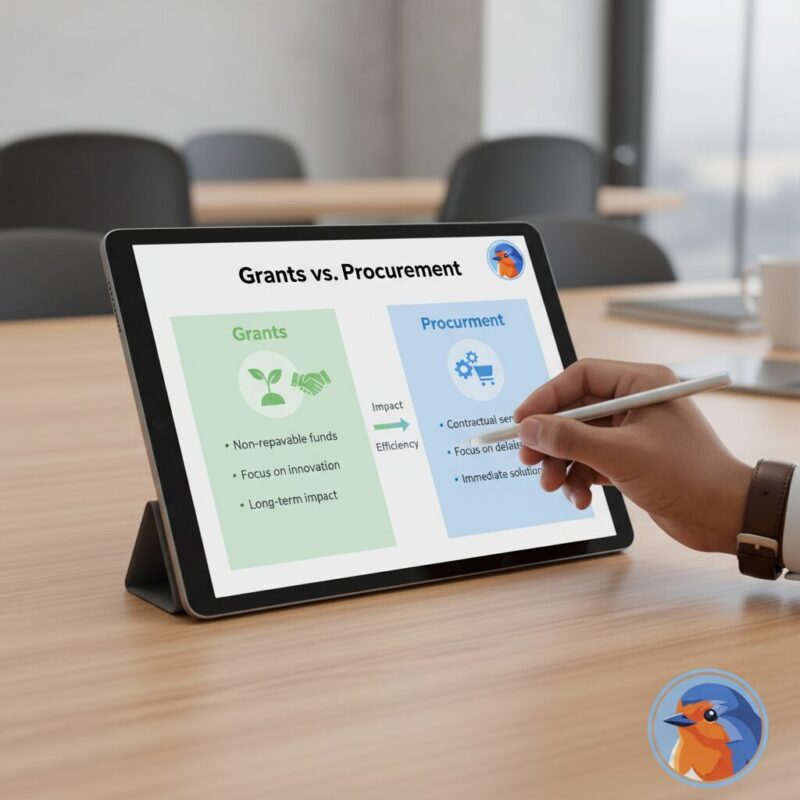
Conflating “grants” with “procurement contracts” is the single most common error mid-sized NGOs make when approaching multilateral institutions. The distinction between a grant and a procurement contract dictates your entire application strategy, compliance burden, and legal liability.
What Are Multilateral Grants?
Grants are financial assistance awards given to an NGO to support its own independent projects, provided those projects support the overarching objectives of the donor. They offer relatively higher flexibility. If a UN agency awards a grant for a community sanitation program, the NGO defines the specific approach and methodology in its proposal, assuming programmatic leadership.
What Are Procurement Contracts?
Procurement is strictly business-to-business purchasing. When a multilateral institution issues a procurement contract, they are buying specific goods, works, or services from your NGO. You are acting as a vendor. The institution sets the exact specifications, strict delivery milestones, and rigid legal terms. Procurement budgets are often significantly larger, but they require a corporate-level capacity for service delivery.
Key Disparities in Application and Bidding Processes
The application processes run on parallel, distinctly different tracks. Grant applications begin with a Request for Application (RFA) and rely heavily on narrative storytelling, theory of change, and demonstrating the “best programmatic fit.” Procurement bids start with a Request for Proposal (RFP) or Invitation to Bid (ITB). They are evaluated mathematically, often prioritizing the “lowest evaluated substantive bid.” Narrative flair matters very little in procurement; exact technical compliance is everything.
Compliance and Reporting Differences
Post-award operations differ dramatically. Grant reporting focuses on programmatic outcomes, impact measurement, and fund utilization against the approved budget. Procurement reporting focuses entirely on strict milestone delivery, verifiable timesheets, and exact specification adherence. Failing an audit on a procurement contract can result in severe financial penalties and immediate contract termination, whereas grant managers typically have more room to discuss necessary programmatic pivots.
Choosing the Right Pathway for Your NGO’s Capabilities
NGO leadership must conduct an honest capacity assessment. Mid-sized NGOs with strong community ties but limited cash reserves should target grants. Procurement contracts often operate in arrears, requiring the vendor to front the capital for operations and invoice later. Organizations should generally master the grant environment before attempting complex, highly scrutinized procurement bids.
Building Institutional Maturity and Audit Readiness
Failing post-award due diligence is the most common reason approved proposals are ultimately rejected. Treat audit readiness as a foundational asset, not a bureaucratic hurdle.
Why Institutional Capacity is the Ultimate Prerequisite
Public international bodies operate under intense scrutiny from member states. From the donor’s perspective, “fiduciary risk” is the primary threat. If an NGO mismanages funds, the political fallout hits the UN or World Bank directly. Therefore, programmatic brilliance cannot overcome operational weakness. Capacity building must be finalized before your NGO applies for funding.
Establishing Robust Financial and Fiduciary Controls
Your NGO must utilize transparent, segregated accounting systems. This exhaustive scrutiny is why having standard accounting practices, such as the International Financial Reporting Standards (IFRS) for Non-Profits, is a non-negotiable baseline. Multilateral donors will require annual external audits conducted by recognized firms. Furthermore, you must have an established, documented method for calculating indirect costs (NICRA) to ensure transparent overhead recovery.

Implementing International Safeguarding and Ethics Standards
Financial compliance is only half the equation. The UN and World Bank require uncompromising non-financial policies. Your organization must have documented and enforced policies for Protection from Sexual Exploitation and Abuse (PSEA). You must also pass Anti-Money Laundering (AML) and Anti-Terrorism financing checks, supported by robust internal whistleblower and conflict-of-interest protocols.
Creating Bulletproof Data Management and M&E Frameworks
Monitoring and Evaluation (M&E) systems must meet international standards. Donors require clear differentiation between outputs (what you did) and outcomes (what changed). Data collection methods must comply with modern privacy requirements, including GDPR equivalent standards. Your internal evidence-based Theory of Change model must clearly show how field data informs strategic decision-making.
Using Technology to Maintain Continuous Audit Readiness
Manual tracking via spreadsheets leads directly to compliance failures. Modern NGOs utilize dedicated grant management software to maintain continuous readiness. A centralized digital repository for all incorporation documents, past financial audits, and organizational policies ensures your team never panics when a donor requests a spot-check. Real-time dashboards provide role-based views that keep all stakeholders aligned on compliance status.
Navigating the World Bank: From CPFs to Project Portals
Accessing World Bank funding requires an entirely different vocabulary and strategic posture compared to standard foundation grants. You are engaging with sovereign debt structures and national frameworks.
Demystifying Country Partnership Frameworks (CPFs)
Country Partnership Frameworks (CPFs) are the central documents dictating the World Bank’s investments in a specific nation. The World Bank does not view NGOs as primary clients; it views them as potential implementing partners for a specific country’s development framework. You must locate the current CPF for your operating country and understand its core pillars. If your project does not explicitly support a stated CPF goal, the World Bank will not fund it.

Strategies to Align NGO Projects with CPFs
Reverse-engineer your proposals to fit the framework. If your NGO focuses on maternal health, but the local CPF focuses on regional infrastructure, you must position your clinics as essential social infrastructure connected to those new developments. Timing is critical. According to recent analysis by Devex 2026 Global Funding Trends, the highest leverage point for an NGO is engaging during the Systematic Country Diagnostic (SCD) phase, before the final CPF is written.
The 6 Stages of the World Bank Project Cycle Explained
The official World Bank Project Cycle Overview defines six strict stages: Identification, Preparation, Appraisal, Negotiation/Approval, Implementation, and Completion/Evaluation. NGOs have the highest chance of entry during the Preparation phase (assisting governments in designing the project) or the Implementation phase (bidding on specific service contracts). Understanding this cycle, which frequently takes 12 to 18 months, allows you to time your engagement effectively.
Decoding the Systematic Tracking of Exchanges in Procurement (STEP)
The Systematic Tracking of Exchanges in Procurement (STEP) is the mandatory digital portal for World Bank implementation. According to the World Bank STEP System Guide, NGOs must maintain an active profile here to bid on procurement contracts. Registration requires precise documentation. Once registered, NGOs can set up specific alerts for country or sector-level tenders, moving away from manual daily checks.
Identifying and Targeting Grant-Specific Trust Funds
While the World Bank primarily issues loans to governments, it also manages specific grant mechanisms known as Trust Funds. A prominent example is the World Bank Global Environment Facility (GEF). These funds operate outside the standard IDA/IBRD lending structures and frequently issue direct Calls for Proposals for NGOs. Identifying these specialized funds is the most direct route for mid-sized organizations seeking grant-based (rather than procurement-based) World Bank capital.
Unlocking United Nations Grants: Portals and Processes
The United Nations is not a single funding entity. It is a massive, fragmented ecosystem of distinct agencies, each with specific mandates, budgets, and operational portals.
Mastering the UN Partner Portal (UNPP) Ecosystem
The UN Partner Portal Official Site (UNPP) is the primary gateway for engaging with UNHCR, UNICEF, UNFPA, and WFP. NGOs must create an organizational profile and upload comprehensive due diligence documents (incorporation certificates, audits, board structures). Once verified, NGOs use the UNPP to search for and respond to specific Calls for Expression of Interest (CEI). Maintaining an updated “green” status on the UNPP is mandatory for partnership.
Navigating UNDEF and Specialized Agency Grant Opportunities
Beyond the UNPP, several UN agencies run independent grant mechanisms. The United Nations Democracy Fund (UNDEF), for example, provides direct funding to civil society organizations without requiring host government approval. The UNDEF Civil Society Grant Guidelines clearly state their distinct timeline and narrative requirements. Other specialized agencies, like UN Women or the World Health Organization (WHO), also issue independent grants that must be tracked separately from the primary UNPP ecosystem.
The Complex Reality of Sub-2% UN Success Rates
Expect intense competition. Historically, UNDEF receives thousands of applications per cycle and funds fewer than 2%. The vast majority of rejections do not stem from bad ideas, but from strict non-compliance with formatting rules, missing documentation, or a failure to clearly articulate localized context. Flawless compliance simply gets your proposal onto the reviewer’s desk; it is the absolute minimum requirement for participation.
Step-by-Step: Registering with UN DESA
Securing formal consultative status is a massive trust signal. This process is managed by the UN Department of Economic and Social Affairs – NGO Registration.
- Create a profile in the integrated Civil Society Organizations (iCSO) System.
- Submit a comprehensive summary of your activities over the past two years.
- Provide verified financial statements and a copy of your constitution.
- Apply for ECOSOC consultative status, which grants access to UN premises and specific high-level funding discussions.
Demonstrating Strategic Alignment with the UN SDGs
Paying lip service to the Sustainable Development Goals (SDGs) by pasting a colored wheel into your document results in immediate rejection. Multilateral reviewers look for deep, structural integration. You must map your specific project outcomes to precise SDG targets and indicators (e.g., matching a local education initiative specifically to Target 4.2). Your Theory of Change must explicitly reflect the vocabulary used by the UN framework.
Mitigating the Bureaucracy Tax with Strategic Compliance
Administrative exhaustion is the primary reason capable organizations abandon multilateral funding. You must transition your team from manual, painful document creation to streamlined, systemized compliance.
Quantifying the Hidden Costs of Multilateral Applications
Drafting a competitive proposal for a UN agency or a World Bank tender requires an immense investment of resources. Development managers routinely report spending 100 to 200 staff hours on a single application. According to ReliefWeb Multilateral Aid Analysis, this represents a severe opportunity cost. Having senior leadership tied up in formatting spreadsheets and verifying compliance checklists drains the very operational capacity the donor seeks to fund.
Streamlining NGO Compliance Checks and Due Diligence
The solution is a pre-built “compliance library.” Create a centralized, continually updated repository containing your NGO’s incorporation documents, audited financials, PSEA policies, and boilerplate organizational capacity statements. When a Call for Expression of Interest drops with a two-week deadline, your team should spend zero time gathering documents. Having this library ready reduces application time by half and eliminates the risk of disqualification due to missing attachments.
Leveraging AI for Rapid Needs Assessment and Alignment
Artificial intelligence is the great equalizer for mid-sized NGOs fighting the bureaucracy tax. Modern Natural Language Processing (NLP) algorithms can digest a 50-page donor guideline document in seconds, extracting the mandatory compliance requirements and core objectives. Algorithms instantly cross-reference your organization’s verified capacities against 50-page donor guidelines, returning a contextual match score. This Smart Grant Matching eliminates the wasted hours spent pursuing low-probability tenders.

Accelerating High-Stakes Proposals with AI Generation
Drafting complex narratives that strictly adhere to donor vocabulary is incredibly time-consuming. Using a specialized AI Grant Proposal Generator trained specifically on successful multilateral applications transforms this process. AI can draft highly compliant first-draft narratives, logic models, and budget justifications, cutting proposal writing time from 40 hours to under 4 hours. This grounded AI approach ensures human experts spend their time refining strategy rather than staring at a blank page.
Centralizing Multi-PI Collaboration and Documentation
Large multilateral bids frequently require international consortiums involving multiple Principal Investigators (PIs) and sub-grantees across different time zones. Managing version control over email is a guaranteed path to failure. Platforms designed specifically as FundRobin for International Organisations provide centralized collaborative workspaces. Role-based permissions ensure that regional partners can update their specific budgets while the Prime applicant maintains total control over the final submission document.
The Strategic Funding Lifecycle: Cultivating Long-Term Donor Partnerships
The ultimate goal of mastering multilateral portals is to graduate from project-based survival to proactive portfolio management.
Moving from Reactive Bidding to Proactive Pipeline Management
Reactive organizations wait for an RFP to appear on a portal before acting. Proactive organizations study World Bank CPFs and UN agency strategic plans to anticipate RFPs 12 months in advance. You must build a forward-looking funding pipeline. By tracking anticipated solicitations, your leadership team can forecast funding probabilities and align hiring and operational expansions appropriately.
Mapping Multi-Year Funding Trajectories
Winning a massive UN grant introduces a new risk: the “fiscal cliff” when that specific project ends. Financial sustainability requires staggering your applications. You must combine highly restricted, multi-year multilateral contracts with unrestricted foundational funding. This blended trajectory ensures that temporary gaps in multilateral disbursement do not force you to lay off critical field staff.
Leveraging Past Grant Performance for Future Wins
The UN and World Bank are heavily networked internally. Past performance is the most heavily weighted metric in future evaluations. Exceeding your M&E targets and submitting flawless financial reports on a small UN grant builds an institutional reputation. An NGO that successfully implements a $200,000 pilot project with perfect compliance is the immediate front-runner for a $2 million scale-up procurement contract the following year.
Structuring Multi-National Consortia for Global Bids
As project scopes increase, no single NGO has the geographic or technical reach to win independently. You must learn to build and manage competitive international consortia. Understand the strict legal difference between acting as the “Prime” applicant (holding total fiduciary responsibility to the donor) versus acting as a “Sub-recipient” (reporting only to the Prime). Strategic partnering allows mid-sized NGOs to participate in massive, multi-country World Bank tenders.
Utilizing Data Analytics for NGO Portfolio Management
Finally, apply strict data analysis to your funding strategy. Track your win/loss success rates by funder, specific grant type, and geographic region. Analyzing this data reveals your organizational strengths and exposes blind spots in your proposals. Utilizing a Smart Dashboard for real-time analytics provides instant performance benchmarking, saving development directors countless hours on quarterly board reporting and continuously refining your approach to the multilateral sector.
Frequently Asked Questions
How can NGOs access World Bank funding?
Accessing World Bank funding requires registering on their STEP portal, understanding the difference between procurement and trust fund grants, and aligning proposals with specific Country Partnership Frameworks (CPFs). The World Bank primarily funds national governments; NGOs access these funds by acting as implementing partners that execute the goals outlined in a specific country’s CPF document.
How do NGOs apply for United Nations grants?
United Nations grants are accessed primarily through the UN Partner Portal (UNPP), require registration with UN DESA, and are highly competitive, prioritizing NGOs with robust institutional maturity and audit readiness. Organizations must create verified profiles, pass rigorous due diligence checks, and submit proposals that strictly align with UN Sustainable Development Goals (SDGs) during specific Call for Expression of Interest (CEI) windows.
What is the difference between UN grants and UN procurement?
Grants are financial awards given to support an NGO’s independent project aligned with donor goals, while procurement contracts are legally binding agreements where the NGO provides specific services or goods required by the UN/World Bank. Grants allow for more programmatic flexibility and narrative reporting, whereas procurement demands exact specification adherence and strict milestone-based delivery.
How do NGOs register with the United Nations?
Create an organizational profile in the integrated Civil Society Organizations (iCSO) System, submit required compliance documents including financial audits, and apply for consultative status with ECOSOC. This centralized UN DESA registration provides the foundational vetting required to interact with major UN bodies and apply for subsequent funding opportunities.
What is the ‘bureaucracy tax’ in international grant applications?
The bureaucracy tax is the exhausting administrative burden, complex compliance requirements, and opaque navigation processes that drain NGO resources when applying for multilateral funding. This tax heavily deters mid-sized organizations, forcing them to spend hundreds of staff hours on formatting and portal navigation rather than focusing on field operations and project strategy.
How can AI help with World Bank and UN grant proposals?
AI platforms like FundRobin save hundreds of hours by automatically matching NGOs with relevant grants, analyzing complex donor guidelines, and generating compliant, high-quality proposal drafts tailored to specific multilateral requirements. By utilizing natural language processing to verify requirements, NGOs can bypass the initial manual reading phase and focus entirely on programmatic narrative refinement.
What are World Bank Country Partnership Frameworks (CPFs)?
CPFs are the central strategic documents that outline the World Bank’s development goals and investment priorities in a specific country over a set period. NGOs must align their proposals directly with these frameworks to be considered for funding, as the World Bank will only authorize resources for projects that explicitly advance the stated pillars of the active CPF.
Key Takeaways:
- The “Bureaucracy Tax” is real but manageable: Shift your mindset from seeing compliance as an administrative burden to viewing it as a strategic, competitive advantage (Institutional Maturity).
- Know your pathway: Conflating ‘grants’ with ‘procurement contracts’ is the #1 reason mid-sized NGOs fail to secure multilateral funding. Target the right vehicle for your capabilities.
- Stop reactive bidding: Align your NGO’s programmatic goals proactively with World Bank Country Partnership Frameworks (CPFs) and UN Sustainable Development Goals (SDGs) before solicitations are even published.
- Leverage AI to scale impact: Utilize platforms like FundRobin to reduce proposal writing time by up to 80%, allowing your team to focus on partnership building rather than administrative formatting.
- Audit readiness is mandatory: Ensure your financial controls, safeguarding policies, and M&E frameworks meet international standards before registering on the UNPP or World Bank STEP portals.
Mastering multilateral funding is not about changing your organization’s mission; it is about changing your operational posture. The United Nations and the World Bank control the largest pools of development capital on earth, but they are gated by immense administrative friction. By prioritizing institutional maturity, establishing rigorous compliance libraries, and leveraging AI tools to handle the heavy lifting of proposal generation, your NGO can bypass the bureaucracy tax entirely. Stop reacting to unmanageable portals and start treating compliance as the foundation for long-term, global impact.
