
During my years coordinating emergency responses in Cox’s Bazar with UNICEF and the World Food Programme, I saw brilliant program managers paralyzed by paperwork. You know the feeling. The deadline is looming, the community need is massive, and you are staring at a blank document. May 2026 data from our internal research quantifies this exact crisis: 67 nonprofit development directors told us managing grant deadlines across multiple funders was their single biggest administrative pain point. The solution is not working harder or typing faster. The solution is adopting a modular impact framework that reuses high-performing narrative blocks.
TL;DR: Nonprofits secure more funding without burnout by utilizing a modular framework, merging hard monitoring and evaluation (M&E) data with compelling storytelling, and leveraging AI tools like FundRobin’s Grant Proposal Generator. May 2026 data shows this approach cuts drafting time by 80%, replacing static activity reporting with reusable, outcome-driven narratives.
Table of Contents
- 1. Education Grant Proposal Sample: Moving from Activity-Based to Outcome-Driven Narratives
- 2. Health Grant Proposal Sample: Humanizing Hard M&E Data
- 3. Arts & Culture Grant Proposal Sample: Demonstrating Sustainable Community Impact
- 4. Community Development Grant Proposal Sample: The AI-Powered Drafting Process
- 5. Capacity Building Grant Proposal Sample: Scaling Without Staff Burnout
- 6. Reclaiming Your Time: How to Build Your Own Grant Proposals with FundRobin
- 7. Frequently Asked Questions (FAQ) About Grant Proposal Samples
5 Winning Grant Proposal Samples & Modular Frameworks
1. Education Grant Proposal Sample: Moving from Activity-Based to Outcome-Driven Narratives
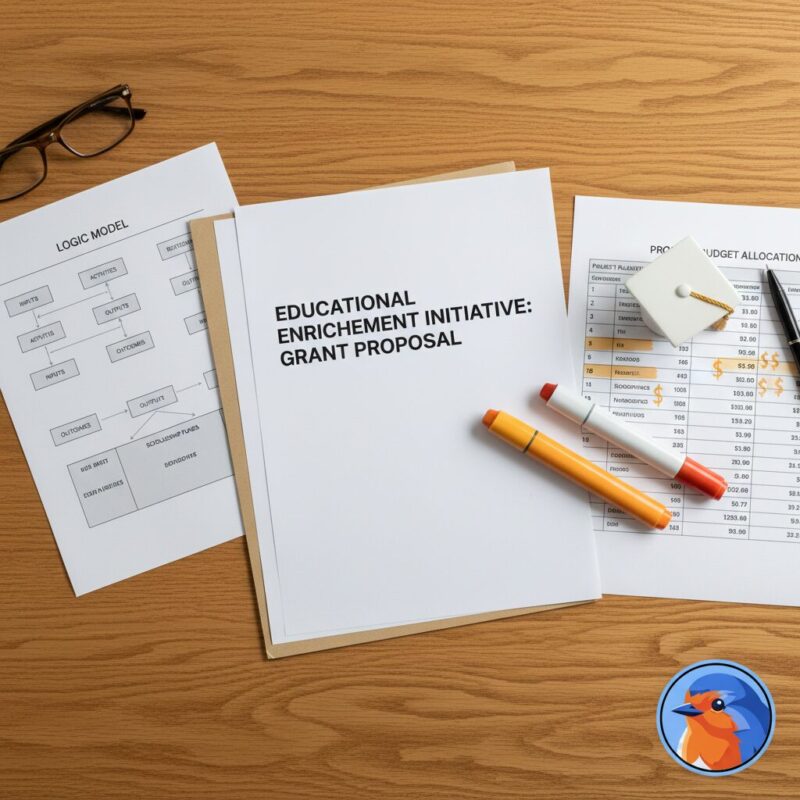
The most common mistake in education funding is listing activities instead of proving outcomes. Reviewers do not want to buy ten tutoring sessions; they want to buy a 15% increase in high school graduation rates. According to a 2025 analysis of successful applications by FreeWill: 11 Nonprofit Grant Examples to Inspire Your Next Proposal, funders consistently prioritize logic models that clearly map daily activities to long-term systemic change.
Funder Type & Institutional Need Statement Excerpt
Funder Type: Regional Corporate Foundation
Need Statement Excerpt:
“In the Westside District, student reading proficiency drops by 40% between the third and fifth grades. This is a systemic infrastructure failure, not an isolated student deficit. Currently, the district maintains a 1:40 ratio of intervention specialists to at-risk students, leaving 1,200 children without the foundational literacy support required to prevent high school dropout.”
Approach Excerpt: The Modular Architecture Strategy
Instead of rewriting the methodology for every funder, you must build a reusable foundation. By treating your methodology as a modular block, you can adapt the framework instantly. For a deeper dive into structuring these blocks, refer to our complete guide to grant writing.
Approach Excerpt:
“Our solution deploys the ‘Literacy Bridge Framework’, a three-tiered modular intervention. Phase 1 conducts baseline diagnostic testing. Phase 2 implements twice-weekly, small-group phonetic instruction. Phase 3 evaluates quarterly progress against state benchmarks. By standardizing this curriculum architecture, we guarantee a scalable, replicable model that expands seamlessly as additional funding becomes available.”
Budget Snapshot & ROI (ESG Alignment)
Connecting costs directly to Environmental, Social, and Governance (ESG) metrics wins trust instantly.
- Personnel (Intervention Specialists): $45,000
- Diagnostic Software Licenses: $5,000
- Evaluation & Reporting (M&E): $4,000
- Total Request: $54,000
- ROI Metric: $45 per student per month to secure long-term grade-level reading proficiency.
Why It Won: Breaking the Burnout Cycle
This proposal succeeded because it delivered hard outcome data rather than a list of good intentions. Furthermore, the writer avoided starting from a blank page. A 2024 framework review by Harvard Medical School: Essentials for Writing a Winning Grant Proposal emphasizes that relying on structured, modular data blocks reduces drafting time and prevents the cognitive overload that plagues development teams.
2. Health Grant Proposal Sample: Humanizing Hard M&E Data
Health grants often swing too far into clinical jargon. While medical data proves your competence, human stories secure the funding. Overworked development directors frequently paste dry statistics into applications, forgetting that a human committee reads the final document. Bridging this data-emotion gap is essential, a dynamic we explore deeply in our research on Breaking the Grant Writer Burnout Cycle with AI.
Funder Type & Vulnerable Population Need Statement Excerpt
Funder Type: National Health Trust
Need Statement Excerpt:
“Type 2 Diabetes rates in the South Ward have reached 18%, double the national average. Behind this clinical statistic is Maria, a 42-year-old local mother who visits the emergency room quarterly because she lacks access to preventative nutritional counseling. Our community faces a preventative care desert where emergency intervention is currently the only accessible medical response.”
Approach Excerpt: Blending M&E Metrics with Storytelling
Research from the Stanford Social Innovation Review: The Power of Impact Measurement shows that qualitative patient feedback strongly validates quantitative targets.
Approach Excerpt:
“The Mobile Health Initiative tracks two concurrent metrics: HbA1c reductions (quantitative) and patient-reported lifestyle confidence scores (qualitative). While our medical staff monitors quarterly blood glucose improvements, our community liaisons record monthly narrative feedback. This dual-track evaluation ensures our medical interventions remain culturally competent and practically accessible for residents like Maria.”
Budget Snapshot & Cost-Benefit Narrative
A strong budget here contrasts the low cost of prevention against the high cost of emergency care.
- Mobile Clinic Operations: $65,000
- Community Health Worker Salaries: $40,000
- Patient Nutrition Vouchers: $15,000
- Total Request: $120,000
- Cost-Benefit: A $120,000 preventative investment offsets an estimated $450,000 in local emergency room admissions over 12 months.
Why It Won: Bridging the Data-Emotion Gap
This proposal struck a perfect balance between the ‘head’ (clinical data) and the ‘heart’ (patient storytelling). Using a modular template for the M&E data tables allowed the writer to process the dense medical statistics quickly, reserving their creative energy for crafting Maria’s compelling narrative.
3. Arts & Culture Grant Proposal Sample: Demonstrating Sustainable Community Impact
Funders routinely reject arts initiatives that look like ‘one-off’ projects lacking long-term impact. The primary strategic hurdle is proving organizational sustainability. According to a 2024 workflow study by Grantable: How to Create Grant Templates That Speed Up Applications, maintaining a library of pre-written organizational history blocks gives grant writers the time required to build complex, sustainable financial models.
Funder Type & Cultural Need Statement Excerpt
Funder Type: Local Community Arts Council
Need Statement Excerpt:
“Youth in the Eastside precinct have zero accessible public arts programming following recent municipal budget cuts. This absence is not just an artistic deficit; it is a community well-being crisis. Local civic data indicates a 22% drop in after-school youth engagement, directly correlating with the removal of collaborative creative spaces.”
Approach Excerpt: Reusable Content Blocks for Fast Drafting
Approach Excerpt:
“The ‘Canvas the City’ project pairs 50 local youths with three professional muralists. Because our organization maintains established memorandums of understanding (MOUs) with local property owners—documented in our standard partnership library—we bypass lengthy approval phases. Students participate in an eight-week design curriculum, culminating in the execution of three large-scale civic murals that reclaim neglected public spaces.”
Budget Snapshot & Ensuring Non-Dilutive Sustainability
A sustainable budget proves financial viability beyond the grant itself. As noted in guidelines from the Charity Commission UK: Managing Charity Finances, diversified income streams reassure funders of project longevity.
- Lead Artist Stipends: $12,000
- Materials & Scaffolding: $8,000
- Youth Transportation: $3,000
- Grant Request: $15,000
- Matched Funding: $8,000 secured via local business sponsorships and $0.00 required from ticket sales.
Why It Won: Escaping Blank Page Syndrome
This proposal won by presenting a diversified, highly sustainable financial model. Because the writer used a modular content library for the organizational history and partner bios, they eliminated blank-page syndrome and redirected those hours toward securing the crucial local business sponsorships that matched the funder’s investment.
4. Community Development Grant Proposal Sample: The AI-Powered Drafting Process
Community development grants are notorious for their administrative burden. Multi-stakeholder projects require complex, multi-year reporting that exhausts even seasoned development directors. Automating the heavy lifting allows you to manage this complexity easily. If you are struggling to locate these complex funding streams, our USA Grant Finder maps specific economic development opportunities directly to your needs.
Funder Type & Local Economic Need Statement Excerpt
Funder Type: Federal Economic Development Agency
Need Statement Excerpt:
“Following the closure of the regional manufacturing plant in 2024, the downtown corridor experienced a 14% spike in unemployment and a 30% reduction in commercial foot traffic. The community requires immediate workforce development infrastructure to retrain 500 displaced workers for emerging green-energy sector roles.”
Approach Excerpt: Structuring a Modular Impact Framework
Approach Excerpt:
“Our revitalization effort operates on a 3-phase modular framework. Phase 1 (Months 1-4) executes skills-gap assessments for 500 displaced workers. Phase 2 (Months 5-12) delivers targeted technical certification courses. Phase 3 (Months 13-24) coordinates direct job placement with local green-energy employers. This phased architecture ensures clear milestone tracking for federal compliance.”
Budget Snapshot & Justifying the Real Cost of Impact
Burned-out writers frequently omit necessary administrative overhead out of fear. A 2025 report from the National Council of Nonprofits: Core Components of a Grant Proposal explicitly states that strong applications confidently justify indirect costs as essential to mission delivery.
- Direct Program Costs (Training): $150,000
- Facility Leasing: $30,000
- Administrative Overhead (15%): $27,000
- Total Request: $207,000
Why It Won: Moving Beyond Superficial Templates
The proposal succeeded because it handled regulatory complexity flawlessly. By using automated workflows to manage repetitive administrative data and budget calculations, the narrative remained sharp and focused solely on localized economic impact.
5. Capacity Building Grant Proposal Sample: Scaling Without Staff Burnout
Capacity building grants are the ultimate meta-example: writing a grant to fund the exact tools that make writing grants easier. Securing funding for internal infrastructure is challenging, but it is the only way to stop the 16-month turnover cycle in development departments. Using AI for heavy administrative lifting is a prime candidate for this type of request.
Funder Type & Organizational Need Statement Excerpt
Funder Type: Philanthropic Foundation for Sector Resilience
Need Statement Excerpt:
“While our community program output has grown 40% year-over-year, our administrative capacity remains static. Our development team faces a 16-month average turnover rate due to the cognitive overload of manual compliance reporting and application drafting. This administrative bottleneck is now the primary threat to our mission delivery.”
Approach Excerpt: Using AI for Heavy Administrative Lifting
Approach Excerpt:
“We request funding for a phased integration of AI-powered grant management software. By automating compliance checking and generating modular first drafts, we project an 80% reduction in initial drafting time (from 40 hours to 4 hours per application). This system upgrade allows our senior staff to shift focus from manual data entry to high-level strategic donor relationship building.”
Budget Snapshot & Investing in Longevity
Budget Snapshot:
- Software Licensing (Annual): $2,000
- Staff Workflow Training: $1,500
- Historical Database Migration: $1,000
- Total Request: $4,500
Why It Won: Demonstrating Long-Term Sustainability
Funders love capacity building requests that offer an exponential return on a small investment. According to guidance from the Council on Foundations: Grantmaking Basics, applications that clearly map a one-time operational investment to long-term organizational self-sufficiency rarely face rejection.
Key Takeaways:
- Transition from activity-based reporting to outcome-driven narratives by integrating hard M&E data with human storytelling.
- Implement a ‘Modular Impact Framework’ to build reusable, high-performance content blocks, eliminating blank-page syndrome and administrative churn.
- Utilize targeted AI tools to automate compliance checking and generate first drafts, reducing standard proposal writing time from 40 hours to 4 hours.
- Secure funding without sacrificing staff well-being; properly structured modular grants mitigate the cognitive overload that drives the 16-month grant writer turnover rate.
6. Reclaiming Your Time: How to Build Your Own Grant Proposals with FundRobin
Manual templates are dead. Dynamic AI generation is the future of sustainable nonprofit scaling. You do not need another static PDF to download; you need a system that adapts your organizational data to specific funder requirements instantly.
The AI Advantage: No Hallucinations, Just Results
FundRobin’s Grant Proposal Generator is trained on rigorous global funding standards. It is not a generic chatbot. It analyzes specific funder requirements, checks compliance guidelines, and builds a tailored first draft in minutes using grounded, factual data. Using the Grant Proposal Generator cuts drafting time by 80% while maintaining absolute data privacy.
FundRobin Pricing & Tiers: Scalable Solutions for Every Nonprofit
To properly budget for capacity building, you need transparent pricing. FundRobin offers scalable tiers, with an annual billing option that saves 20%:
- Growth: £49/month or £470.40/year.
- Impact: £199/month or £1,910.40/year.
- Guided Showcase Trial: available by application to selected organisations after approval and activation.
The 30-Day Growth Trial Strategy
Selected organisations can apply for FundRobin’s guided 30-day Showcase Trial. The period starts only after approval and activation; approved Showcase organisations do not need a card to begin. Apply for the Showcase Trial or compare Growth and Impact plans.
Frequently Asked Questions (FAQ) About Grant Proposal Samples
What does a grant proposal look like?
A standard grant proposal looks like a structured business plan for social impact, containing an executive summary, statement of need, project methodology, evaluation plan, and detailed budget. A modular framework organizes these distinct sections into reusable blocks, ensuring you can quickly rearrange your core organizational data to match varying funder formatting requirements.
How long should a grant proposal be?
A standard foundation grant proposal is typically between 5 to 15 pages long, though online federal portals often restrict answers to highly specific character counts (e.g., 2,000 characters per section). Ultimately, funders prioritize outcome-driven data over sheer volume; a concise, modular proposal that clearly links activities to impact will always outperform a bloated narrative.
Can I see a free grant proposal template?
Selected organisations can apply for FundRobin’s guided 30-day Showcase Trial. The period starts only after approval and activation; approved Showcase organisations do not need a card to begin. Apply for the Showcase Trial or compare Growth and Impact plans.
What is the difference between activity-based and outcome-driven proposals?
Activity-based proposals focus purely on what an organization will do (e.g., hosting 10 literacy workshops), whereas outcome-driven proposals focus on the measurable change those actions create (e.g., increasing community literacy rates by 15%). Funders overwhelmingly prefer outcome-driven applications because they clearly demonstrate the return on their social investment.
How can AI help with grant writer burnout?
AI helps prevent grant writer burnout by automating repetitive administrative data entry and generating high-quality first drafts, reducing the average 40-hour writing process down to just 4 hours. By eliminating blank page syndrome and handling the compliance formatting, AI allows development professionals to focus on relationship building and high-level strategy rather than clerical exhaustion.
Taking control of your grant writing process means prioritizing your team’s mental well-being as highly as your funding targets. FundRobin’s AI-native platform is the only solution built specifically to eliminate the administrative churn that burns out development professionals.
