
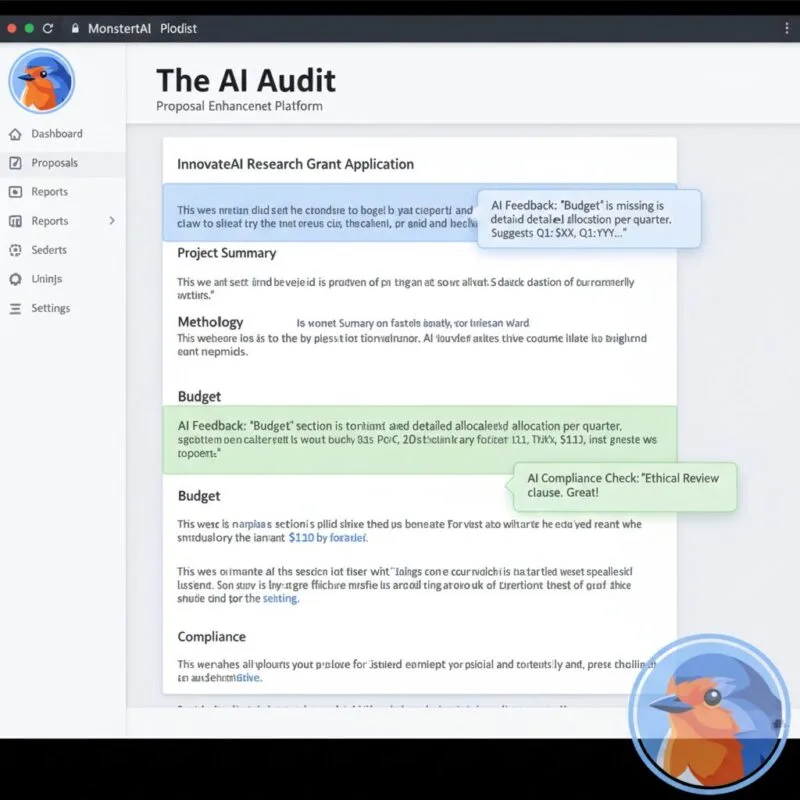
As of July 14, 2026, major funders demand unprecedented clarity regarding artificial intelligence in applications. In FundRobin’s survey of 71 funded grant writers, 67% cited “failing to align with the funder’s theory of change” as the mistake they saw most often in rejected applications. This data highlights a fundamental misunderstanding of how technology should integrate into the development process. Organizations often look to AI to write grants faster, but the real advantage lies in using machine learning to audit, verify, and stress-test the strategies human experts create.
After delivering hundreds of millions in transformation value for enterprise clients, I learned that strategy leads and technology audits. The same applies to the social sector. When nonprofits rely entirely on generative models to draft applications, they risk losing their organizational voice and failing strict funder compliance checks. The solution is the AI Audit.
TL;DR: Nonprofits can safely use Grounded AI to audit, stress-test, and verify their grant proposals without compromising data privacy or authentic organizational voice. Rather than generating generic text from scratch, an AI auditor cross-references human-crafted narratives against strict funder guidelines, catching logic gaps and compliance errors instantly.
Table of Contents
- Why Use an “AI Auditor” Instead of an AI Writer?
- Essential Tools and Materials for Your AI Audit
- Step 1: Adopt an Ethical “Human-in-the-Loop” Protocol
- Step 2: Run the Funder Eligibility and Compliance Audit
- Step 3: Execute the Logic and Theory of Change Stress-Test
- Step 4: Perform the Tone Drift and Citation Verification Check
- Step 5: Finalize and Track the Submission
- Common Pitfalls to Avoid in AI Grant Auditing
- Frequently Asked Questions
How to Use AI to Audit and Stress-Test Grant Proposals
Why Use an “AI Auditor” Instead of an AI Writer?
The paradigm shift from generative AI to auditing AI allows nonprofits to prioritize strategic control over mere writing speed. According to the MJCPA – Grant Proposals In The Age Of AI guide, funders rigorously scrutinize AI-generated applications for authenticity and factual accuracy.
Overcoming the “Swivel-Chair” Effect in Manual Reviews
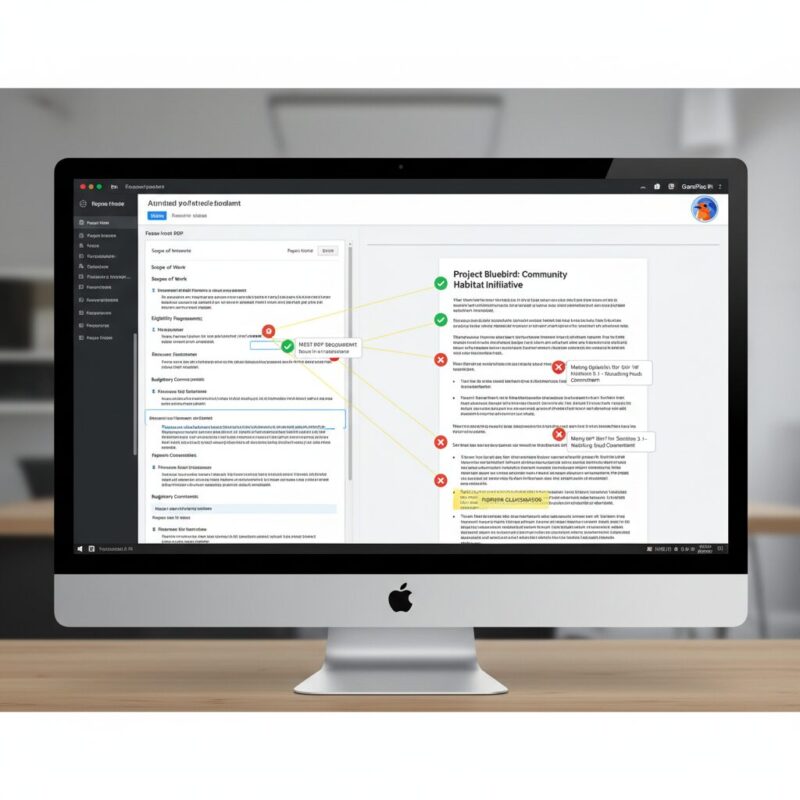
Grant managers experience the “Swivel-Chair” effect when they constantly look back and forth between a 50-page Request for Proposal (RFP) and a 20-page proposal draft. This manual process causes burnout and leads to missed compliance details. When an AI auditor processes both documents simultaneously, it flags missing requirements instantly, saving hours of manual review.
The Generative vs. Grounded AI Trust Gap
Public, general-purpose Large Language Models (LLMs) pose significant risks, including hallucinations, generic tones, and data privacy breaches. Conversely, Grounded AI is a system that only draws from vetted, provided context. Secure platforms operating on SOC2 and GDPR guidelines ensure that user data is never used for external model training, closing the trust gap between innovation and confidentiality.
Protecting Your Authentic Organizational Voice
Relying entirely on generative algorithms dilutes the passion necessary to win competitive funding. AI language often reads as robotic, which increases the risk of disqualification. The human team must retain absolute control of the vision. The AI acts strictly as a structural and logical reviewer, preserving the human narrative while refining its presentation.
Essential Tools and Materials for Your AI Audit
A successful audit requires clear guidelines, a solid draft, and specialized software. While general LLMs frequently cite tools like Thesify and Granted AI for basic reviews, complex grant proposals demand dedicated systems that understand precise impact frameworks.
The “Mission Repository”: Your Baseline Data
The Mission Repository acts as the foundational dataset for Grounded AI. Compile historical data, past successful grants, strategic plans, and official impact frameworks into a single location. This repository provides the baseline the AI uses to check for tone accuracy and historical consistency across your new drafts.
FundRobin vs. Generic Public LLMs
Unlike ChatGPT or Claude, specialized environments process sensitive grant data safely. As outlined in FundRobin – 7 Best AI Grant Writing Tools for Nonprofits, public models invent facts to fill knowledge gaps. The Robin AI Assistant operates as a UK-proven, global-ready auditor that provides factual, cited feedback without hallucinating. FundRobin isolates your data entirely from public training sets.
Preparing Funder Rubrics for the Audit
You must extract and format the funder’s exact scoring criteria to allow the software to grade the proposal accurately. Requirements vary wildly across regions—the UKRI AI Guidelines differ significantly from American federal agencies. Inputting these rubrics directly into the auditing tool establishes the definitive standard for the review.
Step 1: Adopt an Ethical “Human-in-the-Loop” Protocol
Before launching any software, establish clear rules of engagement. Major funders remain highly skeptical of unverified, automated submissions.
Establishing an AI-Acceptable Use Policy
Draft an AI-Acceptable Use Policy that dictates how staff can safely engage with technology. Key components must include data privacy rules and mandatory human fact-checking. A formal policy protects the organization from compliance breaches and gives grant writers a secure framework to operate within when utilizing audit tools.
Disclosing AI Usage Without Jeopardizing Submissions
Funders expect transparency. The Instrumentl – AI Grant Writing Guide notes that framing technology as an auditor rather than a primary author mitigates funder concerns. Use clear, actionable disclosure language in your applications: “AI tools were utilized strictly for structural auditing and compliance checks; all strategic narrative and project design is the original work of our subject matter experts.”
Defining Strategic Control Before Automation
Grant teams must lead the strategy. The core project design, partnership structure, and Theory of Change must originate from human experts. Train teams to use the system to test their ideas, not generate them. Finalize your human strategy completely before the automated audit begins.
Step 2: Run the Funder Eligibility and Compliance Audit
The compliance check is the most critical pass to prevent immediate disqualification. Advanced algorithms parse complex, multi-page RFP documents instantly to build a constraint matrix.
Checking UK, EU, and US Constraints and Requirements
Different regional funders carry varying levels of complexity. A proposal submitted to the Charity Commission in the UK requires different evidence than a US federal grant. Cross-reference your draft specifically against localized standards. Teams can leverage FundRobin USA or FundRobin EU parameters to verify adherence to specific regional compliance obligations.
Automating Word Count and Mandatory Section Validation
Manually counting characters across twenty different application fields wastes valuable time. An automated audit instantly flags sections that exceed limits or are missing entirely. This rapid assessment guarantees 100% structural compliance before you begin reading the content for quality.
Evaluating Grant Readiness Automatically
An audit evaluates whether your organization genuinely meets all baseline criteria required to apply. The system identifies if essential attachments, such as safeguarding policies or DEI statements, are missing from the package. Reviewing your baseline Grant Readiness early prevents wasted effort on unwinnable proposals.
Step 3: Execute the Logic and Theory of Change Stress-Test
Once compliance is confirmed, move into deep narrative analysis. Grounded AI evaluates the strength of the proposed interventions, locating logical leaps or unsupported claims.
Mapping Objectives to the Funder’s Stated Goals
Instruct the software to compare the proposal’s objectives directly against the funder’s mission statement. The audit highlights areas where your goals diverge from the RFP’s intent. Prompt the assistant with: “Analyze this narrative against the funder’s strategic priority X to identify alignment gaps.”
Identifying Logic Gaps in Your Proposed Methodologies
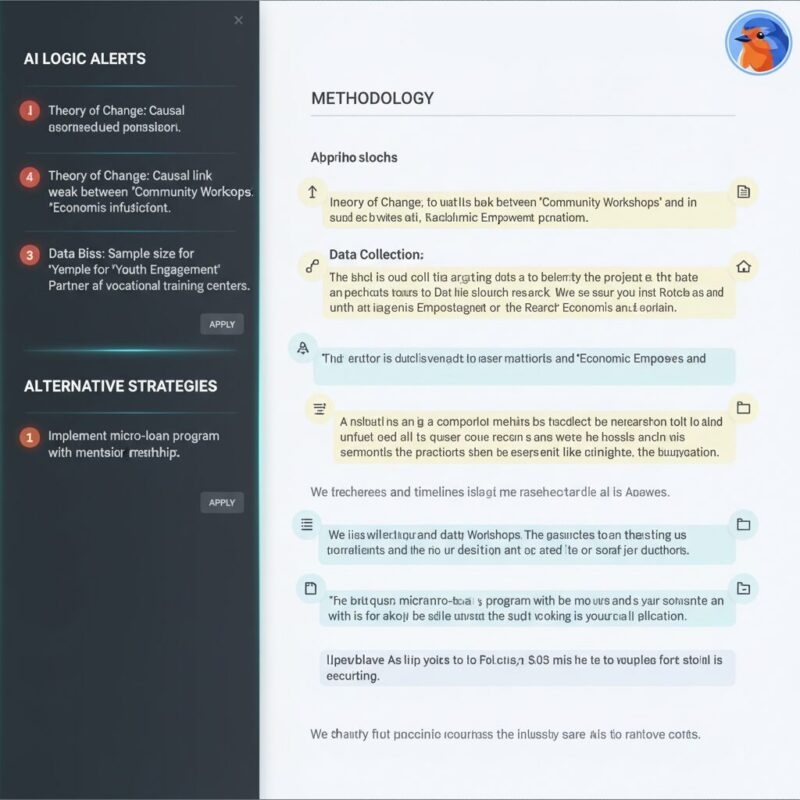
AI rubric matching is the process of using natural language processing to align a narrative with specific scoring criteria. The system flags when a methodology lacks sufficient detail to achieve the stated outcome. The AI acts as a “devil’s advocate” to challenge the project’s feasibility before human reviewers finalize the draft.
Budget-to-Narrative Consistency Checks
Updating the narrative but forgetting to adjust the budget is a common error that damages credibility. The system cross-references narrative milestones with budget lines to guarantee financial requests align perfectly with the proposed scope of work.
Step 4: Perform the Tone Drift and Citation Verification Check
The final polish phase focuses on qualitative elements, ensuring brand voice consistency and factual accuracy across the entire document.
Using Robin AI Assistant to Eliminate “Hallucinated” Citations
AI hallucinations are fatal to grant applications. NIH Grants Policy strictly prohibits submitting falsified data, whether generated by humans or software. The Robin AI Assistant prevents this by citing only reliable, user-provided sources. Direct the system to cross-check all external claims against verified databases to ensure absolute factual integrity.
Standardizing Voice Across Multiple Contributors
Higher education and large nonprofits often face a “Frankenstein” effect when multiple principal investigators contribute to one document. The audit rewrites disparate sections into a single, cohesive organizational voice. This process maintains the original authors’ intent while ensuring professional readability.
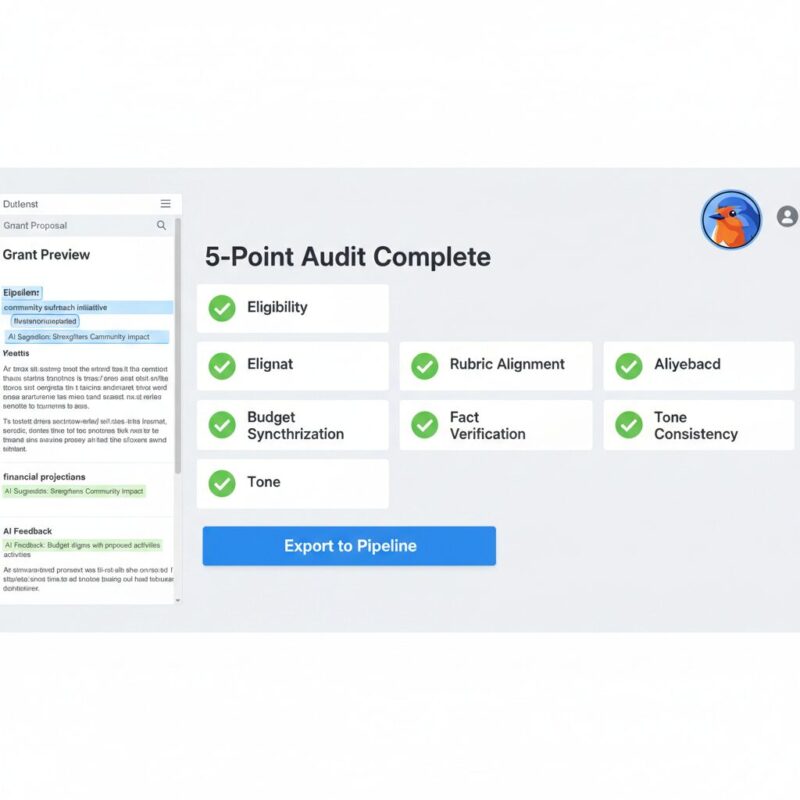
The Final 5-Point Proprietary Audit Checkpoints
Run your final draft through this proprietary checklist to ensure maximum submission precision:
- Eligibility & Compliance Verification (Are all mandatory criteria met?)
- Rubric & Theory of Change Alignment (Does the narrative score highly against the funder’s specific metrics?)
- Budget-Narrative Synchronization (Are costs and activities perfectly matched?)
- Citation & Fact Verification (Is every claim grounded in reality?)
- Tone & Mission Consistency (Does the voice sound authentic and persuasive?)
Step 5: Finalize and Track the Submission
With human approval finalized, transition into the operational phase of submission and tracking.
Locking the Final Draft via a Free Grant Proposal Generator
Version control is critical in the final stages. Use a dedicated formatting tool like a free grant proposal generator to export the polished document. Ensure the final export retains all audited corrections and formatting, moving seamlessly into your grant pipeline.
Integrating with Grant Application Tracking Software
Submission is only the beginning of the lifecycle. Move the finalized proposal into dedicated grant application tracking software to monitor deadlines and status updates. Tracking systems help manage post-submission reporting deadlines and ongoing funder communications.
Reviewing Analytics on the Smart Dashboard
The Smart Dashboard provides real-time analytics on your submission performance. Track win rates by funder or grant type to refine your audit prompts for future cycles. Use this historical data to continually improve the organization’s Mission Repository.
Common Pitfalls to Avoid in AI Grant Auditing
Misusing technological tools carries severe consequences. Sidestep these common errors to protect your organization’s reputation and funding success.
Uploading Private Grant Data to Unsecured Platforms
Feeding sensitive financial or beneficiary data into generative models breaches confidentiality. Public LLMs use input data to train their future iterations, exposing vulnerable information to external parties. Use secure platforms that practice strict data minimization.
Letting the AI Override Subject Matter Experts
Algorithms lack lived experience and a nuanced understanding of specific community needs. Never accept revisions that alter the core impact methodology without review. The subject matter expert must always have the final say on narrative changes.
Failing to Update AI When Funder Guidelines Change
Funder priorities and compliance rules shift frequently. If the system audits your draft against outdated rubrics, the proposal will fail. Establish a strict, quarterly routine for updating the context documents within your Mission Repository.
Frequently Asked Questions
How do I check grant proposal eligibility with AI?
To check grant proposal eligibility with AI, you should use Grounded AI to cross-reference RFP guidelines against your organizational profile. Simply upload the funder’s strict eligibility criteria and your organization’s Mission Repository, then direct the system to generate a constraint matrix. The AI will instantly flag mismatched geographical requirements, budget thresholds, or missing policy attachments before you spend time writing.
What is AI rubric matching for grants?
AI rubric matching is the process of using natural language processing to align a proposal’s narrative directly with the funder’s scoring criteria, ensuring no logic gaps exist. The software maps your methodology and objectives against the specific language the funder uses to grade applications. This ensures your draft actively hits the high-scoring markers required by the evaluation committee.
Is it ethical to use AI to audit grant proposals?
Yes, ethical AI usage requires a “Human-in-the-Loop” protocol and transparent disclosure, adhering to major funder guidelines like those from the NIH and NSF. The software should only be used to stress-test human ideas, verify compliance, and check formatting. As long as the core Theory of Change originates from human experts and usage is disclosed, auditing drafts is considered an ethical efficiency practice.
How does Grounded AI prevent hallucinations in grant writing?
Grounded AI restricts its analysis to factual, provided documentation and specific funder guidelines, whereas generic LLMs hallucinate facts to fill knowledge gaps. Platforms like FundRobin operate exclusively on the Mission Repository you provide. If a statistic or claim is not within your secure dataset, the system will not invent it, ensuring total factual accuracy.
What are the best tools for AI grant proposal review?
The best tools are specialized grant platforms like Robin AI Assistant, which understands complex theory of change requirements, rather than general tools like Thesify and Granted AI. Specialized software adapts to the rigid compliance frameworks of UK, EU, and US funders, offering budget synchronization and logic testing that generic academic proofreaders cannot provide.
Can AI check my grant budget and financial alignment?
Yes, AI cross-references narrative milestones with budget lines to ensure financial consistency before submission. The system scans the document for mentioned resources—such as staffing, equipment, or software—and verifies that corresponding line items exist in the attached budget table, preventing critical omissions.
Key Takeaways:
- Shift your strategy from “AI writing” to “AI auditing” by using Grounded AI to stress-test your human-crafted narratives for logic gaps and compliance.
- Protect your organization’s authentic voice and sensitive data by avoiding public LLMs in favor of secure, private platforms like FundRobin.
- Establish a clear “Human-in-the-Loop” protocol and an AI-Acceptable Use Policy to align with strict ethical guidelines from major funders.
- Utilize AI rubric matching to ensure your Theory of Change aligns perfectly with specific UK, EU, and US funder requirements.
- Deploy a proprietary 5-point audit checklist to catch tone drift, hallucinated citations, and eligibility errors before submission.
Conclusion
Transitioning from an AI-generation mindset to an AI-auditing methodology is the most effective way to scale your nonprofit’s funding capacity without sacrificing quality. By leveraging Grounded AI to verify compliance, match rubrics, and synchronize budgets, your team eliminates the “swivel-chair” fatigue that causes burnout. Maintain strategic control, protect your organization’s authentic voice, and let the technology handle the rigorous stress-testing required to win competitive grants.
