
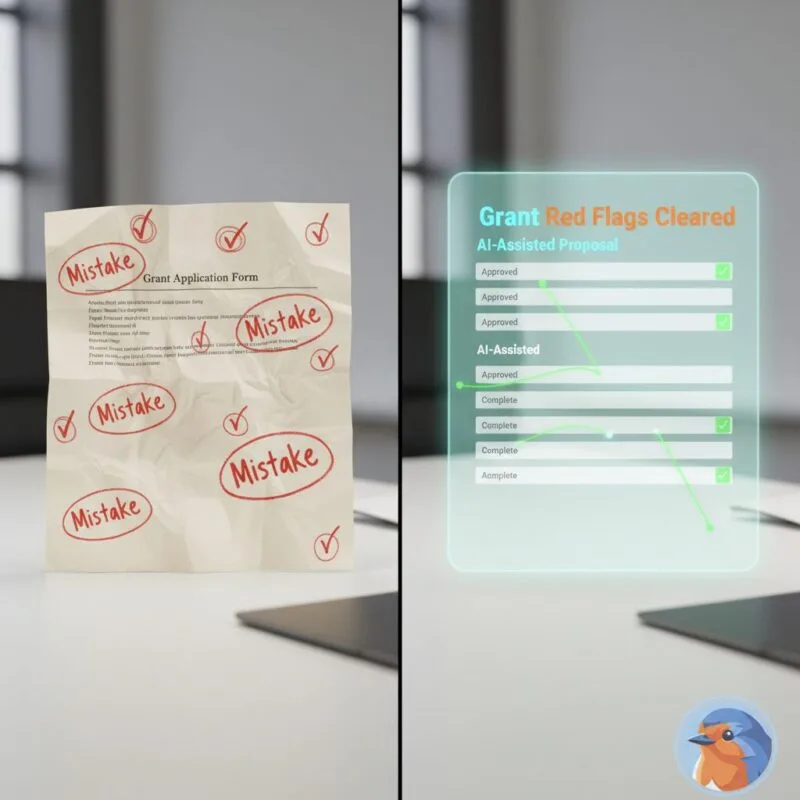
In FundRobin’s survey of 71 funded grant writers, 67% cited “failing to align with the funder’s theory of change” as the mistake they saw most often in rejected applications. The non-profit sector runs on a chronic deficit of time. Overworked development directors face blank-page paralysis daily, churning out applications to keep their organizations afloat. This exhaustion breeds repetitive, need-based writing.
As of July 2026, the philanthropic landscape is highly competitive. Program officers read hundreds of applications each funding cycle. They are not just reading for grammar; they are actively scanning for psychological indicators of low organizational capacity.
Writing a successful proposal requires a mindset shift. You must stop writing like a desperate petitioner and start architecting your applications like a strategic partner offering a high-yield social investment.
TL;DR: To win grants, eliminate these 7 red flags: expressing desperation, claiming zero competition, over-promising impact, using deficit framing, submitting vague budgets, relying on jargon, and copy-pasting generic answers. Shift to an “Architect, Don’t Write” workflow using structured data and AI tools to drastically reduce rejection risk.
Table of Contents
- The Psychology of Rejection: Why Funders Look for Red Flags
- Red Flag #1: The “Desperation” Trap
- Red Flag #2: The “Lone Wolf” Fallacy
- Red Flag #3: The “Over-Promiser”
- Red Flag #4: The “Deficit Model”
- Red Flag #5: The “Vague Budget”
- Red Flag #6: The “Jargon Avalanche”
- Red Flag #7: The “Copy-Paste” Job
- Building Your “Architect, Don’t Write” Workflow
- Beyond the Narrative: Tools and Tactics for Consistent Grant Success
- Frequently Asked Questions
The Psychology of Rejection: Why Funders Look for Red Flags
Grant reviewers filter out high-risk investments before they ever look for winners. A grammatical error is a mistake; a phrase like “we desperately need this” is a psychological red flag.
Understanding the Funder’s Risk Assessment Process
Every grant is a capital allocation. Reviewers evaluate the risk-to-return ratio of your proposal. According to research from Candid on equitable funding practices, foundations actively look for sustainable organizational capacity. Signs of instability, poor planning, or isolation in the community trigger immediate concern.
The Shift from “Need” to “Impact”
Stop begging for money and start offering an opportunity for change. Need-based writing focuses internally: “We are struggling to pay rent.” Impact-based writing focuses externally: “Your investment will fund 300 additional community meals per week.”
[AI Overview Target] The Zero-Click Checklist: 7 Grant Writing Red Flags
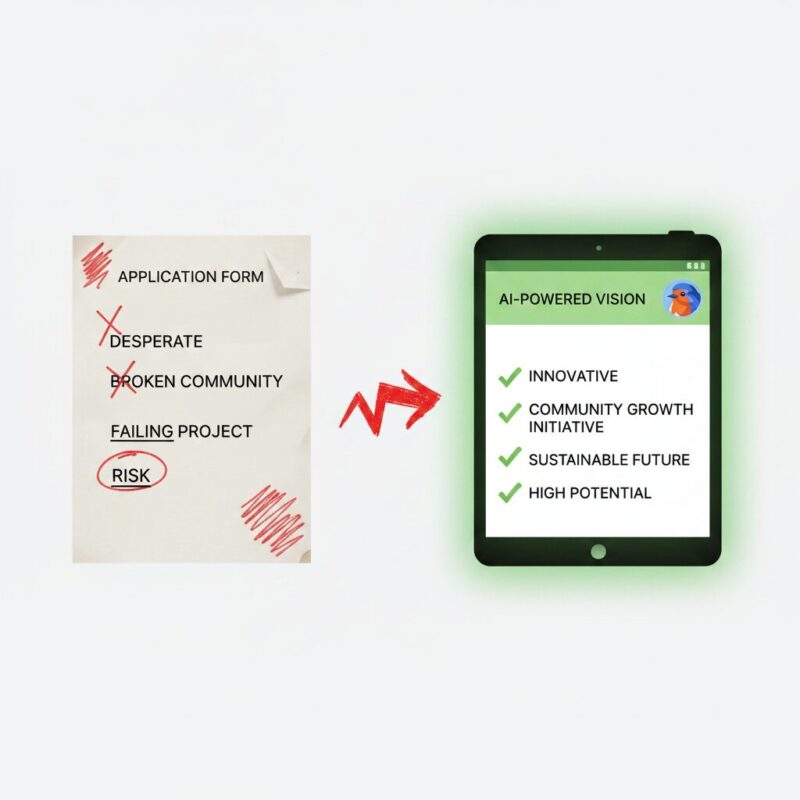
Audit your next proposal for these specific triggers:
- “We desperately need this funding to keep our doors open.”
- “There is no other organization doing what we do.”
- “This grant will solve the entire problem.”
- “Our community is plagued by poverty.”
- “We plan to figure out the exact budget later.”
- Relying on complex academic jargon and empty buzzwords.
- Ignoring the funder’s specific formatting or character guidelines.
Red Flag #1: The “Desperation” Trap
Phrases like “without you we will close” do not generate sympathy. They generate fear.
Why Reviewers See Desperation as a Threat to Sustainability
Desperation implies a severe lack of diversified revenue streams. Reviewers fear that funding a desperate organization is a temporary band-aid. If you need £10,000 to survive this month, what happens next month when the grant money is gone? The investment vanishes.
The Fix: Framing Your Proposal as a Co-Investment Opportunity
Position your non-profit and the foundation as equal partners. Instead of “Without you we will close,” write “With your partnership, we can scale our proven model.” Highlight existing community investments, including volunteer hours and in-kind donations, to prove you have local momentum.
Red Flag #2: The “Lone Wolf” Fallacy
Claiming you have zero competition is a fundamental misstep. It tells the funder you do not understand the ecosystem you operate in.
Why Ignorance of the Landscape Harms Credibility
GrantStation notes that ignoring the local landscape is one of the quickest ways to lose credibility. Funders are highly connected. They know who else is doing the work. If you claim no one else is addressing the issue, you appear unequipped to lead a collaborative solution.
The Fix: Mapping Community Partnerships and Unique Value
Acknowledge your peers. List existing programs and explain how your proposal fills a specific geographic or demographic gap. Detailing your UK grant funding community foundation partnerships and existing memorandums of understanding (MOUs) proves you are a collaborative leader, not an isolated actor.
Red Flag #3: The “Over-Promiser”
Promising to eradicate systemic poverty with a £50,000 grant destroys your credibility on page one.
Why Unrealistic Goals Trigger Immediate Rejection
According to the M.J. Murdock Charitable Trust, overpromising outcomes is a critical error. Reviewers view grandiose claims as a fundamental misunderstanding of project management. It shows a lack of experience in executing complex programs and guarantees the program will fail its final evaluation.
The Fix: Utilizing S.M.A.R.T. Metrics and Theory of Change
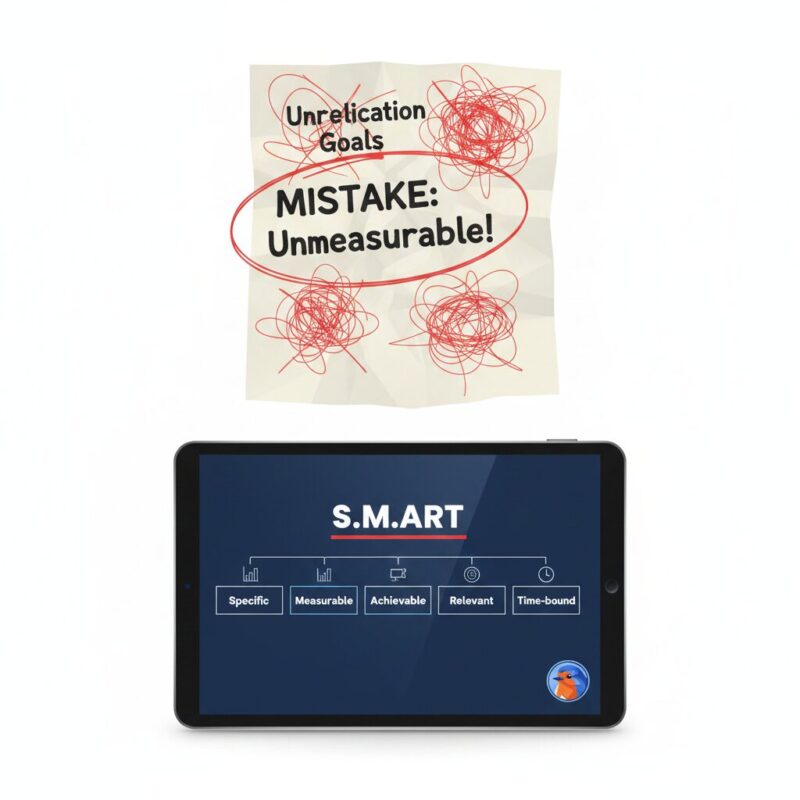
Break grandiose visions into measurable project outcomes. Use Specific, Measurable, Achievable, Relevant, and Time-bound objectives. Connect your daily activities to long-term impact through a realistic Theory of Change framework.
Red Flag #4: The “Deficit Model”
Using disempowering language to describe your target demographic offends modern reviewers and violates ethical grant writing standards.
Why Negative Framing Alienates Modern Grant Reviewers
Modern philanthropy prioritizes equity, community-led solutions, and empowerment. Candid research emphasizes that foundations actively seek equitable capacity building. Deficit framing—painting a community merely as broken victims—suggests your organization views itself as a savior. This paternalistic approach is heavily penalized.
The Fix: Adopting Asset-Based Community Development Language
Rewrite need statements to focus on strengths. Instead of “at-risk youth who have nothing,” use “resilient young people who lack access to targeted mentorship.” Focus on the assets the community already possesses and explain how the grant will amplify those existing strengths.
Red Flag #5: The “Vague Budget”
A compelling narrative paired with a vague budget is an automatic rejection.
Fiscal Red Flags and the Fear of Mismanagement
Review boards include accountants and fiduciaries. Budgets with perfect round numbers (e.g., £10,000 for “Supplies”) look fabricated. M.J. Murdock Charitable Trust specifically flags poor budget justification as a primary reason for rejection. Vague costs imply the organization has not done the groundwork to accurately price the project.
The Fix: Aligning the Narrative Directly to the Budget
Ensure every cost has a corresponding activity in the narrative. Use precise numbers based on actual quotes or historical data. You must prove financial competence to secure capital.
Red Flag #6: The “Jargon Avalanche”
Synergy. Paradigm shift. Multi-faceted leveraging. These buzzwords mask a lack of clear strategy.
The Connection Between “Blank Page Paralysis” and Jargon
When faced with a blank page, exhausted writers rely on academic filler to sound intelligent. This creates dense proposals devoid of actual substance. Reviewers read dozens of applications daily; jargon slows them down and frustrates them.
The Fix: How Grounded AI Drafts Clarify Complex Concepts
Write at an accessible reading level. If a smart high schooler cannot understand your executive summary, rewrite it. Use specialized, grounded AI tools to draft clear, concise sections based purely on your uploaded facts, entirely avoiding hallucinatory buzzwords.
Red Flag #7: The “Copy-Paste” Job
Reusing a generic proposal for every funder without tailoring it to their specific guidelines guarantees failure.
Why Generic Proposals Signal Low Organizational Capacity
Copy-pasting is immediately obvious. GrantStation highlights that failing to follow formatting or prompt directions results in immediate disqualification. Funders view a lack of customization as laziness. If an organization cannot follow application instructions, reviewers assume they will mismanage the reporting guidelines later.
The Fix: Deep Contextualization for Every Application
Map your proposal explicitly to the funder’s stated goals. Reference comprehensive grant guides to understand specific funder nuances. Modern tools automate this alignment, ensuring your proposal matches character counts and institutional priorities exactly.
Building Your “Architect, Don’t Write” Workflow
Writing from scratch causes burnout. The modern solution is to architect a central repository of data and let grounded AI handle the initial drafting.
Centralizing Institutional Knowledge
Gather your strongest past proposals, Theory of Change frameworks, and precise impact metrics into a single repository. This ensures that regardless of who handles the application, the core messaging remains consistent, accurate, and high-quality.
Integrating AI: Generating Compliant Drafts 10x Faster
Feeding your architectural data into a specialized grant proposal generator bypasses blank page paralysis entirely. FundRobin’s models evaluate your institutional knowledge against the funder’s requirements, reducing a 40-hour writing process to just 4 hours. The resulting draft is professional, compliant, and free of emotional red flags.
Ethical AI Transparency for Funders
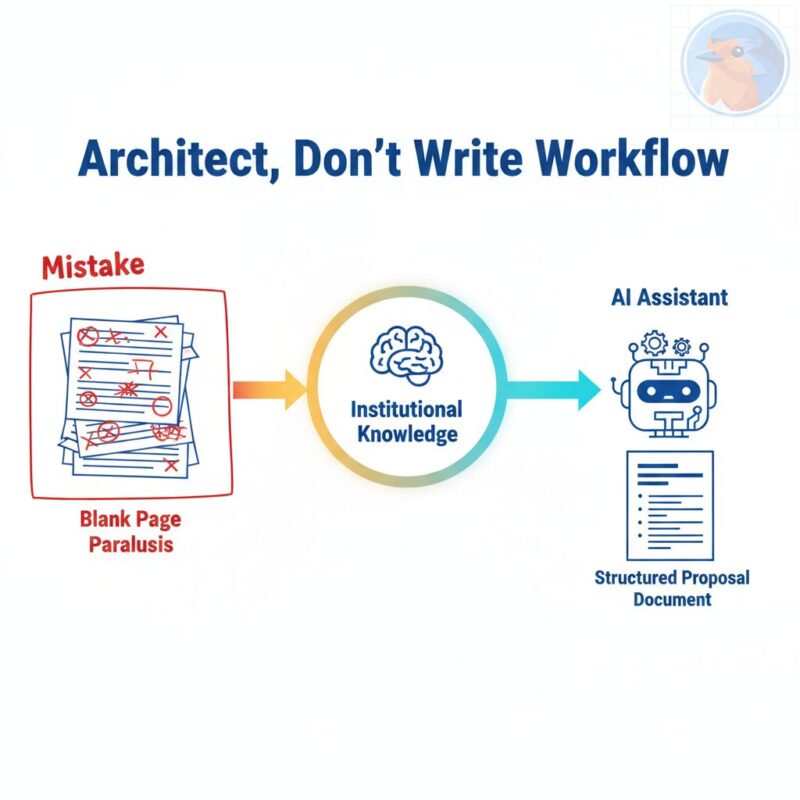
AI creates the first draft, but a human must edit, enhance, and finalize. Ethical AI usage focuses on administrative efficiency, freeing up your time to run programs and build relationships. Ensure you use secure platforms like FundRobin that never train public models on your private organizational data.
Beyond the Narrative: Tools and Tactics for Consistent Grant Success
A flawless proposal fails if the organizational relationship with the funder is weak. You must manage your pipeline aggressively.
Moving Past the Submission: Building Evaluator Relationships
Use the 200+ hours saved by AI automation to network with funders. Ask program officers questions during the open period to clarify guidelines. If rejected, request feedback immediately to refine your institutional knowledge repository for the next cycle.
Automating the Admin and Tracking Success
Utilize a centralized dashboard and grant application tracking software to monitor deadlines and win rates. Effective pipeline tracking proves to funders and your board that you have the administrative capacity to manage large financial investments.
Frequently Asked Questions
Read our full FAQ for more insights on optimizing your grant strategy.
What is the biggest red flag in a grant application?
The biggest red flag is purely need-based, desperate language. Funders want to invest in scalable impact and solutions, not just bail out struggling organizations with a temporary cash injection.
How do funders view the use of AI in grant writing?
Funders accept ethical AI use when it increases efficiency and clarity, provided the final narrative is authentic. However, AI-generated hallucinations or thoughtless copy-pasting is a massive red flag. Use grounded AI tools that draft strictly from your proprietary data.
What does it mean to “architect” a grant proposal?
Architecting means building a structured repository of institutional knowledge and impact data rather than starting from a blank page. You feed this data into an AI tool to assemble the narrative framework quickly and consistently.
Why is “need-based” language bad for grant applications?
Need-based language focuses entirely on the organization’s lack of resources, signaling low capacity and high financial risk to reviewers. It frames the grant as a survival tactic rather than an investment in community outcomes.
How can I speed up my grant writing process without losing quality?
Adopt the ‘Architect, Don’t Write’ methodology and utilize specialized, non-hallucinating AI platforms like FundRobin. This approach generates compliant initial drafts in minutes while maintaining strict fidelity to your organization’s verified data.
What should I do if my grant proposal is rejected?
Politely request reviewer feedback from the program officer, map their critiques against common red flags, and use those insights to update your institutional knowledge repository. Treat every rejection as data to improve your next submission.
Key Takeaways:
- Eliminate “need-based” language immediately. Frame proposals as high-yield co-investments in scalable impact to reduce perceived organizational risk.
- Shift from writing from scratch to “Architecting.” Build a centralized repository of institutional knowledge to ensure messaging consistency and conquer blank page paralysis.
- Avoid the “Lone Wolf” and “Deficit Model” traps by explicitly naming community partners and using asset-based language that empowers the populations you serve.
- Leverage grounded, AI-powered platforms like FundRobin to cut proposal drafting time by up to 80% while ensuring strict compliance with complex funder guidelines.
Next Steps: Eliminate Red Flags with FundRobin
Selected organisations can apply for FundRobin’s guided 30-day Showcase Trial. The period starts only after approval and activation; approved Showcase organisations do not need a card to begin. Apply for the Showcase Trial or compare Growth and Impact plans.
