
During my years coordinating emergency responses and development projects, I learned a harsh lesson about funding: passion does not win grants. Compliance does. The nonprofit sector suffers from a massive application burnout epidemic. Leaders spend hundreds of hours drafting tear-jerking narratives, only to face silent rejections from online portal gatekeepers over a missed checkbox or a non-compliant bank account.
According to FundRobin’s August 19, 2026 internal research bank, 76 nonprofit leaders told us that organizations with a documented grant strategy were 3.1x more likely to maintain consistent year-over-year funding compared to those taking an ad-hoc approach. Securing lottery funding is no longer an exercise in creative writing. It requires a consultant-level readiness audit.
TL;DR: Small nonprofits can secure lottery funding in 2026 by prioritizing administrative readiness, strictly meeting the 16-week lead time, passing online portal gatekeepers with compliant governance, and utilizing AI proposal tools. Aligning a data-driven project narrative with the funder’s strategic missions prevents the common 78% early-stage failure rate.
Table of Contents
- Why 2026 is a Defining Year for Lottery Funding Applications
- Awards for All vs. Reaching Communities: The Quick-Check Guide
- Step 1: Governance and Administrative Preparedness
- Step 2: Financial Compliance and 2026 Budgeting Rules
- Step 3: Integrating the 15% Environmental Sustainability Mandate
- Step 4: The Dual-Process Model in Action: Narrative vs. Evidence
- Step 5: Leveraging AI to Accelerate Proposal Generation
- Step 6: The 2026 Pre-Submission Readiness Audit
- Common Pitfalls: Why Small Charities Fail the Initial Review
- Expanding Your Horizon: Blended Funding Strategies
- Frequently Asked Questions About Lottery Grants (FAQ)
2026 Lottery Funding: How to Secure UK Community Grants
Why 2026 is a Defining Year for Lottery Funding Applications
The funding environment has shifted heavily. The 2023-2030 strategy implemented by major funders demands stringent operational data alongside community heart. Applicants face a 78% failure rate at the initial review stage, almost entirely due to administrative oversights rather than poor project ideas.
The 16-Week Lead Time and Changing Portal Gateways
Applications must be submitted exactly 16 weeks prior to the project start date. According to the National Lottery Community Fund – Awards for All England guidelines, the online portal filters out applications missing mandatory administrative fields instantly. Set your internal organizational deadline at the 20-week mark to allow your board ample time for final adjustments before hitting the online gateway.
Shifting from Pure Narrative to the Dual-Process Evidence Model
The “Dual-Process Model” pairs community storytelling with rigid operational data. Small charities frequently over-rely on narrative empathy and subsequently lose out to larger entities equipped with hard data. Assessors need numbers to justify awarding public money. A modern application treats the narrative as the hook and the data as the closer.
Aligning with the 4 Priorities of the 2023-2030 Strategy
Your project must map directly to the funder’s core objectives. The National Lottery Community Fund – Awards for All England explicitly lists 4 priorities: supporting communities to connect, supporting children and young people, enabling environmental action, and helping people live healthier lives. If you run a youth coding club, you must explicitly state how the technology skills you teach fulfill the priority of “supporting children and young people” to thrive in a digital economy.
Key Takeaways: Strategic ROI
- Implement a 20-week internal deadline for lottery funding applications to ensure compliance with the strict 16-week funder lead time.
- Connect every project activity directly to one of the 4 NLCF strategic priorities to prevent automated rejection.
- Shift to a data-driven Dual-Process Model to increase your organization’s win rate and reduce wasted administrative labor.
Awards for All vs. Reaching Communities: The Quick-Check Guide
Understanding which funding stream to pursue saves weeks of misdirected effort. “Awards for All” focuses on smaller, fast-turnaround community interventions, whereas “Reaching Communities” targets complex, multi-year structural changes.
Stream Complexity and Financial Funding Caps
Awards for All caps funding at £20,000 for up to one year. This makes the application process significantly leaner. Reaching Communities offers large-scale grants, frequently exceeding £10,000 per year for up to five years, but demands intensive logic models, full cost recovery spreadsheets, and advanced demographic analytics. Evaluate the ROI of the time spent applying versus the potential grant size.
Feature-by-Feature Table Comparison
| Feature | Awards for All | Reaching Communities |
|---|---|---|
| Max Grant Size | £20,000 | Over £10,000 (Multi-year) |
| Lead Time | 16 Weeks | 16-24 Weeks (Two-stage) |
| Required Evidence | Basic Budget, Local Need | Logic Models, FRS 102 Data |
| Best Suited For | Pilot projects, local events | Sector-wide interventions |
| Complexity Score | Low | High |
Determining Operational Readiness for CICs and Charities
Newly formed nonprofits and Community Interest Companies (CICs) must self-assess honestly. Do you have a track record of delivery? Do you possess multi-year audited accounts? According to the FundRobin – 2026 Guide to National Lottery Grants, newly incorporated entities should start with Awards for All to build a trusted track record with the NLCF before attempting the demanding Reaching Communities pathway.
Step 1: Governance and Administrative Preparedness
Governance is the unglamorous foundation of any successful grant bid. Assessors scrutinize your administrative data before they read a single word of your project narrative.
Passing the NLCF ‘Silent Rejection’ Check
A silent rejection occurs when your submission fails automated portal checks without ever reaching a human assessor. The three main triggers are mismatched organizational names across documents, invalid bank details, and conflicting mission statements. Fixing these costs nothing but attention to detail.
Registering Essential Identifiers (DUNS and Charity Numbers)
You need active, verifiable organizational identifiers. The Charity Commission number or Companies House registration must exactly match your application text. Additionally, many broader grant systems utilize DUNS numbers to verify corporate identities. You can quickly verify your organizational footprint using our DUNS lookup tool before beginning any major bid.
Board Readiness and Legal Structure Requirements
Legal structure pitfalls trap many well-meaning founders. The National Lottery Community Fund – Awards for All England requires a minimum of two unconnected people on your board or committee. “Unconnected” means they are not married, not living together, and not related by blood. Your governing document—whether a constitution or Memorandum and Articles of Association—must be up-to-date and signed.
Step 2: Financial Compliance and 2026 Budgeting Rules
Financial ambiguity represents the second highest cause of application failure. Your budget must prove operational viability and meticulous long-term planning.
Structuring Compliant Dual-Signature Accounts
A standard retail business account will trigger an immediate rejection. You must possess a UK-based bank account in the exact legal name of the organization, configured with at least two unconnected signatories. Banks currently take anywhere from four to eight weeks to authorize new charity accounts, so initiate this process long before you draft your proposal.
FRS 102 and Charity SORP Alignment for Smaller Nonprofits
Funders care deeply about how you record your money. While small community groups use simple cash accounting, growing charities must adhere to FRS 102 and the Charity SORP standard. Submitting accounts formatted to these standards builds immense trust with financial assessors. For a detailed breakdown of these requirements, review our Surviving FRS 102 and Charity SORP 2026 Strategy guide.
Incorporating Inflation and Core Operating Costs
A common mistake is under-budgeting to look “cheap” to the funder. Assessors view this as a lack of financial acumen. You must practice full cost recovery by including core operational overheads (rent, administration, software). For multi-year bids, factor in annual inflation rates to ensure the project remains sustainable in year three.
Key Takeaways: Financial Compliance ROI
- Ensure your bank account requires two unconnected signatories to avoid instant portal rejection.
- Practice full cost recovery by including operational overheads in every budget line item.
- Never round numbers excessively (e.g., exactly £10,000); specific pricing demonstrates thorough market research.
Step 3: Integrating the 15% Environmental Sustainability Mandate
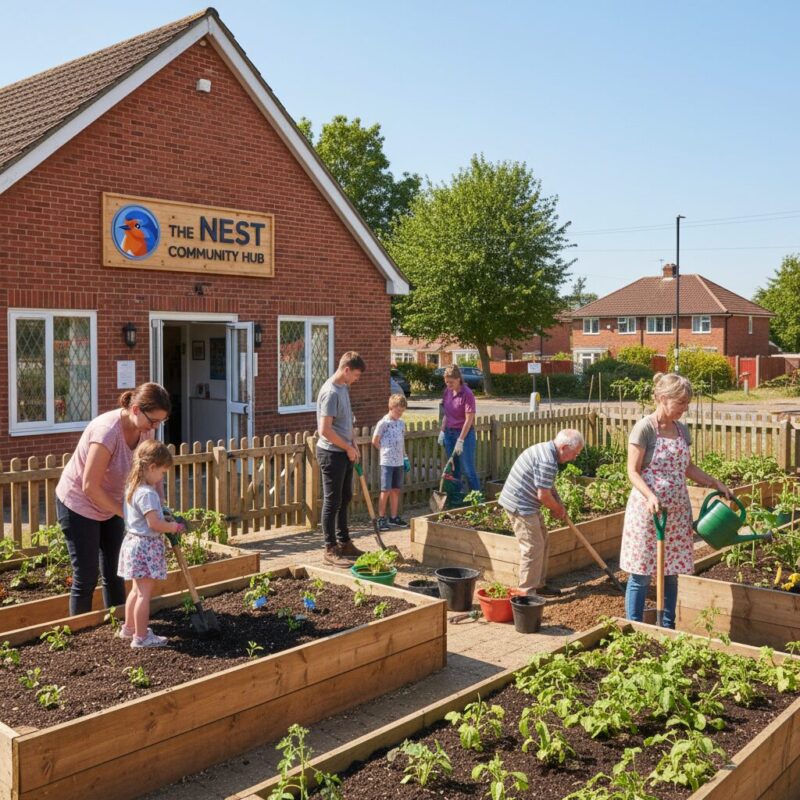
The environmental mandate is a non-negotiable component of modern lottery funding. Every project, regardless of its primary focus, must demonstrate ecological awareness.
Decoding the 15% Environmental Mandate for Small Projects
This mandate does not mean you have to change your core mission from youth mental health to climate change advocacy. It simply means allocating budget and operational effort toward reducing your specific project’s carbon footprint. According to the National Lottery Community Fund – Awards for All England, you must demonstrate how you will mitigate environmental impact locally.
Actionable Green Budget Examples for Community Initiatives
To capture this in your budget narrative, use explicit line items:
- Purchasing reusable metal catering trays instead of single-use plastics for community meals.
- Subsidizing public transport or bicycle repair vouchers for volunteers rather than paying personal car mileage.
- Using local, sustainable material suppliers for community center renovations.
Documenting and Tracking Sustainability Outcomes
Establish a baseline at the project’s inception. If your community space upgrades its insulation using the grant, track the monthly energy bills before and after the intervention. Documenting these specific outcomes provides the empirical proof assessors demand in your final report.
Step 4: The Dual-Process Model in Action: Narrative vs. Evidence
The narrative grabs the assessor’s attention; the evidence closes the deal. Integrating these two forces is the secret to winning high-value grants in 2026.
Moving Beyond Emotional Storytelling
We all know the power of a compelling human story, but tear-jerkers alone do not secure six-figure investments. Assessors are accountable for public funds. Change your framing from “We help sad children” to “We reduce local youth truancy by 15% through targeted after-school interventions, benefiting 40 families.”
Aligning Local Community Needs with High-Level Strategic Missions
Local charities frequently fail because they do not connect hyper-local issues to national agendas. You must master “micro-to-macro” alignment. If you are renovating a neighborhood park, you are not just planting trees; you are executing the NLCF priority of “enabling people to live healthier lives” by providing safe, accessible green spaces. According to the FundRobin – 2026 Guide to National Lottery Grants, mirroring the funder’s exact vocabulary in your proposal increases alignment scores.
Utilizing Data Analytics to Prove Impact and ROI
You do not need to be a data scientist to build a statistical argument. Pull free public data from the Index of Multiple Deprivation or your local council’s annual health reports. Weave this demographic data into the very first paragraph of your statement of need to establish immediate, quantified authority.
Step 5: Leveraging AI to Accelerate Proposal Generation
Manual grant hunting wastes hundreds of hours, pulling dedicated staff away from frontline impact work. Smaller organizations face a heavy penalty simply because they cannot afford dedicated, full-time bid writers.
Overcoming Resource Constraints and ‘Application Burnout’
Resource constraints suffocate innovation. Nonprofits cycle through the same repetitive writing tasks for every new application. The solution is treating AI as an administrative copilot. It does not replace human passion; it removes the friction of formatting, structure, and repetitive compliance checks.
Generating Compliant Drafts in Minutes with FundRobin
Our platform is engineered specifically for the nonprofit sector. The AI analyzes NLCF guidelines, word limits, and mandatory evidence sections to generate tailored, compliant first drafts. According to the FundRobin – 2026 Guide to National Lottery Grants, utilizing this technology reduces proposal writing time from 40 hours to just 4 hours. Organizations ready to reclaim their week can leverage the Growth tier at £49.00/month, or apply for an operator-activated 30-day guided Showcase trial to test the workflow.
Grounded AI and Maintaining Governance Standards
Generic AI tools hallucinate facts and hallucinate budgets. FundRobin utilizes “Grounded AI,” strictly limiting the system to factual, user-provided inputs and live funder data. The system operates on a secure, GDPR-compliant UK cloud setup, ensuring your sensitive organizational data is never utilized to train public models. Learn more about protecting your data in our Strategic AI Implementation Governance report.
Step 6: The 2026 Pre-Submission Readiness Audit

Never let the primary writer be the final reviewer. Your pre-submission audit simulates a professional consultant’s review process, broken into three distinct phases.
The Financial and Narrative Audit Integration
Verify that every single activity promised in the narrative has a corresponding line item in the budget spreadsheet. Check that the 15% environmental sustainability mandate is visibly funded, and confirm that your inflation calculations for multi-year projects are transparently documented.
The Administrative Pre-Flight Checklist
Revisit the triggers for silent rejection. Confirm your bank statements are dated within the last three months and clearly display the dual-signatory setup. Verify that the governing document is properly signed. Finally, ensure all contact details on the portal match your registered Charity Commission data perfectly.
Navigating the Online Portal Smoothly Without Timeouts
The technical reality of the online portal is often frustrating. Draft all answers in a separate document or within FundRobin before pasting them into the live portal to avoid session timeouts. Be hyper-aware of character limits—which include spaces—rather than just word counts. Always aim to submit the final application at least 48 hours before your internal deadline to account for unexpected technical glitches.
Common Pitfalls: Why Small Charities Fail the Initial Review
Most failures are structural. NLCF assessors process immense volumes of applications, and they look for rapid disqualifiers to manage their workload.
Misalignment with the Fund’s 4 Priorities
A project can be objectively wonderful for a community but still fail if it does not explicitly link to the specific priority definitions. Do not force the assessor to guess your alignment. State it clearly in the opening summary.
Lack of Clear, Quantifiable Project Budgets
Excessive rounding looks suspicious. Submitting a budget line for “Equipment: £2,000” demonstrates poor planning. Submitting “3x Laptops for Youth Coding Class @ £650 + £50 delivery” proves you have researched the exact costs required for delivery.
Submitting Too Close to Intended Start Dates
The 16-week rule is absolute. According to the National Lottery Community Fund – Awards for All England, the NLCF cannot fund activities that have already commenced. Pushing the timeline and requesting retroactive funding guarantees an automatic rejection.
Expanding Your Horizon: Blended Funding Strategies
Relying entirely on a single source of funding is a severe organizational risk. Use the NLCF as a foundational anchor to attract diversified match-funders.
Exploring the 2026 Capital Stack for Social Enterprises
The “capital stack” refers to the layers of financing an organization uses, including grants, loans, and equity. Securing a lottery grant provides non-dilutive capital that extends your operational runway. Social enterprises should review our analysis of the 2026 Social Enterprise Capital Stack to learn how to layer these different instruments effectively.
Partnering with Community Foundations for Match Funding
NLCF assessors look favorably upon projects that secure local match funding. Community Foundations operate differently from national lotteries, often prioritizing highly localized, rapid-deployment grants. Discover how to build these specific relationships in our guide to Community Foundation Partnerships.
Discovering New Grants with AI Finders
Keeping the funding pipeline full requires constant discovery. FundRobin’s Smart Grant Matching database analyzes over 1,200 active opportunities. Our NLP algorithm understands contextual needs, automatically matching terms like “disadvantaged youth” to “at-risk teenagers” without manual keyword guessing. You can begin exploring opportunities immediately via our Grant Finder Tool.
Frequently Asked Questions About Lottery Grants (FAQ)
How do I apply for lottery funding in 2026?
Apply via the NLCF online portal, ensuring all governance documents (DUNS, dual-signature accounts) are prepared prior to submission. According to the National Lottery Community Fund – Awards for All England, you must strictly observe the 16-week lead time and ensure your organizational identities match exactly across all submitted forms.
What are the primary priorities for big lottery funding?
The 4 core NLCF priorities are: supporting communities to connect, enabling environmental action (the 15% mandate), supporting children and youth, and helping people reach their potential. Your application must explicitly map its outcomes to at least one of these specific strategic missions to be considered for funding.
Why are lottery grants rejecting applications silently?
Applications are silently rejected by the portal’s automated systems when organizations fail administrative checks, such as lacking compliant dual-signature accounts or missing governance documents, before human assessors even read the narrative. These automated gatekeepers filter out incomplete applications to manage the fund’s massive submission volume.
How does the 16-week lead time affect project start dates?
Applications must be submitted a minimum of 16 weeks before your project officially begins, as the NLCF will instantly reject requests for retroactive funding for activities that have already commenced. According to the National Lottery Community Fund – Awards for All England, you should set internal deadlines a month earlier to ensure the portal submission clears the timeline threshold.
Can startups and social enterprises get lottery funding?
Yes, Community Interest Companies (CICs) and social enterprises can secure funding provided the project heavily serves community needs, avoids profit-distribution from the grant, and meets strict governance standards like having a distinct board. You must demonstrate that the public money is entirely ring-fenced for community benefit rather than private commercial gain.
How can FundRobin save time on lottery grant applications?
FundRobin utilizes NLP and successfully trained LLMs to automatically generate compliant, tailored first drafts of proposals, reducing manual writing time by up to 80% while checking against strict UK charity regulations. According to the FundRobin – 2026 Guide to National Lottery Grants, this allows resource-constrained teams to submit higher-quality bids without exhausting their frontline staff.
Key Takeaways: Implementation Summary
- Failing to prepare for 2026 administrative ‘gatekeepers’ results in silent rejections; investing in governance upfront secures a high-ROI grant and prevents wasted effort.
- Leveraging AI proposal tools like FundRobin can reduce bid writing time by 80%, saving over 200 hours monthly and severely cutting external consultancy costs.
- Always account for the strict 15% environmental sustainability mandate in your financial budget to align perfectly with the NLCF 2023-2030 strategic missions.
- Transition to the ‘Dual-Process Model’—mapping exact project metrics to the NLCF ‘4 priorities’ early guarantees your emotional narrative is backed by data-driven evidence.
Winning lottery funding is a test of organizational resilience and precision. By auditing your governance, budgeting for full cost recovery, and utilizing AI to shoulder the administrative burden, you transform a grueling process into a repeatable, high-ROI funding pipeline. Take control of your readiness today, and let the data prove the value of your community impact.
