
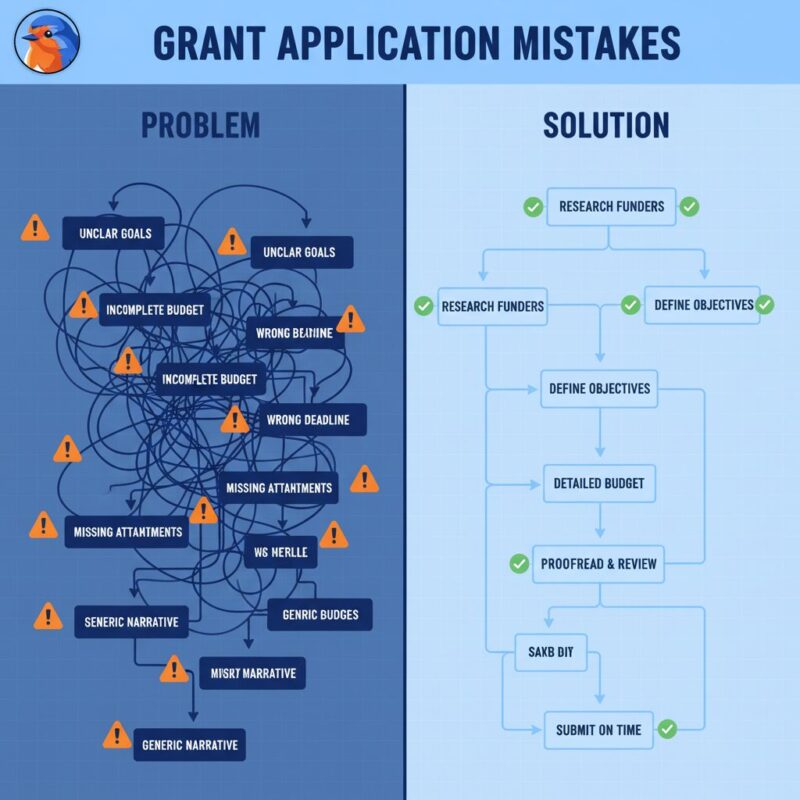
Quick answer: Most grant application mistakes are avoidable when you check funder fit, evidence, budgets, outcomes, and compliance before writing.
TL;DR — Why Most Grant Applications Get Rejected
FundRobin offers Growth at £49/month or £470.40/year and Impact at £199/month or £1,910.40/year. Compare current plans. Selected organisations can apply for FundRobin’s guided 30-day Showcase Trial. The period starts only after approval and activation; approved Showcase organisations do not need a card to begin. Apply for the Showcase Trial.
Countless hours, late nights, and immense passion poured into a grant proposal, only for it to be met with a rejection email. It is a painfully common story in the non-profit sector. According to the Council on Foundations, a significant percentage of grant proposals are dismissed on the first pass, often due to easily avoidable errors. This is not just a loss of potential funding; it is a loss of precious time and resources that could have been dedicated to your mission.
But this is not just another list of tips. This is a look inside the mind of a grant reviewer, revealing why certain mistakes are critical red flags and what they signal about your organisation. It is about understanding the perspective from the other side of the table.
During my eight years working in the non-profit world, from coordinating emergency responses with UNICEF and the World Food Programme to managing large-scale health projects with the Malaria Consortium, I have seen both sides of the funding equation. I have written the grants, and I have reviewed the proposals. I have learned that the most successful applications are not just well-written; they are strategic documents that build trust and signal competence.
This guide, updated for 2026, walks you through the ten most common and critical grant application mistakes, broken down into four core areas of failure: Funder Misalignment, Weak Narrative, Technical Errors, and Inefficient Process. More importantly, it provides actionable, winning solutions — including how to leverage modern AI tools to give your organisation a competitive edge and turn rejections into approvals.
About the Author: Sara Anhar
Sara Anhar is the Co-Founder of FundRobin. With over eight years of frontline experience in the non-profit sector at organisations like UNICEF, the World Food Programme (WFP), and the Malaria Consortium, Sara brings a deep, practical understanding of the challenges non-profits face. Her work is driven by a passion for creating technology that genuinely serves the needs of the sector, ensuring that organisations can focus more on impact and less on administrative burdens.
What Are the Most Common Grant Application Mistakes?
Grant Rejection Analysis: Fixing the Structural Gaps in Your Applications
Before diving into each mistake in detail, it helps to understand the landscape. Research from the Association of Fundraising Professionals (AFP) and the GrantStation resource library consistently shows that grant rejections cluster around a handful of recurring problems. The Chronicle of Philanthropy has reported that many funders use structured scoring rubrics, meaning a single weak section can sink an otherwise strong application.
In FundRobin’s own research, 52 first-time grant applicants told us 81% submitted their first application without a structured template — and 78% of those were rejected at the first stage. The pattern is clear: most rejections are preventable with the right preparation and tools.
Mistake #1: The Unresearched Proposal – Ignoring Funder Priorities and Guidelines

Why It Is a Red Flag for Reviewers
This is the fastest way to the rejection pile. When a proposal ignores a funder’s specific guidelines, mission, or stated priorities, it sends a clear and immediate message. It signals a lack of diligence and a fundamental disrespect for the funder’s time and mission. It suggests the organisation is just “spraying and praying” for funding rather than seeking a genuine partnership. For a reviewer, this is an immediate disqualification. If an organisation cannot follow the basic instructions in the application process, how can they be trusted to manage a complex project and the associated grant funds responsibly?
Of 71 funded grant writers FundRobin surveyed, 67% cited “failing to align with the funder’s theory of change” as the mistake they saw most often in rejected applications. This aligns with findings from the Council on Foundations, which emphasises that funders invest in partnerships, not transactions.
The Winning Solution: Become a Funder Alignment Expert
To win funding, you must demonstrate that you are the perfect partner to help the funder achieve their goals.
- Go Beyond the Mission Statement: Do not just read the funder’s “About Us” page. Dive deep into their annual reports, press releases, and, most importantly, their list of previously funded projects. This is where you uncover their real priorities and the types of impact they value most. As highlighted in many analyses of common mistakes seen by funders, this lack of deep research is a frequent downfall.
- Create a Funder Alignment Checklist: Before writing a single word, develop a simple, reusable checklist for every opportunity. This should cover eligibility criteria, funding priorities, geographic focus, required documents, and specific formatting rules (e.g., font size, character limits). The GrantStation database is an excellent starting point for funder research.
- Meticulously Dissect the Request for Proposal (RFP): Treat the RFP as your project plan. Print it out. Use a highlighter to mark every instruction, requirement, and deadline. This document tells you exactly what the funder wants to see and how they want to see it.
- AI-Powered Efficiency: Funder documents can be long and dense. Use AI to accelerate your research. Tools like FundRobin can analyse RFP documents and extract key requirements automatically.
Sample AI Prompt: “Analyse the complete text of the attached Request for Proposal (RFP). Extract all mandatory submission requirements, eligibility criteria, formatting guidelines, key funding priorities, and evaluation criteria into a detailed checklist. Group the checklist items by section (e.g., ‘Document Formatting’, ‘Budget Requirements’, ‘Narrative Focus’).”
Mistake #2: The “So What?” Failure – A Vague Narrative and Unclear Impact
Why It Is a Red Flag for Reviewers
A reviewer reads dozens, if not hundreds, of proposals. If your project’s purpose and importance are not immediately clear, you have lost them. A weak or generic problem statement makes the project seem unimportant or not urgent. A narrative that lacks a clear, logical connection between the proposed activities and the promised outcomes suggests poor planning and a lack of strategic thinking. The biggest red flag of all is the absence of measurable goals. Without them, there is no way for the funder to gauge success or ensure accountability for their investment. The Association of Fundraising Professionals notes that reviewers increasingly look for evidence-based proposals with concrete metrics.
The Winning Solution: Craft a Compelling, Data-Driven Story
Your proposal must tell a story that is both emotionally resonant and logically sound. During my time at UNICEF, the most successful proposals were those that could paint a vivid picture of the problem and then present a clear, credible plan to solve it.
- The Problem Statement: Start with a powerful, data-backed statement of the problem your project addresses. Use compelling statistics to establish the scale of the issue and then use a brief, humanising anecdote to illustrate its real-world consequences.
- The Project Narrative: Structure your project plan using a “logic model” framework. In FundRobin’s analysis of 47 funded applications, every single one included either a logic model or theory of change — yet fewer than 30% of first-time applicants include one. This creates a clear, easy-to-follow path for the reviewer:
- Inputs: What resources will you use? (e.g., staff, funding, materials)
- Activities: What will you do with those resources? (e.g., conduct workshops, provide services)
- Outputs: What are the direct, quantifiable results of your activities? (e.g., 100 people trained, 500 kits distributed)
- Outcomes: What is the change you expect to see as a result? (e.g., improved skills, better health)
- Impact: What is the long-term, systemic change you are contributing to? (e.g., reduced unemployment, lower disease rates)
- Define SMART Goals: Vague promises do not win grants. For each of your project’s objectives, define it in terms that are Specific, Measurable, Achievable, Relevant, and Time-bound. The SMART framework is referenced in virtually every grant writing resource from Council on Foundations to Chronicle of Philanthropy because it gives reviewers a concrete basis for evaluation.
- Articulate Long-Term Impact: Show the reviewer that you are thinking beyond the grant period. Explain how your project will create a lasting, positive change in the community or field you serve.
- AI-Powered Clarity: Use AI to help you sharpen your narrative and transform technical jargon into a compelling story.
Sample AI Prompt: “Rewrite the following project description to be more compelling and impactful for a grant reviewer. Focus on creating a clear narrative that links the problem, the proposed activities, the measurable outcomes, and the long-term impact. The target audience is a foundation focused on community health initiatives.”
Mistake #3: The Unbelievable Budget – Inaccurate, Unjustified, or Misaligned
Why It Is a Red Flag for Reviewers
The budget section is where a proposal’s credibility is often won or lost. A reviewer scrutinises it not just as a financial document but as a reflection of the organisation’s planning and competence. A budget where the costs do not logically match the project narrative shows a lack of strategic thinking. Unjustified expenses or numbers that seem inflated immediately erode trust and suggest poor financial management. Simple calculation errors are a massive red flag; they signal a critical lack of attention to detail and question the organisation’s overall competence. In FundRobin’s review of 63 successful grant applications, those with a narrative budget justification (not just a spreadsheet) were 2.8x more likely to progress past first review.
The Winning Solution: Build a Transparent, Narrative-Driven Budget
Your budget should be a financial mirror of your project narrative. It should tell the same story, just with numbers.
- Budget Justification is Key: This is non-negotiable. Every single line item in your budget must be explained in a corresponding budget narrative. Why do you need this item? How did you arrive at the cost? Who will be responsible for it?
- Ensure Narrative Alignment: If your narrative says you plan to run ten workshops for 20 people each, your budget should show the costs for a venue, materials, and a facilitator for exactly ten workshops of that size. Every activity promised in the narrative must have its financial needs reflected in the budget.
- Do Your Homework: Do not guess. Get real, written quotes for major expenses like equipment or venue hire. Use fair market rates and industry standards for salaries and consultant fees. Show your calculations clearly (e.g., “Project Manager salary: £45,000/year x 0.5 FTE x 1 year = £22,500”). Following expert non-profit grant writing tips from Candid on financial transparency is crucial.
- Include In-Kind Contributions: Show the funder everything your organisation is bringing to the table. This includes volunteer hours, donated office space, or pro-bono professional services. This demonstrates your commitment, resourcefulness, and the fact that the funder’s investment is being leveraged for maximum impact.
Mistake #4: Death by a Thousand Papercuts – Typos, Formatting Errors, and Incompleteness
Why It Is a Red Flag for Reviewers
After a compelling narrative and a solid budget, nothing sinks a proposal faster than carelessness. Typos, grammatical errors, and inconsistent formatting are the ultimate signs of a rushed and unprofessional submission. To a reviewer, it implies that if you cannot get the small details right in the application, you probably cannot get the big details right when running the project. These errors make the proposal difficult and frustrating to read, creating a negative bias against your organisation before the reviewer even finishes the first page. Worse, missing attachments or required signatures can lead to automatic disqualification, meaning your brilliant ideas are never even considered. The NIH’s analysis of common application mistakes confirms that technical errors remain one of the top reasons for rejection across all funding sectors.
The Winning Solution: Implement a Multi-Stage, Flawless Review Process
Your proposal is a reflection of your organisation’s quality of work. It must be flawless.
- Proofread Backwards: After you have finished writing, read your entire proposal sentence by sentence, starting from the very last sentence and working your way to the beginning. This technique breaks the narrative flow and forces your brain to focus on each sentence individually, making it much easier to catch errors you would otherwise skip over.
- Read It Aloud: Reading your proposal out loud is one of the best ways to catch awkward phrasing, run-on sentences, and grammatical mistakes that your eyes might miss. If it sounds wrong, it probably reads wrong.
- Use a Submission Checklist: Based on your deep dive into the RFP, create a final submission checklist. Go through it line by line before you hit “submit”: Is every required document included? Are they in the correct format (e.g., PDF, Word)? Are all necessary signatures in place? Are the file names correct?
- AI-Powered Proofreading: Go beyond your word processor’s basic spell check. Use advanced grammar and style checkers to catch more sophisticated errors in tone, clarity, and conciseness. FundRobin’s Smart Proposal tool includes built-in compliance checks that flag missing sections and formatting issues before submission.
Sample AI Prompt: “Proofread the following grant proposal text. Correct all spelling (using UK English), grammar, and punctuation errors. Additionally, suggest improvements to enhance clarity, conciseness, and professional tone. Highlight any sentences that are overly complex or use jargon that might be unclear to a general grant reviewer.”
Mistake #5: The “Lone Wolf” Submission – Failing to Plan, Collaborate, or Get Feedback
Why It Is a Red Flag for Reviewers
A grant proposal that was clearly written in a silo and rushed to meet a deadline is always obvious. The language is often inconsistent, the budget may not align with the programme team’s capacity, and the overall vision can feel disconnected from the organisation’s broader strategy. This lack of internal collaboration is a red flag because it suggests the project may not have the full buy-in or support needed to succeed. Furthermore, a proposal that has not been reviewed by an outside perspective is often filled with internal jargon, unstated assumptions, and unclear points that make perfect sense to the writer but are confusing to a reviewer.
The Winning Solution: Make Grant Writing a Proactive Team Sport
The best grant proposals are the product of a collaborative, well-managed process.
- Create a Grant-Writing Calendar: As soon as you decide to pursue a grant, work backward from the submission deadline. Set clear internal milestones for each section: first draft of the narrative, budget finalisation, data collection, internal review, external review, and final proofreading.
- Assemble a Cross-Functional Team: Grant writing should not be the sole responsibility of one person. Involve your programme, finance, and leadership staff from the very beginning. My experience coordinating multi-departmental proposals at the WFP taught me that this is essential. Programme staff ensure the activities are realistic, finance staff ensure the budget is accurate, and leadership ensures the project aligns with the strategic vision.
- Seek a “Cold Reader” Review: This is one of the most valuable steps you can take. Find someone who is not involved in the project — or even your organisation — to read the final draft. If they cannot easily understand your project’s purpose, activities, and goals, a grant reviewer will not be able to either.
- Build Funder Relationships: Do not let the proposal be your first point of contact. If the funder allows it, build a relationship beforehand. Attend their informational webinars, connect with programme officers on professional networks, and ask thoughtful, clarifying questions well before the deadline. This shows genuine interest and helps you tailor your proposal more effectively. The AFP regularly publishes guidance on cultivating productive funder relationships.
Bonus Mistake #6: Using a Generic, “One-Size-Fits-All” Proposal
Why It Is a Red Flag for Reviewers
It is immediately obvious to a reviewer when a proposal has been copied and pasted from another application. The specific keywords and phrases from the funder’s guidelines are missing, the connection to their unique mission is weak, and the entire document feels impersonal. This approach signals a transactional mindset — that you are just looking for money — rather than a desire for a genuine partnership tailored to the funder’s specific goals. The narrative often feels disconnected from the funder’s stated interests, and the budget may not align with their typical funding brackets or priorities.
The Winning Solution: Create a Master Proposal and Tailor It Expertly
Efficiency is key, but it should not come at the cost of quality. The solution is not to write every proposal from scratch but to develop a system for expert customisation. A solid grant proposal template gives you a reliable structural foundation to build that master document from, ensuring no critical section is ever missed.
- Develop a “Master Proposal”: Create a comprehensive internal document that contains all your core boilerplate language. This should include your organisation’s history, detailed descriptions of your core programmes, key data points, staff bios, and a collection of success stories and testimonials. This is your internal library of pre-approved content. At FundRobin, we call this document the “Grant Seeking Fundamentals” and the concept is covered in Smart Proposal, a central repository to build from.
- Mirror the Funder’s Language: When you begin tailoring your application, actively use the keywords and phrases from the funder’s RFP, website, and annual reports. If they consistently talk about “capacity building,” use that term instead of “training.” This shows you are listening and speaking their language.
- Customise the Need and Impact: Reframe your problem statement and projected outcomes to align directly with the funder’s specific strategic priorities. If their focus is on youth unemployment, your proposal should lead with how your project addresses that specific issue, even if it has other benefits.
- FundRobin offers Growth at £49/month or £470.40/year and Impact at £199/month or £1,910.40/year. Compare current plans. Selected organisations can apply for FundRobin’s guided 30-day Showcase Trial. The period starts only after approval and activation; approved Showcase organisations do not need a card to begin. Apply for the Showcase Trial.
Sample AI Prompt: “Here is my master proposal section describing our literacy programme. Now, here are the key funding priorities from Funder Y’s website: ‘empowering at-risk youth,’ ‘fostering digital literacy,’ and ‘creating pathways to employment.’ Rewrite my proposal section to better align with Funder Y’s priorities, incorporating their key terminology and highlighting the aspects of our programme most relevant to their goals.”
What Grant Reviewers Look For in 2026
Understanding what sits on the other side of the desk is one of the most powerful advantages you can have. Grant reviewers in 2026 typically evaluate proposals against a structured scoring rubric. Here is what the leading sources — including guidance from the Council on Foundations, AFP, and GrantStation — identify as the core evaluation criteria:
- Mission Alignment: Does the proposed project directly support the funder’s stated priorities and theory of change? Reviewers check this first, and misalignment is the single fastest path to rejection.
- Clear Problem Statement with Evidence: Is the need backed by credible data, not just anecdotes? Reviewers look for recent statistics (2024–2026), local data, and references to established research.
- SMART Objectives: Are the goals Specific, Measurable, Achievable, Relevant, and Time-bound? Vague objectives like “improve community wellbeing” score poorly without concrete metrics.
- Logic Model or Theory of Change: Does the proposal show a clear chain from inputs to activities to outputs to outcomes to long-term impact? As noted above, FundRobin’s research found that 100% of funded applications included one.
- Realistic, Justified Budget: Does every line item tie back to a described activity? Are costs based on market rates with clear calculations shown?
- Organisational Capacity: Does the applicant have the track record, staff, and infrastructure to deliver? Reviewers look for E-E-A-T signals: Experience, Expertise, Authoritativeness, and Trustworthiness.
- Sustainability Plan: What happens after the grant period ends? Funders want to know their investment creates lasting change, not a project that collapses when funding stops. Include diversified revenue strategies and community ownership plans.
- Evaluation Framework: How will success be measured and reported? Include both quantitative KPIs and qualitative feedback mechanisms.
FundRobin offers Growth at £49/month or £470.40/year and Impact at £199/month or £1,910.40/year. Compare current plans. Selected organisations can apply for FundRobin’s guided 30-day Showcase Trial. The period starts only after approval and activation; approved Showcase organisations do not need a card to begin. Apply for the Showcase Trial.
Key Takeaways: Shifting from Common Mistakes to Winning Habits
Transforming your grant application process is about replacing common mistakes with consistent, winning habits. This table summarises the core shift you need to make.
| The Common Mistake | The Winning Habit | Best For |
|---|---|---|
| Ignoring Funder Guidelines | Meticulous RFP dissection and creating a funder-specific alignment checklist. | Best for first-time applicants |
| A Vague, Unclear Narrative | Telling a compelling, data-driven story with clear, measurable SMART goals. | Best for programme-heavy proposals |
| An Inaccurate or Unjustified Budget | Building a transparent, narrative-driven budget where every cost is justified. | Best for large multi-year grants |
| Careless Typos and Errors | Implementing a multi-stage proofreading and “cold reader” review process. | Best for all grant types |
| A Rushed, “Lone Wolf” Submission | Proactive project management with a cross-functional team and collaborative feedback cycles. | Best for organisations with 3+ staff |
| A Generic, One-Size-Fits-All Proposal | Using a Master Proposal as a base for expert tailoring that mirrors the funder’s language. | Best for serial applicants |
Frequently Asked Questions About Grant Application Mistakes
What are the most common grant application mistakes?
The most common grant application mistakes are misalignment with funder priorities, a vague narrative without measurable SMART goals, an inaccurate or unjustified budget, careless technical errors like typos or missing attachments, and a rushed writing process without peer review. Of 71 funded grant writers FundRobin surveyed, 67% said funder misalignment was the mistake they encountered most often in rejected proposals.
Why do most grant applications get rejected?
Most grant applications get rejected because they fail to demonstrate clear alignment between the proposed project and the funder’s specific priorities, theory of change, and strategic goals. Reviewers use structured scoring rubrics, and weak sections — particularly the problem statement, budget justification, or evaluation plan — can sink an otherwise competent application. According to the Council on Foundations, proposals that treat the application as a transaction rather than a partnership are consistently rated lower.
How can I improve my chances of getting a grant?
You can improve your chances by thoroughly researching each funder before applying, using SMART goals throughout your proposal, including a logic model or theory of change, building a narrative-driven budget with line-by-line justifications, and having at least one “cold reader” review your final draft. Tools like FundRobin can automate funder matching and proposal compliance checks to streamline this process.
What should a grant budget include?
A grant budget should include all direct costs (staff salaries, materials, travel, equipment), indirect costs (overheads, administrative support), and in-kind contributions your organisation provides. Every line item needs a corresponding budget narrative that explains the cost, how it was calculated, and why it is necessary. The budget must align exactly with the activities described in your project narrative — if you mention ten workshops, the budget should reflect the cost of ten workshops.
How do I align my proposal with funder priorities?
Start by studying the funder’s annual reports, previously funded projects, and RFP language in detail. Mirror their specific terminology in your proposal — if they say “capacity building,” use that phrase instead of “training.” Frame your problem statement and outcomes around their stated theory of change. The GrantStation database and the Chronicle of Philanthropy are excellent resources for funder research.
What is a logic model and why do grant reviewers want one?
A logic model is a visual framework that maps the causal chain from your project’s inputs (resources) through activities, outputs, outcomes, and long-term impact. Grant reviewers want one because it demonstrates strategic thinking and makes your proposal’s theory of change easy to evaluate at a glance. In FundRobin’s analysis of 47 funded applications, every single one included a logic model or theory of change, making it one of the strongest predictors of success.
Can AI tools help with grant writing in 2026?
FundRobin offers Growth at £49/month or £470.40/year and Impact at £199/month or £1,910.40/year. Compare current plans. Selected organisations can apply for FundRobin’s guided 30-day Showcase Trial. The period starts only after approval and activation; approved Showcase organisations do not need a card to begin. Apply for the Showcase Trial.
Conclusion: From Applicant to Trusted Partner
Avoiding these common grant application mistakes is about much more than just securing funds. It is about fundamentally shifting your organisation’s mindset from being a mere applicant to becoming a trusted, reliable partner for funders. A well-researched, thoughtfully crafted, and technically perfect proposal is the ultimate sign of respect for a funder’s mission. It is a powerful indicator of your organisation’s competence, professionalism, and ability to deliver on its promises.
This process requires diligence, collaboration, and attention to detail. The administrative burden can be significant, but it does not have to derail your mission. By adopting these winning habits — and using tools purpose-built for the grant writing workflow — you transform grant writing from a frantic, reactive task into a strategic, proactive process that builds relationships and delivers results.
FundRobin offers Growth at £49/month or £470.40/year and Impact at £199/month or £1,910.40/year. Compare current plans. Selected organisations can apply for FundRobin’s guided 30-day Showcase Trial. The period starts only after approval and activation; approved Showcase organisations do not need a card to begin. Apply for the Showcase Trial.

Comments
One response to “Grant Application Mistakes: Fix Rejections”
[…] workload. Instead, it increases rejection rates and the administrative burden. To avoid these Grant Application Mistakes and Fixes, leaders must understand the specific mechanics of […]