
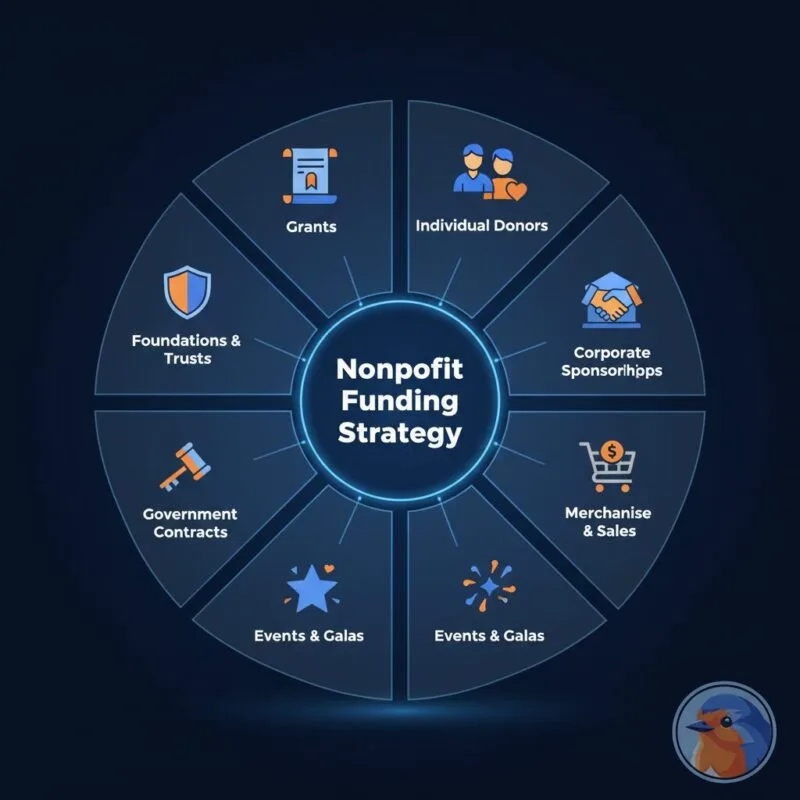
After delivering £200M+ in transformation value for FTSE 100 clients, I learned a difficult truth: treating a nonprofit differently than an enterprise business guarantees failure. Organizations attempting to survive solely on rolling grant cycles are mathematically planning for their own collapse.
As of May 04, 2026, the data confirms this reality. In FundRobin’s May 2026 survey of 58 nonprofits, 74% cited finding the right grant as their biggest operational challenge—yet only 12% use AI-powered matching tools. Furthermore, 67 development directors told us managing grant deadlines is their single biggest administrative pain point. The traditional funding playbook is broken. Nonprofits need a strategic overhaul, transitioning from a survivalist, grant-dependent mindset to a scalable, tech-forward business model.
TL;DR: The 2026 Sustainable Resilience Framework requires nonprofits to cap any single revenue stream at 33% of their total budget. By diversifying across seven channels—grants, major gifts, recurring donors, earned income, corporate partnerships, events, and endowments—and utilizing platforms like FundRobin, organizations can replace burnout-heavy grant cycles with efficient, multi-stream financial stability.
Table of Contents
- The Shift to Sustainable Resilience in 2026
- 1. Grants & Foundation Funding
- 2. Major Gifts & High-Net-Worth Individuals
- 3. Recurring Donors & Individual Giving
- 4. Earned Income & Social Enterprise
- 5. Corporate Partnerships & Sponsorships
- 6. Special Events & Peer-to-Peer Fundraising
- 7. Endowments & Planned Giving
- The 2026 Nonprofit Revenue Maturity Model & Pricing
7 Revenue Streams for Sustainable Nonprofits in 2026
The Shift to Sustainable Resilience in 2026
The “grant-only” survival model is dead. For decades, nonprofits operated on a reactive cycle: win a grant, expand programming, drain the funds, and frantically search for replacement capital. This cycle causes systemic burnout and leaves vulnerable communities at the mercy of unpredictable funding shifts.
We must pivot to the Sustainable Resilience Framework. According to the Nonprofit Finance Fund: 2026 Nonprofit Trends, organizations that proactively diversify their income are three times more likely to survive economic downturns. The cornerstone of this framework is the 33% Rule: no single revenue stream should account for more than 33% of your total operating budget. If a government grant makes up 80% of your funding, you do not have a business model; you have an administrative contract.
Artificial Intelligence is the great equalizer in modern fundraising. It eliminates the friction of managing multiple revenue streams simultaneously. By automating compliance, proposal generation, and donor stewardship, AI allows executive directors to focus on high-leverage relationship building rather than administrative triage.
1. Grants & Foundation Funding
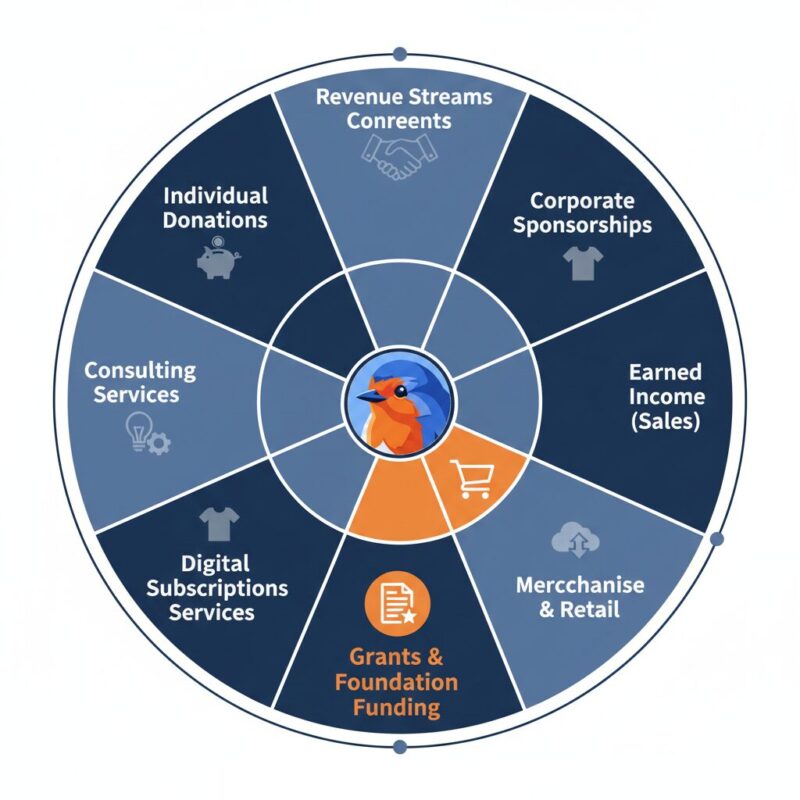
Grants remain a foundational revenue stream, but the acquisition strategy has fundamentally changed. The modern approach requires “Strategic Refusal”—the discipline of aggressively declining misaligned, compliance-heavy funding. Writing a grant proposal for low-probability grants is a negative-ROI activity that actively harms your organization’s capacity.
How it works: Strategic Refusal means only applying for grants where your programmatic data perfectly matches the funder’s historical giving profile. You stop chasing every dollar and start pursuing the right dollars.
Benchmark: Grants should represent 20% to 30% of your total budget, safely below the 33% threshold. According to 2026 data from the Nonprofit Finance Fund, organizations exceeding this threshold report severe staff retention issues due to reporting burdens.
Best for: Organizations with specific, project-based needs, capital campaigns, and highly measurable impact metrics.
FundRobin Tool Support: FundRobin’s grant finder uses advanced NLP context matching—not just basic keyword searches—to identify high-probability opportunities. Furthermore, our Smart Proposal Generation reduces 40 hours of writing to just 4 hours, increasing success rates by over 60% while maintaining rigorous UK data privacy standards. For North American users, our USA grant finder applies these same enterprise-grade AI capabilities to federal and state databases.
2. Major Gifts & High-Net-Worth Individuals
Major gifts represent the shift toward private impact capital. High-net-worth individuals no longer give simply out of goodwill; they view their donations as investments in social outcomes. They require the same level of reporting and ROI justification they expect in their business ventures.
How it works: You secure major gifts by proving Impact ROI. You must draw a straight, mathematically sound line between a donor’s contribution and a verified outcome. According to Pivot CPAs: 2026 Nonprofit & Higher Education Industry Predictions, major donors now prioritize organizations that present data-driven dashboards over traditional emotional appeals.
Benchmark: Major gifts typically account for 15% to 25% of a healthy, diversified budget. Building this pipeline requires an 18-to-24-month ROI timeline.
Best for: Mid-to-large nonprofits with established community trust, dedicated executive outreach, and rigorous impact tracking.
FundRobin Tool Support: Major donor cultivation requires highly personalized documentation. The Robin AI Assistant—a grounded, non-hallucinating 24/7 AI—instantly drafts tailored proposals and impact reports. You can quickly generate a compelling case for support that aligns your operational data with a specific donor’s philanthropic thesis, completely preserving the human element of the relationship.
3. Recurring Donors & Individual Giving
The era of the sporadic, one-off donation appeal is ending. Modern nonprofits are transforming individual giving into subscription-based models driven by Unified Digital Commerce.
How it works: You transition donors from annual appeals to frictionless monthly subscriptions. Research from NonprofitPRO: 7 Nonprofit Trends Shaping the Sector in 2026 shows that organizations adopting Unified Digital Commerce see a 40% increase in donor lifetime value. This model uses a “Virtual Engagement Officer”—automated, personalized digital touchpoints—to maintain donor retention without requiring manual staff outreach for every $15 gift.
Benchmark: Recurring individual giving should constitute 15% to 20% of your total revenue. This provides the predictable, unrestricted cash flow necessary to build your nonprofit reserves policy and cover operational overhead.
Best for: Organizations with strong grassroots support, highly emotional cause areas (like animal welfare or disaster relief), and high digital engagement.
FundRobin Tool Support: FundRobin’s Smart Dashboard analytics track your entire funding pipeline in real time. By automating the heavy lifting of grant administration, your development team reclaims dozens of hours each week. They can redirect this time toward individual donor stewardship and community building.
4. Earned Income & Social Enterprise
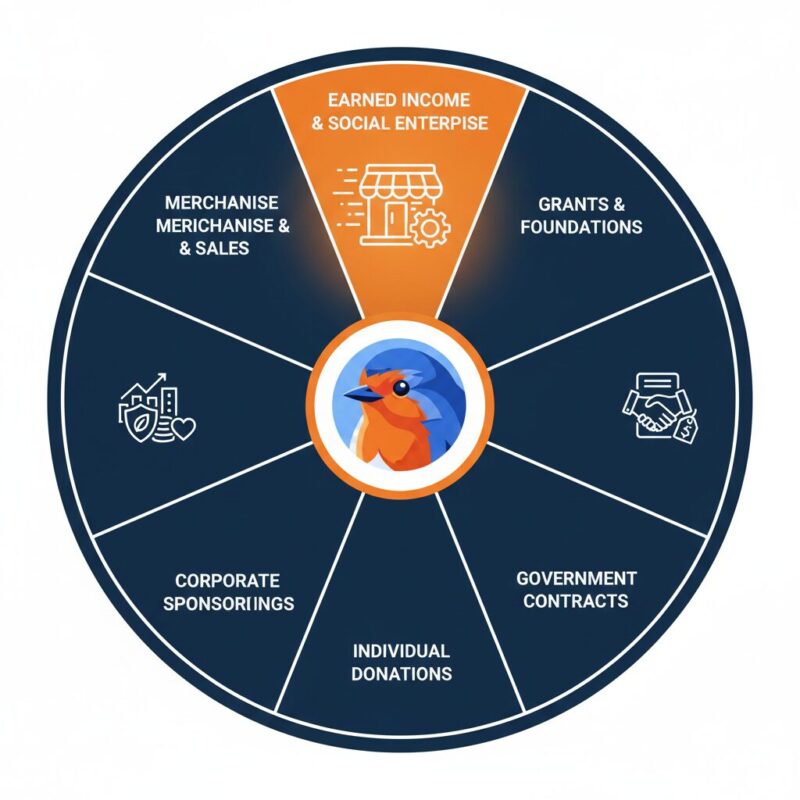
Earned income is the ultimate form of unrestricted revenue. Instead of asking for money to run programs, the organization sells goods, services, or expertise directly aligned with its mission.
How it works: You transition from a purely dependent fundraising model to operating self-sustaining business units. This might involve an environmental nonprofit selling sustainability consulting to local businesses, or a workforce development charity running a commercial bakery. Nonprofit Finance Fund data indicates that earned income is the fastest-growing revenue stream among nonprofits scaling past the $5M budget mark.
Benchmark: Aim for 10% to 25% of your budget, depending on your sector. Growth trajectories for social enterprises often mirror tech startups, requiring initial runway before reaching profitability.
Best for: Nonprofits with unique assets, specialized training capabilities, physical community spaces, or highly proprietary intellectual property.
FundRobin Tool Support: Launching a social enterprise requires seed capital. FundRobin’s Smart Matching identifies specific “innovation grants” and non-dilutive startup funding designed specifically to underwrite the launch of nonprofit business ventures.
5. Corporate Partnerships & Sponsorships
Corporate partnerships have evolved far beyond putting a logo on a gala banner. In 2026, companies seek networked partnerships and shared services that drive mutual scalability and align deeply with their Corporate Social Responsibility (CSR) mandates.
How it works: You build alliances where the nonprofit and the corporation share resources. For example, a tech company might donate cloud infrastructure and engineering hours (saving the nonprofit thousands in overhead) while the nonprofit provides structured employee engagement programs. Pivot CPAs highlights that Public Benefit Corporation collaborations are rapidly replacing transactional event sponsorships.
Benchmark: Corporate partnerships should provide 10% to 15% of total revenue.
Best for: Organizations addressing workforce development, environmental sustainability, local community health, or STEM education—areas where corporate interests naturally intersect with social good.
FundRobin Tool Support: FundRobin utilizes a global database encompassing the UK, EU, USA, and Australia to identify corporate foundations matching your specific local and sector criteria.
6. Special Events & Peer-to-Peer Fundraising
Special events are a double-edged sword. While they generate community visibility, they are historically the leading cause of staff burnout and often yield terrible financial returns when labor hours are properly accounted for.
How it works: You must strictly calculate the true cost-to-raise-a-dollar (CTRD). If a gala raises $100,000 but costs $60,000 in expenses and 500 staff hours to execute, it is a failed initiative. Successful organizations leverage peer-to-peer digital networks, pushing the fundraising labor out to community advocates rather than internal staff. According to NonprofitPRO, digital peer-to-peer campaigns have a CTRD that is 45% lower than physical galas.
Benchmark: Due to their volatility, cap event revenue at 5% to 10% of your budget. View events primarily as awareness-building and initial donor acquisition tools, not foundational revenue.
Best for: Initial donor acquisition, community mobilization, and high-visibility advocacy.
FundRobin Tool Support: When planning your fundraising strategy, use the Robin AI Assistant to automatically generate tailored event sponsorship packages and run rapid compliance checks for local charity regulations, slashing event administration time.
7. Endowments & Planned Giving
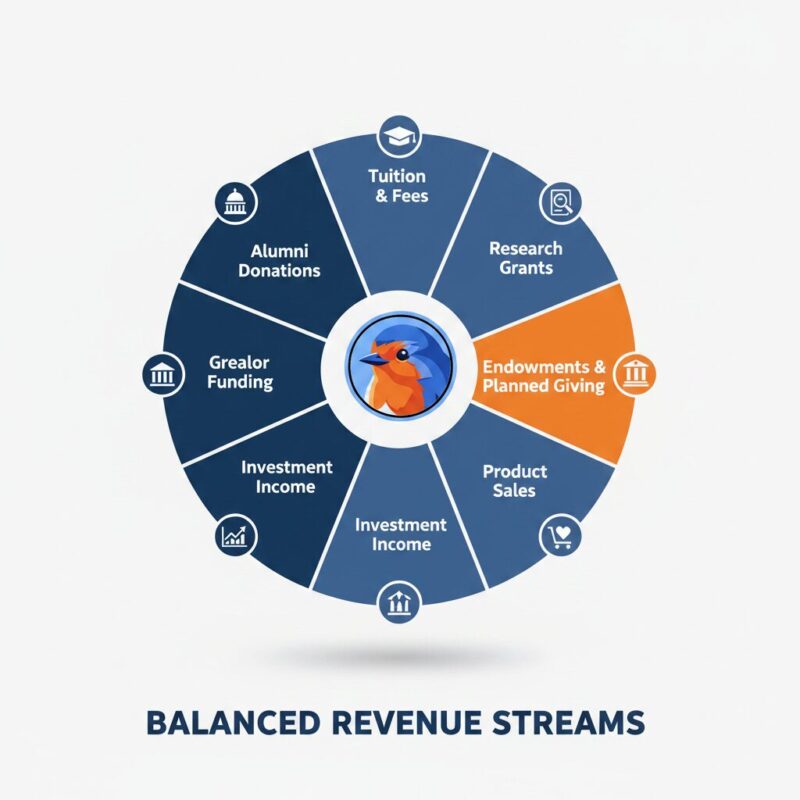
Endowments and planned giving represent the pinnacle of the Sustainable Resilience Framework. These are permanently restricted investment funds and legacy gifts that ensure long-term, multi-generational survival.
How it works: You cultivate multi-generational supporters who write the organization into their wills or establish trusts. The principal amount is never touched; the organization operates solely on the generated interest.
Benchmark: Rather than measuring this as an annual operating budget percentage, track it via growth targets. A robust endowment should eventually equal two to three times your annual operating budget.
Best for: Mature organizations, higher education institutions, and established charities with an aging, deeply committed donor base.
FundRobin Tool Support: Legacy donors need absolute assurance that the organization will survive for decades. FundRobin’s Smart Dashboard provides advanced financial forecasting, projecting long-term institutional stability. This concrete data is essential for proving to wealth managers that your nonprofit is a safe vessel for legacy wealth.
Frequently Asked Questions
What is the 33% rule in nonprofit funding?
The 33% rule dictates that no single revenue stream should exceed 33% of an organization’s total operating budget. Relying on one source for more than a third of your income creates dangerous volatility. If that source disappears—like a sudden government grant cut—the organization risks immediate operational collapse. Diversifying across grants, individual giving, and earned income guarantees stability.
How can AI help nonprofits find grants faster?
AI platforms use Natural Language Processing (NLP) and machine learning to scan thousands of funding databases daily, matching contextual guidelines rather than relying on flawed keyword searches. FundRobin’s AI tools save organizations 200+ hours monthly by instantly filtering out misaligned grants and drafting highly customized proposals. This eliminates the manual labor of scrolling through outdated foundation directories.
What are the most profitable nonprofit revenue streams in 2026?
The most profitable revenue streams in 2026 are earned income, major gifts, and recurring individual donations driven by Unified Digital Commerce. While grants are essential for project capital, recurring subscriptions provide unrestricted funding with a significantly lower cost-to-raise-a-dollar, allowing nonprofits to predictably cover administrative overhead and staff salaries.
How do you calculate impact ROI for major donors?
You calculate impact ROI by linking the donor’s financial contribution directly to specific, data-driven programmatic outcomes and operational savings. To ensure accuracy, we recommend using a nonprofit logic model template. For example, if a $50,000 gift funds an AI-driven logistics system that reduces food waste by 20%, you translate that 20% into exact dollar savings and the increased number of meals served. This demonstrates how qualitative impact frameworks translate directly to financial efficiency.
Which FundRobin plan is best for a mid-sized nonprofit?
FundRobin offers Growth at £49/month or £470.40/year and Impact at £199/month or £1,910.40/year. Compare current plans. Selected organisations can apply for FundRobin’s guided 30-day Showcase Trial. The period starts only after approval and activation; approved Showcase organisations do not need a card to begin. Apply for the Showcase Trial.
How does a nonprofit start an earned income stream?
A nonprofit starts an earned income stream by transitioning internal expertise or physical assets into a fee-for-service model. This often begins by securing an initial “innovation grant” to underwrite the startup costs. Organizations then launch initiatives like specialized consulting, branded merchandise, or community training programs, effectively creating a self-sustaining business unit aligned with the overarching mission.
Key Takeaways:
- Adopt the ‘33% Rule’: Never let a single revenue stream exceed 33% of your total budget to maintain true financial stability.
- Implement ‘Strategic Refusal’: Stop chasing low-ROI grants; declining misaligned funding saves hundreds of administrative hours and prevents burnout.
- Leverage AI for efficiency: Use AI proposal generators to cut grant writing time by 80%, shifting staff focus to major gifts and corporate partnerships.
- Embrace Unified Digital Commerce: Turn sporadic one-time donations into predictable, subscription-based recurring revenue streams.
The 2026 Nonprofit Revenue Maturity Model & Pricing
Transitioning to the Sustainable Resilience Framework requires an honest assessment of your current operations. The 2026 Nonprofit Revenue Maturity Model is a simple diagnostic tool: evaluate your budget right now. If any single slice of your pie chart exceeds the 33% threshold, you are currently in a high-risk operational state.
To move up the maturity model, you must audit your infrastructure. Do you have the technological capacity to run multiple revenue streams simultaneously without burning out your staff? If your team spends 40 hours manually formatting a single grant proposal, they physically cannot cultivate major donors or launch a social enterprise.
This is why AI is not a luxury; it is operational infrastructure. By leveraging FundRobin to handle grant identification, proposal generation, and compliance tracking, you instantly reclaim the time needed to build corporate partnerships and recurring digital donor bases.
FundRobin Pricing: Choosing Your AI Advantage
FundRobin offers precise, transparent tiers to match your organization’s maturity level. Please note, there is no free tier; we provide enterprise-grade capabilities for serious organizations. Choosing an annual plan saves you 20%.
- Growth: £49/month or £470.40/year.
- Impact: £199/month or £1,910.40/year.
- Guided Showcase Trial: available by application to selected organisations after approval and activation.
Stop letting grant cycles dictate your organization’s survival. Diversify your revenue, adopt the 33% rule, and utilize technology to scale your impact sustainably in 2026.
