
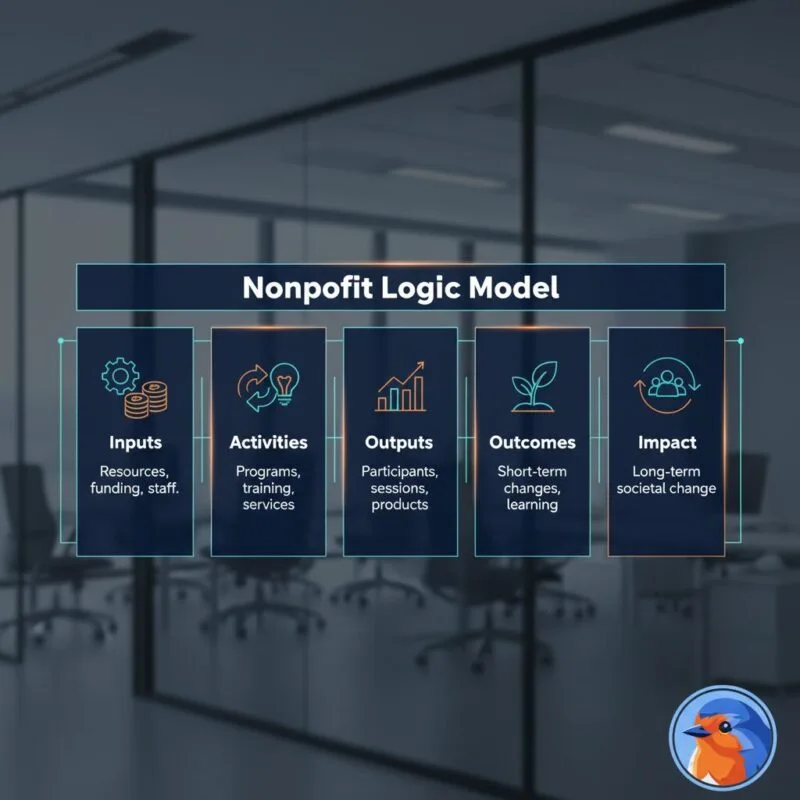
During my time coordinating emergency responses with organizations like UNICEF and WFP, I watched brilliant program directors burn out over paperwork. They treated logic models as a box to check—a hurdle to clear before receiving funds. But this compliance-first mindset strips the logic model of its true power.
As of May 2026, the funding environment demands more. In FundRobin’s nonprofit sector analysis of 58 organizations, 74% cited finding the right grant as their biggest operational challenge—yet only 12% used AI-powered tools to map their data. Furthermore, 67 nonprofit development directors told us managing grant deadlines across multiple funders was their single biggest administrative pain point.
We need to reframe this framework. A logic model is an operational compass, not just a donor requirement.
TL;DR: A nonprofit logic model is a visual roadmap proving to funders how financial inputs translate into long-term impact. The standard 5-column framework (Inputs → Activities → Outputs → Outcomes → Impact) prevents strategic drift. To transition from grant compliance to operational clarity, use the free Logic Model Builder from FundRobin to automate your reporting strategy.
Table of Contents
- Introduction: Escaping Grant Compliance Burnout
- Core Anatomy: The 5-Column Logic Model Framework
- The Great Debate: Logic Model vs. Theory of Change
- Step-by-Step: Building Your ‘If-Then’ Causal Chain
- Worked Example 1: Youth Education Nonprofit
- Worked Example 2: Community Health Initiative
- Transforming Your Static Model into a Live Dashboard
- Leveraging AI and FundRobin for Grant Success
- Common Pitfalls in Nonprofit Program Evaluation
Master the Nonprofit Logic Model for Grant Success
Introduction: Escaping Grant Compliance Burnout
Executive Directors at small-to-mid-sized nonprofits frequently fall into the trap of reactive planning. You spot a promising funding opportunity with a deadline two weeks away. Suddenly, your team scrambles to draft a logic model that aligns perfectly with the funder’s rubric, regardless of your daily operational reality.
The Plight of the Overwhelmed Executive Director
This reactive cycle creates strategic drift. When you write a separate logic model for every grant application, your core mission splinters into a dozen different directions. Program managers lose sight of the overarching goal, focusing entirely on immediate deliverables. Standard templates often fail modern nonprofits because they feel like rigid bureaucratic forms rather than living documents.
The ‘Living Logic’ Framework: A Strategic Compass
We advocate for the “Living Logic” framework. A living logic model operates as a dynamic navigation tool. Instead of filing it away after submitting a grant proposal, your leadership team uses it to guide annual planning, allocate resources, and measure real-world performance. According to the W.K. Kellogg Foundation Logic Model Development Guide, an effective logic model builds credibility with donors by demonstrating a systematic, data-backed approach to social change.
Navigating this Guide and Free Template Access
This guide breaks down the mechanics of the logic model, resolves common theoretical debates, and provides actionable examples for health and education initiatives. We highly recommend mapping your program as you read. Access the free FundRobin Logic Model Builder now to start translating your daily operations into a fundable strategy.
Core Anatomy: The 5-Column Logic Model Framework
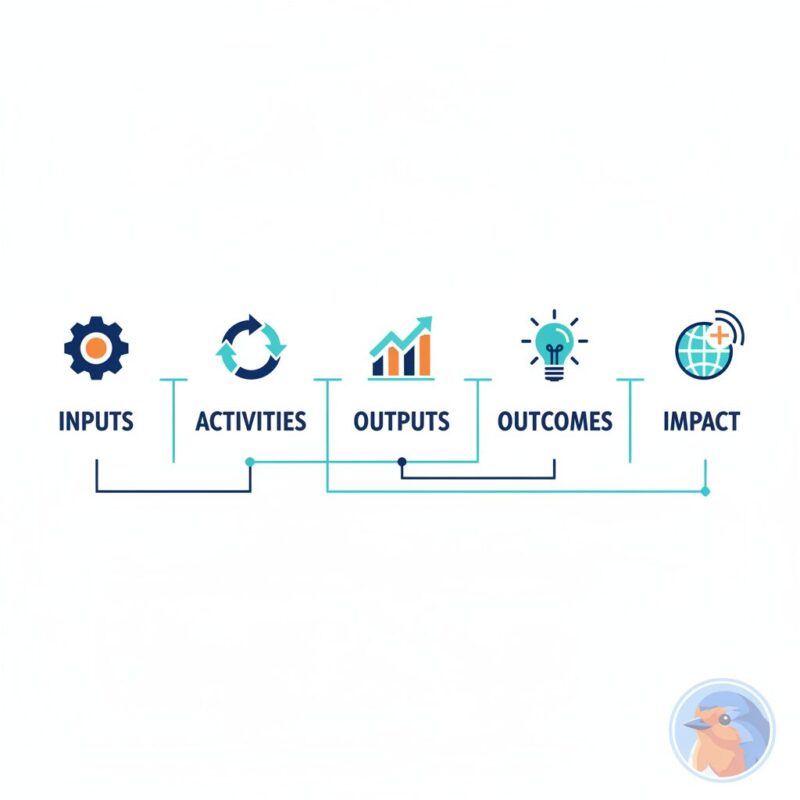
Major funders universally expect a specific sequential flow in your reporting. The standard anatomy maps causality: what you invest determines what you can do, which dictates your immediate results and ultimate impact.
Inputs: Mapping Your Core Resources
Inputs are the raw materials required to execute your program. Common examples include funding, staff time, facility space, volunteers, and technology infrastructure. Accurately mapping inputs prevents burnout; if you only list £50,000 in grant money but fail to document the 500 required volunteer hours, your budget request will inevitably fall short of your actual operational needs.
Activities & Outputs: The Daily Grind and Immediate Deliverables
Activities are the exact actions your nonprofit takes. If you run a food bank, an activity is “distributing meals.” Outputs are the immediate, tangible products of those actions. Following the previous example, the output is “1,000 meals served.”
The most common error in impact reporting is stopping here. Outputs are merely a stepping stone. A high output number proves your team is busy, but it does not prove your intervention is working.
Outcomes & Impact: Shifting from Paperwork to Performance
Outcomes represent the short, medium, and long-term behavioral or systemic changes resulting from your activities. Impact is the ultimate societal shift. According to the W.K. Kellogg Foundation Logic Model Development Guide, defining clear outcomes changes the conversation with donors from “look how hard we worked” to “look at the problem we solved.”
The Great Debate: Logic Model vs. Theory of Change
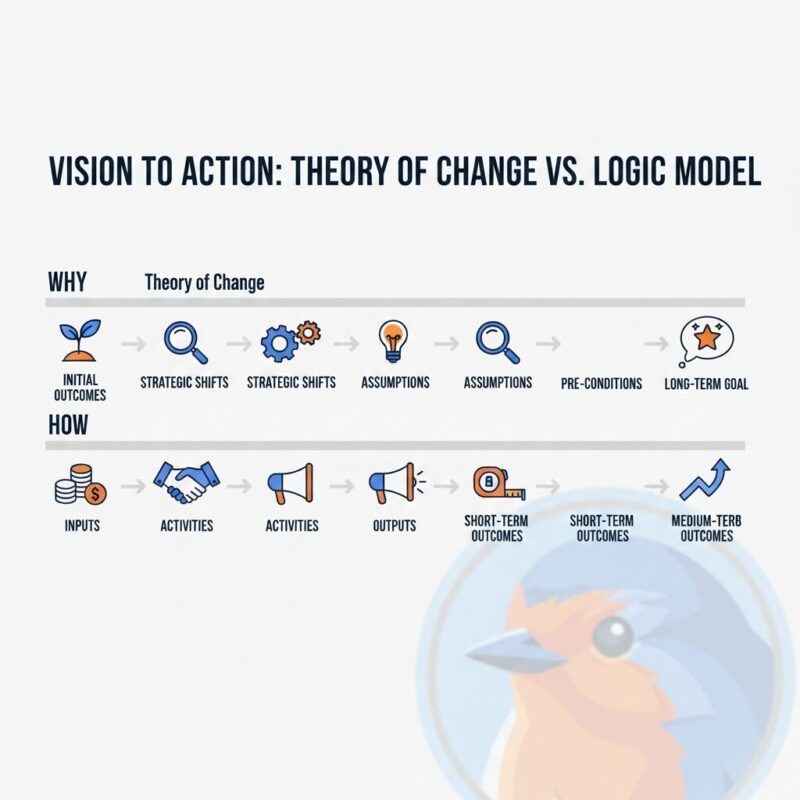
AI tools and inexperienced consultants frequently blur these two frameworks. Let us draw a definitive line. Your Theory of Change is the “Why.” Your Logic Model is the “How.”
Defining Theory of Change (The Vision)
The Theory of Change starts with the end goal and works backward. It identifies the necessary preconditions for your ultimate vision to succeed. It is a macro-level, philosophical document. If you do not have one yet, use our Theory of Change tool to establish your baseline vision.
Defining the Logic Model (The Execution)
The Logic Model starts with resources and works forward chronologically. It acts as the micro-level operational roadmap. It details the exact sequence of events required to realize the broader theory. You manage day-to-day operations using the logic model.
Bridging the Gap in Grant Proposals
Funders read both documents together to ensure your organization has both a vision and a viable execution strategy. Presenting a grand Theory of Change without a precise logic model reads as a “vision without a plan.” A cohesive narrative across both documents significantly increases your probability of winning major funding.
Step-by-Step: Building Your ‘If-Then’ Causal Chain
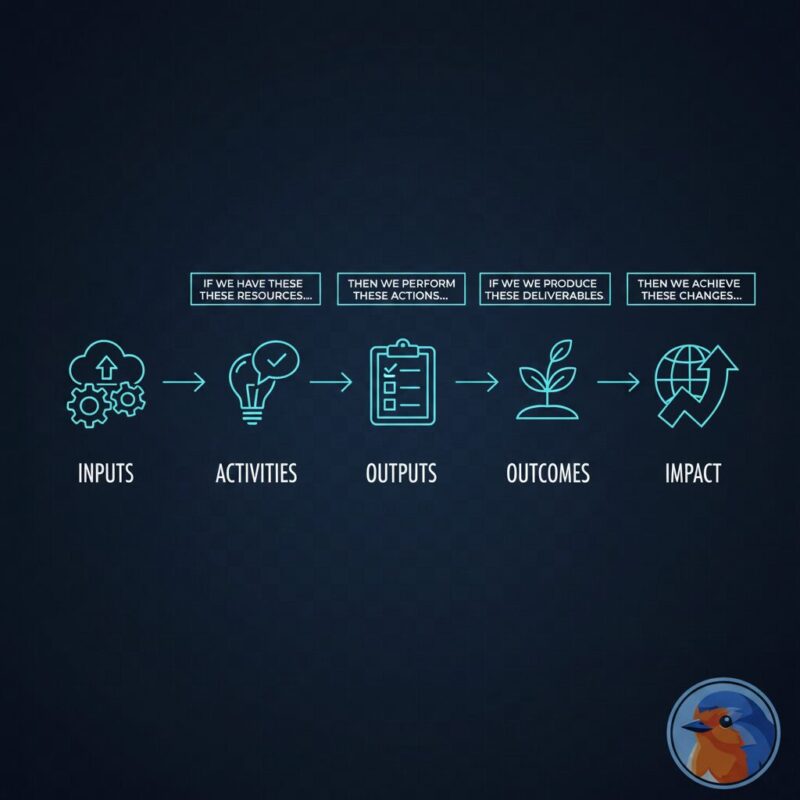
Constructing a logic model requires rigorous sequential thinking. Do not dump a list of activities into a column and hope they naturally lead to your outcomes. Connect them explicitly.
Formulating Valid Operational Assumptions
Write “If-Then” statements to connect your columns. “If we secure £20,000 (Input), then we can hire two part-time tutors (Activity). If we tutor 50 students (Output), then 75% will improve their math scores (Outcome).” This exercise quickly exposes leaps in logic. You cannot tutor 50 students effectively if your input is only £500.
Stress-Testing Your Logic Against External Factors
Your program does not exist in a vacuum. Identify assumptions and external environmental factors that could derail your outcomes. According to Logic Models: An Overview – Stanford PACS, addressing economic shifts, policy changes, or community resistance within your model builds immense credibility with risk-aware donors.
Fostering Inclusive ‘Shared Power’ Strategy Sessions
Never build a logic model in isolation. Adopt a “Shared Power” approach by involving your program staff, volunteers, and beneficiaries in strategy sessions. They understand the operational friction points better than executive leadership. To streamline this collaborative retreat, use the free FundRobin Logic Model Builder to capture insights in real time.
Worked Example 1: Youth Education Nonprofit
To bridge the gap between theory and execution, let us map a real-world example: a youth education and after-school tutoring program aiming to increase high school graduation rates in an underserved district.
Setting the Foundation (Inputs and Activities)
The raw resources (Inputs) include a £50,000 foundation grant, a donated community center space, a standardized math curriculum, and 15 volunteer teachers. The core action (Activity) is hosting three, two-hour tutoring sessions per week for a full academic year.
Tracing Outputs to Educational Outcomes
The immediate deliverables (Outputs) are 100 enrolled students and 15,000 total hours of tutoring logged. We move beyond counting attendance to measure learning. The short-term result (Outcome) is that 80% of attendees complete their homework regularly. The medium-term result (Outcome) is that 70% of enrolled students improve their overall GPA by at least one letter grade.
Long-term Community Impact Measurement
The ultimate goal (Impact) is a 10% increase in the district’s high school graduation rate over a five-year horizon, leading to improved long-term economic mobility. When you measure and track this progression securely, you build an ironclad case for major multi-year grant renewals.
Worked Example 2: Community Health Initiative
Our second example involves a community health clinic providing preventative care. Medical and health terminology must align precisely with standard government grant requirements.
Mapping Clinic Resources and Operations
The necessary resources (Inputs) consist of four licensed nurse practitioners, two mobile clinic vans, £100,000 in medical supplies, and local government permits. The operation (Activity) involves deploying the vans to identified food deserts three days a week for preventative screenings.
Health Interventions and Behavioral Changes
The quantifiable services (Outputs) are 500 vaccines administered and 1,200 blood pressure screenings conducted. The behavioral and physiological shifts (Outcomes) include a 40% increase in community awareness regarding hypertension risks and the successful early detection of pre-diabetes in 150 patients. Funders highly scrutinize the distinction between outputs and outcomes in healthcare; according to How to Develop a Program Logic Model – AmeriCorps, maintaining airtight metrics here is non-negotiable.
Validating Health Impacts for Major Donors
The overarching goal (Impact) is a 15% reduction in the local incidence of preventable cardiovascular disease over ten years. Validating clinical outcomes through secure patient follow-ups provides the exact data needed to win large-scale foundation or government grants.
Transforming Your Static Model into a Live Strategic Dashboard
Filing your logic model in a drawer after a grant submission wastes strategic potential. Modern nonprofits use digital dashboards to keep the strategy alive year-round, ensuring teams remain focused on proven interventions.
Avoiding Strategic Drift During Annual Planning
Integrate your logic model into quarterly board reviews and annual planning sessions. When new opportunities arise, evaluate them against your established columns. If a proposed project demands heavy inputs but does not logically connect to your defined impact, you reject it. This discipline stops mission creep dead in its tracks.
Layered Models for Multi-Service Organizations
Larger organizations struggle to fit multiple complex programs into a single template. Develop a “master” logic model mapping the entire organization, supported by “layered” sub-models for individual departments. This maintains cohesion across the executive team while giving department heads the granular detail they need to operate.
Streamlining the Data for Annual Impact Reports
Maintaining a live model makes end-of-year reporting completely frictionless. Because you have tracked outcomes sequentially, the narrative writes itself. You can easily feed these verified metrics into our Impact Report generator to produce donor-ready materials in minutes rather than weeks.
Leveraging AI and FundRobin for Grant Success
Once your logic model clearly articulates your outcomes, the final step is matching that strategy to active funding. FundRobin takes your perfected framework and connects it to a live database of global opportunities.
Moving from Logic Model to Smart Proposal Generation
Writing grant narratives from scratch drains hundreds of hours. FundRobin’s Smart Proposal Generation utilizes secure LLMs to turn the data parameters from your logic model into a compliant, high-quality first draft. While you maintain editorial control over the final submission, this AI acceleration handles the heavy lifting. Try the standalone Grant Proposal Generator to see the difference immediately.
FundRobin’s AI Assistant and Smart Grant Matching
The Robin AI Assistant provides grounded, factual strategy guidance without hallucinations—it never trains on your proprietary data. Furthermore, our Smart Grant Matching algorithm scans over 1,200 active opportunities daily across the UK, EU, US, and global databases, assigning an accuracy score (0-100%) based precisely on the inputs and outcomes defined in your logic model.
Transparent Pricing for Sustainable Growth
FundRobin offers Growth at £49/month or £470.40/year and Impact at £199/month or £1,910.40/year. Compare current plans. Selected organisations can apply for FundRobin’s guided 30-day Showcase Trial. The period starts only after approval and activation; approved Showcase organisations do not need a card to begin. Apply for the Showcase Trial.
Common Pitfalls in Nonprofit Program Evaluation
Even with the best tools, human error disrupts the planning process. Avoid these frequent mistakes to protect your funding applications.
Confusing Outputs (Deliverables) with Outcomes (Impact)
This is the most common grant-killing mistake. Funders ask for the behavioral change achieved (outcome), and nonprofits respond with the number of classes taught (output). As noted in Logic Models: An Overview – Stanford PACS, output metrics measure volume, whereas outcome metrics measure value. Institute a rigorous internal review specifically targeting this distinction before any submission.
Retrofitting the Model After Program Launch
Writing a logic model only after a program launches—just to satisfy a foundation requirement—leads to misaligned budgets and forced narratives. Build the framework proactively. Let the logic dictate the program design, not the other way around.
Treating the Framework as an Administrative Burden
Reporting only feels burdensome when you execute it manually. Reframe your approach. Treat program evaluation as a strategic advantage that puts you ahead of the competition.
Key Takeaways:
- Transition your logic model from a static grant compliance document into a dynamic “Living Logic” dashboard for daily decision-making.
- Clearly distinguish between your Theory of Change (the visionary ‘Why’) and your Logic Model (the operational ‘How’) to avoid strategic drift.
- Master the 5-column framework (Inputs → Activities → Outputs → Outcomes → Impact) and never confuse outputs with true programmatic outcomes again.
- Use specific ‘If-Then’ causal chains to identify external assumptions and build immediate credibility with major donors.
- Leverage FundRobin’s Smart Dashboard and AI to turn your mapped outcomes directly into compliant grant proposals, saving up to 200 hours monthly.
Frequently Asked Questions
What is a logic model in a grant proposal?
A logic model in a grant proposal serves as a one-page visual roadmap proving to funders exactly how their financial inputs will translate into measurable, long-term impact through specific activities. It visually maps causality, demonstrating that your organization has an execution plan rather than just a visionary idea.
What is the difference between a logic model and a theory of change?
The Theory of Change acts as the “Why” (the overarching vision and long-term problem solving), while the logic model is the “How” (the operational roadmap of inputs, activities, and outputs to get there). According to How to Develop a Program Logic Model – AmeriCorps, the Theory of Change works backward from the ultimate goal, whereas a logic model works forward chronologically from resources to results.
Where can I find a free logic model template for my nonprofit?
You can access our dynamic “Living Logic” framework template via the FundRobin Free Tools section, specifically tailored for 2026 nonprofit reporting standards. Unlike static Word documents, this builder helps you construct logically sound “If-Then” statements that transition smoothly into grant proposals.
How does a dynamic logic model prevent nonprofit burnout?
By shifting the logic model from a static grant requirement to a live strategic dashboard, Executive Directors avoid “strategic drift” and align their daily operations with real-world outcomes. It centralizes decision-making, so staff no longer waste energy pursuing isolated initiatives that do not serve the overarching organizational goals.
How do you measure impact using a logic model?
You measure impact by validating the “If-Then” causal chain, tracking immediate deliverable metrics (outputs), and formally assessing long-term behavioral or environmental changes (outcomes). Measuring impact requires capturing baseline data before the intervention and comparing it against post-program results.
Can AI help write my nonprofit grant proposals using my logic model?
Yes. FundRobin’s Smart Proposal Generation uses LLMs trained on successful applications to turn your logic model into a compliant, high-quality grant proposal in minutes, saving up to 80% of writing time. By feeding the AI your verified inputs and outcomes, it produces factual, grounded drafts without hallucinating claims.
