

The era of “throw it at the wall and see what sticks” in research funding is effectively over. As research administrators look toward the 2026 fiscal year, the landscape is defined not by opportunity, but by austerity and administrative gridlock. As of May 2025, federal funding projections suggest a tightening of belts across the NIH and NSF, creating a “fiscal cliff” that threatens to stall innovation just as the cost of research is skyrocketing.
For the Besieged Research Director managing a $50M+ portfolio, the enemy isn’t just budget cuts—it’s burnout. The traditional model of hiring more staff to manage more grants is broken. The only viable path forward is Strategic AI Orchestration: moving beyond simple text generation to a comprehensive, enterprise-grade ecosystem that manages the entire lifecycle of Multi-PI grants.
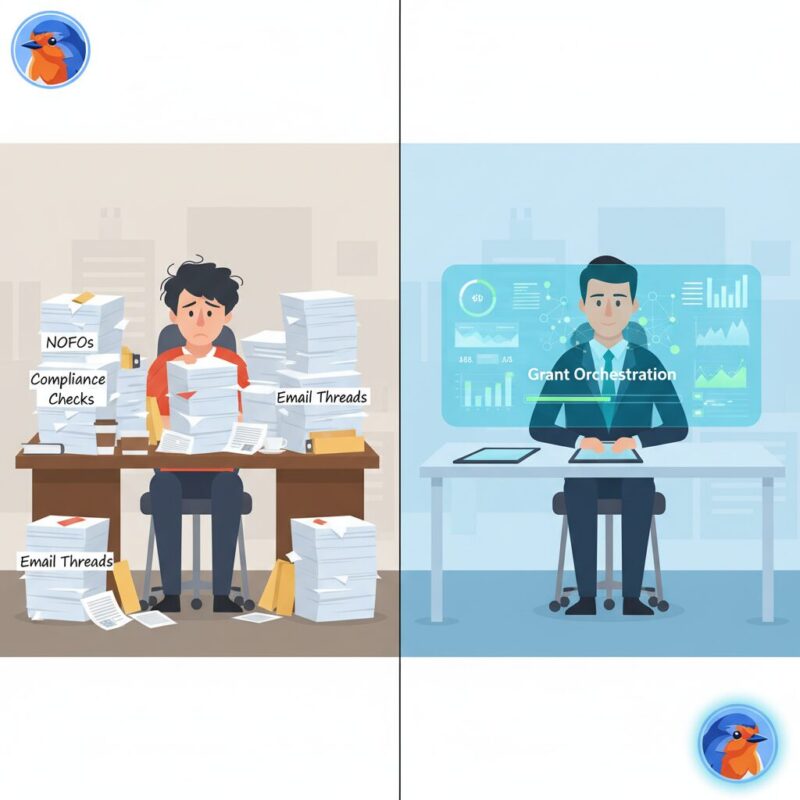
TL;DR: Strategic AI grant orchestration is the shift from manual, siloed grant writing to centralized, AI-managed workflows that handle version control, compliance, and timeline management for Multi-PI teams. This approach is critical for navigating the 2026 fiscal cliff, as it allows institutions to reclaim the 44% of staff time currently lost to administrative burdens. By adopting “Grounded AI” solutions like FundRobin, research directors can ensure data privacy and compliance while maintaining proposal volume despite looming budget cuts.
Table of Contents
- The 2026 Fiscal Cliff: Why Efficiency is Now a Survival Metric
- Defining Strategic AI Orchestration for Multi-PI Frameworks
- The Collaborative Tech Stack: Building a Unified Research Ecosystem
- Governance, Compliance, and the “Grounded AI” Mandate
- Future-Proofing Your Institution: The 2026 Implementation Roadmap
- Frequently Asked Questions
The 2026 Fiscal Cliff: Why Efficiency is Now a Survival Metric
The term “efficiency” often feels like corporate jargon, but for university research offices in the current climate, it is a survival metric. We are facing a convergence of reduced federal inflows and increased administrative complexity.
Quantifying the Burnout Crisis
The most alarming statistic governing our daily lives is not the grant acceptance rate, but the burden rate. According to a survey by SRA International, research administrators lose approximately 44% of their time to purely administrative burdens—tasks that do not directly contribute to the intellectual quality of a proposal.
In a flush budget year, this inefficiency is an annoyance. Facing the 2026 fiscal cliff, it is fatal. With potential austerity measures looming for major federal funders, institutions cannot afford to have nearly half of their human capital tied up in formatting checks and email chases.
The “Frozen Pipeline” Risk
Uncertainty breeds hesitation. As reported by the Cavalier Daily, federal funding uncertainty is already halting progress and limiting graduate student recruitment. This creates a “frozen pipeline” where Principal Investigators (PIs) hesitate to apply for new grants because they lack the administrative support to manage the complex application process.
The old survival method was simple: hire more grant administrators. Today, with hiring freezes common across higher education, that option is off the table. The only lever left to pull is technology. We must decouple proposal volume from headcount.
Defining Strategic AI Orchestration for Multi-PI Frameworks
To solve this, we must clarify our terms. “AI Grant Writing” is a commodity; “AI Grant Orchestration” is a strategy. Writing tools generate text. Orchestration platforms manage the chaos of human collaboration.
From Drafting to Orchestration
For a single PI working on a small foundation grant, a text generator is sufficient. But for a Multi-PI center grant involving five institutions and three distinct sub-projects, text generation is the least of your worries. The real nightmare is logistical: version control, timeline synchronization, and data consolidation.
Strategic AI Orchestration involves using agents not just to write, but to manage the workflow. It is the difference between a tool that helps you type faster and a platform that acts as a project manager, ensuring that PI #3’s data entry doesn’t overwrite PI #1’s hypothesis.
Breaking the Silos: The “Clean Room” Concept
One of the primary barriers to Multi-PI collaboration is data sovereignty. How do you share sensitive preliminary data across institutions without risking IP leakage?
Modern orchestration platforms utilize a “Clean Room” concept—secure, encrypted digital workspaces where data can be analyzed by the AI for the purpose of the proposal without ever being trained on or exposed to the public model.
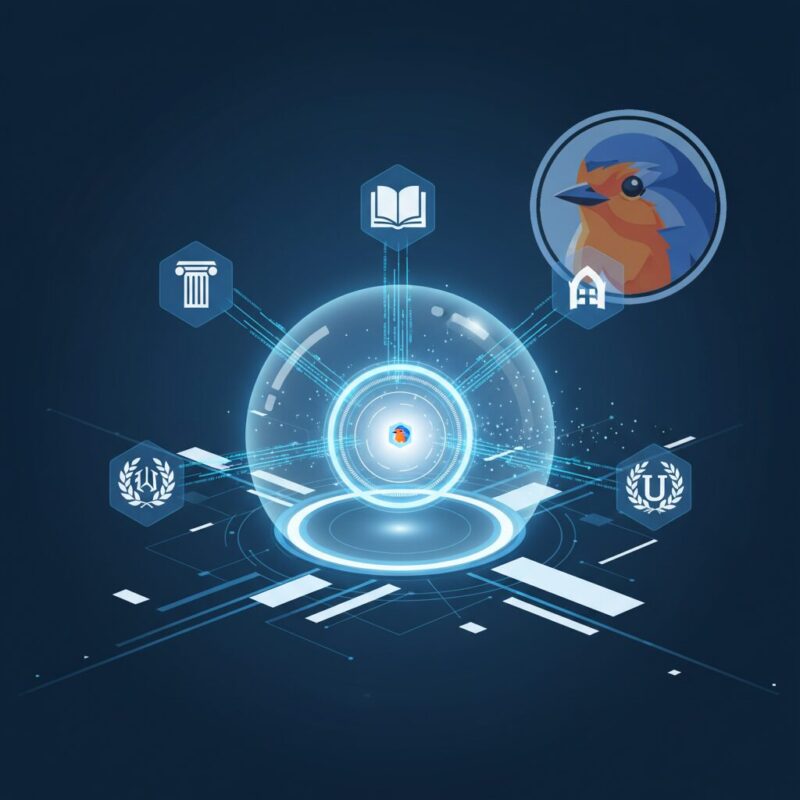
This allows for what Changing Higher Ed describes as the necessary evolution of institutional planning: moving from fragmented, individual efforts to cohesive, cross-institutional strategies.
The Collaborative Tech Stack: Building a Unified Research Ecosystem
What does a “modern stack” look like for a Research Director preparing for 2026? It moves away from the “Frankenstein” approach of combining Excel, Word, and Dropbox, toward a unified ecosystem.
Automated “Shredding” and Predictive Fundability
The orchestration process begins the moment a Notice of Funding Opportunity (NOFO) is released. Advanced tools now use AI to “shred” a 100-page RFP in seconds, extracting critical requirements, deadlines, and compliance matrices.
Furthermore, before a single word is written, AI can assess “Fundability.” By analyzing past award data and specific funder priorities, platforms can generate an accuracy score for the proposed project. This is crucial for avoiding the “shotgun approach” that wastes valuable PI time on low-probability applications. For more on targeting the right opportunities, refer to FundRobin’s Sector Specific Grants Guide.
Centralized Visibility: The Smart Dashboard
For leadership, the primary value of orchestration is visibility. Instead of emailing twenty different PIs to ask for status updates, a Smart Dashboard provides a real-time view of the entire grant pipeline.
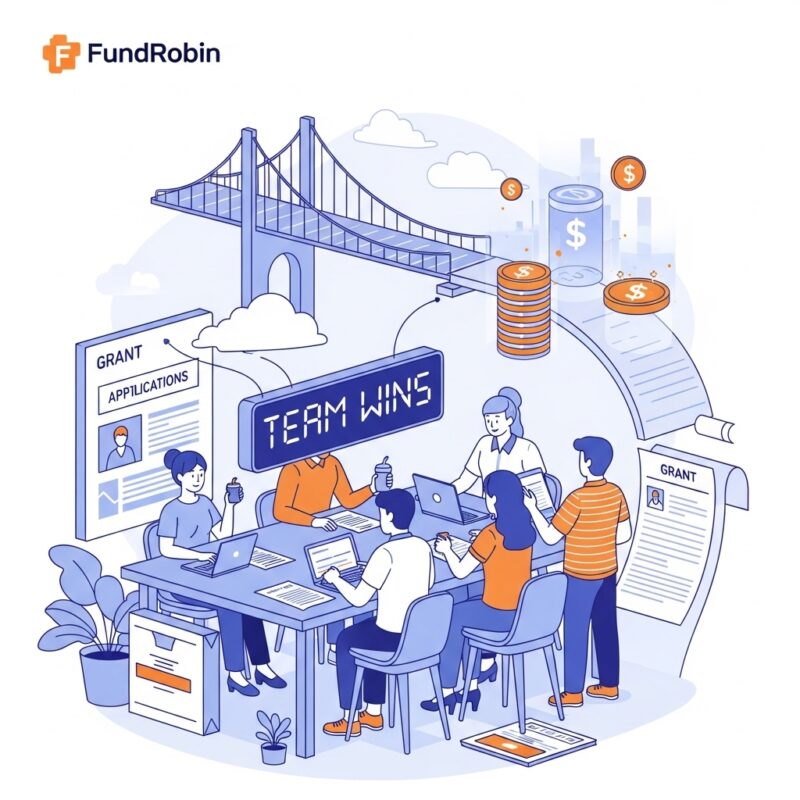
| Feature | Legacy Process (Manual) | Orchestrated Process (AI-Driven) |
|---|---|---|
| Discovery | Manual search across disparate databases | Automated “Smart Matching” & RFP Analysis |
| Coordination | Email threads with multiple attachments | Unified Hub with Real-Time Version Control |
| Visibility | Excel spreadsheets updated monthly | Live Dashboard with Predictive Analytics |
| Compliance | Manual checklist review (prone to error) | Automated AI Compliance & Requirement Audit |
This shift transforms the Research Office from a reactive processing center to a proactive strategic partner.
Governance, Compliance, and the “Grounded AI” Mandate
Whenever AI is introduced into research, the immediate (and valid) concern is compliance. Will the AI hallucinate citations? Will it compromise our data?
The Ethics of “Grounded AI”
In the context of federal grants (NIH/NSF), a “creative” AI is a liability. You need “Grounded AI.” This refers to AI architectures specifically designed to prioritize factual accuracy over creative flair. Grounded AI systems are constrained to pull information only from verified sources and the specific inputs provided by the researchers.
Crucially, these systems provide audit trails. Every claim generated is linked to a source, preventing the “hallucination” risks that plague generalist LLMs. This adherence to strict sourcing is a cornerstone of the AI Nonprofit Funding Strategic Guide, which emphasizes that ethical AI use is now a compliance requirement, not just a best practice.
Data Sovereignty and Security
Institutional adoption of AI hinges on data privacy. Enterprise-grade orchestration platforms like FundRobin operate in private environments. Unlike public tools (like the free version of ChatGPT) where inputs may be used to train the model, a private orchestration environment ensures that your proprietary research data remains yours. This “Data Sovereignty” is the only way to meet the stringent IP requirements of university technology transfer offices.
Future-Proofing Your Institution: The 2026 Implementation Roadmap
Transitioning to an orchestration model is not an overnight process. It requires a roadmap.
1. Assess Your Infrastructure
Do you currently rely on Excel to manage a $50M portfolio? If so, you are already behind. The first step is a brutal assessment of your current “time sinks.” Identify where that 44% of administrative time, cited by SRA International, is actually going.
2. The “Dartmouth Model” vs. Integrated Platforms
Some institutions, like Dartmouth, have built robust internal resource hubs (GrantGPS). While valuable, these are often static. The 2026 standard requires active platforms—tools that don’t just tell you how to write a leadership plan, but help you build it collaboratively in real-time.
3. Change Management and Adoption
The biggest hurdle isn’t software; it’s culture. PIs are skeptical of new tools. To succeed, focus on the “Clean Room” and “Time Saved” value propositions. Show them how orchestration removes the administrative drudgery, allowing them to focus on the science. As noted by Disco, the future of higher education technology lies in platforms that facilitate community and learning—the same applies to research collaboration using semantic funding discovery.
Frequently Asked Questions
How will the 2026 federal budget cuts impact university research funding?
The “Fiscal Cliff” could see potential 40% cuts or significant austerity measures for NIH/NSF budgets, making efficiency a survival metric. To navigate this, institutions must shift from volume-based applying to high-yield “orchestrated” proposals using AI to maximize efficiency and success rates.
Is using AI for grant proposals compliant with NIH and NSF rules?
Yes, using AI for drafting is generally compliant provided it is human-reviewed and does not falsify data. FundRobin’s “Grounded AI” specifically prevents hallucinations by citing sources and operating within strict boundaries, ensuring adherence to the rigorous compliance standards of federal funders.
What is the difference between AI grant writing and AI grant orchestration?
AI grant writing focuses merely on generating text, whereas AI grant orchestration manages the entire lifecycle including matching, timeline tracking, version control, and Multi-PI collaboration. Orchestration is the enterprise-grade solution that solves the logistical chaos of complex grants, not just the drafting phase.
What features should a Multi-PI grant management platform have?
A robust platform must include centralized dashboards for pipeline visibility, secure “clean rooms” for cross-institutional data sharing, and automated compliance checkers. These features are essential to reduce the administrative burden and prevent the version control nightmares common in multi-partner applications.
How can AI reduce the 44% administrative burden on research staff?
AI automates repetitive, high-volume tasks such as RFP “shredding” (analysis), compliance matrix generation, and initial drafting. According to SRA International, relieving this burden allows administrators to reclaim nearly half their time for strategic planning and high-value support.
Is my research data safe when using AI grant tools?
Yes, provided you use enterprise-grade platforms rather than public LLMs. Tools like FundRobin operate in private environments where user data is encrypted and never used for model training, ensuring complete data sovereignty and protection of intellectual property.
Key Takeaways:
- The 2026 Fiscal Cliff requires a strategy shift: With potential austerity measures hitting NIH/NSF budgets, efficiency is no longer optional—it is a survival metric for research institutions.
- Orchestration beats Drafting: Successful Multi-PI teams are moving beyond simple AI writers to “Orchestration Platforms” that manage version control, timelines, and compliance in one hub.
- Reclaim 44% of your time: By automating administrative tasks like RFP analysis and first-draft generation, research directors can redirect staff focus to high-value strategic planning.
- Compliance is non-negotiable: Use “Grounded AI” solutions like FundRobin that cite sources and operate in secure, private environments to ensure adherence to strict funder guidelines.
- Unify your pipeline: Replacing ad-hoc email threads with a centralized dashboard provides the real-time visibility needed to forecast income and manage institutional portfolios.
Conclusion
The 2026 funding climate will not be kind to institutions that cling to manual workflows. The administrative burden is too high, and the margin for error is too low. By embracing Strategic AI Orchestration, Research Directors can build a resilient infrastructure—one that not only survives the fiscal cliff but empowers researchers to focus on what matters: the science. The tools exist. The strategy is clear. The only remaining question is whether your institution will lead the orchestration or be left managing the chaos.

Leave a Reply