

During my years coordinating emergency responses and development programmes across international NGOs, I watched the same pattern break brilliant teams: the grant cycle trap. Organisations secure a major government grant, hire staff, launch critical services, and immediately begin panicking about how to replace that funding when the cycle ends 24 months later.
In September 2026, as the sector transitions toward a heavily regulated impact economy, the traditional grant-seeking model is visibly failing. More grants do not automatically equal more impact if the administrative burden scales linearly. True revenue resilience means shifting from reactive grant writing to building a diversified, proactive funding ecosystem.
TL;DR: Nonprofits can transition from grant dependency to a sustainable, diversified funding ecosystem by conducting a strategic 4-Pillar Funder Readiness Audit and adopting modern prospecting workflows. Balancing traditional grants with earned income models protects core missions from government funding volatility while ensuring long-term revenue resilience.
Table of Contents
- The Shift to Revenue Resilience: Moving Beyond Grant Dependency
- The Funder Readiness Audit: A 4-Pillar Diagnostic for Scaling Capital
- Modern Prospecting: Using Data-Driven Intelligence Over Cold Outreach
- Ethical Vetting and Risk Management: Protecting Your Brand Integrity
- Software Ecosystems for Sustainable Fundraising: A 2026 Comparison
Sustainable Funding Strategies for Nonprofits
The Shift to Revenue Resilience: Moving Beyond Grant Dependency

The Dangers of Over-Reliance on Single Funding Sources
Depending entirely on single funding sources—especially government grants or a handful of major donors—creates structural vulnerability. When a single grant accounts for over 40% of an operating budget, the charity is essentially a contractor for that funder, rather than an independent entity executing its own vision.
This volatility often forces budget deficits that lead to sudden programme closures. A common misconception is that applying for more grants solves the problem. It does not. Pursuing low-alignment funding simply increases the administrative burden. To fix this, organisations must map their fundraising strategy to prioritize a mix of unrestricted recurring donations, corporate partnerships, and targeted grants.
Cultural Shift: From Grant-Reliant to Proactive Revenue Models
Diversifying revenue requires a cultural shift within the staff. Programme leaders and front-line workers often resist earned income models or corporate partnerships, fearing a dilution of the charitable mission.
Leadership must train teams to look for value exchange rather than just charitable handouts. A proactive revenue model means empowering development teams to identify assets the organisation already possesses—like training modules, specialized data, or community access—that can generate sustainable earned income to supplement traditional grants.
Balancing Grants with Earned Income (Without Mission Drift)
The most frequent objection to earned income is the fear of mission drift. You maintain focus by creating strict boundaries between profit-driving activities and mission-critical services. Assess every earned-income idea against your core mandate: does this activity directly benefit our primary demographic, or does it merely generate cash? If a new revenue stream pulls staff away from the core programme, it is a liability, not an asset.
The Funder Readiness Audit: A 4-Pillar Diagnostic for Scaling Capital

Pillar 1: Financial and Operational Capacity
Funders invest in capacity, not just ideas. You must evaluate your current accounting software and financial tracking systems. Do you have the staff bandwidth to manage post-award reporting for multiple, complex revenue streams? Identifying gaps in operational infrastructure before scaling prevents compliance failures down the line.
Pillar 2 & 3: Strategic Alignment and Governance Readiness
New funding must align with board governance and existing compliance requirements. A charitable grant should never force your organisation to invent a new programme just to secure the money. Review your board oversight structures to establish clear governance around fund usage and reporting, ensuring total alignment with your strategic plan.
Pillar 4: Centralizing Knowledge with an ‘Organisation Brain’
The inefficiency of rewriting mission statements, track records, and outcomes for every application is a massive drain on nonprofit resources. Across FundRobin’s customer research spanning 240+ customer records, teams repeatedly struggle not just with finding grants, but with finding and safely reusing their own past answers and evidence.
Building an Organisation Library creates a human workspace for reviewed knowledge. By using an Organisation Brain—a system that turns reviewed organisation knowledge and relevant evidence into reusable factual context—you can radically accelerate your proposal workflows. You can learn more about implementing these systems in our guide on AI tools for nonprofits.
Modern Prospecting: Using Data-Driven Intelligence Over Cold Outreach
Bridging the CRM and Relationship Gap
The era of volume-based, ‘spray and pray’ grant writing is over. Modern prospecting relies on targeted data. According to CCS Fundraising, effective donor prospecting requires aligning a funder’s historical giving patterns with your exact programmatic needs. However, CRMs often fail because they lack human context. You must use data to segment donors logically while retaining the nuanced history of personal interactions that drive major gifts, as noted in recent strategies by Bloomerang.
Managing In-Kind Donations and Non-Traditional Revenue
A holistic funding picture must recognize non-traditional revenue. Organizations frequently silo their data when tracking pro-bono services or physical goods. According to Double the Donation, best practices dictate integrating in-kind donation values directly into your financial forecasts. This ensures you accurately present your organization’s total resource footprint to potential major funders.
Leveraging AI and Smart Discovery for Grant Prospecting
FundRobin’s customer research indicates that one of the highest-value decisions in grant work happens before drafting: deciding whether a funding opportunity deserves scarce staff time at all.
This is where Smart Discovery and Smart Matching fundamentally change the workflow. Instead of generic keyword searches, Smart Discovery surfaces relevant opportunities tailored specifically to your organisation’s context. Smart Matching helps prioritise opportunity fit by providing rationale, rather than arbitrary success probabilities. With tools like the USA Grant Finder, a contextual grant assistant (Robin) can support your review process, ensuring that AI does the heavy lifting on research while professionals make the final strategy choices.
Ethical Vetting and Risk Management: Protecting Your Brand Integrity
The Growing Importance of Funder Alignment in 2026
Stakeholders, staff, and the public demand high ethical standards from funders. The days of ‘any money is good money’ are gone. Accepting misaligned funds risks immediate and severe brand damage. As we operate within a highly scrutinized impact economy, transparency is a non-negotiable requirement for sustainable growth.
Creating an Actionable Donor Acceptance Policy (Framework)
A proactive defense strategy requires moving from abstract warnings to clear rules. A formal Donor Acceptance Policy dictates exactly who you will and will not accept money from. According to the Orr Group, a robust policy must include defined red lines, strict review processes, and clear escalation paths for front-line fundraisers to report questionable prospects.
Mitigating Reputational Risk Using Data Provenance
When evaluating a funder, using outdated or unverified historical data is dangerous. Proper governance preserves the distinction between reviewed, current knowledge and lower-trust historical information. By relying on strict source provenance, you can track exactly where evidence came from to support your vetting decisions. FundRobin preserves this review, source, and conflict context so current reviewed knowledge is never conflated with historical guesswork.
Software Ecosystems for Sustainable Fundraising: A 2026 Comparison
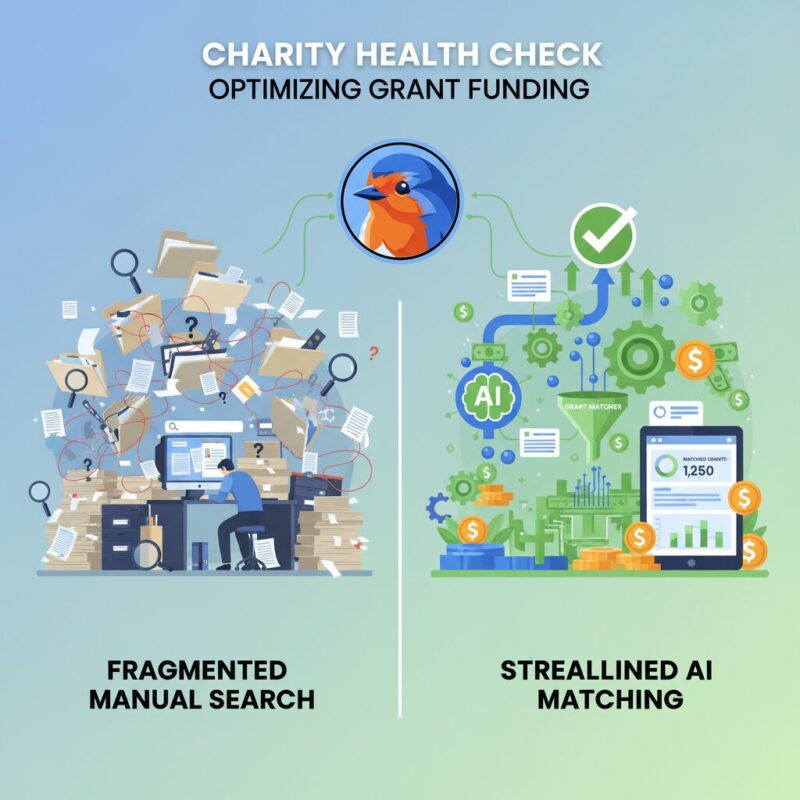
Legacy CRM Solutions (DonorPerfect, Kindful, Givebutter)
Traditional CRM systems focus primarily on individual donor management and retention metrics. Platforms like DonorPerfect, Kindful, and Givebutter are highly effective for managing the recurring donor side of a diversified revenue ecosystem. However, they are fundamentally databases for people and payments. They lack the deep, contextual workflows required to manage complex institutional grants from discovery through submission.
Dedicated Grant Databases vs. Connected Workflows
Traditional search engines like Candid and GrantWatch are excellent for listing opportunities, but they stop at the ‘Find’ stage. Conversely, post-award platforms like Fluxx, Foundant, SmartSimple, and Submittable focus heavily on the funder-side experience and post-award compliance.
To build true sustainability, organisations need connected workflows. A comprehensive grant database approach combined with a Find → Know → Draft → Manage workflow keeps opportunity and application work in one workspace, preventing the workflow fragmentation that plagues so many development teams.
Choosing the Right Tech Stack (Features & Pricing Context)
Audit your current tools against the 4-Pillar Funder Readiness framework. Isolated tools create disjointed fundraising efforts. Choose platforms with transparent pricing and clear utility.
| Platform Category | Best For | Key Features | Pricing Model |
|---|---|---|---|
| Legacy CRMs (e.g., DonorPerfect) | Individual giving & recurring donor management | Donor retention metrics, payment processing | Tiered by contact records (requires verification) |
| Static Databases (e.g., Candid) | High-volume grant research and discovery | Funder 990 lookups, basic filtering | Annual subscriptions (requires verification) |
| Connected Workflows (FundRobin) | End-to-end grant discovery, drafting, and management | Smart Discovery, Organisation Brain, Robin Assistant | Growth: £49.00/month. Impact: £199.00/month. |
(Note: Always verify competitor pricing directly via their official documentation, as market rates fluctuate.)
Frequently Asked Questions
How can a nonprofit diversify its funding sources?
Nonprofits diversify funding by transitioning from a reliance on single government grants to a multi-channel mix of earned income, recurring individual donors, and aligned corporate partnerships. This requires identifying existing organizational assets—like specialized training or data—that can be monetized ethically without causing mission drift.
What is a Funder Readiness Audit?
A Funder Readiness Audit is a 4-pillar diagnostic tool covering financial/operational capacity, strategic alignment, legal/governance readiness, and the centralization of organizational knowledge. It ensures a nonprofit has the internal infrastructure necessary to manage and report on complex, high-tier funding before applying.
How do nonprofits vet potential donors for ethical alignment?
Nonprofits vet donors by implementing a standardized Donor Acceptance Policy that outlines clear red lines and review processes. This policy guides staff to review prospect histories, verify ethical alignment against core organizational values, and escalate questionable funding sources to the board to protect brand integrity.
Which AI tools are best for nonprofit fundraising?
The best AI tools for fundraising act as contextual grant assistants that operate within a connected workflow, utilizing grounded organizational knowledge rather than generic internet data. Tools like FundRobin’s Robin use an Organisation Brain to organize past successful applications and match profiles to relevant opportunities without replacing human review.
What is the difference between a grant database and a grant workflow platform?
A grant database is a static search engine (like Candid or GrantWatch) that solely lists funding opportunities, stopping at the discovery phase. A grant workflow platform (like FundRobin) connects the entire lifecycle—Find, Know, Draft, and Manage—allowing teams to research, collaborate, draft proposals, and track pipelines in one unified workspace.
How should nonprofits manage and record in-kind donations?
Track in-kind donations—both physical goods and pro-bono services—directly alongside traditional monetary gifts in your CRM to avoid data silos. Assigning a fair market value to these contributions ensures they are factored into financial forecasts and correctly demonstrate your organization’s total resource capacity to major funders.
Key Takeaways:
- Grant dependency is a structural vulnerability; true revenue resilience requires balancing traditional grants with earned income and recurring donor models.
- A 4-Pillar Funder Readiness Audit ensures your organization has the operational, financial, and strategic maturity to manage complex, diversified revenue streams without mission drift.
- Modern prospecting relies on data-driven intelligence rather than cold outreach, leveraging centralized organizational knowledge (an Organisation Brain) to streamline the Find → Know → Draft → Manage workflow.
- Implementing a formal Donor Acceptance Policy is a non-negotiable step for mitigating reputational risks and ensuring ethical alignment with new corporate or foundational funders.
- When comparing tech stacks, choose platforms that move beyond static databases to contextual AI assistants, while retaining human-in-the-loop oversight and clear data provenance.
Conclusion
Chasing the next grant deadline is a survival tactic, not a growth strategy. By conducting a rigorous Funder Readiness Audit, implementing strict ethical vetting, and adopting a connected grant workflow, your team can finally break the grant cycle. Ultimately, sustainable nonprofit funding requires shifting from reactive, volume-based applications to a proactive ecosystem where data-driven intelligence and highly-aligned partnerships drive long-term resilience.
