
As of April 02, 2026, local authority funding cuts have severely constrained small heritage organizations across the UK. According to the UK Government’s Impacts of changes to local authority funding on small to medium heritage organisations report, councils have drastically reduced discretionary arts and heritage spending. This forces small charities into a highly competitive national grant environment. Years of operating on shoe-string budgets create a “scarcity mindset” among nonprofit teams. Staff members constantly chase small pots of money just to keep the lights on, resulting in chronic exhaustion, mission drift, and poor-quality applications.
We need to stop the panic-driven hamster wheel. Securing National Lottery Heritage Fund (NLHF) grants requires shifting from a volume-based strategy to sustainable, evidence-based scaling. This guide provides a clear methodology for protecting your team’s mental health while increasing your funding win rate.
TL;DR: Small UK heritage charities can win NLHF funding in 2026 by adopting “Strategic Refusal”—saying no to misaligned grants to prevent staff burnout. Focus strictly on the Heritage 2033 mandate, use the 800-word EOI as a diagnostic tool, and deploy AI platforms like FundRobin to cut proposal drafting time by 80%.
Table of Contents
- Why This Method? The Power of ‘Strategic Refusal’
- Tools and Materials Deep Dive for Heritage 2033
- Steps 1-3: Building Your ‘Grant-Ready’ Decision Matrix
- Steps 4-6: Mastering the ‘Battle-Hardened’ EOI
- Steps 7-9: Systematizing Baseline Data Collection
- Steps 10-12: Writing the Full Proposal with AI Assistance
- Overcoming Common Pitfalls in Heritage Bids
- Scaling Up: Preparing for National Lottery Large Grants
- Frequently Asked Questions (FAQ) About NLHF Applications
How to Win NLHF Heritage Grants in 2026
Why This Method? The Power of ‘Strategic Refusal’
The traditional “apply for everything” method breaks small charity teams. It mathematically guarantees failure by spreading limited resources too thin. Instead, organizations must adopt Strategic Refusal.
Strategic Refusal is the deliberate choice to skip misaligned grants. Saying “no” to a highly competitive, poorly aligned £10k grant saves the staff hours needed to build a winning narrative for a £100k grant that perfectly matches the charity’s mission. By escaping the low-probability hamster wheel, leaders protect the mental health of charity workers and trustees.
Data from the UK Government’s impact report on small to medium heritage organisations shows that organizations with focused, mission-aligned funding strategies survive local cuts far better than those deploying a scattergun approach. Working smarter with tools designed for the sector, such as those found on the FundRobin platform, allows teams to target high-probability opportunities efficiently.
Tools and Materials Deep Dive for Heritage 2033
Before drafting a single word for your 2026 applications, your team needs specific documents and technological frameworks in place. The definitive text for all current bids is the NLHF roadmap. According to the Heritage 2033 Delivery Plan 2023–2026, the fund operates on four strict investment principles: saving heritage, protecting the environment, inclusion, and organizational sustainability. Small charities must explicitly align their language with this document.
Executing Strategic Refusal efficiently requires specialized technology. FundRobin’s Smart Grant Matching platform uses AI to filter over 1,200 active opportunities, delivering a 0-100% match score that directly informs your “go/no-go” decisions. Discovering these matches through FundRobin’s UK portal replaces weeks of manual spreadsheet research.
Additionally, standardized impact framework tools are non-negotiable. Building a “Theory of Change” establishes your baseline metrics before a project even begins. You can access tailored templates and outcome measurement guides through specialized sector grants resources.
Steps 1-3: Building Your ‘Grant-Ready’ Decision Matrix
The first phase of securing a grant involves looking inward. A structured decision matrix aligns your local micro-projects with national mandates, eliminating weak concepts immediately.
Step 1: Map Your Local Micro-Projects
Audit your current charity activities. Categorize existing and proposed projects by scale and community impact. Identify clearly which initiatives represent core operations and which are innovative extensions of your mission.
Step 2: Cross-Reference with the Four Heritage Pillars
Map every project directly against the NLHF pillars. According to the Heritage 2033 Delivery Plan 2023–2026, a project must deliver strong outcomes in at least one of their four investment areas. If an initiative does not natively map to environmental protection, inclusion, saving heritage, or organizational resilience, do not force it. Move on.
Step 3: Apply the Strategic Refusal Filter
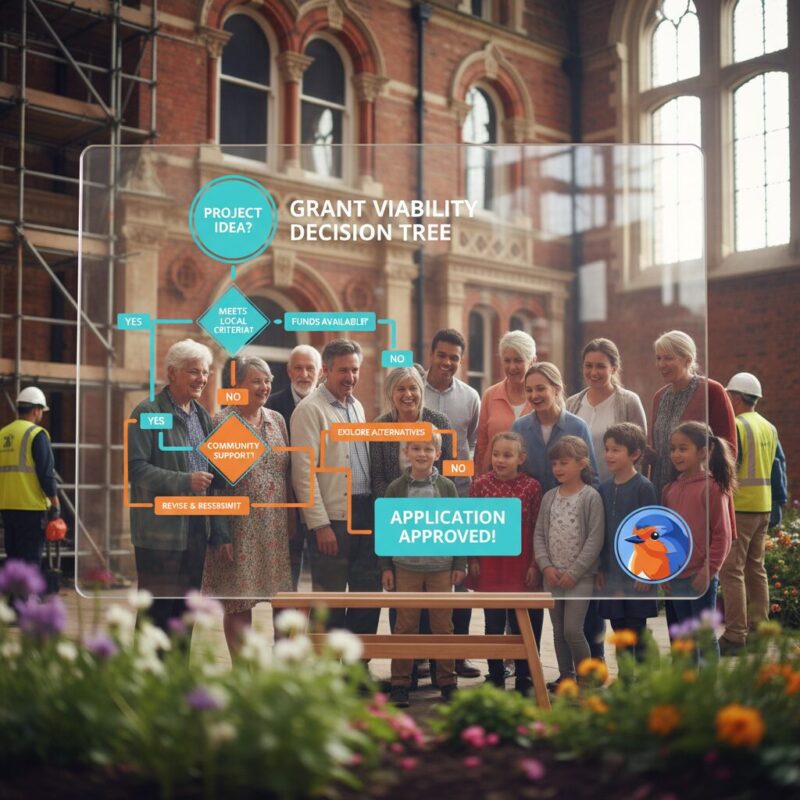
Make the hard decision. Use an objective scoring system—or an AI match score—to evaluate the project’s viability. The criteria for a definitive “no-go” decision saves hundreds of staff hours annually.
Steps 4-6: Mastering the ‘Battle-Hardened’ EOI
The 800-word Expression of Interest (EOI) is a strategic feedback mechanism, not an exam to pass or fail. Use it to gauge funder appetite and perfect the final bid.
Step 4: Draft the 800-Word Expression of Interest
Write a compelling, concise narrative. Focus purely on clarity, community impact, and direct alignment with Heritage 2033. Avoid sector jargon. Use plain English to describe exactly what heritage is at risk and how your proposed solution fixes the problem.
Step 5: Use the EOI as a Diagnostic Tool
Change your team’s mindset around EOI rejections. A rejected EOI provides valuable data; it prevents your team from wasting 40 hours drafting a doomed full bid. According to the National Lottery Heritage Fund’s How to apply guidance, the EOI phase is designed explicitly to give applicants a steer before they commit massive resources.
Step 6: Leverage the 20-Day Feedback Window
Do not wait idly for a response. The NLHF states in their How to apply documentation that they aim to respond to EOIs within 20 working days. Use this window to gather partner letters of support, pull baseline data, and prepare your team to execute a swift pivot if the grant officer requests changes.
Steps 7-9: Systematizing Baseline Data Collection
Small charities must move away from anecdotal storytelling and build internal infrastructure for data-driven evidence.
Step 7: Establish Evidence-Based Metrics Early
Identify three to five Key Performance Indicators (KPIs) that matter to the NLHF. Implement simple, low-cost ways to survey community members and track engagement before the project kicks off.
Step 8: Document “Learning and Failure” Strategically
Admitting mistakes demonstrates operational maturity. Funders appreciate honesty. Frame a “failed” micro-initiative as a vital learning step that informed the current, resilient project design. This sophisticated reporting tactic builds immense trust with grant officers.
Step 9: Integrate Compliance and Safeguarding Checks
Ensure your data collection meets legal requirements. Map out GDPR considerations when capturing community feedback. Integrating safeguarding policies directly into project milestones protects both the community and the organization’s reputation.

Steps 10-12: Writing the Full Proposal with AI Assistance
Writing the full proposal traditionally takes 40 hours. Utilizing Large Language Models can reduce this to just 4 hours, allowing you to focus on the human details.
Step 10: Generate First Drafts with Smart Proposal Tools
Feed your refined EOI, project data, and baseline metrics into an AI grant assistant. Tools like FundRobin’s Smart Proposal feature generate the executive summary and core narratives. The AI handles the compliance checking against NLHF guidelines, while the human writer injects local history and emotional hooks.

Step 11: Optimize Narratives for Local Community Impact
The AI provides the structure; you provide the soul. Edit the generated draft to include specific community quotes, neighborhood history, and emotional hooks that a machine cannot invent. This hybrid approach ensures the bid remains deeply authentic.
Step 12: Finalize the Core Funding and Budget Allocation
Ensure your financial narrative perfectly matches the text. Apply Full Cost Recovery principles to guarantee overheads are accurately calculated. Link every single budget line item directly back to the Heritage 2033 outcomes. To scale this approach effectively across your organization, review tailored software tiers at FundRobin Pricing.
Overcoming Common Pitfalls in Heritage Bids
Small charities frequently trip over three specific hurdles during the NLHF application process.
Pitfall 1: Misunderstanding the “Heritage 2033” Jargon
Misinterpreting policy language leads to immediate rejection. Many charities misunderstand what the fund means by “inclusion” or “environmental sustainability.” Always use the official NLHF glossary to ensure exact alignment with their definitions.
Pitfall 2: Overpromising with Limited Charity Capacity
Do not try to do too much to impress the funder. Grant assessors spot unrealistic timelines and under-resourced projects immediately. Present realistic staffing levels and acknowledge the broader economic context. The UK Government’s local authority funding impact report highlights that stretching staff too thin is a major operational risk for small heritage sites.
Pitfall 3: Lacking a Sustainable Post-Grant Plan
The NLHF funds legacy, not temporary fixes. Detail a clear revenue or volunteer transition plan for years two and three to avoid the “cliff edge” when funding ends.
Scaling Up: Preparing for National Lottery Large Grants
Ambitious small charities can graduate from micro-grants to transformational, large-scale NLHF funding by shifting their operational focus.
Transitioning requires moving from a single project officer model to a multi-stakeholder management approach. Build partnerships with larger anchor institutions in your region to share the administrative burden of six-figure grants.
Replace messy spreadsheets with centralized data dashboards for real-time pipeline tracking. Forecasting financial income based on historical win rates allows for confident scaling. Finally, diversify your income streams by looking beyond the UK. The same core project narrative developed for NLHF can often be adapted for international philanthropic foundations. Explore cross-border opportunities using platforms like FundRobin USA and FundRobin EU to supplement your local grants.
Key Takeaways:
- Adopt “Strategic Refusal” to protect your charity’s limited capacity by saying no to low-probability, misaligned funding opportunities.
- Use the 800-word Expression of Interest (EOI) as a diagnostic feedback loop, leveraging the 20-day response window to validate project alignment with the “Heritage 2033” mandate.
- Move away from the “hamster wheel” of constant applications by systematizing baseline data collection early, enabling evidence-based impact reporting.
- Leverage AI-powered platforms like FundRobin to reduce proposal drafting time by 80%, freeing up your team to focus on relationship-building and core operations.
- Frame “learning and failure” as organizational strengths in your impact reports to demonstrate operational resilience to the National Lottery Heritage Fund.
Frequently Asked Questions (FAQ) About NLHF Applications
What are small heritage grants under the Heritage 2033 plan?
Small heritage grants typically cover projects under £250,000 and prioritize community-led initiatives over massive infrastructure. According to the Heritage 2033 Delivery Plan, the NLHF framework demands that even small-scale grants deliver clear outcomes in at least one of their four core investment principles: saving heritage, protecting the environment, inclusion, or organizational sustainability.
How long does it take to hear back about a National Lottery Heritage Fund EOI?
An Expression of Interest (EOI) typically receives a response within 20 working days. Small charities should use this 20-day window actively to refine their project, gather baseline data, and secure partner letters of support rather than waiting passively for a decision.
What is strategic refusal in grant writing?
Strategic Refusal is the active process of choosing not to apply for low-probability grants to protect staff mental health and organizational capacity. It shifts charities from a scarcity mindset—where they apply for everything out of panic—to a model of sustainable growth focused only on highly aligned opportunities.
What are the four pillars of the Heritage 2033 mandate?
The four pillars are saving heritage, protecting the environment, inclusion/access, and organizational sustainability. To successfully secure an NLHF grant, a small charity project must map robustly to at least one of these core principles without forcing an unnatural fit.
Can AI help write a National Lottery Heritage Fund grant application?
Yes, tools like FundRobin’s Smart Proposal Generation reduce drafting time by up to 80% and ensure compliance with UK standards. While AI cannot guarantee funding or invent authentic local stories, it handles the structural and policy-alignment heavy lifting, allowing charity staff to focus entirely on the community narrative.
How do small charities transition to national lottery large grants?
Successful National Lottery large grants begin as highly organized, scalable pilot projects backed by robust baseline data. Small charities must build operational resilience, establish centralized data tracking dashboards, and demonstrate multi-partner collaboration capabilities before applying for six-figure transformational funding.
