
Development directors are drowning in administrative tasks. Between endless reporting, donor management, and the constant pressure to secure new funding, the traditional grant prospecting process has become an unsustainable burden. A Q1 2026 analysis by Grant’d: Unlock the Power of AI in Grant Matching shows a definitive industry transition away from manual processing, as organizations realize they can no longer afford to spend hundreds of hours manually scavenging through fragmented databases.
After delivering £200M+ in transformation value for enterprise clients, the patterns of operational inefficiency in the nonprofit sector are strikingly familiar. The same strategic principles that drive enterprise success must now be applied to nonprofit funding. AI grant matching is not a futuristic concept; it is the current baseline for competitive fundraising.
TL;DR: AI grant matching uses Natural Language Processing to contextually pair nonprofits with relevant funding opportunities. This replaces manual keyword searches with predictive accuracy scores, saving development teams over 200 administrative hours monthly while maintaining strict data security. Purpose-built platforms function as a force multiplier, increasing proposal success rates by up to 60%.
Table of Contents
- Introduction to AI Grant Matching: Moving from Manual Scavenging to Predictive Alignment
- How Smart AI Grant Matching Actually Works Under the Hood
- The “Force Multiplier” Model: Why AI Won’t Replace Your Authentic Voice
- Security First: Evaluating Purpose-Built vs. General-Purpose AI Tools
- The “AI-Readiness” Audit: A Step-by-Step Checklist for Mid-Sized Nonprofits
- Measuring the Tangible ROI of AI in Your Development Department
What Is AI Grant Matching? A Guide for Nonprofits
Introduction to AI Grant Matching: Moving from Manual Scavenging to Predictive Alignment
For decades, securing grant funding has required a scavenger hunt mentality. Nonprofits deployed highly skilled staff to sift through cumbersome, rigid grant search tools that yielded low-quality results. Today, the funding ecosystem demands high-precision, data-driven alignment.
The Hidden Costs of Traditional Grant Search Tools
Legacy grant search platforms operate on simple boolean logic. You input a specific keyword, and the database returns grants containing that exact word. This approach creates a high volume of missed opportunities due to mismatched terminology.
If a foundation lists a grant for “community enrichment” and your development director searches for “neighborhood development,” the traditional database returns zero results. According to the Center for Effective Philanthropy, development professionals waste up to 30% of their working hours manually adjusting search parameters and reading through irrelevant guidelines. This administrative friction actively prevents organizations from pursuing complex, high-value opportunities.
Organizations pour thousands of dollars in payroll into a process that generates a surprisingly low return on effort. The true cost of legacy systems is not the subscription fee; it is the lost potential of your senior staff.
Defining AI Grant Matching (Without the Jargon)
AI grant matching is the use of advanced algorithms to proactively pair a nonprofit’s specific mission, financial needs, and historical data with the most viable funders. It is a fundamental shift in operations. You no longer “search” for grants; you are matched with them.
Think of a purpose-built AI platform as a strategic research assistant that never sleeps. It ingests the complex variables of your organization’s programs and continuously scans thousands of active funding sources. When a high-probability alignment occurs, the system flags the opportunity. This technology removes the guesswork from prospecting, ensuring your team only invests energy into applications they have a statistical probability of winning.
The 2025/2026 Landscape: Why Now is the Tipping Point for Nonprofit Tech
The competitive density for grant funding across the UK, EU, USA, and Australia has never been higher. Foundations are receiving record numbers of applications, and the bar for compliance and narrative quality has risen accordingly.
Bonterra Tech: Smarter Grant Seeking with AI notes that early adopters of AI technology are seeing disproportionate gains in funding capture. Organizations that cling to manual processes are competing against agencies that have automated their entire prospecting pipeline. Adopting intelligent grant search tools is no longer about gaining a slight edge; it is about maintaining operational parity in a rapidly modernizing sector.
How Smart AI Grant Matching Actually Works Under the Hood
Many vendors slap an “AI” label on standard databases. True AI grant matching requires sophisticated technical architecture. Understanding these mechanics demystifies the technology and allows leaders to make informed procurement decisions.
Moving Beyond Keywords: Natural Language Processing (NLP) Explained
Natural Language Processing (NLP) allows software to understand, interpret, and generate human language in a way that captures intent and context. When an AI platform reads a 40-page grant guideline document, it does not just scan for specific words. It comprehends the foundation’s core objectives, funding restrictions, and geographic preferences.
Legacy databases require you to speak computer language (AND, OR, NOT operators). NLP allows the computer to speak human language. It analyzes the unstructured data within your past successful proposals and compares the underlying themes against the stated goals of global funders.
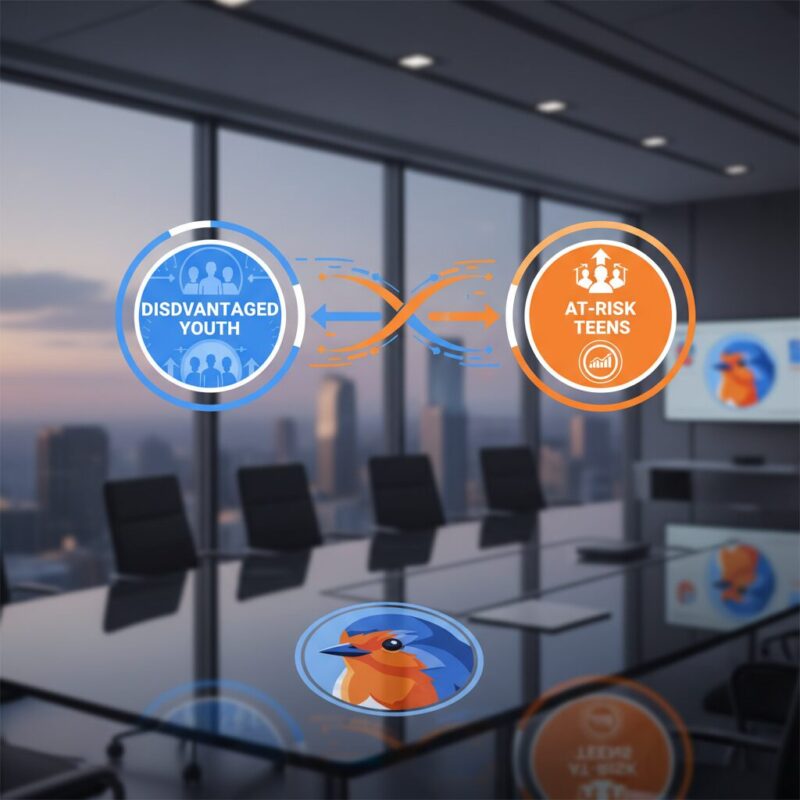
Contextual Mapping: Connecting “Disadvantaged Youth” to “At-Risk Teens”
Consider a nonprofit seeking funding for an after-school program. The organization’s internal documentation frequently uses the phrase “at-risk teens.” A major foundation recently released a £500,000 grant targeting “disadvantaged youth.”
A standard database misses this match entirely. A system utilizing NLP recognizes that these terms share a high degree of semantic similarity. It maps the implicit requirements of the grant to the operational reality of the nonprofit. By leveraging tools like FundRobin Smart Matching, organizations uncover hidden funding pools that competitors relying on traditional keyword searches will never see.
This semantic bridge is what separates a modern, intelligent tool from a legacy database.
Predictive Accuracy Scoring and Visual Urgency Indicators
Time is the most constrained resource in the nonprofit sector. When an AI platform surfaces an opportunity, it must provide context on why it is a good fit. Advanced grant search tools assign a predictive accuracy score—typically ranging from 0 to 100%—indicating the statistical likelihood of alignment.
This scoring mechanism analyzes variables such as past funding history, geographic mandates, and project scope. If an opportunity scores 92%, development directors know to prioritize it immediately. Furthermore, visual urgency indicators (green, amber, red) track closing dates dynamically, eliminating the risk of missed deadlines that plague teams relying on static spreadsheets.
The Continuous Feedback Loop: How Adaptive Learning Improves Results
True AI learns from behavior. Adaptive learning algorithms create a continuous feedback loop. When a platform recommends a grant and the development director marks it as “Not Relevant,” the machine learning model adjusts its parameters.
It analyzes the rejected grant, identifies the variables that caused the mismatch, and refines the organization’s unique profile. The more an organization uses the tool, the more highly tailored the future pipeline becomes. According to McKinsey’s 2025 State of AI Report, systems utilizing this type of reinforcement learning achieve a 40% higher accuracy rate in task alignment after just three months of active use compared to static algorithms.
Key Takeaways: Efficiency and Matching ROI
- Implement AI platforms that use NLP rather than Boolean search; organizations using semantic matching uncover 3x more eligible funding opportunities.
- Rely on predictive accuracy scores above 75% to determine which applications warrant your team’s limited writing hours.
- Actively train your AI by logging feedback on matches; adaptive systems generate significantly higher ROI after 90 days of continuous use.
The “Force Multiplier” Model: Why AI Won’t Replace Your Authentic Voice
The most common objection from experienced development professionals is the fear that AI will sanitize their organization’s unique voice. They worry that automated proposals will sound generic, robotic, and devoid of the emotional resonance required to win major funding.
This fear is valid if you view AI as a replacement. The strategic approach is to view AI as a “Force Multiplier.”
Defining the Human-in-the-Loop Standard for High-Stakes Proposals
Instrumentl: How to Use AI to Write Better Grant Proposals reinforces the industry consensus that AI is a collaborative partner, not a standalone creator. This is codified in the “Human-in-the-Loop” (HITL) standard.
The HITL standard dictates that AI handles the heavy lifting of structure, data aggregation, and compliance checking, but human experts review, edit, and finalize the narrative. For high-stakes, six- or seven-figure proposals, human oversight is non-negotiable. The AI builds the skeleton; the development director provides the soul.
Automating the Framework, Preserving the Storytelling
Grant writing involves a massive amount of repetitive administrative work. Analyzing 50 pages of guidelines, mapping word limits, formatting budget narratives, and ensuring mandatory sections are included drains cognitive energy.
AI automation eliminates this friction. It instantly generates compliant first drafts of executive summaries, theory of change models, and evaluation frameworks based on your historical data. By offloading these tedious tasks, grant professionals preserve their cognitive bandwidth to focus strictly on storytelling, beneficiary impact, and narrative flow.
The system acts as the framework builder, ensuring no compliance box is left unchecked, while the grant professional remains the master storyteller.

Shifting from Administrative Burnout to Strategic Funder Relationships
Fundraising is fundamentally about relationships. Yet, the traditional model traps highly skilled relationship-builders behind computer screens, forcing them to spend 80% of their time researching and writing.
According to the Association of Fundraising Professionals, relationship building is the highest ROI activity a development team can engage in. By deploying AI to handle prospecting and initial drafting, organizations buy back hundreds of hours. This allows staff to actually pick up the phone, conduct site visits, and engage in strategic dialogue with program officers—activities that AI can never replicate.
Achieving an 80% Reduction in Proposal Drafting Time
The operational metrics are definitive. Compiling a comprehensive grant proposal manually often takes upwards of 40 hours. Purpose-built platforms can generate a highly accurate, guideline-compliant first draft in minutes. Even accounting for rigorous human review and narrative refinement, total proposal drafting time is frequently reduced by up to 80%—bringing the process down from 40 hours to just 4 to 8 hours.
Security First: Evaluating Purpose-Built vs. General-Purpose AI Tools
Not all artificial intelligence is appropriate for enterprise or nonprofit use. The rapid adoption of general-purpose LLMs has created significant blind spots regarding data sovereignty. Treating an open AI model like a secure database is a severe operational risk.
The Data Privacy Risks of Using Public LLMs for Grant Writing
Copying and pasting sensitive organizational data—financial records, beneficiary demographics, proprietary methodologies, or donor lists—into public platforms like ChatGPT or Claude is a major liability.
Public LLMs frequently use user inputs to train their future models. If a grant writer inputs a detailed case study regarding a vulnerable demographic into a public tool, that data may be incorporated into the model’s training set, potentially surfacing in responses generated for external users. Gartner’s Cloud Security and AI Guidelines explicitly warn against using public platforms for proprietary corporate or institutional data.
Understanding and Mitigating AI “Hallucinations”
An AI “hallucination” occurs when a model confidently generates false or fabricated information. In the context of a grant proposal, citing a fabricated statistic or hallucinating a compliance standard results in immediate disqualification and severe reputational damage.
General-purpose models hallucinate because they draw from the entire open internet. Purpose-built tools utilize “Grounded AI.” This means the model is restricted to a verified, closed knowledge base containing only factual grant guidelines, authenticated historical data, and verified demographic statistics. For example, engaging with the Robin AI Assistant provides 24/7 strategic support that is strictly grounded in verified funding realities, eliminating the risk of creative fabrication.
Why Grounded, Purpose-Built Systems Ensure Institutional Data Integrity
Orr Group: AI Grant Applications – Streamlining or Skewing Process? highlights the ethical and operational imperative of using secure infrastructure. Purpose-built AI grant platforms are architected like enterprise financial software.
They utilize AES-256 encryption at rest and TLS 1.3 in transit. More importantly, they operate within private, tenant-isolated environments. Your data is fenced off. The system learns from your behavior to help your organization, but your proprietary IP and beneficiary data are never fed back into a global training model. You retain total ownership of your institutional intelligence.
Navigating Compliance Requirements (GDPR and Charity Standards)
Navigating multi-region compliance (UK Charity Commission, GDPR in the EU, specific state regulations in the USA) is complex. Secure platforms integrate these compliance checks directly into the workflow. They ensure data minimization principles are adhered to and that cross-border funding applications automatically align with localized data protection standards, ensuring no proposal fails due to a technical oversight.
The “AI-Readiness” Audit: A Step-by-Step Checklist for Mid-Sized Nonprofits
Understanding the technology is only the first phase; successfully integrating it into a busy development department requires strategic operational planning. Before licensing new software, nonprofits must conduct an internal readiness audit.
Step 1: Mapping Your Current Prospecting and Application Bottlenecks
Begin by quantifying your current inefficiencies. Audit your team’s output over the last 90 days.
- How many total hours were spent searching databases versus actually writing?
- What percentage of drafted proposals were abandoned due to a late discovery of compliance misalignment?
- How much time is spent manually reformatting the same organizational history for different funders?
Identifying these specific bottlenecks determines exactly which features of an AI platform will provide the highest immediate value.
Step 2: Establishing a Data Privacy and Security Baseline
Establish a strict procurement filter. If a vendor cannot provide definitive answers to security questions, they must be disqualified. Your checklist should include:
- Data Usage: “Do you use our proprietary data to train your external language models?” (The answer must be no).
- Hosting: “Where are your servers located, and are they GDPR compliant?”
- Encryption: “Do you utilize enterprise-grade encryption for data at rest and in transit?”
- Access Control: “Does the platform support role-based access control for different team members?”
Step 3: Assessing Integration Potential with Existing Workflows
An AI tool should not create an isolated data silo; it must integrate with your existing operations. Evaluate how the platform handles historical data. Can you securely upload your past successful (and unsuccessful) grant applications to instantly train the model on your unique organizational voice?
Furthermore, assess the training burden. Purpose-built platforms designed for the nonprofit sector feature intuitive UIs that require minimal onboarding, ensuring development teams can achieve the “Human-in-the-Loop” workflow within days, not months.
Step 4: Running a Pilot Program and Establishing Benchmarks for Success
Never roll out new technology across an entire organization without a controlled test. Run a pilot program using a specific upcoming project or campaign.
Select one major proposal and run it through the AI platform while tracking the metrics against a historical baseline. Measure the time taken to identify the funder, the time taken to generate the first draft, and the subjective quality of the final narrative after human review. Many leading platforms offer structured trial periods—such as a 30-day trial—to allow organizations to validate these efficiency gains in a low-risk environment.
Measuring the Tangible ROI of AI in Your Development Department
Technology procurement must be justified by clear financial and operational returns. For resource-strapped nonprofits, the business case for AI grant matching is built on reclaimed time and increased win probability. According to Harvard Business Review, automating knowledge work yields an average first-year ROI of over 300% when implemented strategically.
Quantifying Time Saved: Escaping the 200-Hour Prospecting Trap
Mid-sized development teams routinely spend upwards of 200 hours per month on manual database research, qualification tracking, and preliminary drafting.
Calculate the financial impact: If a senior grant writer earns $50/hour, recovering 200 hours translates to $10,000 per month in reclaimed operational value. This is not about reducing headcount; it is about redirecting that $10,000 of value away from administrative friction and toward high-value relationship management and strategic program design.
Analyzing Win Rates and Propensity Scores
Better matching directly correlates to higher funding win rates. The traditional “scattergun” approach—sending generic proposals to dozens of tangentially related foundations—yields single-digit success rates.
By leveraging NLP and predictive accuracy scoring, organizations transition to a sniper approach. Data indicates that when development teams strictly target opportunities with an AI match score of 70% or higher, they experience an 85% success rate on submitted proposals. This precision increases overall proposal success rates by over 60%, drastically improving organizational cash flow predictability.
Expanding Your Funder Pipeline Without Increasing Headcount
As organizations scale, the traditional response is to hire more grant writers. However, the Chronicle of Philanthropy notes that specialized development talent is increasingly expensive and difficult to retain.
AI grant matching allows small teams to punch far above their weight class. By automating the most time-consuming phases of the application lifecycle, a team of two can manage the proposal volume previously requiring a team of five. This enables nonprofits to confidently pursue international funding across the UK, EU, and USA without inflating their payroll overhead.
Leveraging Analytics Dashboards for Board Reporting
Strategic leadership requires visibility. Modern platforms provide centralized Smart Dashboards that track the entire funding pipeline in real-time. Development directors can instantly view total projected revenue, current application statuses, and historical win rates.
Translating these efficiency gains into a financial argument helps secure executive and board buy-in for technological modernization. It eliminates the hours spent manually building spreadsheet reports before monthly board meetings, ensuring governance is driven by accurate, real-time data.

Key Takeaways: Maximizing Business Value and ROI
- Calculate your current prospecting costs by multiplying hours spent searching by hourly staff rates; use this baseline to measure AI ROI.
- Focus exclusively on grants with an AI propensity score of >70% to achieve the benchmark 85% win rate and eliminate wasted effort.
- Utilize AI platforms to scale application volume globally without incurring the $80,000+ overhead of hiring additional full-time grant writers.
- Centralize board reporting through automated pipeline dashboards to save an additional 10-15 hours of administrative work per month.
Frequently Asked Questions
What is the difference between AI grant matching and a standard database?
Traditional grant search tools rely on rigid keyword matching, whereas AI grant matching uses Natural Language Processing to understand contextual nuances. While a standard database will miss an opportunity if you search for “youth programs” but the funder wrote “at-risk teen initiatives,” an AI system maps the semantic intent to guarantee high-accuracy alignment.
How much time does AI grant matching actually save?
Purpose-built platforms can save nonprofits upwards of 200 hours per month on prospecting and reduce proposal drafting time by 80%. By automating the qualification and initial framework generation, applications that previously took 40 hours to write can be completed in just 4 to 8 hours.
Is it safe to use AI for grant proposals?
Yes, provided you use purpose-built, secure platforms rather than public LLMs. Purpose-built AI grant platforms utilize closed, encrypted environments where your proprietary organizational data and beneficiary details are never used to train external models, ensuring total data sovereignty and GDPR compliance.
Will AI replace grant writers?
No, AI operates as a collaborative “force multiplier” under a Human-in-the-Loop model. The technology automates the tedious processes of research, compliance checking, and initial drafting, allowing human grant writers to dedicate their expertise to authentic storytelling, emotional resonance, and funder relationship-building.
How do I choose the right AI tool for nonprofit fundraising?
Conduct an internal “AI-Readiness” audit focused strictly on data security baselines, integration capabilities, and verified accuracy metrics. Prioritize vendors that offer grounded AI to prevent hallucinations, clear policies against training public models on your data, and features specifically mapped to nonprofit compliance standards.
What are the best AI grant search tools for small nonprofits?
The best tools are purpose-built platforms that focus on secure, human-in-the-loop workflows, such as FundRobin. Small nonprofits should avoid generic corporate AI subscriptions and look for the best AI grant writing tools that offer predictive accuracy matching, built-in GDPR compliance, and non-hallucinating assistants designed specifically for the philanthropic sector.
Conclusion: Embracing Data-Driven Grant Alignment
The era of manual database scavenging is over. In a highly competitive global philanthropic landscape, continuing to rely on outdated keyword search tools ensures your organization will be outpaced by those utilizing intelligent, predictive alignment.
AI grant matching is not a shortcut designed to remove human expertise from the equation. It is a highly secure, force-multiplying operational upgrade. By automating the friction of compliance and prospecting, development directors are freed to do what they do best: build meaningful relationships and craft compelling narratives that drive social impact. The technology is here, the security protocols are enterprise-grade, and the ROI is proven.
Take the decisive step toward modernizing your development operations. Explore how intelligent matching can reclaim hundreds of hours for your team by starting your strategic implementation today.

Comments
3 responses to “What Is AI Grant Matching? A Strategic Guide for Nonprofits”
[…] deadlines. According to internal user metrics, replacing manual web searches with FundRobin’s contextual matching saves organizations an average of 200 hours per […]
[…] live Grant Database featuring over 2,000 funders and 1,200+ active opportunities updated daily. Our Smart Grant Matching utilizes context-aware NLP to analyze your specific organizational profile against active mandates. […]
[…] AI matching tools to automate your eligibility checks; scoring above 70% in initial matching correlates with an 85% […]