
Quick answer: The best AI grant writing tools help nonprofits find better-fit funders, draft stronger proposals, and keep a human reviewer in control.
AI can help nonprofit teams research, organise and draft grant work, but the useful workflow depends on whether a tool is a general-purpose language model, a writing assistant, a grant-specific drafting tool, a discovery database, or an end-to-end grant workspace. This FundRobin-authored guide compares those categories using current public product information and keeps human review as a requirement.
TL;DR: This guide compares public product information for FundRobin, Instrumentl and other grant-writing tools. FundRobin combines multi-region grant discovery with explainable matching and AI-assisted proposal drafting: match scores are prioritisation signals, not award probabilities, and Smart Proposal creates a structured first draft for human review.
The 2026 Grant Writing Landscape: Why AI is No Longer Optional for Nonprofits
7 Best AI Grant Writing Tools for Nonprofits in 2026
Key Takeaways:
– Compare source grounding, current funder evidence and human-review controls rather than assuming a generic accuracy uplift from any AI category.
– Prioritize end-to-end platforms that unify prospecting and drafting to eliminate the ‘swivel-chair’ efficiency drain.
– Review each provider’s current privacy, retention and model-training terms before sharing sensitive charity information.
The macroeconomic pressures on charitable organizations have reached a boiling point. Development directors are tasked with securing more funding with flatlining operational budgets, creating a systemic capacity crisis across the sector. For more insights on surviving these market shifts, see our guide on the strategic grant discovery 2026 triple crunch.
Reducing Repetitive Grant Work
Repeated prospect searches and proposal formatting can consume time. A useful software evaluation records the team’s actual workload and review effort instead of assuming a universal staff-tenure or time-saving figure. 
Research from the Urban Institute on Nonprofit Leaders’ Concerns shows that workforce challenges and financial constraints are inextricably linked. AI can reduce repetitive searching and blank-page drafting when it is used inside a reviewable workflow. The practical benefit depends on the organisation, the opportunity and the amount of human verification required, so teams should measure their own workflow rather than assume a fixed time saving.
Generic LLMs vs. Grant-Specific AI Tools
General-purpose language models can help with brainstorming, rewriting and first drafts, but they do not by themselves make funder information current or application requirements verified. Grant-specific tools can add discovery data, structured funder requirements and organisation context, but those capabilities vary by product and source. In either case, teams should verify facts, eligibility and current funder guidance before submission.
Protecting Your Charity’s Data and Brand Voice
Before putting sensitive charity information into any AI product, review the provider’s current privacy notice, data-processing terms, retention controls, model-training policy, access controls and subprocessor disclosures. Avoid assuming that a product is safe merely because it is described as “enterprise” or “grounded”. Keep beneficiary and special-category personal data out of drafting workflows unless your organisation has approved the tool and the use case.
Key Takeaways: ROI and Cost Reduction
- An end-to-end grant workflow can reduce repeated searching, copy-pasting and blank-page drafting, but the actual time saved should be measured by each team.
- Avoid ‘enterprise bloat’ and exorbitant costs by choosing platforms that balance enterprise-grade AI features with affordable pricing.
- Compare your actual subscription costs and staff review time against a short, documented evaluation before deciding whether a unified workflow saves money.
How This Comparison Was Prepared
Editorial disclosure: FundRobin publishes this guide and is one of the products compared. We did not run a standardised hands-on benchmark of every product. We compared current public product and pricing information, reviewed on 6 September 2026, against the jobs nonprofit teams commonly need to complete.
Factual updates checked 15 September 2026: the Grantable, Candid and GrantFinder details below use their current public pages. These are provider-described features and prices, not hands-on performance results. Other comparison material retains its 6 September review date.
FundRobin case-study evidence (September 2026): among 18 of 24 organisations able to quantify both periods, self-reported time to a reviewable first draft fell from an average of 9.5 to 5.5 working hours per application, about 40%. Those teams reported spending about 60% of the saved drafting time on evidence gathering, mapping funder questions and final review rather than generating text. These are self-reported results from the defined case-study cohort, not guaranteed time savings or a sector-wide benchmark.
We distinguish five product types so unlike tools are not treated as direct substitutes:
- Generic LLMs: general drafting and reasoning tools that are not dedicated grant databases.
- AI writing assistants: tools focused primarily on drafting, rewriting or proposal reuse.
- Grant-specific drafting tools: products that structure AI assistance around grant applications.
- Grant discovery and research databases: products focused on finding and researching funders or opportunities.
- End-to-end grant workspaces: products that connect discovery, prioritisation, organisation context, drafting and workflow management.
“Best for” labels below are editorial fit judgements, not claims that one tool will outperform another for every organisation. Pricing and product capabilities can change, so verify the provider’s current documentation before purchase.
The 7 Best AI Grant Writing Tools for Nonprofits in 2026
The right choice depends on whether your bottleneck is discovery, research, drafting, organisation knowledge or workflow management.
1. FundRobin — End-to-End Grant Workspace
Category: End-to-end grant workspace. Best for: Teams that want supported-source discovery, organisation-specific matching, reusable organisation knowledge, AI-assisted first drafts and pipeline work in one workflow.
Pricing: Growth is £49/month or £470.40/year; Impact is £199/month or £1,910.40/year. Standalone free tools are separate from paid platform access.
Strengths: Smart Matching helps prioritise fit with a rationale for human review; Organisation Library and Organisation Brain make reviewed organisation knowledge reusable; Smart Proposal supports structured first drafts; Robin works with authorised opportunity and organisation context across the workflow.
Limitations: Funding-source coverage varies by region and source; the original funder remains authoritative. AI-assisted work still needs human review, and FundRobin does not guarantee eligibility, compliance, funding or application success.
2. Instrumentl — Grant Prospecting, Tracking and Pre-Award Workflows
Category: Grant discovery and workflow platform. Best for: Teams that value Instrumentl’s prospecting, funder research, tracking and Pre-Award workflow.
Pricing: Official pricing reviewed 6 September 2026 lists Discover at $299/month with annual billing ($349 month-to-month), Pre-Award at $499/month annually ($579 month-to-month), Full Lifecycle at $999/month annually ($1,159 month-to-month), and Enterprise as custom. AI-assisted application workflows are available beyond the basic discovery-only use case.
3. Grantable — AI-Assisted Prospecting, Drafting and Workflow
Category: AI-assisted prospecting, drafting and grant workflow. Best for: Teams evaluating funder research, reusable proposal material, drafting and pipeline work together. Grantable’s current product and pricing page, checked 15 September 2026, describes those capabilities across Free, Starter ($50/month) and Pro ($150/month) plans, with different usage capacity.
What to verify: funding coverage for your region, output quality and usage limits against your own workflow. The advertised first-year 50% nonprofit discount is for qualifying organisations recognised under US section 501(c)(3) with operating budgets below $500,000; UK charity status alone does not establish eligibility. Agency Hub is marked coming soon and is not treated here as an available feature.
4. Candid Search — Funder and Nonprofit Research
Category: Funder/nonprofit research with AI-assisted fundraising support. Best for: Teams researching giving relationships that also want to evaluate AI-assisted funder queries and letters of inquiry. Candid’s official pricing page, checked 15 September 2026, lists a limited Free plan, Premium at $219 month-to-month, and Premium starting at $1,199 billed annually. The annual commitment is not a $100 rolling monthly subscription.
What to verify: geographic coverage, profile/grant-download limits and AI credits for your plan. Candid describes an AI fundraising assistant and LOI support, so treating it as research-only would omit part of its current offer. Verify its fit for your target UK funders rather than assuming complete coverage.
5. GrantStation — Grant Research
Category: Grant discovery and research database. Best for: Teams focused on prospect research that can handle drafting and workflow management elsewhere.
6. GrantFinder / Idox — UK Funding Discovery
Category: UK funding intelligence and discovery. Best for: UK organisations researching relevant funding and alerts. GrantFinder’s official plans, checked 15 September 2026, list VCSE Essentials at £1,020 annually for one user, Growth at £1,500 annually for up to three users, and Enterprise by enquiry.
What to verify: organisation eligibility, tax treatment, funding coverage and workflow requirements. Essentials is for UK VCSE organisations; Growth also covers eligible registered UK small businesses. Confirm whether you need a separate drafting tool rather than assuming a discovery subscription includes proposal-writing AI.
7. ChatGPT, Claude or Gemini — General-Purpose AI Assistance
Category: Generic LLMs. Best for: Brainstorming, rewriting, summarising and draft assistance when your team already has reliable grant information. They are not a substitute for a dedicated grant database by default, and users should verify current funder requirements and follow their organisation’s data-handling policy.
Quick Comparison by Job to Be Done
| Need | Tools to shortlist | What to verify |
|---|---|---|
| Integrated discovery + organisation context + drafting | FundRobin | Source coverage for your regions; workflow fit |
| Prospecting + tracking + Pre-Award workflow | Instrumentl | Plan cost, geographic coverage and required features |
| AI-assisted prospecting, drafting and pipeline work | Grantable | Regional coverage, usage capacity and output review |
| Funder / nonprofit research | Candid Search, GrantStation | Coverage, billing and exports; Candid also offers AI fundraising/LOI support |
| UK funding discovery | GrantFinder / Idox | Relevant UK funding coverage and workflow integrations |
| General writing assistance | ChatGPT, Claude, Gemini | Data policy, fact checking and lack of dedicated grant data |
For UK charities, the important question is not simply which AI writes the most text. Compare UK funding coverage, the quality of source evidence, how organisation knowledge is reused, how much human review the workflow expects, and whether the product replaces one task or connects the full grant process.
Implementing AI Without Losing Your Nonprofit’s Unique Voice
Choosing software is only part of the work. A useful rollout also needs clear data rules, human review and a workflow the team will actually use. 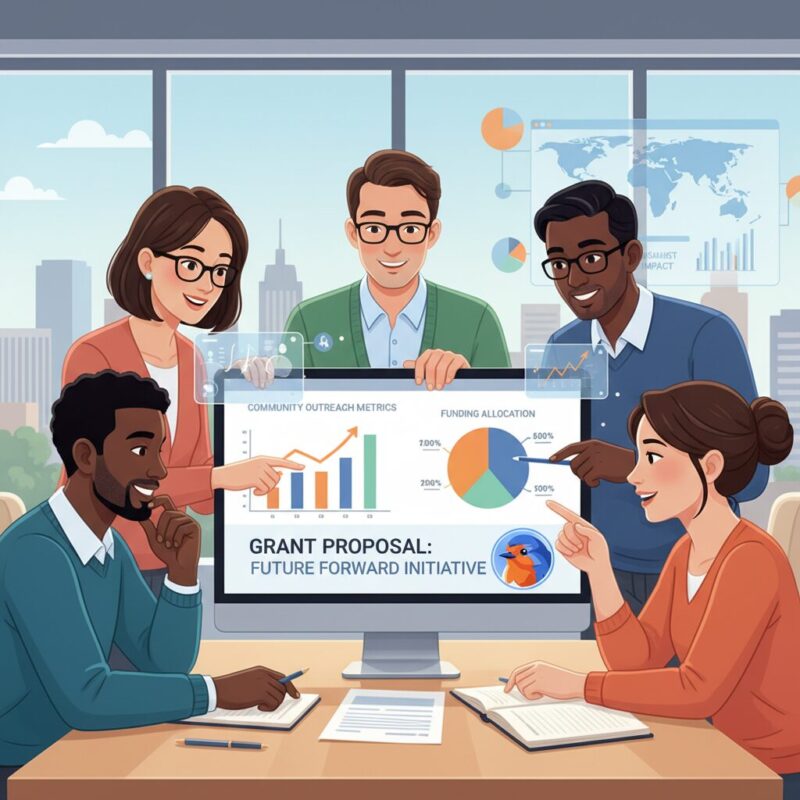
Step 1: Establish Internal AI Policies and Data Security
Before deploying any software, draft an AI acceptable use policy to ensure data minimization and compliance.
Step 2: Utilize “Human-in-the-Loop” Editing Workflows
As noted by Forrester’s 2025 AI Workflow Guide, the “Human-in-the-Loop” paradigm is essential. Let the AI handle the heavy lifting of compliance and drafting, while your team injects the authentic storytelling. For a deeper dive, read our guide on the ethics of grant automation and the HITL model.
Step 3: Build Reusable Organisation Context
Keep reviewed organisation information and supporting evidence reusable rather than repeatedly pasting old proposals into prompts. In FundRobin, Organisation Library and Organisation Brain can provide reviewed organisation context for Robin and proposal work, with source or provenance information retained where available. Users should resolve missing or conflicting information before relying on it.
Frequently Asked Questions
What is the best AI tool for grant writing?
There is no single best tool for every nonprofit. Use a general-purpose LLM when you mainly need writing assistance; a research database when discovery is the bottleneck; a grant-specific drafting tool when application writing is the bottleneck; or an end-to-end workspace when you need discovery, organisation context, drafting and workflow management together.
Is it ethical to use AI for grant writing?
It can be, provided your organisation has an appropriate AI and data-handling policy, people verify factual claims and funder requirements, and a human remains responsible for the final narrative and submission decision.
How should a charity assess AI data security?
Review the provider’s current privacy notice, data-processing terms, retention controls, model-training policy, access controls and subprocessors. Match those terms to the sensitivity of the information you plan to use rather than relying on a generic “secure AI” label.
Can I use ChatGPT, Claude or Gemini for grant writing?
They can assist with brainstorming, rewriting and drafts when you already have reliable source material. They are not dedicated grant databases by default, so verify current funder guidance yourself and follow your organisation’s policy before sharing sensitive information.
What does FundRobin add beyond a generic LLM?
FundRobin connects supported-source discovery and organisation-specific matching with Organisation Library, Organisation Brain, contextual Robin assistance, structured proposal drafting and grant workflow management. Match signals support prioritisation rather than predicting awards, and users remain responsible for reviewing drafts and current funder requirements.
Conclusion: Choose for the Workflow, Not the AI Label
Shortlist tools by the job your team needs to improve, then test them against real opportunities and your own review process. For FundRobin, compare the Growth and Impact plans or apply for the guided Showcase Trial if you want a structured evaluation.

Comments
5 responses to “7 Best AI Grant Writing Tools for Nonprofits”
[…] professional, compliant first drafts in minutes. According to software utilization metrics from G2, purpose-built grant generation tools can reduce initial writing time by up to […]
[…] such as FundRobin. Small nonprofits should avoid generic corporate AI subscriptions and look for the best AI grant writing tools that offer predictive accuracy matching, built-in GDPR compliance, and non-hallucinating assistants […]
[…] to 7 Best AI Grant Writing Tools for Nonprofits in 2026 | FundRobin, specialized proposal generators safely reduce writing time from 40 hours down to just 4 hours per […]
[…] can small nonprofits afford AI grant writing tools in […]
[…] page syndrome kills momentum. Use grounded software to generate your initial structure. Dedicated smart proposal tools analyze the specific grant guidelines and your provided raw data to build a compliant first draft. […]