
During my eight years coordinating emergency responses and writing proposals across UNICEF, WFP, and the Malaria Consortium, I witnessed a recurring systemic failure. Exceptional organizations with life-saving missions routinely faced financial collapse because they treated grant writing as a reactive emergency rather than a proactive science.
This guide to grant writing for nonprofits reflects the funding reality reported by the Nonprofit Finance Fund (NFF) 2026 Trends Report (published March 2026): the post-pandemic surge in unrestricted capital has dried up and organizations are navigating a severe funding cliff. In a recent FundRobin survey, 76 nonprofit leaders told us organisations with a documented grant strategy were 3.1x more likely to maintain consistent year-over-year funding than those relying on ad-hoc applications. Skip the blank page with the free FundRobin Grant Proposal Generator, then refine the draft with the framework below.
FundRobin offers Growth at £49/month or £470.40/year and Impact at £199/month or £1,910.40/year. Compare current plans. Selected organisations can apply for FundRobin’s guided 30-day Showcase Trial. The period starts only after approval and activation; approved Showcase organisations do not need a card to begin. Apply for the Showcase Trial.
Table of Contents
- Introduction: The 2026 Grant Writing Environment and the Resilience Pivot
- Types of Nonprofit Grants
- How to Apply for Nonprofit Grants: Step-by-Step
- Building a 12-18 Month Proactive Funding Roadmap
- Integrating AI into Grant Writing Workflows
- 2026 Compliance & Mitigating Federal “Clawback” Risks
- Beyond Grants: Achieving Sustainable Fundraising and Revenue Diversification
- Frequently Asked Questions
Grant Writing for Nonprofits: A 2026 Strategic Guide
What Grant Writing for Nonprofits Looks Like in 2026
Modern grant writing for nonprofits in 2026 is a strategic, data-driven competency, not a reactive task. Organizations must pivot from “grant chasing”—the frantic pursuit of any available dollar—toward “grant resilience,” which focuses on long-term pipeline stability, precise funder alignment, and rigorous compliance tracking.
The 2026 Funding Cliff and Donor Fatigue
The macroeconomic pressures facing the sector are acute. The NFCB 2026 Nonprofit Trends: Navigating Pressure and Possibility report details how donor fatigue has created hyper-competitive grant cycles. Foundations are receiving double the application volume compared to 2023, while distributing similar or reduced total award amounts. This concentration means funders have raised their evaluation standards. Proposals that lack specific, measurable impact data or fail to demonstrate long-term financial viability are discarded in the first review round.
Why the Traditional “Grant Chasing” Model is Failing Mid-Sized Nonprofits
When funding gets tight, the natural instinct is to apply for more grants. This “spray and pray” approach drains resources and rarely yields results. The reactive model directly causes the top user pain point in the sector: severe staff burnout.

Writing a custom proposal from scratch traditionally takes 30 to 40 hours. If a development team manually chases 10 poorly-matched grants a month, they waste 400 hours of highly skilled labor. At an average loaded staff cost of $45 per hour, that is $18,000 of monthly overhead burned on low-probability applications. Fragmented databases exacerbate this issue, forcing staff to spend endless days verifying eligibility criteria that should be automated.
Shifting to a Proactive Grant Strategy for Sustainable Resilience
Sustainable resilience requires a data-backed, technology-enabled operational model. It prioritizes long-term alignment over short-term cash injections. By adopting advanced tracking and AI-native tools, mid-sized nonprofits flip their operations. They identify the grants they want to win 18 months in advance, build the necessary relationships, and execute applications systematically.
Types of Nonprofit Grants
Diversifying your funding portfolio requires understanding the distinct compliance and narrative requirements of different funding vehicles.
| Grant Type | Primary Source | Ideal Use Case | Compliance Burden |
|---|---|---|---|
| Foundation Grants | Private/Family Foundations | Pilot programs, capacity building, community initiatives | Low to Medium |
| Corporate Grants | Corporate Giving Arms / CSR | High-visibility local projects, event sponsorships | Low |
| Federal Grants | Government Agencies (e.g., NIH, DOE) | Large-scale, multi-year scaling and systemic interventions | Extremely High |
| Seed/Innovation | Specialized Accelerators | Non-dilutive capital for social enterprise startups | Medium |
| Charity Grants | Regional Bodies (e.g., UK Lottery) | Sustained community impact matching strict regional frameworks | High |
Foundation and Corporate Grants
Philanthropic giving from private entities offers the most narrative flexibility. Family foundations often fund based on legacy interests and personal relationships, while corporate giving arms look for alignment with their 2026 Environmental, Social, and Governance (ESG) goals. These grants allow organizations to tell compelling human stories. They are excellent sources for capacity building—funding the staff, technology, and infrastructure that federal grants often refuse to cover.
Government and Federal Grants
Federal and state grants provide high-value capital essential for scaling operations. However, this money comes with immense complexity. Navigating systems like Grants.gov requires meticulous attention to detail. Public funds carry strict reporting mandates, mandatory audits, and rigid procurement rules. Organizations should only pursue federal grants when they have robust internal financial tracking mechanisms already in place.
UK Charity Grants and Global Equivalents
Regional funding bodies often set the gold standard for compliance and impact measurement. The UK funding environment, heavily regulated by the Charity Commission, demands rigorous operational transparency. Navigating major funders like the National Lottery Community Fund requires specialized knowledge. Understanding UK Charity Grants prepares nonprofits for global funding success, as the strict frameworks required in the UK are increasingly being adopted by major international funders across the EU and Australia.
Innovation and Seed Grants for Scaling Impact
Social enterprises and tech-forward nonprofits require specific capital to build new solutions. Innovation grants provide non-dilutive funding, allowing founders to scale their impact without sacrificing equity or board control. Discovering these niche grants requires advanced discovery tools, as they are rarely listed on traditional philanthropic databases. They often prioritize R&D potential and disruptive approaches to legacy social problems.
How to Apply for Nonprofit Grants: A Step-by-Step Grant Writing for Nonprofits Workflow
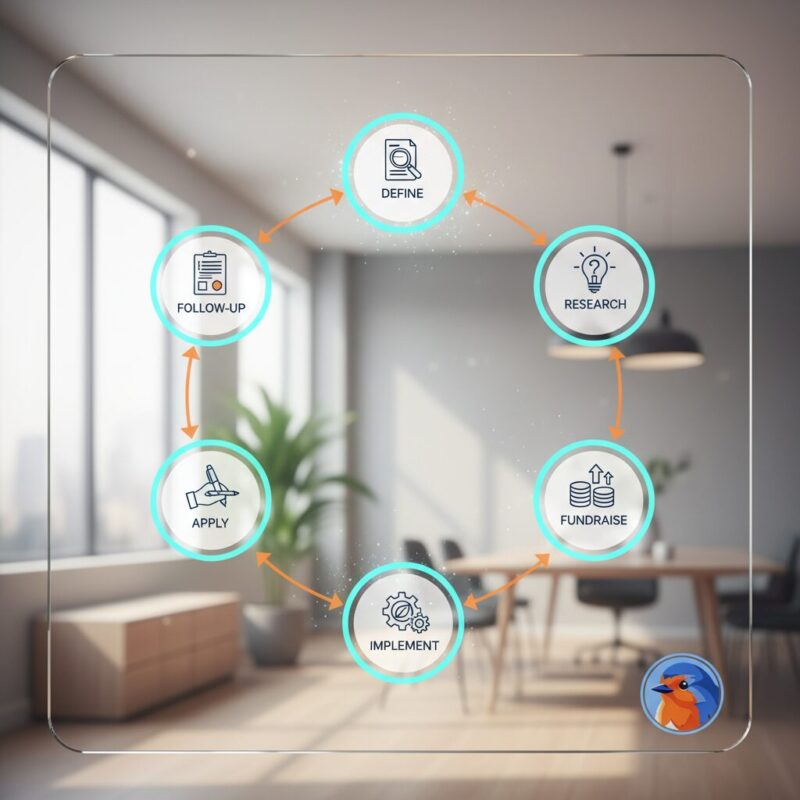
Executing a successful grant application requires a structured 6-step lifecycle. Following this exact workflow prevents mission drift and maximizes the ROI of your development team.
Step 1: Define Your Needs and Project Scope
Establish exactly what you need funding for before you look at a single grant opportunity. Build a clear Theory of Change that maps inputs to specific outcomes. Define your budget fundamentals early, strictly separating direct program costs (materials, specific staff time) from indirect costs (rent, utilities, administrative overhead). Defining your project after finding a grant causes mission drift—forcing your organization to execute programs outside its core competency simply because the money was available.
Step 2: Research and Identify the Right Funders
Contrast the manual Google search method with modern AI-driven discovery. Searching manually yields outdated guidelines and takes hundreds of hours. You must analyze a funder’s historical giving data (e.g., 990 tax forms in the US) to see if they actually fund organizations of your size and in your region. Using a specialized Grant Finder automates this analysis, instantly surfacing funders with high-probability match rates based on past giving behavior.
Step 3: Assess Eligibility and Organizational Readiness
This is the critical filtering phase. Do not write a single word until you verify your 501(c)(3) or equivalent charity status requirements, audit prerequisites, and geographic restrictions. Calculate the true cost of managing the grant. If a $10,000 grant requires $4,000 worth of staff time to administer and report on, it is a net loss. Make the “go/no-go” decision immediately during this step.
Step 4: Develop the Proposal Narrative and Budget
Draft the executive summary, statement of need, project goals, and financial breakdown. This phase historically causes the most burnout due to the repetitive nature of rewriting organizational history. Modern teams eliminate this bottleneck using Grant Writing Software that securely analyzes the organization’s verified data to generate highly compliant, funder-specific first drafts in minutes, leaving staff to focus purely on refining the narrative nuance.
Step 5: Review, Format, and Submit
Formatting errors remain the number one reason for automatic rejection. If a funder demands 1-inch margins and 12-point Times New Roman font, an 11-point Arial submission will be discarded unread. Conduct an independent internal review for clarity—have someone who did not write the proposal read it. Submit applications at least 48 hours before the deadline to avoid inevitable portal crashes and technical glitches.
Step 6: Follow-Up and Relationship Management
Win or lose, the follow-up dictates long-term sustainability. If rejected, request reviewer feedback immediately; this intelligence is invaluable for the next cycle. If awarded, execute immediate stewardship protocols: sign agreements, align internal teams on reporting dates, and issue collaborative press releases. Treat funders as long-term partners, not ATMs.
Key Takeaways: ROI of Proactive Grant Management
- Shift to a proactive 12-18 month funding roadmap to eliminate low-yield grant chasing, drastically improving organizational ROI and operational stability.
- Calculate the true cost of acquisition: Saving 30 hours per proposal through structured workflows reclaims roughly $1,350 in staff time per application.
- Make the “go/no-go” decision in Step 3—rejecting a misaligned $10,000 grant saves more money than winning it if reporting overhead exceeds the award value.
Building a 12-18 Month Proactive Funding Roadmap
Working strictly on upcoming deadlines causes inevitable pipeline gaps. A 12-18 month roadmap acts as the ultimate tool for revenue stability, aligning your grant pipeline directly with the organization’s overarching strategic plan.
Establishing Organizational Capacity and Buy-in
Long-term strategy requires breaking down the silos between program delivery, finance, and development teams. Conduct a funding gap analysis to determine exactly what core operations require capital next year. Secure executive buy-in by presenting grants as a shared organizational responsibility, not just the development director’s problem. Specialized Nonprofits technology solutions can help structure this capacity building, providing transparent access to pipeline data for all stakeholders.
Implementing a “Strategic Refusal” Policy to Prevent Burnout
Strategic Refusal is the intentional policy of passing on grants that do not align perfectly with your mission, regardless of the dollar amount. Create a template criteria for refusal. For example: “We will refuse any grant where restricted funding does not cover at least 15% overhead, or where the application timeline is under 14 days.” Empowering staff to say ‘no’ to bad-fit grants directly protects ROI and dramatically improves team morale.
Using Smart Matching to Align Projects with Funder Priorities
Automate your Strategic Refusal filter using AI. There is a vast difference between simple keyword searching and Natural Language Processing (NLP) contextual understanding. A basic search might miss a funder looking for “at-risk teenagers” if your project says “disadvantaged youth.” NLP understands the context. By relying on Smart Matching, organizations can filter their pipeline to only pursue grants with a match score above 70%, which historical data shows yields an 85% success rate.
Pipeline Tracking and Revenue Forecasting
Tracking complex, multi-year grants in Excel leads to version-control disasters and missed deadlines. Executives need real-time dashboards to project funding income based on historical win rates and current pipeline stages. If you have $500,000 in pending proposals and a historical win rate of 40%, you can reasonably forecast $200,000 in revenue. Utilizing a centralized Dashboard provides this exact operational clarity, allowing finance teams to hire and scale confidently.

Grant Writing Tools for Nonprofits — Best for X
The right tool depends on whether you’re a first-time applicant, chasing federal awards, or filing UK trust applications. This shortlist maps the most-cited grant writing tools to the audience they actually serve.
| Tool | Best For | Pricing (2026) | Why It Wins |
|---|---|---|---|
| FundRobin Grant Proposal Generator | Best for AI-assisted drafting (UK & global nonprofits) | Growth: £49/month or £470.40/year; Impact: £199/month or £1,910.40/year | Grounded AI on your verified org data — no hallucinated stats; covers research, drafting, compliance. |
| Grants.gov Workspace | Best for federal grants (US) | Free | Mandatory portal for SF-424 federal applications; collaborative form fill. |
| Instrumentl | Best for foundation prospect research (US) | From $215/mo | Strong 990-tax-form intelligence and funder match scoring. |
| Candid (formerly Foundation Directory) | Best for funder due diligence | From $39.99/mo | Largest US foundation database; deep historical giving data. |
| National Lottery Community Fund — Funding Finder | Best for UK trusts and lottery grants | Free | Authoritative source for UK community fund opportunities. |
| GrantHub by Foundant | Best for beginners managing a small pipeline | From $79/mo | Lightweight tracker with templates designed for first-time grant writers. |
If you want to try the AI-assisted route without committing, the free FundRobin Grant Proposal Generator is the lowest-friction starting point.
Integrating AI into Grant Writing for Nonprofits Workflows
AI tools practically improve the grant writing workflow by automating the most tedious, repetitive elements of the application process. They allow teams to write proposals 10x faster, saving over 200 hours annually for mid-sized organizations. Importantly, AI is an assistant that creates high-quality first drafts; human expertise is still required for the final strategic polish.
Overcoming Narrative Drafting Bottlenecks
AI solves the agonizingly slow process of manually writing compliant drafts from scratch. Modern systems instantly analyze complex grant guidelines, word limits, and mandatory sections. The AI pulls from a nonprofit’s existing, verified knowledge base to generate custom executive summaries, needs assessments, and preliminary budget narratives. Reducing drafting time by up to 80% allows grant professionals to submit higher volumes of quality applications without increasing headcount.
Maintaining Authenticity and Ethical AI Usage
Data privacy and ethical usage are non-negotiable. Public, free-tier AI models often train on user inputs, posing severe risks for organizations handling sensitive beneficiary data or proprietary program models. Enterprise-grade tools never use proprietary user data to train general models, ensuring strict GDPR compliance and data minimization. When editing AI drafts, staff must actively inject personal, authentic stories and specific field observations to maintain the organization’s unique voice.
Scaling Production Without Hallucinations
A major risk of using generic AI tools is “hallucination”—where the AI invents false data, statistics, or citations to fill space. In grant writing, a single fabricated statistic destroys credibility and guarantees rejection. “Grounded AI” architecture solves this by restricting the AI’s output entirely to the verified knowledge base and cited sources provided by the organization. This specialization allows nonprofits to safely scale their application volume.
FundRobin: Writing 10x Faster with Grounded AI Assistance
The Robin AI Assistant is a 24/7 companion for grant professionals. It provides instant research analysis and step-by-step drafting guidance based explicitly on successful historical applications and strict international guidelines. By strictly relying on grounded AI architecture, it answers specific grant questions factually without hallucination, transforming how rapidly an organization can respond to sudden funding opportunities.
Key Takeaways: AI Efficiency and Cost Reduction
- Leverage purpose-built AI grant writing software to reduce proposal drafting time by 80% (from 40 to 4 hours).
- Implement a ‘Strategic Refusal’ policy to protect high-value staff time, focusing resources exclusively on grants with an AI-verified match score of 70% or higher.
- Avoid generic AI platforms that pose data privacy risks; utilize Grounded AI architecture to eliminate hallucinations and ensure strict GDPR compliance.
2026 Compliance & Mitigating Federal “Clawback” Risks
Post-award compliance is facing unprecedented regulatory scrutiny. Federal “clawbacks”—where a government entity forces a nonprofit to return mismanaged funds—are a top fear for executives in 2026. Compliance is no longer an administrative afterthought; it is a core phase of the grant lifecycle. According to the Johnson Center for Philanthropy: 11 Trends in Philanthropy for 2026, macro trends demand significantly higher transparency and continuous reporting from grant recipients.
Understanding Pass-Through Funds and Documentation Needs
Pass-through funds occur when federal money is awarded to a state or local government, which then grants it to your nonprofit. These funds retain their federal compliance requirements. If your organization expends more than $750,000 in federal funds annually, you trigger a mandatory Single Audit. Protecting against these audits requires flawless documentation protocols: exact timesheets tracking hourly work against specific grants, clear procurement policies, and segregated accounting codes. Disorganized documentation leads directly to clawback events.
Modern Frameworks for Data Collection and Impact Measurement
Funders have shifted entirely from output reporting (e.g., “we served 500 meals”) to outcome measurement (e.g., “food insecurity in the target demographic decreased by 15%”). Build data structures that satisfy these strict reporting requirements without overwhelming your program staff. Integrate Theory of Change builders directly into daily operations so data collection happens naturally at the point of service. This allows your team to rapidly pivot impact data to meet varying funder requirements.
Using Technology to Streamline Regulatory Adherence
Leverage software platforms to automate compliance tracking. Specialized technology includes built-in checks for local and federal regulations, Charity Commission rules, and privacy standards. Real-time dashboards alert managers to upcoming reporting deadlines before breaches occur. Automating compliance tracking ensures adherence to international standards and frees staff to focus on actual program delivery rather than chasing receipts.

Beyond Grants: Achieving Sustainable Fundraising and Revenue Diversification
The most secure grant strategy is one supplemented by diverse income streams. Over-reliance on restricted funding creates fragile organizations that cannot adapt to economic shocks or invest in their own sustainable fundraising infrastructure.
Treating Grant Readiness as a Core Capability
Grant readiness is an organizational state of being, not an individual task. Embed the “grant-ready” mindset into the DNA of your organization. Ensure annual audits, logic models, board lists, and impact narratives are constantly updated in a central repository. Building this culture of compliance and data collection drastically reduces application turnaround times when emergency funding opportunities arise.
Balancing Restricted Grants with Unrestricted Income Streams
There is constant friction between highly restricted program funds and the necessity to pay for core operations. To maintain agility, aggressively negotiate indirect cost rates in all grant applications to maximize overhead coverage. Simultaneously, build robust individual giving programs, corporate sponsorships, and earned-revenue models to generate unrestricted income. Unrestricted funds are the lifeblood that allows you to scale, hire better talent, and upgrade technology.
Creating Long-Term Funder Partnerships
The ROI of retaining an existing funder vastly outweighs the cost of acquiring a new one. Transform transactional grant wins into multi-year, strategic partnerships through excellent stewardship. Go “beyond the portal” by inviting funders to site visits, sharing transparent impact reports, and communicating proactively when projects face challenges. Leveraging AI for the heavy lifting of narrative drafting and compliance tracking frees up your human capital to focus on this vital, irreplaceable relationship building.
Key Takeaways: Strategic Revenue Diversification
- Proactively mitigate the 2026 federal ‘clawback’ risk by integrating rigorous, real-time compliance tracking into your core workflows.
- Negotiate maximum indirect cost rates on every application to build unrestricted operational reserves.
- Treat grant readiness as a continuous organizational capability, maintaining updated audits and impact data to reduce emergency application turnaround times by 50%.
Frequently Asked Questions
What is grant writing for nonprofits?
Grant writing for nonprofits is the structured process of researching funders, drafting funding proposals, and submitting compliant applications to foundations, corporations, and government agencies to secure financial support. In 2026, the discipline has shifted from manual research and copy-paste templates to AI-assisted strategic alignment, where teams use software to match their organization to funders before drafting data-backed narratives.
How long does it take to learn grant writing?
Most professionals reach competent grant writing within 3 to 6 months of focused practice, and reach senior proficiency in 18 to 24 months. The core mechanics — needs statement, theory of change, SMART goals, logic model, budget narrative — are learnable in weeks; the slow part is funder-specific judgement, which only comes from writing real applications and reading rejection feedback.
What does a nonprofit grant writer do?
A nonprofit grant writer researches funders, assesses eligibility, drafts proposal narratives and budgets, manages submission deadlines, and reports on awarded grants. The role increasingly includes funder-relationship stewardship, post-award compliance documentation, and using AI tools to scale draft production while keeping the organisation’s voice consistent.
How much do nonprofit grant writers charge?
In 2026, freelance nonprofit grant writers in the US typically charge $50–$150 per hour or a flat $1,500–$5,000 per proposal; in the UK, day rates run £300–£700. Ethical practitioners (and the Association of Fundraising Professionals) do not charge contingency fees based on grant awards. Salaried in-house grant writers in the US earn $55,000–$85,000 a year on average.
Can AI write grant proposals for nonprofits?
Yes, AI can write a competent first draft of a grant proposal in minutes when given verified organisational context and a funder brief. The free FundRobin Grant Proposal Generator uses grounded AI — it draws only from the data you supply, which prevents fabricated statistics and citations. Human grant writers must still edit for funder-specific tone, beneficiary stories, and final compliance review.
What software helps with grant writing for nonprofits?
FundRobin offers Growth at £49/month or £470.40/year and Impact at £199/month or £1,910.40/year. Compare current plans. Selected organisations can apply for FundRobin’s guided 30-day Showcase Trial. The period starts only after approval and activation; approved Showcase organisations do not need a card to begin. Apply for the Showcase Trial.
How do nonprofits avoid federal grant clawbacks?
Nonprofits avoid federal grant clawbacks by implementing rigorous real-time documentation, segregating accounting codes, and using compliance-tracking software. Tie spending directly to measurable impact metrics from day one and prepare for a mandatory Single Audit if your organisation expends more than $750,000 in federal pass-through funds annually.
What is a strategic refusal policy in grant management?
A strategic refusal policy is a formal organisational rule where nonprofits decline to apply for grants that fall below a defined alignment threshold (commonly a 70% match score) to protect staff capacity. Implementing this policy prevents burnout and stops development teams from wasting hours on low-probability or restrictive funds.
