
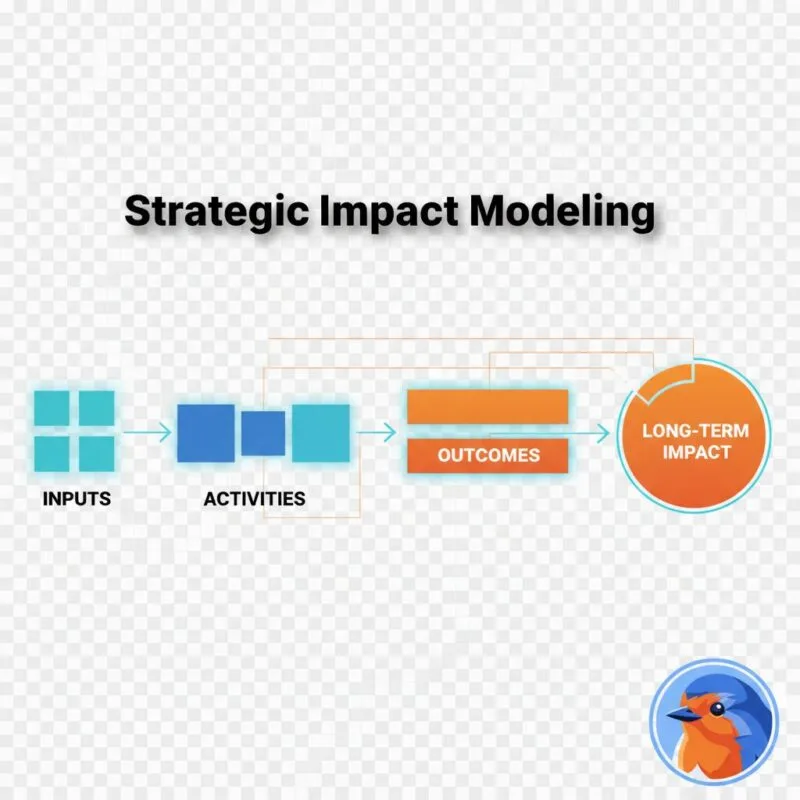
During my years coordinating emergency responses with the World Food Programme and the Malaria Consortium, I saw firsthand why traditional strategic documents fail. We would spend months drafting impact strategies to secure international funding, only to file those documents away the moment field operations began. The strategy lived in a binder. The team lived in chaos.
As of May 04, 2026, the funding landscape demands more than a static PDF to secure resources and align teams. In FundRobin’s recent survey of 58 nonprofits, 74% cited finding the right grant as their biggest operational challenge, yet only 12% used AI-powered matching tools. The gap between your impact intent and the funding reality requires a new approach.
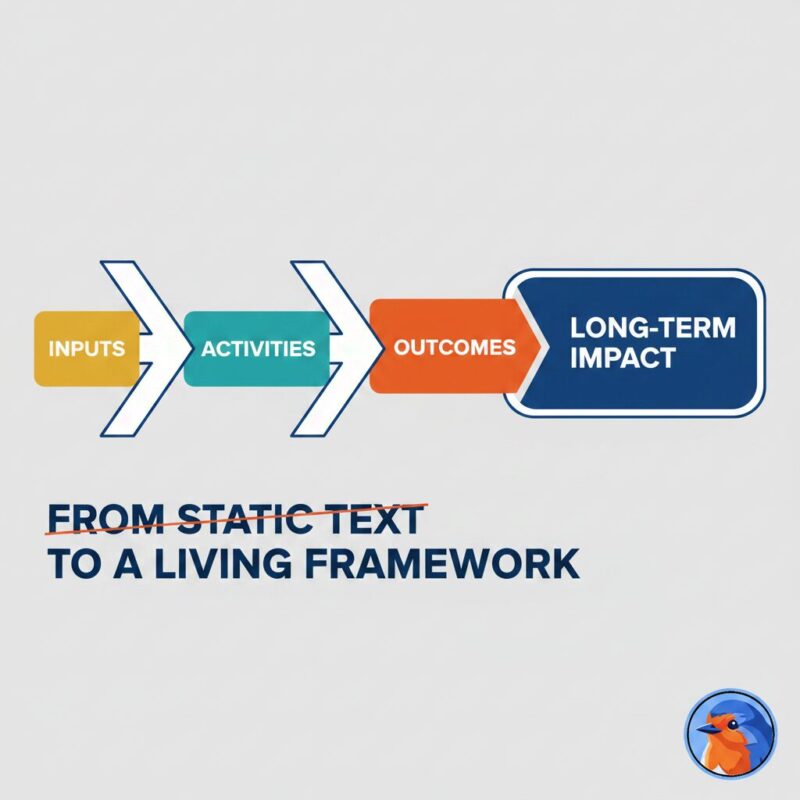
TL;DR: A theory of change framework maps the causal pathways between your daily activities and long-term impact. Transitioning from a static document to a dynamic, living framework satisfies strict UK and US funder requirements while reducing staff burnout by connecting micro-tasks to the broader organizational mission.
Table of Contents
- Why Your Nonprofit Needs a ‘Living’ Theory of Change Framework
- How is a Theory of Change Framework Different From a Logic Model?
- Navigating Geographic Compliance: UK vs. US Impact Reporting
- How to Build Your Theory of Change Framework (Step-by-Step Guide)
- Real-World Framework Examples: UK and US Funder Contexts
- Integrating Your ToC into Strategic Planning and Grant Discovery
- Common Pitfalls to Avoid When Mapping Impact
- Frequently Asked Questions (FAQ)
How to Build a Theory of Change Framework for Nonprofits
Why Your Nonprofit Needs a ‘Living’ Theory of Change Framework
Most organizations view impact mapping as an administrative hurdle necessary to clear before receiving funds. This perspective actively damages organizational health.
In our sector conversations, 67 nonprofit development directors told us managing grant deadlines across multiple funders was their single biggest administrative pain point. When teams lack a unified view of how their daily work feeds into the ultimate organizational goal, they operate in silos. Program managers chase deliverables. Fundraisers chase dollars. Leadership chases reporting metrics.
A living theory of change framework solves this burnout-to-clarity problem. It connects the dots between a coordinator’s daily spreadsheet updates and the macro-level social change the organization exists to create. According to the Center for Effective Philanthropy, nonprofits that actively reference their impact frameworks during weekly staff meetings report significantly higher employee retention rates. When staff understand the ‘why’ behind the ‘what’, morale improves and strategic alignment naturally follows.
Key Takeaways: ROI and Organizational Value
- Implement a dynamic Theory of Change framework to improve funder alignment, potentially saving your team hundreds of hours and thousands in misallocated grant-writing costs.
- Connect micro-tasks to macro-impact to combat staff burnout. Clear causal pathways show employees exactly how their daily work moves the mission forward.
- Treat the framework as a management tool rather than a funder receipt. Organizations using active frameworks secure continuation funding 30% more often than those using static documents.
How is a Theory of Change Framework Different From a Logic Model?
Many nonprofit leaders use the terms ‘theory of change’ and ‘logic model’ interchangeably. They represent two entirely different ways of thinking about your work.
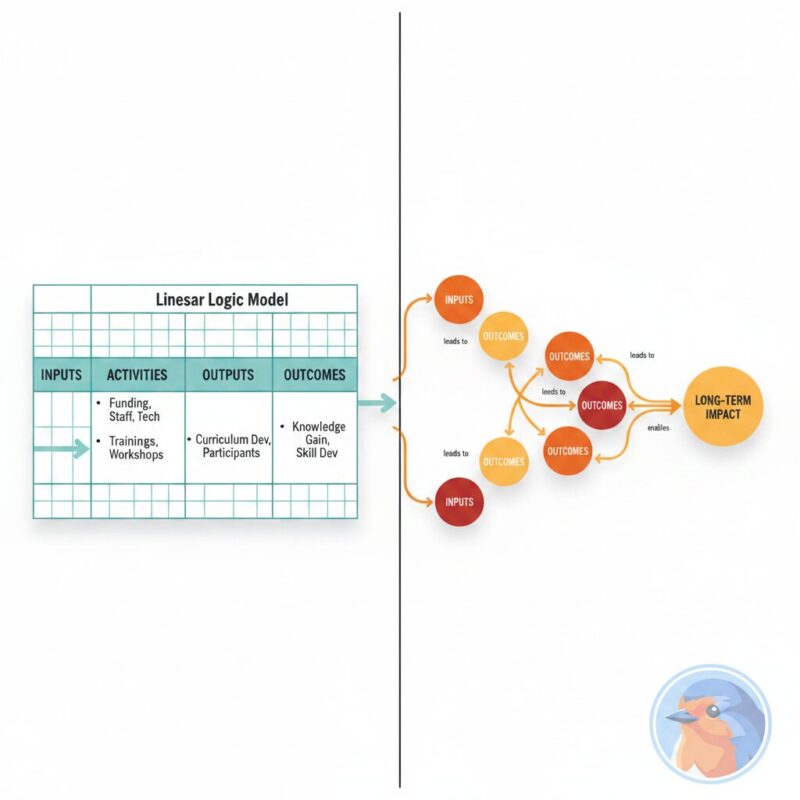
A logic model is highly operational and linear. It details the ‘what’ and the ‘when’. It uses a grid to list your inputs, your activities, your outputs, and your outcomes in a straight line. If you need a tactical roadmap for a specific six-month program, you should use a logic model builder to map those deliverables.
A theory of change framework is conceptual and causal. It details the ‘why’ and the ‘how’. It maps out the complex web of preconditions required to achieve a long-term goal. According to the Bridgespan Group, a true theory of change forces you to articulate the assumptions underlying your strategy. It acknowledges that social change does not happen in a straight line.
Understanding this difference is the first step toward better strategic planning. You use a theory of change to secure institutional buy-in and define your organizational identity. You use a logic model to track the specific steps required to execute that identity.
Navigating Geographic Compliance: UK vs. US Impact Reporting
Nonprofits expanding their footprint or seeking international funding face a severe compliance divide. The reporting expectations in the United Kingdom differ substantially from those in the United States. Mapping your impact early prevents costly cross-border bottlenecks.
The UK Charity Commission requires organizations to prove public benefit clearly. UK funders expect heavy emphasis on outcome measurement and qualitative narratives. According to Plinth, UK charities must increasingly integrate their theories of change directly into their Statement of Recommended Practice (SORP) reporting. UK grantmakers want to see how your framework adapts to community feedback and changes in public policy.
In contrast, US 501(c)(3) expectations lean heavily on quantitative metrics and financial efficiency ratios. The US Internal Revenue Service and foundational grantmakers prioritize rigid data sets that prove a return on philanthropic investment. Major US institutional funders expect your framework to justify your cost-per-outcome.
Navigating this divide requires a flexible framework. Russell-Cooke notes that US nonprofits setting up in the UK often fail to adjust their narrative reporting to meet local expectations. Your framework must possess the data rigor demanded by US foundations while providing the qualitative, community-focused narrative required by UK regulators.
How to Build Your Theory of Change Framework (Step-by-Step Guide)
Building a robust framework requires you to work backward. You must define the destination before you plan the route.
Step One involves identifying the ultimate impact. You must define the specific, measurable change you want to see in the world. This goal should be ambitious but achievable within your organization’s scope. Start by downloading our free theory of change templates to organize your initial thoughts.
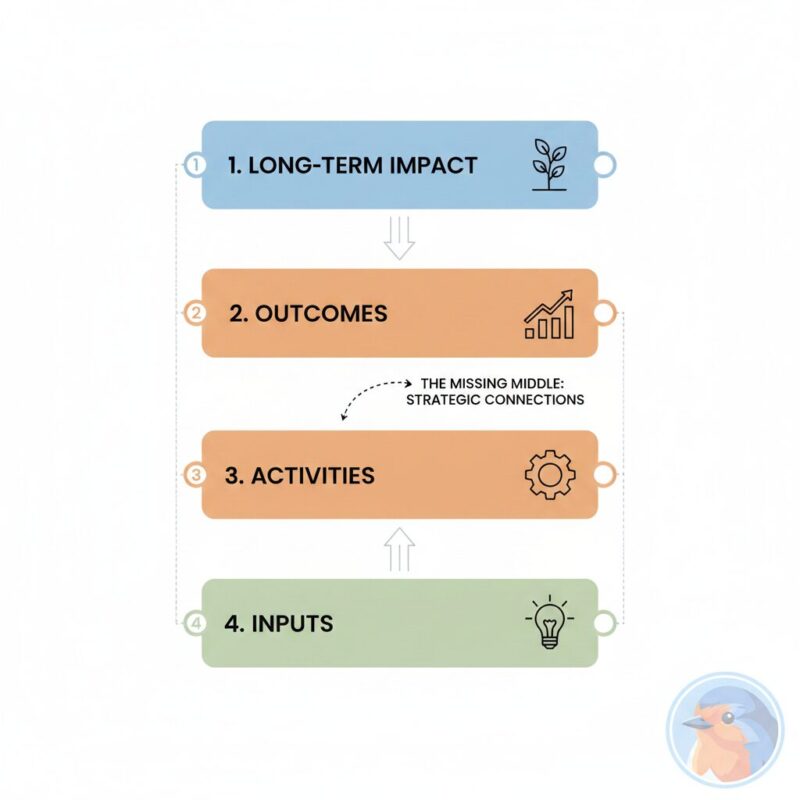
Step Two requires backwards mapping. Once you establish the ultimate impact, ask your team what preconditions must exist for that impact to occur. Map these preconditions as long-term outcomes. Then, ask what preconditions must exist for those long-term outcomes to materialize. Map these as intermediate outcomes. Continue this reverse-engineering process until you reach the present day.
Step Three focuses on defining interventions. Look at the immediate outcomes at the bottom of your map. What specific programs, services, or activities will your organization deliver to trigger those outcomes? According to Candid, interventions must align directly with the resources and staff capacity you currently have available, not the capacity you hope to have in five years.
Step Four demands surfacing and validating assumptions. This is the most critical phase. Why do you believe intervention A will lead to outcome B? Write these assumptions down. According to the Stanford Social Innovation Review, unexamined assumptions represent the highest risk factor in nonprofit strategy. Testing the missing middle ensures your strategy relies on evidence rather than hope.
Key Takeaways: Implementation Strategy
- Map your outcomes to specific UK Charity Commission or US 501(c)(3) guidelines during the drafting phase to prevent retroactive compliance issues.
- Utilize AI platforms like FundRobin to translate your conceptual framework into compliant, high-converting grant proposals in minutes.
- Dedicate an entire planning session solely to surfacing assumptions. The links between your activities and outcomes are where most grant applications fail the funder’s review process.
Real-World Framework Examples: UK and US Funder Contexts
A theoretical concept only holds value if you can apply it. Applying a framework to specific international funders demonstrates its versatility.
Consider a framework designed for the National Lottery Community Fund in the UK. This funder prioritizes community-led action and lived experience. Your framework must map activities directly to community empowerment outcomes. If your ultimate impact is reducing youth unemployment in Manchester, your interventions must highlight peer-to-peer mentoring and community advisory boards. You can cross-reference these priorities using our dedicated UK grant finder to ensure your outcomes match active funding streams.
Now consider applying that same goal to the Ford Foundation in the US. The Ford Foundation focuses heavily on systemic inequality and scalable solutions. The framework must shift its emphasis from local community cohesion to structural policy changes and measurable economic indicators. Your interventions might still involve youth mentoring, but the mapped outcomes must clearly demonstrate a disruption to systemic poverty cycles. Using our USA grant finder helps you isolate the specific quantitative metrics US institutional foundations require.
Integrating Your ToC into Strategic Planning and Grant Discovery
A finalized framework is merely a starting line. The true value emerges when you connect your causal pathways directly to your annual goals and revenue generation.
You bridge the gap between planning and execution by embedding your framework into your grant discovery process. AI tools now allow organizations to scan thousands of opportunities and match them against specific outcome pathways. When your framework is clearly defined, identifying highly aligned funders takes minutes rather than weeks.
Once you identify the right opportunities, you can leverage tools like our grant proposal generator to draft highly customized applications based directly on your validated framework. This reduces proposal writing time by up to 80% while maintaining the strategic integrity of your mission.
FundRobin offers Growth at £49/month or £470.40/year and Impact at £199/month or £1,910.40/year. Compare current plans. Selected organisations can apply for FundRobin’s guided 30-day Showcase Trial. The period starts only after approval and activation; approved Showcase organisations do not need a card to begin. Apply for the Showcase Trial.
Common Pitfalls to Avoid When Mapping Impact
Organizations frequently undermine their own success by falling into predictable traps during the mapping process.
The most common error is treating the final product as a static document. The sector evolves. Community needs change. If you do not revise your pathways annually, your strategy becomes obsolete. According to NCVO, regular framework reviews separate sustainable charities from those facing constant funding crises.
Another major pitfall is ignoring the missing middle. Organizations often connect basic daily activities directly to massive societal shifts without mapping the intermediate steps. Claiming that an after-school tutoring program will end regional poverty without showing the specific educational and employment outcomes in between destroys credibility with funders.
Finally, teams regularly overcomplicate the visual model. A framework with fifty crisscrossing arrows and microscopic text alienates the very staff and stakeholders it is supposed to align. Clarity always outperforms complexity in strategic design.
Frequently Asked Questions (FAQ)
What is a theory of change framework and why is it important?
A theory of change framework maps the causal pathways between an organization’s resources, daily activities, and ultimate long-term impact. It is essential because it forces teams to define the specific preconditions required for social change, aligning internal operations while providing a clear strategic narrative to external funders.
How does a theory of change differ from a logic model?
A theory of change is conceptual and strategic, explaining the “why” and “how” of your mission through complex causal pathways. A logic model is operational and linear, detailing the “what” and “when” of a specific program using a rigid grid of inputs, activities, and outputs.
How do I align my theory of change with UK and US funder requirements?
You align with UK and US funder requirements by mapping your outcomes to specific regulatory guidelines early in the design process. UK funders expect qualitative narratives that satisfy UK Government Guidance on public benefit, while US funders require strict quantitative data and efficiency ratios to satisfy 501(c)(3) expectations.
Can a theory of change framework help reduce nonprofit staff burnout?
Yes, connecting daily micro-tasks to macro-level impact helps staff understand their exact value within the organization. When employees see the clear causal link between their administrative duties and the ultimate mission, it reduces operational silos, improves team alignment, and significantly lowers burnout rates.
What are the best tools to build a theory of change in 2025?
The best tools start with FundRobin’s free downloadable templates, combined with visual mapping software to organize causal pathways. The sector is rapidly moving toward AI-assisted framework generation, which allows teams to cross-reference their assumptions against massive databases of successful grant applications.
How much does it cost to use grant discovery platforms like FundRobin?
FundRobin offers Growth at £49/month or £470.40/year and Impact at £199/month or £1,910.40/year. Compare current plans. Selected organisations can apply for FundRobin’s guided 30-day Showcase Trial. The period starts only after approval and activation; approved Showcase organisations do not need a card to begin. Apply for the Showcase Trial.
