
The gap between a nonprofit’s profound mission and its technological capabilities is widening. A recent 2024 report from Sage highlighted that while many organisations have ambitious goals, they are often held back by operational inefficiencies. Many nonprofit leaders know they need to evolve technologically, but find themselves paralysed by the persistent challenges of budget constraints, cumbersome legacy systems, and the daunting absence of a clear roadmap. They are stuck understanding the ‘why’ and desperately need the ‘how’.
This guide is designed to take you beyond the buzzwords. It is a practical, step-by-step playbook for tech-savvy leaders who need to strategically implement technology that genuinely amplifies mission impact. From the intelligent application of AI to the creation of integrated, efficient platforms, we will provide a framework for transformation that works even with limited resources. This is not just about buying new software; it’s about fundamentally reshaping your organisation for a digital-first future.
Together, we will journey through the key pillars of this transformation: understanding the strategic imperative to change, identifying the core technologies that will power your mission, following a step-by-step implementation playbook, embracing the crucial human element of change management, and finally, learning to measure the true return on investment—your impact.
The Strategic Imperative: Why Digital Transformation is Non-Negotiable
For a modern nonprofit, digital transformation is not a luxury or a passing trend; it is a core component of sustainability and growth. It is the engine that will drive your mission forward in an increasingly complex and competitive landscape.
Defining Digital Transformation for the Modern Nonprofit
It is crucial to move past the simple definition of ‘buying new software’. True digital transformation, as outlined in a nonprofit primer on digital transformation, is a fundamental shift in how a nonprofit operates, delivers value to its beneficiaries, and achieves its mission. It involves integrating digital technology into all areas of the organisation, resulting in profound changes to culture, processes, and value delivery. This shift is essential for survival and growth, especially when competing for funding and attention. The risk of clinging to outdated legacy systems is not just inefficiency; it’s the risk of being left behind entirely.
The Triad of Transformation: Enhancing Fundraising, Operations, and Impact

Digital transformation creates a powerful, positive feedback loop across the three most critical areas of your organisation.
- Fundraising: Modern technology enables personalised donor engagement at a scale previously unimaginable. It allows you to move from generic, broad-stroke appeals to building data-driven relationships. By understanding donor behaviour and preferences, you can craft compelling, individualised journeys that foster loyalty and increase lifetime value.
- Operations: Intelligent automation and integrated systems are the keys to eliminating the data silos and administrative burdens that plague so many nonprofits. By automating time-consuming administrative tasks, you free up your dedicated staff from manual data entry and report generation, allowing them to focus their valuable time and energy on mission-critical work.
- Mission Impact: The connection is direct and powerful. When your fundraising is more effective and your operations are more efficient, you have more resources—time, money, and people—to dedicate to your programmes. Furthermore, modern technology allows you to measure your outcomes with greater accuracy, providing the concrete data needed to prove your impact to funders and stakeholders.
Learning from the For-Profit World (and What to Ignore)
The corporate sector offers valuable lessons in agility, data-driven decision-making, and customer-centricity that nonprofits can and should adopt. The principles of iterating quickly, using data to inform strategy, and creating seamless user experiences are universally applicable. However, it is vital to remember the key differentiator: for a nonprofit, the ultimate return on investment (ROI) is not shareholder value, but mission impact. Every technological decision must be weighed against its ability to advance the organisation’s core purpose. For more information on building a robust digital strategy, visit the FundRobin homepage.
The Technology Pillars: Your Toolkit for a Digital-First Nonprofit
Embarking on a digital transformation journey requires the right set of tools. These three technological pillars form the foundation of a modern, resilient, and impactful nonprofit organisation.

Pillar 1: Artificial Intelligence (AI) – The Intelligence Amplifier
Beyond the hype, Artificial Intelligence offers practical, powerful applications that can amplify your team’s intelligence and effectiveness. The key is to focus on its real-world utility for the nonprofit sector. This includes predictive analytics to identify individuals most likely to become major donors, AI-powered grant discovery tools that slash research time, and generative AI that helps craft personalised donor communications.
A significant evolution is the rise of ‘Agentic AI’, which can automate entire complex workflows. Imagine an AI agent that not only identifies a potential grant but also researches the funder’s priorities, drafts an initial letter of inquiry, and schedules a follow-up for your team. This directly answers the critical question of how will AI affect nonprofit fundraising by transforming it from a manual, time-intensive process into a strategic, AI-assisted one.
At FundRobin, our approach is architected by data science leaders like our CDO, Nabaa Refai, who has over a decade of experience implementing enterprise AI. We believe AI’s true power for nonprofits lies in making complex data simple and actionable, turning insights into funding. As you explore this area, NTEN’s guide to AI in the nonprofit sector provides an excellent, authoritative resource for a deeper dive.
Pillar 2: Intelligent Automation – The Efficiency Engine
Intelligent automation is the workhorse of digital transformation, capable of reclaiming hundreds of staff hours currently lost to repetitive, manual tasks. It is the engine that drives operational efficiency, allowing your team to focus on high-value, strategic work.
Consider this mini-case study: A donor makes a contribution through your website. In a manual world, this triggers a cascade of tasks. In an automated world, the system can instantly:
- Send a personalised thank-you email and receipt.
- Update the donor’s record in your CRM.
- Segment the donor for future, targeted appeals based on their interests.
- Notify the head of fundraising of a significant gift.
This entire workflow happens in seconds, without any human intervention, directly solving the pain point of being buried under time-consuming administrative tasks.
Pillar 3: Unified & Integrated Platforms – The Single Source of Truth
Disconnected technology stacks and the resulting data silos are two of the most significant obstacles to nonprofit effectiveness. When your donor data, volunteer information, programme metrics, and financial records all live in separate, non-communicating systems, you can never have a holistic view of your organisation’s health or your supporters’ engagement.
The solution is a unified and integrated platform that acts as a central nervous system for your organisation. Whether it’s a comprehensive, all-in-one CRM or a carefully curated set of ‘best-in-breed’ tools that integrate seamlessly, the goal is to create a single source of truth. This central hub connects fundraising, marketing, programmes, and finance, breaking down departmental walls and enabling true, data-informed collaboration across your entire organisation.
The Implementation Playbook, Step 1: Assess Your Digital Maturity
You cannot build a roadmap to your destination without first knowing your starting point. The most critical first step in any digital transformation journey is an honest and thorough diagnosis of your organisation’s current digital maturity.
The First Step is Diagnosis, Not Prescription
Many organisations make the mistake of prescribing solutions—”we need a new CRM”—before they have fully diagnosed the problem. A digital maturity assessment provides a clear baseline, helping you understand your strengths, weaknesses, and a realistic path forward. This process directly answers the user query, ‘what are the steps for a digital maturity assessment in nonprofits?’ by providing a clear framework. A simple but effective model categorises maturity into four stages:
- Ad-Hoc: Processes are reactive and undocumented; technology is fragmented.
- Standardised: Key processes are defined and repeatable; some core systems are in place.
- Optimised: Processes are actively managed and improved using data; technology is integrated.
- Transformed: The organisation is agile and data-driven; technology is used for strategic innovation.
How to Conduct a Self-Assessment: Key Questions to Ask
Gather a cross-functional team and work through these key questions. The goal is not to find blame but to build a shared understanding of your current reality.
From Assessment to Vision: Defining What ‘Good’ Looks Like
The findings from your self-assessment are the raw materials for building your vision. Translate the identified gaps and opportunities into a clear, compelling vision statement for the future. This statement should be specific, measurable, and inspiring.
Example Vision: “Our vision is to have a unified data system that provides a 360-degree view of our supporters. This will allow us to automate 80% of our routine administrative tasks, freeing up 20 staff hours per week to focus on building relationships and doubling our personalised outreach to major donors by 2026.”
The Implementation Playbook, Step 2: Build Your Strategic Tech Roadmap
With a clear vision in place, the next step is to build a practical, strategic roadmap. This involves prioritising initiatives, phasing the implementation, and budgeting for technology as a critical investment.
Prioritising with the ‘Impact vs. Effort’ Matrix
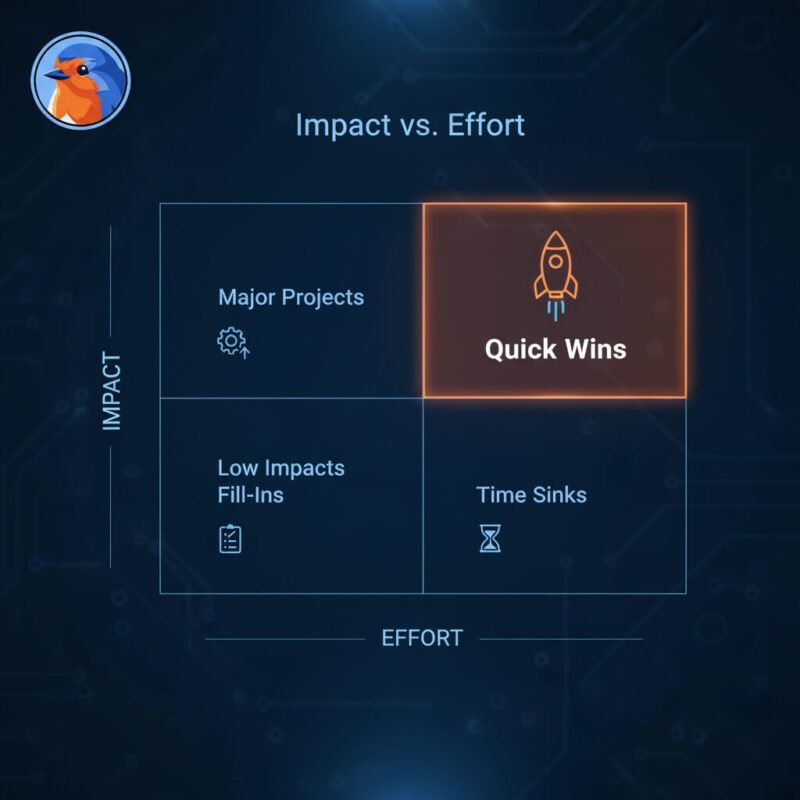
For any nonprofit, but especially those with a limited budget, prioritisation is everything. The ‘Impact vs. Effort’ matrix is a powerful tool for making strategic choices. It helps you map potential technology projects on a simple 2×2 grid, providing a clear framework to prioritise technology investments with a limited budget.
- Quick Wins (High Impact, Low Effort): These are your top priorities. Examples include implementing a simple automation for gift processing or adopting a social media scheduling tool.
- Major Projects (High Impact, High Effort): These are transformative initiatives that require significant planning and resources, like a full CRM migration. They should be planned carefully after securing some quick wins.
- Fill-Ins (Low Impact, Low Effort): These can be done when time and resources permit but should not distract from higher-impact projects.
- Time Sinks (Low Impact, High Effort): Avoid these. They drain resources with little return for your mission.
Phased Implementation: The Crawl, Walk, Run Approach
A ‘big bang’ approach to technology implementation, where everything changes at once, is risky and often fails. A phased, iterative approach—Crawl, Walk, Run—is far more effective and manageable. It allows your organisation to adapt, learn, and build momentum over time.
- Crawl: Begin with foundational fixes. This could be as simple as a project to clean up your existing donor data, documenting key workflows, or implementing a single, high-impact automation identified in your matrix.
- Walk: Once the foundation is stable, implement a core system. This is the stage for introducing a new CRM, a dedicated grant management tool, or an integrated marketing platform.
- Run: With core systems in place and your team growing in confidence, you can explore advanced capabilities. This is where you can begin to leverage AI-driven predictive analytics for fundraising, implement full-scale marketing personalisation, and develop sophisticated impact dashboards.
Budgeting for Technology as an Investment, Not an Expense
To secure the necessary resources, you must reframe the conversation around technology. It is not an overhead expense; it is a strategic investment in your mission’s capacity and impact. When making the case for tech spending, use the language of ROI.
Frame your budget proposal around clear outcomes: “By investing £10,000 in an automation platform, we project we will save 500 staff hours annually, which is valued at £15,000. This will enable our fundraising team to increase their direct donor outreach by 30%, leading to an estimated increase in revenue of £50,000.”
Additionally, actively seek out funding opportunities specifically for technology and capacity building. Philanthropic organisations like Google.org and others often provide grants to help nonprofits modernise their infrastructure.
The Implementation Playbook, Step 3: Selecting the Right Technology Stack
Choosing the right technology is a critical decision point in your transformation journey. The goal is not to find the “best” platform in the abstract, but the “right-fit” platform for your organisation’s unique needs, culture, and budget.
Choosing the Right-Fit, Not Just the ‘Best’ Platform
It is easy to be swayed by big brand names or feature-rich platforms that promise to do everything. However, the most expensive or complex software is often not the best choice. A successful technology implementation depends on user adoption. If your team finds a platform difficult to use, they simply will not use it.
Use this checklist when evaluating potential software and vendors to guide your decision on choosing an all-in-one nonprofit software platform or any other tool:
- Problem-Solving: Does it solve our core, prioritised problem effectively?
- Usability: Is it intuitive and easy for our team to learn and use?
- Scalability: Can it grow with us as our needs evolve over the next 3-5 years?
- Sector Knowledge: Does the vendor understand the unique challenges and workflows of the nonprofit sector?
- Total Cost of Ownership (TCO): What is the full cost, including implementation, training, support, and potential integrations?
Understanding the Landscape: All-in-Ones vs. Best-in-Breed
There are two primary philosophies when building a technology stack:
- All-in-One Platforms: These systems, like Blackbaud Raiser’s Edge NXT or Virtuous Software, aim to provide a comprehensive suite of tools for fundraising, marketing, and programme management within a single, integrated environment. The primary advantage is a unified data model and a single vendor relationship.
- Best-in-Breed Solutions: This approach involves selecting the best possible tool for each specific function (e.g., fundraising, email marketing, grant discovery) and integrating them. This provides greater flexibility and often more powerful features for specific tasks.
FundRobin’s philosophy aligns with the best-in-breed approach. We focus on being the most powerful, AI-driven solution for one critical nonprofit need: grant funding. Our platform is designed to integrate seamlessly into a broader ecosystem, allowing organisations to build a tech stack that uses the best tools for every job. This approach can be a powerful alternative for organisations looking for more specialised capabilities than a single platform like Virtuous Software might offer, moving beyond a simple ‘FundRobin vs Blackbaud’ comparison to a more strategic discussion about what tools best serve the mission.
Cost-Effective Sourcing Strategies for Nonprofits
Addressing the budget pain point requires creative and strategic sourcing. Fortunately, many resources are available to help nonprofits access technology affordably.
- Grants & Discounts: Organisations like TechSoup are invaluable, providing access to donated and heavily discounted software from major vendors like Microsoft, Adobe, and others.
- Open-Source Tools: For certain functions, like a website Content Management System (e.g., WordPress), open-source alternatives can be highly effective. They eliminate licensing fees, though they may require more technical expertise to manage.
- Negotiating with Vendors: Do not hesitate to negotiate. Many software companies have dedicated nonprofit pricing tiers or are willing to offer multi-year discounts. Clearly communicate your budget constraints and the value your organisation brings.
The Human Engine of Transformation: A Change Management Framework
Technology is only a tool. The true engine of digital transformation is your people. Without their buy-in, engagement, and skills, even the most advanced software will fail to deliver on its promise. This is why a deliberate change management strategy is not an optional add-on; it is central to success.
Securing Leadership Buy-In: Speaking the Language of Impact
One of the biggest hurdles is getting executive buy-in for technology investment. The key is to frame your pitch not around features and functions, but around mission and impact. Use this framework for your conversation:
- Start with the Mission: Remind leaders of the organisation’s core purpose.
- Connect Tech to Strategy: Clearly show how this specific technology investment will directly help achieve a key strategic goal (e.g., “increase donor retention by 15%”).
- Present a Clear Business Case: Use the ROI calculations from the budgeting step to demonstrate the financial and operational benefits.
- Outline the Plan: Present your phased implementation plan (Crawl, Walk, Run) to show that the project is well-reasoned, manageable, and has a low initial risk.
Building a Coalition of Champions
A top-down-only approach to change is rarely successful. To overcome employee resistance to new technology, you must build a coalition of champions at all levels of the organisation. Identify individuals who are naturally enthusiastic about technology and empower them. These champions become your advocates, providing informal training to their peers, offering valuable feedback from the front lines, and helping to build positive momentum from the ground up.
Upskilling and Training: Investing in Your People
Training should never be an afterthought; it is an essential part of the technology investment itself. When staff feel confident and competent with new tools, adoption rates soar.
Focus on practical, accessible training methods like lunch-and-learn sessions, creating a library of short video tutorials, and establishing peer-to-peer mentoring. Crucially, frame the training around “what’s in it for them.” Show your team how the new technology will eliminate their most tedious tasks, reduce frustration, and give them more time to focus on the rewarding, impactful work that drew them to your mission in the first place. One nonprofit we worked with faced significant pushback on a new CRM. By identifying a champion in the fundraising team who created simple video tutorials, adoption rates tripled in two months.
Communicating the ‘Why’: Creating a Culture of Continuous Improvement
Transparent, consistent, and inspiring communication is the thread that ties your change management strategy together. Be open about the challenges and realistic about the timeline, but consistently circle back to the ‘why’—the vision of a more impactful organisation.
Celebrate small wins publicly to build momentum and show progress. When a new automation saves a department ten hours in its first week, share that success story in an all-staff meeting. Establish clear feedback loops, like regular check-ins or a dedicated email address for suggestions, to show that staff concerns are being heard and addressed. This fosters a culture where change is not something to be feared, but a continuous, collaborative process of improvement.
Measuring What Matters: Connecting Technology to Mission ROI
The ultimate purpose of digital transformation is to enhance your ability to deliver on your mission. Therefore, you must measure its success in terms of mission ROI. This requires moving beyond simple vanity metrics and focusing on the Key Performance Indicators (KPIs) that truly reflect your organisation’s health and impact.
Beyond Vanity Metrics: Identifying Your Key Performance Indicators (KPIs)
A high number of website visits is interesting, but it doesn’t tell you if you are actually advancing your cause. Meaningful KPIs connect technology implementation directly to strategic goals.
| Area | Meaningful KPIs |
|---|---|
| Fundraising | Donor retention rate, average gift size, donor lifetime value, cost-per-pound-raised. |
| Operations | Staff hours saved via automation, reduction in data entry errors, time-to-close-books. |
| Mission | Number of beneficiaries served, programme efficiency (cost-per-outcome), client satisfaction rates. |
Building Your Impact Dashboard
Once you have identified your KPIs, create a simple, visual dashboard to track them over time. This does not need to be a complex business intelligence tool initially; it can start as a well-organised spreadsheet. This dashboard becomes your single source of truth for progress, allowing you to report tangible results to your board, funders, and supporters, thereby justifying the ROI of your technology investments.

Creating a Feedback Loop for Iteration and Improvement
Digital transformation is not a one-time project with a finish line; it is an ongoing process of learning and improvement. The data from your impact dashboard is critical for creating this feedback loop. Use it to make informed decisions about what’s working, what’s not, and where to focus your efforts next. This data-driven approach, supported by excellent digital success resources for nonprofits, allows you to iterate, adapt, and continuously refine your strategy, ensuring your technology stack evolves with your mission.
Frequently Asked Questions about Nonprofit Digital Transformation
How does technology impact non-profits?
Technology fundamentally impacts nonprofits by increasing operational efficiency, enhancing fundraising capabilities through data-driven outreach, and ultimately amplifying their ability to deliver on their mission. It allows them to automate administrative tasks, gain deeper insights into their donors and programmes, and scale their impact in ways that are impossible through manual processes alone.
How will AI affect fundraising?
AI will profoundly affect fundraising by enabling hyper-personalisation at scale, predicting which donors are likely to give, and automating the discovery of new funding opportunities. Tools using AI can analyse giving patterns to suggest the right ask amount for each donor, identify potential major givers from a large database, and match organisational needs with grant opportunities in minutes, not hours.
What are the first steps to creating a digital roadmap for a nonprofit?
The first steps are to conduct a digital maturity assessment to understand your current state and then define a clear vision for what you want to achieve. This involves evaluating your people, processes, and technology to identify key weaknesses and opportunities before creating a prioritised list of initiatives.
How can we get executive buy-in for technology investment?
The best way to get executive buy-in is to present a clear business case that frames the technology investment in terms of mission ROI, not just cost. Show how the new tech will save money, reduce staff time on low-value tasks, or directly improve fundraising and programme delivery, aligning the investment with the organisation’s core strategic goals.
Which technology will dominate in 2030 for the nonprofit sector?
While difficult to predict precisely, it is highly likely that advanced Artificial Intelligence, particularly agentic AI that can automate complex workflows, and deeply integrated data platforms will dominate the nonprofit sector by 2030. These technologies will be crucial for organisations to make sense of their data, operate with maximum efficiency, and deliver personalised experiences to their supporters.
Your Transformation Starts Today
Digital transformation is not fundamentally about technology. It is a strategic imperative about building a more resilient, efficient, and impactful organisation capable of meeting the challenges of tomorrow. It is about channelling more of your precious resources directly into your mission.
This playbook has provided the key steps for this journey: Assess your starting point, build a strategic roadmap, select the right-fit tools, engage your people as the engine of change, and measure what truly matters. The path may seem challenging, but it is achievable. The most important thing is to begin. Take the first, small step outlined in this guide and start building the future of your organisation today.
Ready to transform your fundraising and grant discovery process? See how FundRobin’s AI-powered platform can become a core part of your digital transformation. Explore how it works.
