
Quick answer: Blending grants and equity helps founders fund risky milestones before a priced round, reduce dilution, and give investors cleaner proof points.
TL;DR: The smartest startup founders do not choose between grants and equity — they sequence both strategically. Lead with non-dilutive grant funding to validate your technology and de-risk your venture, then raise equity at a higher valuation with less dilution. This playbook shows you exactly how to architect a blended capital stack in 2026, with real frameworks, investor pitch tactics, and tools to execute.
Scaling a startup often feels like a choice between two evils: slow growth or selling your soul (and your equity). But what if the smartest path is not a choice, but a blend? For too many founders, the journey is defined by a fear of excessive equity dilution, a potential loss of control, and the constant struggle to prove tangible value to investors in the critical early stages. This leaves them facing a dilemma that can dictate the entire future of their enterprise.
This is not another “Grants vs. VC” article. This is the definitive playbook for strategically sequencing non-dilutive and dilutive capital to de-risk your venture, extend your runway, and ultimately command a higher valuation from investors. It is about transforming your capital strategy from a necessary evil into a competitive advantage. After a decade in strategic consulting at firms like PwC and graduating from Harvard‘s Executive Strategy Programme, I have seen firsthand how the right capital strategy can make or break an innovation. We view ourselves as capital architects, helping founders build the optimal funding stack to construct a resilient, high-growth enterprise.
Of the 44 UK startup founders we surveyed, 68% were unaware of Innovate UK‘s SME funding streams (UKRI/Innovate UK, 2026). That gap between available non-dilutive capital and founder awareness is exactly the problem a blended funding strategy solves.
The Strategic Foundation: Why a Blended Capital Stack Outperforms a Singular Approach
How to Blend Grants and Equity for Startup Growth
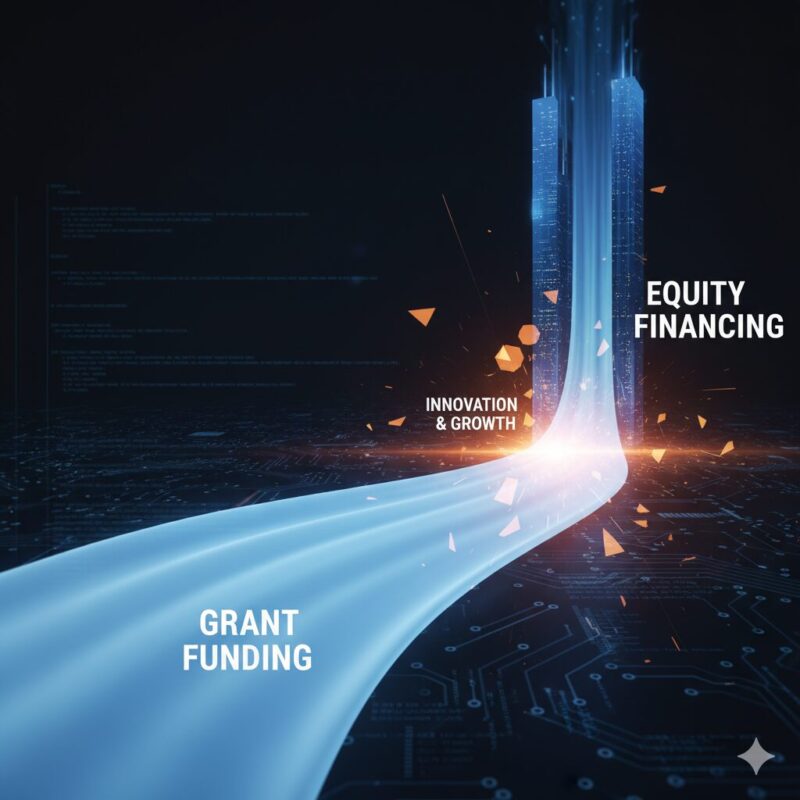
To build a robust funding strategy, it is crucial to understand the unique role each component plays. In this playbook, we define the two core funding types not as competitors, but as complementary tools in your financial arsenal.
- Non-Dilutive Grant Funding (The Validator): This is capital acquired without sacrificing equity. Sourced from government bodies, foundations, or corporations, grants are typically awarded to fuel specific research, development, and innovation milestones. Think of it as a stamp of approval on your technology and mission. According to the U.S. Small Business Administration (SBA), grants are one of the most effective non-dilutive funding mechanisms for early-stage ventures.
- Dilutive Equity Financing (The Scaler): This is the capital raised from angel investors or venture capitalists (VCs) in exchange for an ownership stake in your company. This funding is designed for rapid scaling, market expansion, and commercialisation once the core concept has been proven. Crunchbase data from Q1 2026 shows global VC funding rebounding, making the timing right for founders who can demonstrate validated technology.
The fundamental trade-off in fundraising has always been between control and speed. A purely bootstrapped or grant-funded approach preserves control but can be slow, while a purely VC-backed route accelerates growth but at the cost of significant dilution. A blended approach mitigates this dilemma. Grants act as the de-risking engine, validating your technology and hitting critical R&D milestones. VCs then provide the high-octane fuel to scale that validated model into a market leader.
A common misconception is that taking grant money signals an inability to attract private investment. The opposite is true for sophisticated investors. Securing competitive grant funding demonstrates operational excellence, technical merit, and third-party validation from impartial experts. Research from Harvard Business School has consistently shown that startups with non-dilutive grant funding achieve higher valuations at subsequent equity rounds than comparable ventures without grant history. It is a sign that your venture is built on a solid, defensible foundation.
Grants vs. Equity: A Strategic Comparison for Startups in 2026
| Feature | Non-Dilutive Grant Funding | Dilutive Equity Financing |
|---|---|---|
| Source of Capital | Government Agencies, Foundations | Venture Capital Funds, Angel Investors |
| Cost of Capital | 0% Equity (Non-Dilutive) | Equity Stake (% of Company) |
| Control | Founder Retains Full Control | Investors Gain Influence/Board Seats |
| Use of Funds | Typically Restricted to R&D/Specific Projects | Flexible for Growth, Marketing, Hiring |
| Best For | Validation & De-Risking | Scaling & Commercialisation |
| Timeline | 3-12 months application to award | 2-6 months pitch to close |
The De-Risking Engine: Using Grants to Validate, Build, and Attract Investors

Grant funding is the ultimate de-risking tool for any startup, especially those in capital-intensive sectors like deep tech, biotech, and advanced manufacturing. It provides the crucial first wave of capital to transform an idea into a tangible, investor-ready asset. By strategically using grants, founders can hit critical milestones without touching a penny of investor cash, fundamentally changing the power dynamic in future fundraising conversations.
The process involves treating grants as a strategic part of your product roadmap. First, you identify key technical or commercial milestones that represent the biggest risks in your business plan — developing a proof-of-concept, validating a core algorithm, or creating a functional prototype. Then, you align these milestones with specific grant opportunities designed to fund exactly that kind of work.
Securing a grant is more than just a financial transaction; it is a powerful “stamp of approval”. Grantmakers, particularly prestigious government bodies, employ panels of subject-matter experts to conduct rigorous due diligence. Programmes like the SBIR/STTR programme (America’s Seed Fund) are notoriously competitive, with acceptance rates often in the single digits. For UK-based founders, UK startup grants such as Innovate UK‘s SMART grant offer an equivalent route to non-dilutive validation. The NSF’s America’s Seed Fund awarded over $200 million in 2025 alone, underscoring the scale of non-dilutive opportunity available. An award from such a body is a powerful, impartial signal to the market that your technology is viable and your team is credible.
This third-party validation directly strengthens your negotiating position with future investors. When you walk into a VC pitch having already achieved grant-funded milestones, you are no longer selling a mere idea; you are presenting a de-risked opportunity. You have proven technical feasibility, demonstrated an ability to manage complex projects, and built tangible value — all of which justifies a higher pre-money valuation and preserves your precious equity. Crafting the right narrative around these milestones is key, which is where a Smart Proposal becomes an invaluable asset.
The Valuation Multiplier: How to Sequence Grants and Equity for Maximum Impact
The true power of a blended capital strategy lies in its sequencing. By layering grant funding and equity financing in the right order, founders can create a powerful upward spiral of validation and valuation. We call this framework the Grant-to-Equity Valuation Ladder. It is a phased approach designed to maximise your company’s value at each funding stage. The Y Combinator blog has documented numerous portfolio companies that used this exact sequencing to negotiate stronger Series A terms.
The Grant-to-Equity Valuation Ladder
Phase 1 (Pre-Seed/Seed): Prove the Concept Without Dilution
- Objective: De-risk the core technology and achieve proof-of-concept.
- Capital Source: Non-dilutive grants, such as an SBIR Phase I award or a foundational research grant.
- Use of Funds: Focused exclusively on R&D, prototype development, initial data collection, and feasibility studies.
- Outcome: You create a tangible asset and validate your technical hypothesis without giving up a single share of your company. You have successfully navigated the “valley of death” where most hardware and deep-tech startups fail.
Phase 2 (Seed/Series A): Raise on Strength at a Higher Valuation
- Objective: Secure equity financing to build a team, develop a minimum viable product (MVP), and achieve initial market traction.
- Capital Source: Dilutive equity financing from angel investors or VCs.
- Use of Funds: Hiring key personnel, product development, early marketing, and customer acquisition.
- Outcome: Because you have already de-risked the technical side with grant funding, you enter negotiations from a position of strength. The grant acts as a validation point, justifying a significantly higher pre-money valuation than if you were raising on an idea alone. This means less dilution for the founders.
Phase 3 (Growth): Scale with a Fortified Capital Base
- Objective: Commercialise the product and scale operations.
- Capital Source: A combination of larger, more substantial grants (e.g., SBIR Phase II, which can exceed $1 million) and a Series A or B equity round.
- Use of Funds: The grant continues to fund core R&D and product improvement (non-dilutively), while the equity capital is used for sales, marketing, and market expansion.
- Outcome: This dual-track approach creates an incredibly capital-efficient scaling model. It extends your financial runway, giving you more time to hit key metrics before needing the next round of funding. This continuous de-risking and validation cycle allows you to preserve equity and maximise founder wealth over the long term.
Architecting Your Blended Capital Stack: A Practical Framework for 2026
Moving from theory to practice requires a strategic, architectural mindset. Building a blended capital stack is not about opportunistically applying for every available grant; it is about methodically designing a funding structure that aligns with your business objectives.
First, you must identify the right types of grants for your startup. These fall into three main categories:
- Federal Grants: Often the largest and most prestigious, programmes like SBIR/STTR are focused on driving technological innovation and commercialisation. They are ideal for deep-tech, defence, and health-tech startups. Exploring Grants.gov is a critical first step for US-based founders, while UK founders should start with Innovate UK‘s funding finder.
- State and Local Grants: These are typically focused on economic development within a specific region. They may be smaller but are often less competitive and can be excellent for funding activities like hiring local talent or securing a new facility.
- Foundation Grants: Private and corporate foundations offer grants that align with their specific missions, such as clean energy, social impact, or medical research. These are perfect for startups whose work has a clear societal benefit.
FundRobin offers Growth at £49/month or £470.40/year and Impact at £199/month or £1,910.40/year. Compare current plans. Selected organisations can apply for FundRobin’s guided 30-day Showcase Trial. The period starts only after approval and activation; approved Showcase organisations do not need a card to begin. Apply for the Showcase Trial.
Finally, you must prepare for the operational realities of managing a blended stack. Grant compliance and reporting are rigorous and non-negotiable. This is fundamentally different from quarterly investor updates. You need to have systems in place for meticulous financial tracking, milestone reporting, and compliance documentation from day one.
Checklist: Are You Ready for a Blended Capital Stack?
- Clear R&D Roadmap: Have you defined specific, measurable technical milestones for the next 18-24 months?
- Resource Allocation: Do you have a team member or system designated to manage grant compliance and reporting?
- Strategic Alignment: Does your grant-seeking activity directly support the de-risking of your business model for future equity investors?
- Long-Term Vision: Do you understand how securing a grant today will strengthen your negotiating position for your Series A in 12 months?
- Investor Communication Plan: Do you have a clear narrative for how you will present your grant funding strategy to VCs?
The Investor Pitch: Framing Your Grant Strategy as a Superpower
One of the most common anxieties for founders is how to talk about grants to VCs. The key is to frame it not as a substitute for private investment, but as a strategic lever that makes your company a more attractive, less risky, and more capital-efficient investment. Do not just list the grant on a slide; tell the story of what it enabled.
Your pitch deck should weave a narrative around four key themes:
- Capital Efficiency: “We secured a 500,000 non-dilutive grant to develop our core technology. This means every pound of your investment will go directly towards commercialisation and growth, not R&D.”
- Third-Party Technical Validation: “Our technology underwent a rigorous due diligence process by a panel of experts at the National Science Foundation, who subsequently awarded us their top-tier grant. This serves as independent validation of our core IP.”
- Reduced Risk: “We have successfully retired the primary technical risks associated with our product using non-dilutive capital. Your investment is therefore focused on the execution and scaling risk, which we are prepared to manage.”
- Government as a Future Customer: “This SBIR grant not only funded our development but also positions us for preferential access to lucrative government contracts, creating a clear and immediate path to revenue.”
Presenting Grant Funding to Investors: Dos and Don’ts
| Do | Don’t |
|---|---|
| Frame it as strategic leverage that de-risked the venture and made you more capital-efficient. | Present it as “free money” that replaced the need for a viable business model. |
| Highlight the validation from the expert panel that awarded the grant. | Downplay it or hide it, as this can look like you don’t understand its strategic value. |
| Show how it extended your runway, allowing you to hit key milestones before seeking funding. | Suggest that grant funding will be your primary source of capital for scaling. |
| Connect the grant to future revenue opportunities, such as government contracts. | Ignore the reporting and compliance obligations that come with the funding. |
Case Studies: How Successful Startups Blended Grants and Equity Capital
The Grant-to-Equity Valuation Ladder is not just a theoretical model; it is a proven path taken by some of today’s most innovative companies.
Example 1: “QuantumLeap,” a Hypothetical Deep-Tech Startup
QuantumLeap is developing a next-generation quantum computing chip. The initial R&D is incredibly capital-intensive and high-risk.
- Phase 1 (Validation): The founding team, fresh out of university, secures a 250,000 grant from a national science foundation. They use this capital over 12 months to build and validate their proof-of-concept in a lab setting, achieving a critical performance benchmark. They give up zero equity.
- Phase 2 (Seed Round): With their technology now proven, they approach seed investors. Instead of pitching a theoretical concept, they demonstrate a working prototype validated by a prestigious third party. They successfully raise a 2 million seed round at a 10 million post-money valuation, giving up only 20% equity. Without the grant, they would have been lucky to raise 500,000 for the same equity stake.
- Phase 3 (Growth): As they work towards commercialisation, they secure a larger, 1.5 million SBIR Phase II grant to fund further R&D on chip miniaturisation. Simultaneously, they use their seed funding to hire a sales team and engage pilot customers. The grant covers their deep-tech development, while the equity capital fuels their go-to-market strategy, creating a highly efficient growth engine.
Example 2: Ginkgo Bioworks (Real-World Inspiration)
While every company’s journey is unique, the synthetic biology giant Ginkgo Bioworks provides a powerful example of leveraging significant government and non-dilutive funding. Over its history, the company has been awarded substantial contracts and grants from government bodies like the Defense Advanced Research Projects Agency (DARPA) and other agencies. According to Crunchbase, Ginkgo raised over $700 million in private funding before going public. This funding allowed them to tackle immense technical challenges at the frontiers of science, building a foundational technology platform that later attracted billions in private investment and led to a successful public offering. It demonstrates how non-dilutive capital can be used to build a deep, defensible moat that becomes immensely valuable to equity investors.
Common Pitfalls in Blended Funding and How to Avoid Them
While a blended capital stack is a powerful strategic tool, it is not without its challenges. Acknowledging and planning for these potential pitfalls is crucial for successful execution.
- Pitfall 1: The “Grant Rabbit Hole”
- Problem: Founders become so focused on chasing grants that they lose sight of their core business. They spend countless hours on applications with a low probability of success.
- Solution: Be ruthlessly strategic. Use a qualification process to vet opportunities based on alignment, probability, and ROI. Focus only on grants that directly map to your product roadmap and business milestones. Tools like FundRobin Smart Matching can automate this filtering, saving founders dozens of hours per month.
- Pitfall 2: Mismanaging Timelines
- Problem: The timeline for grant awards can be long and unpredictable (often 6-12 months). This can clash with the fast-paced needs of a startup, which may need capital in 60-90 days.
- Solution: Apply early and run processes in parallel. Never rely on a single grant as your sole source of funding. Always have contingency plans and maintain conversations with equity investors simultaneously, framing the grant as a potential “non-dilutive bonus” to a planned equity round.
- Pitfall 3: Compliance and Reporting Overhead
- Problem: Founders, particularly first-timers, often underestimate the significant administrative burden of government grants. The reporting, financial tracking, and compliance requirements are strict and time-consuming.
- Solution: Allocate resources for grant management from the outset. Designate a specific person on your team to own the process or budget for external accounting and compliance support. Treat it as a core business function, not an afterthought.
- Pitfall 4: Restriction on Funds
- Problem: Unlike venture capital, grant funding is almost always restricted to specific activities outlined in the proposal (e.g., R&D personnel, lab equipment). Using the funds for unapproved expenses like marketing or sales can have severe consequences.
- Solution: Before accepting any grant, conduct a meticulous review of the terms and conditions. Maintain separate, detailed accounting for all grant-related expenditures to ensure a clean audit trail.
The FundRobin Advantage: Your AI Co-Pilot for Building a Blended Capital Stack
Navigating the complexities of a blended funding strategy — the time-consuming search, the uncertainty of alignment, the strategic complexity of crafting a winning narrative — is a significant challenge for even the most capable founders. The playbook is clear, but execution is everything. This is precisely where FundRobin becomes your indispensable co-pilot.
Our platform is designed to solve the exact pain points discussed throughout this guide, empowering you to execute a world-class capital strategy with precision and efficiency.
- Smart Matching: Our AI-powered engine cuts through the noise of thousands of opportunities to find the most relevant grants for your specific technology, stage, and milestones. This allows you to avoid the “Grant Rabbit Hole” and focus your energy where it will have the greatest impact.
- Smart Proposal: We help you transform your technical milestones into a compelling, funder-centric narrative. Our tools assist in crafting persuasive, data-driven proposals that dramatically increase your odds of success and secure that critical “stamp of approval”.
Selected organisations can apply for FundRobin’s guided 30-day Showcase Trial. The period starts only after approval and activation; approved Showcase organisations do not need a card to begin. Apply for the Showcase Trial or compare Growth and Impact plans.
Frequently Asked Questions About Grants and Equity for Startups
How can startups combine grants with equity funding?
Startups combine grants with equity funding by sequencing them strategically: lead with non-dilutive grant capital during the R&D and validation phase, then raise equity once key technical milestones are proven. This “Grant-to-Equity Valuation Ladder” approach de-risks the venture before investor conversations begin, allowing founders to negotiate higher valuations and give up less ownership. The SBA recommends this blended approach for technology-focused startups.
What is the difference between dilutive and non-dilutive funding?
Non-dilutive funding is capital that you do not have to exchange for equity or ownership in your company, such as grants from agencies like Innovate UK or the SBIR/STTR programme. Dilutive funding, like venture capital, requires you to give up a percentage of your company in exchange for the investment, thereby diluting the ownership of existing shareholders. A blended strategy uses both at different stages to optimise for founder control and growth speed.
How hard is it to get a business grant for a startup?
It is highly competitive. According to SBIR.gov, acceptance rates for federal programmes often fall below 15%, and some fall into the single digits. Success depends on the grant’s specificity, your startup’s alignment with the funder’s mission, the quality of your proposal, and the innovation of your technology. A well-structured proposal using tools like FundRobin Smart Proposal can significantly improve your odds.
Do you have to pay back non-dilutive grant funding?
No, you do not have to pay back most forms of non-dilutive funding, such as government or foundation grants. This is a primary advantage over loans, as it is not debt on your balance sheet and does not require repayment. However, grants do come with strict compliance and reporting requirements, and misuse of funds can result in clawback provisions.
How do I raise startup capital without equity dilution?
You can raise capital without dilution primarily through securing grants from government agencies (like Grants.gov in the US or Innovate UK in the UK), winning prize competitions, or utilising revenue-based financing options. Platforms like FundRobin use AI-powered matching to connect startups with non-dilutive opportunities aligned to their specific sector and stage.
Do VCs see grant funding as a positive or negative signal?
Most sophisticated VCs see grant funding as a strong positive signal. It indicates that your technology has been vetted and validated by an expert third party, you are capital-efficient, and you have successfully reduced the technical risk of your venture. Analysis from the Y Combinator blog notes that grant-backed startups often close equity rounds faster because key risks have already been retired.
What are the best grants for tech startups in 2026?
The best grants for tech startups in 2026 include the SBIR/STTR programme (US federal, up to $2M across phases), Innovate UK SMART grants (UK, up to 500K), EIC Accelerator (EU, up to 2.5M), and various state-level innovation grants. The right choice depends on your sector, geography, and development stage. FundRobin Smart Matching scans thousands of opportunities to surface the highest-probability matches for your startup.
Build Your Capital Stack with Confidence
A blended capital stack is the most strategic and resilient way for innovative startups to grow, de-risk, and maximise valuation in 2026 and beyond. It transforms fundraising from a series of disparate, reactive events into a cohesive, long-term strategy that puts the founder in control.
The key takeaway is this: view grants not as just free money, but as a strategic tool to build intrinsic value in your company, making it fundamentally more attractive to the equity investors you will need to scale. By validating your technology and de-risking your business model on someone else’s dime, you earn the right to command better terms, retain more ownership, and build a more enduring enterprise.
Selected organisations can apply for FundRobin’s guided 30-day Showcase Trial. The period starts only after approval and activation; approved Showcase organisations do not need a card to begin. Apply for the Showcase Trial or compare Growth and Impact plans.
Last updated: April 2026.

Comments
One response to “Blending Grants and Equity for Startup Growth”
[…] qualify for R&D relief, a strategic CFO can optimize cash flow cycles. You can read more about Blending Grants and Equity for Growth to understand the precise mechanics of this […]