
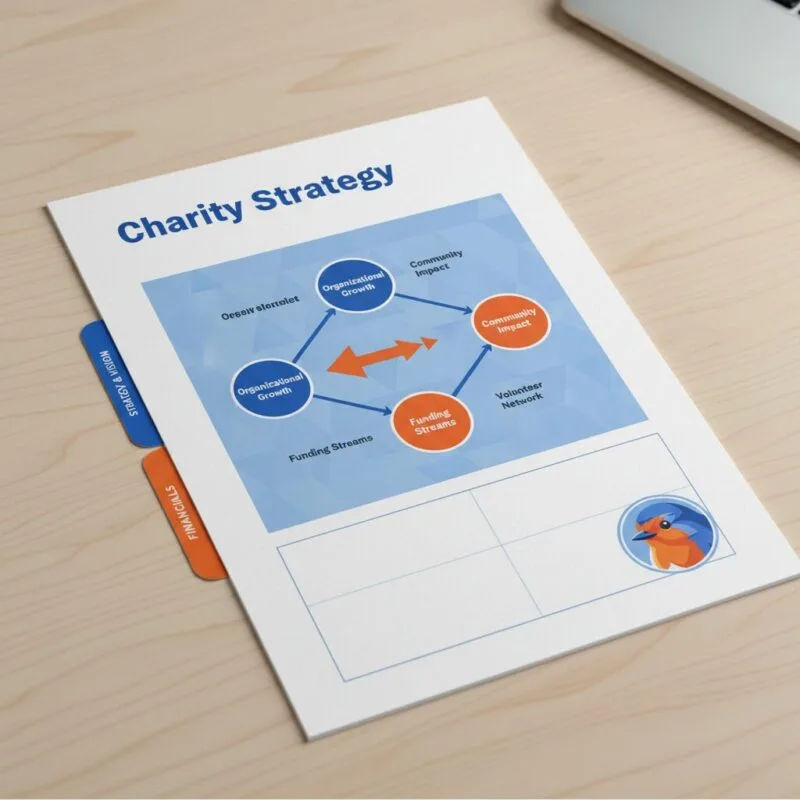
As of May 2026, the regulatory demands on UK charities have fundamentally shifted. Founders are expected to operate with enterprise-grade precision while relying on volunteer-level resources. In FundRobin’s survey of 58 nonprofits, 74% cited finding the right grant as their biggest operational challenge—yet only 12% used AI-powered matching tools to ease the administrative burden. The result is a sector plagued by chronic leadership burnout and stagnant funding.
TL;DR: Creating a 2026-compliant UK charity business plan requires founders to move beyond generic templates and embrace AI-driven financial strategy, strict Charity Commission standards (CC3/CC8), and explicit burnout prevention frameworks. A resilient business plan bridges legal compliance with sustainable human operations to secure long-term funding.
Table of Contents
- Introduction to the 2026 Resilient Charity Framework
- Preparing Your 2026 Strategy: Tools, Mindset, and Frameworks
- Step 1: Executive Summary & Strategic Vision
- Step 2: Mission, Vision, and Values
- Step 3: Demonstrating the Need and Beneficiary Impact
- Step 4: Structuring Core Programs and Services
- Step 5: Establishing Strong Governance & Leadership
- Step 6: Developing a Resilient Marketing & Fundraising Strategy
- Step 7: Optimizing Operations for Human Sustainability
- Step 8: Building Grant-Ready Financials and Reserves
- Step 9: Risk Management and Scenario Planning
- Streamlining Growth with FundRobin Tools
- Common Pitfalls in 2026 Charity Planning
- Frequently Asked Questions
Building a Resilient UK Charity Business Plan (2026)
Introduction to the 2026 Resilient Charity Framework
The post-2025 landscape requires more than a copied-and-pasted PDF. The Charity Commission demands higher accountability, and grant makers expect detailed, data-driven reporting. When founders attempt to meet these standards using outdated administrative models, they hit a wall.
Burnout is a systemic issue across the UK charity sector. Leaders sacrifice their physical and mental health to keep operations running, chasing restricted funds that rarely cover core operational costs.
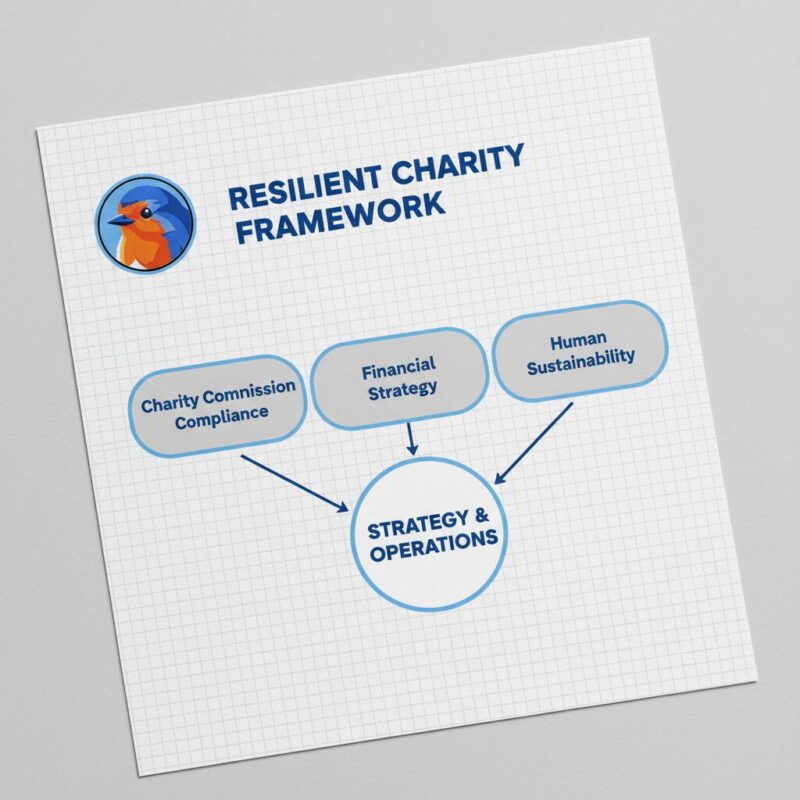
The ‘Resilient Charity’ framework is a dynamic roadmap that bridges strict Charity Commission compliance with sustainable human operations. It transitions the business plan from a static document into a living, agile tool. By building compliance and staff protection into the foundation of your plan, you insulate your organization against leadership turnover and funding droughts.
Preparing Your 2026 Strategy: Tools, Mindset, and Frameworks
Before you draft a single sentence, you must address your organizational structure. For most early-stage founders, the goal is moving from an unincorporated association to a Charitable Incorporated Organisation (CIO).
Navigating CIO Registration and Conversion Backlogs
The CIO structure provides trustees with limited liability and legal personality, making it the preferred model in 2026. However, Charity Commission backlogs remain a reality. According to GOV.UK: Set up a charity, errors in charitable objects or missing governance details are the primary causes of registration delays.
To avoid these bottlenecks, prepare a transition checklist. Ensure your proposed name is unique, draft clear charitable objects that align exactly with the law, and secure trustee declarations early. A robust business plan speeds up this process by providing the Commission with immediate proof of viability.
Bridging Charity Commission CC3 and CC8 Standards
Your business plan must reflect a deep understanding of regulatory duties. Charity Commission CC3: The essential trustee mandates that trustees act in the charity’s best interests, manage resources responsibly, and act with reasonable care.
Simultaneously, Charity Commission CC8: Internal financial controls for charities requires stringent financial oversight. You must document exactly how your board will review bank mandates, authorize spending, and conduct audits. Outline these frameworks before drafting your operational goals.
Essential Workflows for Agile Nonprofits
Abandon scattered Word documents. Centralize your planning using collaborative workspaces that allow trustees to review and comment asynchronously. Introduce specialized tools like FundRobin’s Business Plan Builder to streamline your financial forecasting and narrative structuring, securely integrating AI to eliminate hundreds of hours of drafting time.
Step 1: Executive Summary & Strategic Vision
The executive summary is the hook for grant makers. It must balance your ambitious vision with harsh operational realities, making a clear case for structural resilience immediately.
Section Prompt: Defining Your Ultimate Goal
Summarize your charity’s purpose, your primary objectives for 2026, and your exact financial ask in one page. Who are you serving, and how much capital do you need to do it sustainably?
Best-in-Class UK Charity Example:
“YouthMinds UK (Pending CIO) delivers trauma-informed counseling to adolescents in South London. In 2026, we seek £120,000 to expand our school-partnership program by 40%, reaching 500 new students. This funding includes 15% allocated to core operational costs and staff clinical supervision, ensuring long-term service stability and organizational resilience.”
2026 Resilience & Compliance Integration:
Always state your legal structure (or pending status) upfront. Note your commitment to risk management and long-term sustainability within the first paragraph to establish immediate trust with institutional funders.
Step 2: Mission, Vision, and Values
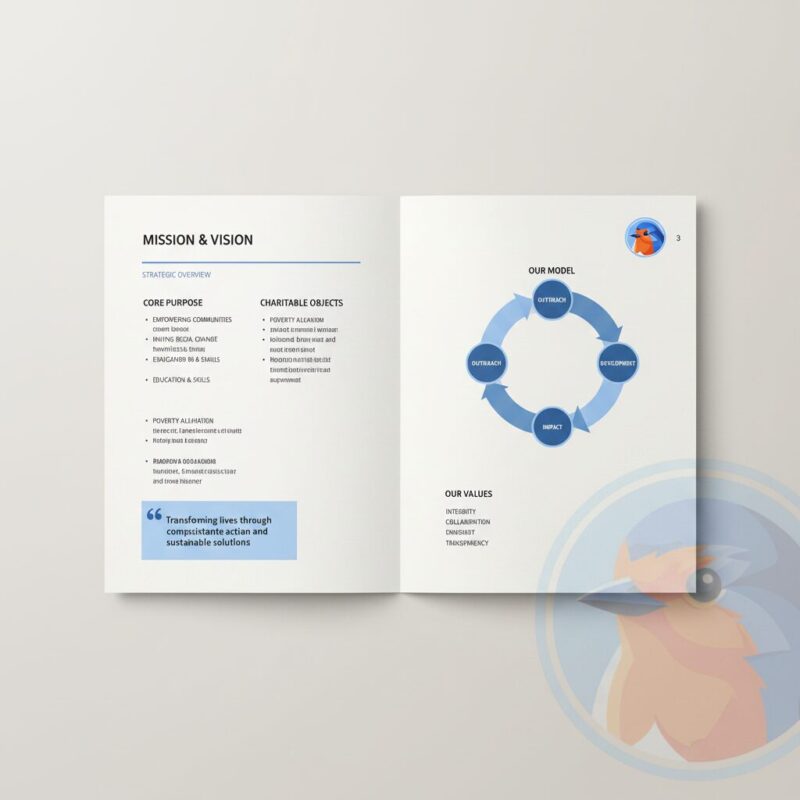
Your mission directs your daily operations, while your vision paints the future you want to see. Most importantly, a strict mission prevents “mission drift”—the dangerous habit of chasing unrelated grants simply because the money is available.
Section Prompt: Cementing Your Core Purpose
What specific problem are you solving today, what is the envisioned future, and what exact principles guide your team’s decision-making?
Real-World UK Charity Example:
- Vision: A society where no young adult faces mental health crises alone.
- Mission: To provide accessible, immediate, and culturally competent counseling to young adults in urban centers.
- Values: Transparency, Trauma-Informed Care, Lived-Experience Leadership, and Operational Sustainability.
Linking Mission to Prevent Mission Drift:
Chasing funding outside your core objects leads to rapid staff burnout and severe compliance warnings from the Charity Commission. This approach anchors your daily decisions and prevents you from drifting away from your core charitable objects.
Step 3: Demonstrating the Need and Beneficiary Impact
Funders require more than anecdotal empathy; they demand data-backed needs assessments.
Section Prompt: Backing Empathy with Data
What demographic data, local statistics, and lived experiences prove that your charity’s intervention is desperately needed in 2026?
Best-in-Class UK Charity Example:
Combine quantitative data from the Office for National Statistics (ONS) with qualitative community narratives. “ONS data indicates a 22% rise in youth anxiety disorders in our borough. However, our community consultations revealed the primary barrier isn’t just incidence, but a 6-month waitlist for NHS services. Our intervention bridges this exact gap.”
Integrating Your Theory of Change:
Prove exactly how your intervention solves the problem by attaching a robust Theory of Change. Map your inputs, activities, outputs, and outcomes clearly. Implement a clear Theory of Change framework to map this journey visually for grant makers.
Step 4: Structuring Core Programs and Services
Detail the actual services you provide. Balance your ambition with realistic staff capacity, embedding trauma-informed principles directly into the design.
Section Prompt: Detailing the Intervention
What specific programs will you run in 2026, who exactly will run them, and how will you measure their success daily?
Real-World UK Charity Example:
“Program 1: Drop-In Crisis Support. Delivered via two licensed therapists working 20 hours per week. KPI: Number of sessions delivered and self-reported anxiety reduction scores post-session, tracked via our secure digital intake system.”
Trauma-Informed Service Delivery Models:
Protect your frontline staff from vicarious trauma. Outline how your delivery models limit caseloads and mandate clinical supervision. Evidencing this care in grant applications shows funders you are a mature, sustainable organization.
Step 5: Establishing Strong Governance & Leadership
Trustees carry the ultimate legal responsibility. You must demonstrate strong oversight to funders, detailing your board structure and mandatory policies.
Section Prompt: Proving Organizational Oversight
Who governs your charity, what are their specific skills, and what policies ensure legal compliance and beneficiary safety?
Best-in-Class UK Charity Example:
Include a skills matrix showing exactly where your board excels (e.g., Finance, Safeguarding, Lived Experience, Legal). Outline your schedule for reviewing mandatory 2026 policies, including GDPR, Safeguarding, and Equality, Diversity, and Inclusion (EDI).
Meeting CC3 and CC8 Standards:
According to NCVO: Knowhow Nonprofit Governance, a compliant plan explicitly maps out how trustees exercise independent judgment (CC3) and detail internal financial control delegations (CC8). Document your conflict of interest register and financial authorization thresholds here.
Step 6: Developing a Resilient Marketing & Fundraising Strategy
Relying on a single grant maker is a massive organizational risk. You need a diversified fundraising portfolio encompassing grants, individual giving, and corporate partnerships.
Section Prompt: Mapping the Income Strategy
How will you raise the funds required in 2026, and what is your specific strategy for dividing income across community, corporate, and grant channels?
Real-World UK Charity Example:
Aim for a balanced mix: 50% multi-year grants, 30% individual community giving, and 20% corporate sponsorships. Draft a clear Fundraising Strategy that aligns with your operational capacity, and ensure you meet basic Grant Readiness criteria before applying for institutional funds.
Using AI for Data-Driven Campaigns:
Modern charities leverage AI to accelerate discovery and tailor proposals. By automating the preliminary research phase, your team reclaims hundreds of hours, radically increasing the ROI on your fundraising efforts.
Step 7: Optimizing Operations for Human Sustainability
Shift your operational focus from purely logistical needs (office space, software) to workforce retention. The burnout crisis requires structural operational changes.
Section Prompt: Designing the Daily Workflow
What physical, digital, and human resources are required to run the charity daily, and how exactly will you protect staff mental health?
Best-in-Class UK Charity Example:
List your IT infrastructure alongside your HR and well-being structures. Include a mandatory 4-day work week trial, paid clinical supervision hours, and a strict “right to disconnect” email policy.
Burnout Prevention and Team Resilience:
Creating a culture of psychological safety requires actual budget allocation and structural support. Refuse under-funded, restrictive grants that do not allow for full cost recovery. Staff turnover costs thousands of pounds; well-being is a legitimate operational expense.
Step 8: Building Grant-Ready Financials and Reserves
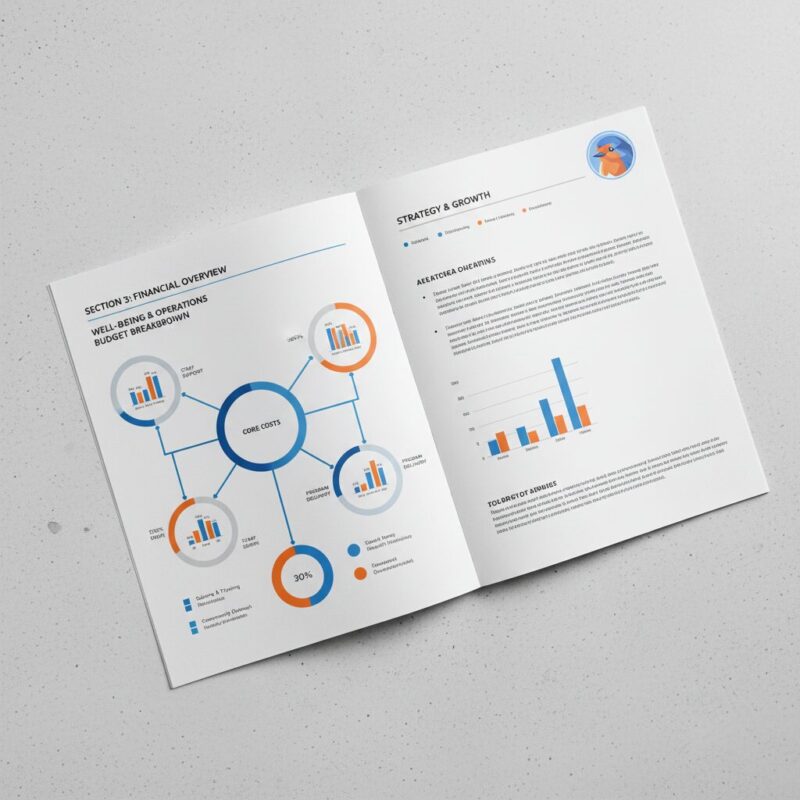
Financial transparency is non-negotiable. You must create robust 3-year projections, accurate cash flow forecasts, and a highly specific reserves policy.
Section Prompt: Projecting Sustainable Growth
Provide a 3-year income and expenditure forecast, a cash flow analysis, and a strict policy for maintaining organizational reserves.
Real-World UK Charity Example:
Your budget breakdown must clearly delineate between core operational costs (rent, salaries, software) and restricted program funds. Transparency here proves to funders that you know exactly what it costs to run your organization.
Crafting a 2026-Compliant Reserves Policy:
The Charity Commission scrutinizes reserves heavily. According to the Hawsons: 2026 Charity Accounts Deadlines Guide, a compliant 2026 reserves policy moves beyond the generic “3 months running costs” rule. You must calculate reserves based on actual wind-down costs, staff redundancy pay, and emergency operational needs, documenting the exact justification for your trustees.
Step 9: Risk Management and Scenario Planning
Economic volatility requires forward-thinking risk management. You must identify, mitigate, and monitor risks dynamically.
Section Prompt: Anticipating the Unexpected
What are the top 5 risks to your charity in 2026, and what exact steps will you take to mitigate them?
Best-in-Class UK Charity Example:
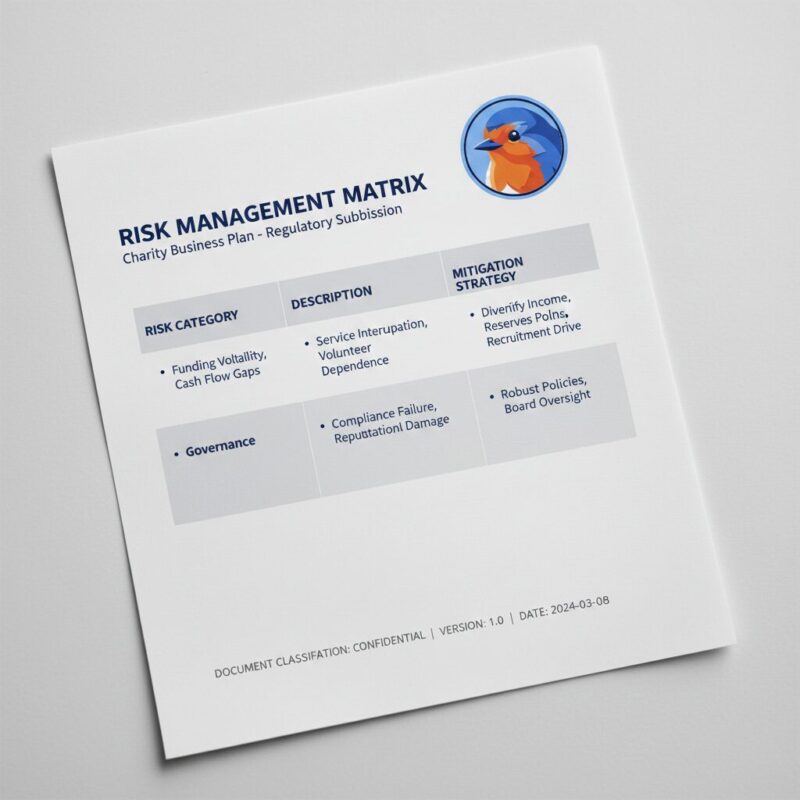
Create a risk register matrix that scores threats by likelihood and impact.
- Financial Risk: Anchor grant not renewed. Mitigation: Maintain 4 months of risk-adjusted reserves; diversify into corporate giving.
- Operational Risk: Key staff burnout. Mitigation: Enforce mandatory supervision and flexible working policies.
Preparing for Economic Shifts in 2026:
As noted in the Azets: Charities & Not-for-Profit Update February 2026, financial stress testing is vital. Use scenario planning (best case, worst case, most likely case) to ensure your charity can adapt its services during a funding drought, communicating this resilience clearly to your donors.
Streamlining Growth with FundRobin Tools
Writing a compliant business plan manually takes weeks. Transitioning from a static strategy to funded proposals requires technological acceleration.
Leveraging the Business Plan Builder
FundRobin’s AI Assistant allows charities to take their core business plan data and instantly generate high-quality first drafts of grant proposals. By matching your strategic objectives with relevant 2026 funds, the builder translates your raw data into compliant, compelling narratives, saving teams up to 200 hours monthly and increasing success rates.
FundRobin Pricing: Transparent Tiers for Every Charity
We provide transparent, flat-rate pricing to suit different organizational stages:
- Growth: £49/month or £470.40/year.
- Impact: £199/month or £1,910.40/year.
- Guided Showcase Trial: available by application to selected organisations after approval and activation.
Note: Opting for an annual subscription saves you 20% across all tiers.
Private AI Data Security for Nonprofits
Using public LLMs for sensitive charity data exposes you to severe privacy risks. FundRobin operates in a private, secure environment. According to the data protection standards set by the Information Commissioner’s Office (ICO): Charities and GDPR and UKRI Data Management, we ensure your beneficiary and donor data is never used to train public models. You maintain total ownership and GDPR compliance while writing your grants.
Key Takeaways:
- Implement a “Resilient Charity” framework—replace static PDF business plans with dynamic models that merge regulatory compliance and operational agility.
- Transitioning to a CIO requires strict adherence to Charity Commission backlog requirements; an airtight business plan accelerates this process.
- Embed well-being into your core planning—treat burnout prevention as a quantifiable operational expense, not an afterthought.
- Calculate your 2026 Reserves Policy based on actual risk and wind-down costs, moving past the outdated 3-month flat rule.
- Leverage secure AI tools like FundRobin to generate compliant grant proposals from your business plan, reclaiming up to 200 hours monthly.
Common Pitfalls in 2026 Charity Planning
Even well-intentioned founders make critical errors that derail their operations and compliance status.
Missing 2026 Charity Accounts Deadlines
Missing your 10-month filing deadline damages your reputation with funders and the Charity Commission. Build these deadlines directly into your operational workflow. Late filing signals poor governance to potential grant makers assessing your risk profile.
Underfunding Reserves and Operational Costs
Founders frequently dedicate 100% of funding to programs at the expense of core costs. This “zero overhead” myth destroys charities. You must educate funders on the necessity of core costs and explicitly budget for staff salaries, software, and reserves to survive.
Creating a Disconnected Fundraising Strategy
Isolating your fundraising plan from operational reality is disastrous. If your fundraisers secure a massive, restrictive grant that your operations team lacks the capacity to deliver, the organization will buckle. Align your teams and revisit your business plan quarterly to ensure cohesion.
Frequently Asked Questions
How long does it take to register a CIO with the Charity Commission in 2026?
Registering a CIO typically ranges from 4 to 12 weeks, depending entirely on current Charity Commission backlogs. Having a robust, compliant business plan prevents unnecessary delays caused by poorly drafted charitable objects or governance gaps.
What are the key Charity Commission CC3 and CC8 requirements?
CC3 outlines essential trustee duties (acting with care, managing resources), while CC8 dictates strict internal financial controls (audits, bank mandates). Your business plan must explicitly document how you enforce these controls to survive regulatory scrutiny and build funder trust.
How do you write a compliant charity reserves policy?
Calculate your reserves based on 2026 economic volatility and actual organizational wind-down costs, typically ranging from 3 to 6 months of operating expenses. You must clearly justify this calculation in your business plan, explaining the specific financial risks your charity faces.
How can UK charity founders prevent operational burnout?
Prevent burnout by embedding well-being line items—such as paid clinical supervision and flexible working models—directly into your operational budgets. Adopt trauma-informed leadership practices and strictly refuse restricted grants that do not allow for full cost recovery.
Is it safe to use AI for charity grant writing and business planning?
Yes, provided you use secure platforms like FundRobin that do not use your proprietary data to train public language models. This private environment ensures you maintain full GDPR compliance while drafting proposals involving sensitive beneficiary information.
How much does FundRobin cost for a UK charity?
FundRobin offers Growth at £49/month or £470.40/year and Impact at £199/month or £1,910.40/year. Compare current plans. Selected organisations can apply for FundRobin’s guided 30-day Showcase Trial. The period starts only after approval and activation; approved Showcase organisations do not need a card to begin. Apply for the Showcase Trial.
