
Eight years across the international development sector taught me a hard truth about funding: good intentions do not pay salaries. As of May 15, 2026, the london funding environment requires strict operational precision. Charities and social enterprises face intense competition, shrinking core-cost allocations, and rapid shifts in how the government and major trusts distribute capital. According to FundRobin’s internal analysis of 76 applications, nonprofits in our survey that maintained a formal grant tracking system secured 2.3x more funding per year than those managing deadlines in spreadsheets.
Winning capital in the capital demands a shift from reactive grant writing to proactive organizational design. You cannot afford to waste 40 hours drafting a proposal for a foundation whose priorities shifted six months ago. You need a data-driven strategy.
TL;DR: The 2026 strategy to secure london funding requires aligning projects with hyper-local, place-based philanthropic priorities and utilizing AI grant matching tools. Organizations that transition from traditional pan-London approaches to data-driven, borough-specific storytelling and blended finance models maximize their win rates while reducing administrative costs.
Table of Contents
- The 2026 London Funding Environment: Place-Based Shifts
- The 2026 Strategic Advantage: Optimizing Your Grant Readiness
- Crafting Evidence-Based London Funding Applications
- Financial Diversification and Sustainable Organization Design
- Building Your 2026 London Funding Calendar & Workflows
- Frequently Asked Questions
Key Takeaways: Maximizing Your Funding ROI
- Transform your ROI on grant applications by adopting AI-powered tools that cut proposal writing time by 80% (from 40 hours to 4 hours), saving crucial administrative costs.
- Align your 2026 strategy with hyper-local, place-based philanthropy trends rather than broad pan-London approaches to maximize your win rate.
- Implement blended finance models and non-dilutive capital strategies to reduce organizational reliance on restricted grant cycles and mitigate staff burnout.
- Utilize contextual matching to ensure resource allocation targets only high-probability grants (70%+ match scores) that historically yield an 85% success rate.
- Incorporate well-being-inclusive budgeting in your grant applications to satisfy 2026 funder requirements for organizational sustainability.
Securing London Funding: 2026 Strategic Grant Guide
The 2026 London Funding Environment: Place-Based Shifts

The strategy of submitting a single, broad narrative to a dozen different London-wide trusts is dead. The capital is decentralizing its philanthropic distribution, forcing organizations to adjust their targeting to hyper-local parameters.
Decentralization: Understanding the ‘Our Place to Give’ Roadmap
The UK government recently finalized frameworks to spread philanthropic investment beyond the traditional central hubs. According to the UK Fundraising: Our Place to Give Roadmap, this national policy heavily impacts how London-based nonprofits justify their funding needs. Funders now prioritize systemic, community-led interventions over broad cause-based initiatives. If your organization operates in Lambeth, your application must address Lambeth’s specific socioeconomic metrics, not just generalized London poverty statistics.
Priorities of The London Community Foundation (LCF)
The London Community Foundation acts as the premier hyper-local grant intermediary for the city. They hold tight restrictions on who qualifies for funding, demanding highly localized impact reporting. According to The London Community Foundation | Available Grants, their 2026 focus targets specific local inequalities, connecting high-net-worth donors directly with grassroots organizations.
Navigating intermediary funders requires understanding their distinct application portals and compliance checks. We outline the exact mechanics of these structures in our comprehensive Community Foundation Guide.
Navigating GLA Grants and London Councils 2026-30 Programmes
Beyond private philanthropy, structural government funding remains a core revenue pillar. The London Councils 2026-30 Grants Programme establishes the next four years of pan-London structural funding. However, the true strategic advantage comes from stacking Greater London Authority (GLA) grants with local borough funds. While GOV.UK interfaces provide regulatory frameworks, localized platforms and councils distribute the actionable cash. You must separate the broad policy intent found on GOV.UK from the hyper-local execution required by the GLA.
The 2026 Strategic Advantage: Optimizing Your Grant Readiness
Finding a grant is easy. Winning it requires an airtight internal strategy. The cost of a rejected application is high; a grant writer’s time is an expensive resource. Organizational readiness is the prerequisite to securing high-value london funding.
The Funding Readiness Scorecard for London Nonprofits
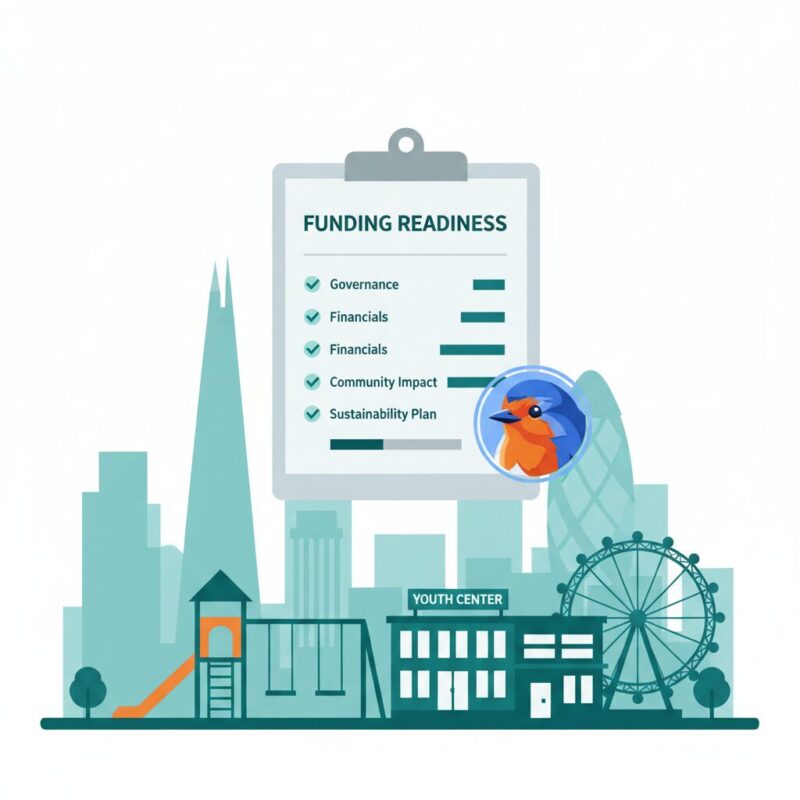
Before allocating staff hours to an application, community groups must pass a strict internal audit. The 2026 Funding Readiness Scorecard requires five critical components:
- Audited Financial Transparency: Clear separation of restricted vs. unrestricted funds.
- Hyper-Local Impact Tracking: Measurable borough-specific data.
- Governance Stability: An active, diverse board meeting Charity Commission standards.
- Safeguarding Policies: Updated 2026 compliance for vulnerable groups.
- A Defined Theory of Change: A logical map connecting funding directly to community outcomes.
FundRobin’s AI match scoring algorithm automatically acts as a digital version of this scorecard, assigning a 0-100% eligibility rating to prevent your team from wasting time on low-probability applications.
Sector-Specific Grant Matching: Navigating Niche London Causes
Broad keyword searches fail in complex funding environments. A search for ‘youth grants’ returns thousands of unqualified results. Granular, sector-specific targeting is necessary. FundRobin’s natural language processing understands the contextual difference between “disadvantaged youth” and “at-risk teenagers transitioning out of care.” This level of precision is how organizations identify obscure, high-yield trusts. You can review how we organize these specialized categories in our breakdown of Sector Grants.
Overcoming Staff Burnout from Restricted Grant Cycles
The most pressing threat to London nonprofits is not a lack of capital; it is institutional burnout. The treadmill of restricted, short-term grant funding forces Executive Directors into constant fundraising mode, leaving no room for strategic planning. This resource starvation creates high staff turnover. When applying for 2026 funding, organizations must aggressively advocate for core cost allocations within their budgets. Funders are increasingly aware that starving overhead destroys the programs they aim to support.
Crafting Evidence-Based London Funding Applications
Once you identify a high-probability grant, the execution phase begins. Winning in 2026 requires blending emotional community narratives with ruthless economic data.
Demonating ‘Value for Money’ to London Grant Reviewers
To a 2026 London funder, “Value for Money” means maximum measurable impact per pound spent, with minimal administrative waste. You must link every budget line item directly to a community outcome. If you request £40,000 for a youth employment program, the narrative must detail the exact cost-per-job-placement. Reviewers score applications based on economic efficiency. Prove that your organization delivers a higher ROI than the charity competing in the adjacent borough.
AI-Powered Proposal Generation: Writing Grants 10x Faster
Manual proposal writing averages 40 hours per application. This is an unacceptable overhead cost. FundRobin’s Smart Proposal Generation reduces writing time by 80%. The platform generates highly tailored, compliant first drafts in minutes. Because the AI relies strictly on factual UK funding standards and your organization’s verified data, it eliminates the hallucination risks common with generic consumer chatbots. You get an evidence-based draft mapped directly to the funder’s criteria.
Data-Driven Storytelling for Hyper-Local Borough Impact
Place-based funders demand place-based data. Pan-London statistics hold no weight when applying for a borough-specific trust. You must weave local poverty metrics, education gaps, or housing statistics directly into the narrative. Explain how a £20,000 grant specifically alters the trajectory of 50 families in Tower Hamlets. Granular data validates the emotional appeal of your application.
Financial Diversification and Sustainable Organization Design
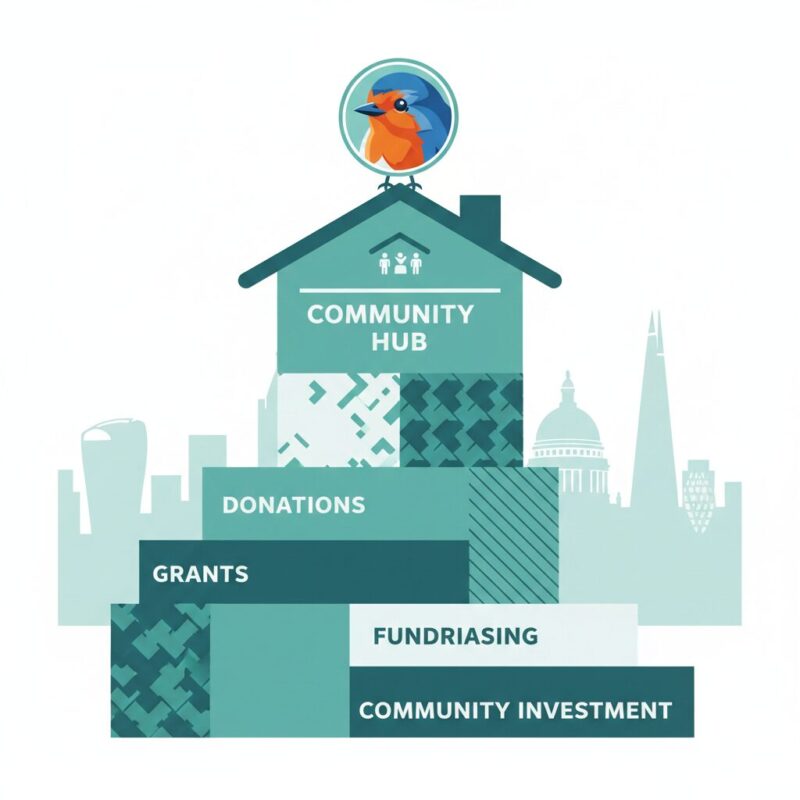
Reliance on a single grant stream is an existential organizational risk. Sustainable charities and social enterprises build diversified capital stacks.
Blended Finance and Earned-Income Transition Models
London nonprofits must look beyond traditional philanthropy. Blended finance combines grants with earned income and non-dilutive capital, creating a resilient financial structure. An organization might use a grant to build a facility, but rely on fee-for-service models to cover ongoing operational costs. We explore the mechanics of this transition in our deep-dive analysis of the 2026 Social Enterprise Capital Stack.
Structuring Governance and Well-Being-Inclusive Budgets
Funders scrutinize organizational governance and staff retention rates. A charity with 50% annual staff turnover signals instability. Anticipate 2026 governance standards by embedding staff well-being, mental health support, and fair wages directly into your grant budgets. Ethical budgeting strengthens your application by proving to reviewers that you are building a sustainable, long-term institution, not just running a short-term project.
Looking Beyond London: Expanding to International Grants
Restricting your search to the M25 limits your capital potential. UK-based initiatives frequently qualify for international grants, particularly those originating from the US or EU focused on global health, climate, or human rights. Global databases capture opportunities that local boards miss. You can expand your capital stack by utilizing tools like the USA Grant Finder and navigating cross-border opportunities through our USA Funding Hub.
Building Your 2026 London Funding Calendar & Workflows
A brilliant strategy fails without operational execution. Fragmented databases cause missed deadlines and duplicate work.
Identifying Missing Key Grant Application Windows
London-specific trusts often operate with narrow, 30-day funding windows. If you miss the submission date, you wait an entire year for the next cycle. You must map out a 12-month calendar that tracks these specific windows, distributing the writing workload evenly across your team to prevent last-minute bottlenecks. FundRobin provides real-time updates and urgency indicators to ensure you never miss a hyper-local deadline.
Multi-PI Collaboration and Institutional Strategic Planning
Larger institutions and universities face the added complexity of multi-partner (Multi-PI) grants. Coordinating data, compliance, and narratives across multiple academic departments requires strict version control and collaborative workspaces. Managing these complex bids manually leads to critical compliance failures. We detail how AI orchestration manages these massive applications in our analysis on Strategic AI Orchestration.
Implementing AI Grant Matching to Save 200+ Hours Monthly
Manual grant discovery drains hundreds of hours from your staff every month. FundRobin’s Smart Dashboard replaces manual searching with real-time pipeline tracking and financial forecasting. The business case is straightforward: automating discovery and drafting saves time, and time is the most expensive resource a nonprofit has.
Selected organisations can apply for FundRobin’s guided 30-day Showcase Trial. The period starts only after approval and activation; approved Showcase organisations do not need a card to begin. Apply for the Showcase Trial or compare Growth and Impact plans.
Frequently Asked Questions
What are the best strategies to secure London funding in 2026?
The top strategy to secure london funding in 2026 is aligning projects with place-based philanthropic priorities and utilizing AI grant matching tools to optimize ROI. By leveraging platforms like FundRobin, organizations automate the discovery of hyper-local grants and generate compliant proposals, allowing staff to focus on relationship-building rather than manual research.
How does place-based philanthropy affect London funding?
Place-based philanthropy shifts funding toward hyper-local, borough-specific impacts rather than broad, pan-London initiatives, requiring highly localized data storytelling. According to the UK government’s roadmap, funders now demand that applicants prove their direct connection to a specific community’s socioeconomic metrics to secure capital.
How can London charities demonstrate value for money to grant reviewers?
Demonstrating value for money requires presenting transparent budgets alongside clear, measurable community outcomes, emphasizing cost-efficiency in grant narratives. Reviewers expect every requested pound to link directly to a specific deliverable, proving that the organization minimizes administrative waste while maximizing local impact.
What are the best revenue diversification strategies for nonprofits?
The best revenue diversification strategies include implementing blended finance, earned-income models, and securing non-dilutive funding, thereby reducing reliance on restricted grant cycles. Transitioning to a diversified capital stack ensures organizational resilience and protects staff from the burnout associated with constant grant-chasing.
Which organizations provide the most London funding for community groups?
The primary structural bodies providing funding for London community groups are the London Community Foundation (LCF), the London Councils Grants Programme, and Greater London Authority (GLA) grants. While the GLA handles large-scale structural funding, the LCF operates as the premier intermediary connecting private donors with grassroots neighborhood projects.
How does AI improve the grant writing process for UK charities?
AI tools like FundRobin automate the discovery process and generate compliant first drafts, saving organizations over 200 hours monthly and cutting proposal writing time by 80%. By utilizing grounded data specific to UK funding frameworks, these systems eliminate hallucination risks and ensure proposals meet strict funder formatting requirements.
