
Eight years working across UNICEF, WFP, and the UK government taught me a hard truth about funding: good intentions do not secure grants. Environmental nonprofits face an unprecedented crunch in 2026. Teams write dozens of proposals, exhaust their staff, and still miss out on major funding because they rely on outdated application strategies.
In 2026, 76 nonprofit leaders told us a striking fact: organisations with a documented grant strategy were 3.1x more likely to maintain consistent year-over-year funding compared to those taking a reactive approach. The era of generic, narrative-heavy applications is over. Today, funders demand hard data, strict compliance, and clear climate resilience metrics. To survive, NGOs must shift from a volume-based application approach to a highly targeted, technology-driven strategy.
TL;DR: The 2026 ‘Strategic Resilience’ framework requires environmental nonprofits to cure grant-writing burnout with AI tools, target niche environmental trusts over broad federal agencies, and align qualitative green initiatives with mandatory federal quantitative metrics. Organisations must adopt data-driven, performance-linked workflows to secure sustainable, multi-region funding.
Table of Contents
- The 2026 Environmental Education Funding Landscape: Navigating Federal Priorities
- The 2026 Grant Readiness Checklist: Compliance and Data Standards
- Combating Development Team Burnout with AI-Enhanced Grant Workflows
- Translating Qualitative Green Initiatives into Quantitative ROI
- Building a Sustainable Capital Stack for Long-Term Environmental Impact
2026 Environmental Grant Strategy and Readiness Guide
The 2026 Environmental Education Funding Landscape: Navigating Federal Priorities
Federal funding structures have grown highly specific. Broad environmental campaigns no longer pass the initial review stages for major national programs. Organizations need precise alignment with climate resilience goals to compete effectively.
Expanding Beyond the EPA: Specialized Environmental Trusts vs. Large Agencies
The EPA remains a primary target for many NGOs. According to the Environmental Protection Agency (EPA) Environmental Education (EE) Grants program guidelines, they prioritize projects that advance environmental literacy and stewardship. However, these federal portals are fiercely competitive and carry heavy administrative burdens.
Mid-sized NGOs often spin their wheels chasing massive federal pools when they should target localized trusts that fund specific community impacts.

Specialized trusts offer tailored opportunities for niche outdoor learning grants and grants for youth programs. These smaller foundations have faster turnaround times and often prioritize long-term partnerships over one-off community project grants. You can use FundRobin’s USA Grant finder to identify these hidden trust opportunities that broad search engines frequently miss.
The Shift Toward Performance-Linked Climate Resilience Funding
Funders now tie capital directly to measurable outcomes. The transition from generic grants to performance-linked environmental impact funding means you must prove your results mathematically. If your organization promises to improve local biodiversity, the funder expects a concrete baseline measurement and a specific percentage increase target. Failure to quantify these outcomes leads to immediate rejection in 2026 application cycles.
Deciphering Technical Climate Reporting (TCFD/GRI) for Mid-Sized NGOs
Acronyms like TCFD (Task Force on Climate-related Financial Disclosures) and GRI (Global Reporting Initiative) intimidate many nonprofit leaders. These frameworks originated in the corporate sector, but large philanthropic foundations now adopt their principles to measure grantee success.
Research on Sustainability Reporting Frameworks (EcoAct) shows that adopting structured data reporting signals organizational maturity to funders. You do not need a corporate compliance team to use these frameworks. Mid-sized environmental nonprofits can borrow simplified GRI principles—such as tracking specific emissions reductions or community engagement hours—to strengthen their applications and stand out to sophisticated grantmakers.
The 2026 Grant Readiness Checklist: Compliance and Data Standards
Proactive readiness beats reactive applying. When a high-value grant opens with a 30-day deadline, organizations with clean data and pre-vetted strategic grant readiness documentation win the capital.
Modernizing Fragmented NGO Data for Federal Application Portals
Fragmented organizational data kills applications. Development teams waste weeks tracking down past success metrics from program managers or financial records from accounting. Centralizing this data is a mandatory prerequisite for navigating 2026 federal application portals efficiently. Clean, accessible data speeds up the application process and ensures that your proposals consistently cite accurate, verifiable numbers.
Navigating the Divide Between ‘Education’ and ‘Infrastructure’ Compliance
Many organizations fail because they misunderstand funder categories. According to the EPA’s 2026 Educational Guidelines, environmental education funding requirements focus strictly on curriculum design, teacher training, and community outreach. Conversely, climate infrastructure compliance funding pays for physical assets like solar panels or energy-efficient HVAC systems. Mixing the two in an application—asking an education funder to buy solar panels—triggers immediate compliance rejections. Tailor your narrative to the precise category of the grant.
Implementing Automated Eligibility and Compliance Checks
Relying on manual compliance checks is a recipe for missed details. Funders bury specific regional requirements and GDPR mandates deep in their guidelines. AI-driven platforms provide built-in compliance integration to ensure applications meet local and international regulations automatically. Automating these funder-specific guideline checks prevents your team from spending 40 hours writing a proposal only to be disqualified over a technicality.
Combating Development Team Burnout with AI-Enhanced Grant Workflows
The nonprofit sector faces a severe burnout crisis. Development managers operate in high-demand, low-resource environments, constantly churning out proposals to keep their organizations afloat.
The Human Cost of the Reactive ‘Proposal Reinvention’ Cycle
Manually rewriting proposals for every new grant drains resources and crushes morale. A study on The Grant Writer’s Dilemma: Ethics, Capacity, and Burnout (Instrumentl) found that continuous proposal reinvention leads to severe exhaustion in the sector. The resulting staff turnover cripples organizational capacity and forces remaining team members to pick up an impossible slack. Starting from scratch on every application is no longer a viable operational model.
Transitioning to the ‘Strategic Resilience’ Framework
The Strategic Resilience framework offers a dual-path approach. It merges operational efficiency through automation with highly targeted, data-backed grant seeking. Instead of applying to 50 grants with a 5% success rate, teams apply to 15 highly matched grants with a 40% success rate. Read more about implementing AI grant writing in 2026 to understand how this pivot transforms organizational growth.
Reclaiming 200+ Hours Monthly Using AI-Powered Smart Matching
FundRobin’s AI Smart Grant Matching and Smart Proposal Generation actively solve the burnout problem. Natural Language Processing (NLP) identifies high-probability grants by understanding organizational context, not just keyword matching. Internal FundRobin data indicates that generating high-quality first drafts in minutes reduces writing time by 80%, saving organizations over 200 hours a month. Grounded AI models—which cite actual sources and strictly adhere to your internal data—prevent the hallucination issues common in generic chatbots.
Translating Qualitative Green Initiatives into Quantitative ROI
Environmental educators know the qualitative value of a student connecting with nature. Unfortunately, modern funders speak the language of quantitative returns. You must convert qualitative outcomes into hard metrics.
Why 2026 Funders Demand Data-Driven Reporting for Green Projects
Macroeconomic pressures force grantmakers to demand strict ROI from their grantees. Funders need verifiable data to justify their philanthropic investments to their own boards and stakeholders.
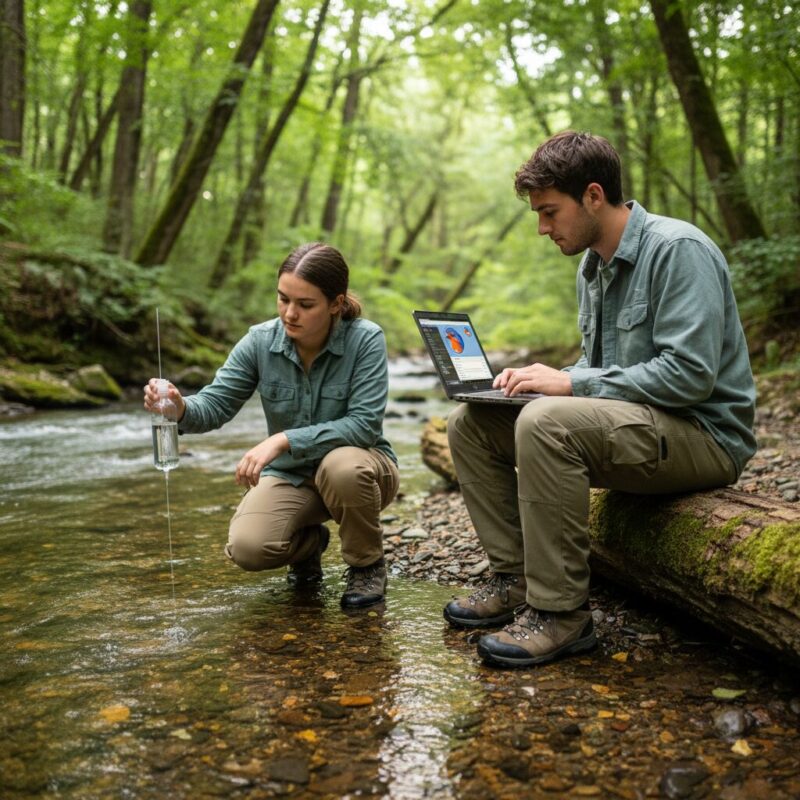
EcoAct’s 2026 corporate compliance analysis notes a massive shift away from trust-based philanthropy toward verified impact metrics in the environmental sector. You must provide specific data points, such as participant retention rates, measurable community carbon footprint reductions, or specific acreages of land restored.
Building Simple Templates for Environmental Impact Measurement
Resource-constrained teams need practical tools, not academic theories. Establish a simple Theory of Change template that identifies 3-5 core quantitative KPIs for every project. For initiatives like grants for early years settings or a learning through landscapes grant, track specific metrics: hours spent outdoors per child, number of educators certified, or measurable increases in local biodiversity indicators. Standardized templates ensure consistency across all applications.
Using AI to Generate Funder-Aligned Impact Narratives
Writing data-heavy narratives manually takes deep concentration and time. Specialized Large Language Models can ingest your qualitative field notes and raw templates to output persuasive, funder-aligned impact narratives. These tools analyze specific grant guidelines and format your data perfectly to match the funder’s scoring rubric. To see this in action, access our free grant matching tool and experience how clean data translates into compelling proposals.
Building a Sustainable Capital Stack for Long-Term Environmental Impact
Relying on a single federal grant stream puts your entire organization at risk. Modern environmental nonprofits must diversify their funding sources to ensure long-term stability.
Integrating Blended Finance and Non-Dilutive Funding Models
Blended finance combines philanthropic grants with private investment or non-dilutive social enterprise capital. Securing initial grant funding de-risks your projects, making them highly attractive to impact investors. Grants serve as the foundation that unlocks larger, unrestricted funding pools. Learn how to structure this approach by exploring blended finance models and building a sustainable capital stack.
Tailoring Strategies for U.S. and Global Environmental Programs
Environmental challenges cross borders, and your funding strategy should too. Platforms built on rigorous international standards help NGOs navigate complex local landscapes. Whether you are tailoring campaigns for U.S. based environmental nonprofits or navigating European funding frameworks, applying stringent global compliance standards to your local applications gives you a massive competitive advantage.
Securing Funding Readiness for the Next Decade
Selected organisations can apply for FundRobin’s guided 30-day Showcase Trial. The period starts only after approval and activation; approved Showcase organisations do not need a card to begin. Apply for the Showcase Trial or compare Growth and Impact plans.
Frequently Asked Questions
What is the difference between environmental education grants and climate infrastructure funding?
Environmental education grants fund curriculum, community outreach, and learning programs, whereas climate infrastructure compliance funding targets physical green assets like solar panels or HVAC upgrades. Mixing these two distinct categories in a single federal application frequently triggers automatic compliance rejections, as funders maintain separate budgets and reporting frameworks for education versus capital expenditures.
How do I find niche environmental education grants beyond the EPA?
Target specialized environmental education trusts and regional foundations rather than relying solely on the EPA. You can use AI-powered grant discovery platforms like FundRobin to match precise organizational criteria with niche funders that broad search engines miss. These smaller trusts often offer faster turnaround times and higher success rates for mid-sized nonprofits.
What are the top 2026 grant readiness requirements for environmental nonprofits?
The top requirements are adopting standardized data reporting based on TCFD/GRI principles, automating compliance checks to meet complex federal rules, and transitioning from qualitative narratives to quantitative, performance-linked ROI metrics. Environmental organizations must centralize their historical data into a single repository to ensure rapid, accurate responses during tight 30-day application windows.
How can AI reduce grant writer burnout in environmental NGOs?
AI grant assistants help combat burnout by automating the reactive ‘proposal reinvention’ cycle, generating compliant first drafts in minutes. According to Instrumentl’s 2026 capacity research, reducing manual rewriting lowers staff turnover and saves development teams up to 200 hours monthly, allowing them to focus on relationship building and strategy.
What is blended finance for environmental nonprofits?
Blended finance combines philanthropic grants with private impact investment or non-dilutive social enterprise capital. This strategy expands the capital stack and reduces over-reliance on a single federal grant source. By using initial grants to de-risk environmental projects, nonprofits can attract private capital to scale their climate resilience initiatives sustainably.
Key Takeaways:
- Transition from volume-based applying to the ‘Strategic Resilience’ Framework, prioritizing high-match, performance-linked environmental grants.
- Combat staff burnout and the ‘proposal reinvention’ cycle by leveraging AI-assisted workflows to save 200+ hours monthly on grant writing.
- Bridge the gap between technical climate reporting (like TCFD/GRI) and daily operations by translating qualitative green initiatives into hard, quantitative ROI metrics.
- Expand beyond highly competitive EPA grants by utilizing AI smart matching to uncover specialized, niche environmental education trusts globally.
The future of environmental funding belongs to organizations that adapt to data-driven realities. By moving away from reactive grant writing and embracing AI-powered efficiency, your nonprofit can end the cycle of burnout and secure the sustainable capital needed to drive genuine climate impact.
