

The landscape of local council funding is undergoing a massive restructuring. According to the Local government finance policy statement 2025 to 2026 – GOV.UK released earlier this year, regional devolution has moved from a theoretical concept to an operational reality. For overwhelmed charity leaders and development managers, this shift breaks historic, highly localised funding relationships.
TL;DR: How is UK devolution changing local council funding in 2026, and how can charities adapt? Devolution consolidates local council funding into large, complex regional contracts, eliminating smaller ad-hoc grants. Charities must survive by abandoning reactive grant-chasing, building 18-24 month funding pipelines, utilizing AI for bid discovery, and forming bidding consortia to compete for these new regional resources.
Table of Contents
- The 2026 Shift: How Devolution Changes Local Council Funding
- Building Strategic Resilience: Creating an 18-24 Month Funding Pipeline
- From ‘Grant Chasing’ to ‘Go/No-Go’: Implementing Automated Bid Management
- Collaborative Power: Forming Consortia for Large-Scale Regional Contracts
- Step-by-Step: Securing Local Council Funding in 2026
- Frequently Asked Questions
Securing UK Local Council Funding in 2026
The 2026 Shift: How Devolution Changes Local Council Funding
Regional devolution represents the largest transfer of financial authority in decades. The central UK government continues to pass budgetary control down to regional combined authorities and mayors. The transition replaces localized micro-grants with consolidated regional contracts, fundamentally altering how the third sector secures revenue.

Understanding Local Authority Reorganization
Structural changes at the local government level mean your historical contacts at the borough or district council likely hold less discretionary funding today. According to the Navigating local authority devolution | Cranfield Trust guide, charities must understand new political boundaries to remain viable. Previously separate municipal budgets are now pooled into large-scale commissioning models focused on regional impact rather than neighbourhood-level intervention.
The Impact on Small-to-Medium UK Charities
The consolidation disproportionately affects small-to-medium non-profits with turnovers between £100k and £2m. Data from the National Council for Voluntary Organisations (NCVO) frequently highlights that smaller organizations struggle to absorb the high administrative costs of massive regional bids. The loss of £5,000 to £10,000 localized micro-grants creates a revenue vacuum. Development managers now face immense cognitive overload, trying to decipher complex regional procurement portals while fearing larger national charities will price them out of their own backyards.
Why ‘Grant-Chasing’ No Longer Works in 2026
Grant-chasing is the reactive process of spotting a deadline two weeks away and scrambling to assemble an application. This approach generates severe administrative burnout. Research from the Directory of Social Change (DSC) regularly demonstrates that reactive searching across fragmented databases results in abysmally low success rates. Small teams cannot sustain this cycle. Instead of chasing isolated pots of money, organizations must develop strategic resilience—a systematic, long-term approach to revenue.
Building Strategic Resilience: Creating an 18-24 Month Funding Pipeline
Replacing ad-hoc applications with a structured 18-24 month funding pipeline protects charities from sudden local council funding cuts. According to the Grant Funding for UK Charities 2026: Resilience | FundRobin report, long-term planning moves a charity from a state of survival to sustainable growth.
Establishing Centralized Content Repositories
Most non-profits suffer from internal data fragmentation. Proposal answers live in old emails, impact statistics sit in isolated spreadsheets, and compliance documents are scattered across hard drives. To bid successfully on complex local council funding, charities must establish centralized content repositories.
A functional repository holds your Theory of Change, verified impact statistics, financial audits, and safeguarding policies in one searchable location. Centralization ends the painful process of “re-inventing the wheel” for every application, accelerates the writing phase, and strictly maintains GDPR and Charity Commission compliance standards.
Leveraging Technology for Deadline & Pipeline Tracking
Tracking rolling local council funding deadlines manually on a whiteboard or basic spreadsheet invites failure. Regional bids involve multi-stage processes: expressions of interest, full proposals, interviews, and compliance checks.
The FundRobin Smart Dashboard provides a centralized, role-based view of your funding pipeline, bringing executives and grant managers onto the same page.
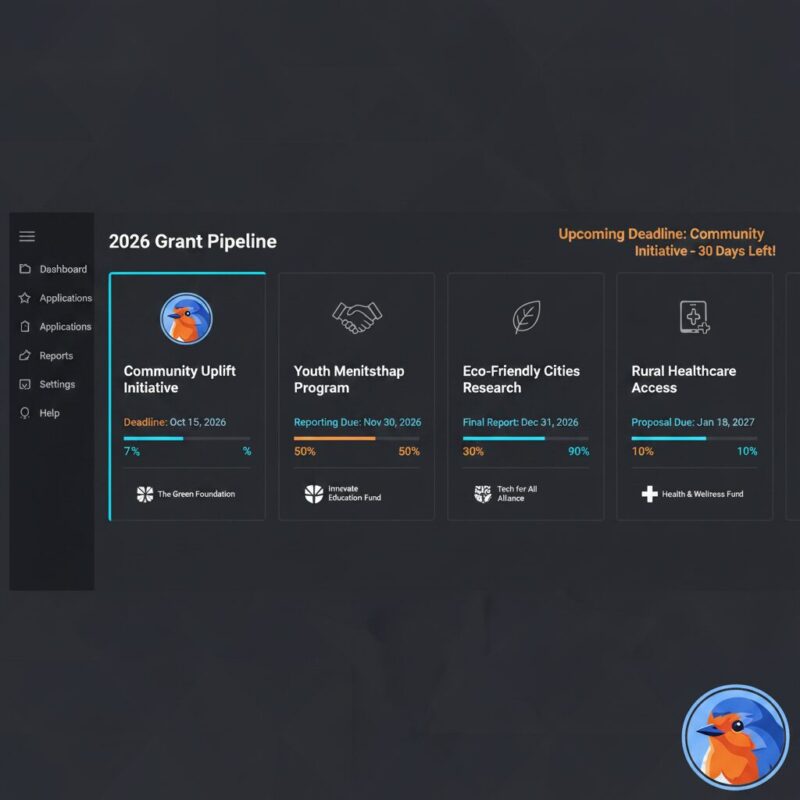
Approved organisations can evaluate this capability through a guided Showcase trial. By surfacing what is due next and what is blocked, technology turns a chaotic calendar into a manageable operational flow.
From ‘Grant Chasing’ to ‘Go/No-Go’: Implementing Automated Bid Management
Writing a grant proposal costs significant staff time. Implementing a formal Go/No-Go decision matrix filters out low-probability local council funding bids before you write a single word.
Assessing Eligibility and Institutional Capacity
FundRobin’s customer research suggests that one of the highest-value decisions in grant work happens before drafting: deciding whether a funding opportunity deserves scarce staff time at all.
Before applying for a local council contract, leadership must honestly assess institutional capacity.
| Assessment Area | Question to Answer |
|---|---|
| Financial Viability | Does the grant cover full cost recovery, or will it create a deficit? |
| Delivery Capacity | Do we have the staff and infrastructure to deliver the regional contract immediately? |
| Mission Drift | Are we contorting our core mission just to fit the funder’s criteria? |
If the answer to any of these creates extreme risk, the decision is “No-Go.”
Utilizing AI Match Scoring to Stop Wasting Resources
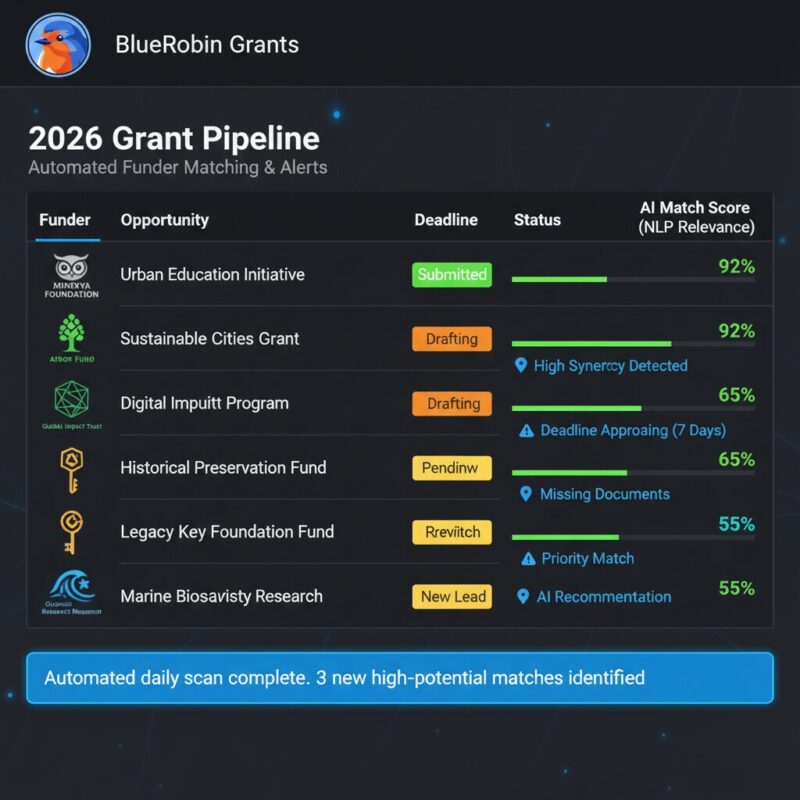
AI-driven match scoring replaces manual guesswork with data-backed probabilities. FundRobin’s AI uses natural language processing to understand context beyond basic keywords—recognizing the nuanced difference between “disadvantaged youth” and “at-risk teenagers.”
The platform generates a 0-100% accuracy score for every opportunity. Pursuing grants with match scores above 70% yields an 85% success rate, redirecting staff energy toward contracts they can actually win.
Collaborative Power: Forming Consortia for Large-Scale Regional Contracts
Devolution forces charities into collaborative models. As local councils bundle £50,000 community grants into £500,000 regional contracts, single small charities cannot meet the delivery scale required. A consortium—a formal partnership of multiple non-profits bidding together—is the most effective response.
Finding the Right Partners for Joint Proposals
Selecting the right partners determines the success of a joint proposal. Look for charities with complementary services and intersecting geographic overlaps rather than direct operational clones. According to Charity Commission guidance on collaborative working, early and transparent agreements are mandatory. Outline exactly how the funding split works, who acts as the lead accountable body, and how delivery responsibilities are measured before approaching the council. Overcoming the historic, zero-sum competitive mindset between local non-profits is essential for survival in 2026.
Streamlining Multi-Organization Proposals with Smart Tools
Merging distinct voices, budgets, and data sets from three different charities into one cohesive local council bid often results in a disjointed, unpersuasive document.
Collaborative workspaces with strict version control prevent these disasters. Smart tools allow the lead organization to pull data from partner repositories safely. Furthermore, AI writing assistants synthesize the combined inputs, ensuring the final joint proposal maintains a unified, professional tone while rigorously meeting the regional council’s compliance checklist.
Step-by-Step: Securing Local Council Funding in 2026
Securing funds in a devolved landscape requires a strict, chronological methodology. Follow this roadmap to move from discovery to award.
Step 1: Navigating GOV.UK and Local Council Portals
Start with the official Find a grant service – GOV.UK as your primary source of truth. However, recognize its limitations. Government portals suffer from fragmentation and lack strategic filtering. To ensure no localized funding slips through the cracks, cross-reference official government databases with AI discovery tools that scan regional procurement portals and specialized third-sector networks automatically.
Step 2: Drafting Compliance-First Proposals Using AI
Do not start with a blank page. Leverage AI platforms to analyze the complex local council guidelines, word limits, and mandatory sections.
FundRobin uses your centralized organizational profile to generate tailored, highly compliant first-draft proposals, including executive summaries and narrative responses. This process reduces proposal writing time from roughly 40 hours to 4 hours. The AI does not write the final version; it provides a comprehensive, structurally sound foundation grounded entirely in your own evidence, leaving clear gaps for human expertise and final polish.
Step 3: Post-Submission Reporting and Building Funder Trust
Winning the grant is only the beginning of the relationship. Regional councils demand rigorous, data-driven reporting to justify their commissioned contracts.
Use impact framework tools to track deliverables against your initial Theory of Change. Accurate, transparent reporting demonstrates institutional competence. Charities that prove they can manage regional funds reliably become preferred partners for future, larger-scale local council funding allocations.
Frequently Asked Questions
What is local council funding and how does it work for charities?
Local council funding is financial support distributed by regional UK authorities, which has now transitioned from small discretionary grants to large-scale commissioned contracts. Charities must now bid on these regional tenders by proving their capacity to deliver public services at scale, rather than applying for localized neighborhood projects.
How has UK local authority devolution affected charity grants?
Regional devolution consolidates smaller, fragmented local grants into larger regional funding contracts controlled by combined authorities. This structural shift requires charities to collaborate, form consortia, and adapt their bidding strategies to compete for massive funding pools instead of relying on historic relationships with individual district councils.
How can small non-profits compete for regional council contracts?
Small non-profits compete for regional council contracts by forming consortia to pool resources, geographic reach, and expertise. By partnering with organizations that offer complementary services, smaller charities can collectively prove they have the scale and operational capacity required to deliver on £500k+ regional tenders.
What is a go/no-go decision matrix in grant writing?
A go/no-go matrix is an internal checklist used to assess eligibility, institutional capacity, and financial return before writing a proposal. It prevents charities from wasting staff resources on low-probability bids by objectively evaluating if the organization can actually deliver the contract without risking mission drift or financial deficit.
How do I find local council grants effectively?
Move beyond manual daily searches on GOV.UK by building a proactive 18-24 month pipeline using AI discovery platforms. Tools like FundRobin continuously scan regional procurement portals, applying an organization’s specific profile to surface highly relevant grants and notify teams well before the deadlines approach.
Can AI write a local council grant proposal for my charity?
AI should never autonomously write and submit a final application, but platforms like FundRobin generate high-quality, compliant first drafts in minutes. By synthesizing the charity’s centralized evidence against the funder’s exact criteria, AI cuts the writing phase by 80%, allowing staff to focus on final strategic refinement.
Key Takeaways:
- Build strategic resilience by replacing reactive grant-chasing with data-backed, 18-24 month funding pipelines.
- Implement a strict ‘Go/No-Go’ decision matrix to filter out low-probability bids and protect staff from administrative burnout.
- Form consortia with complementary non-profits to remain competitive for large-scale, consolidated regional contracts.
- Centralize your organization’s data, impact metrics, and past bids to prevent “re-inventing the wheel” during complex regional applications.
- Utilize AI platforms like FundRobin to automate grant discovery and generate compliant first drafts, saving up to 200 hours monthly.
Devolution has fundamentally rewritten the rules of UK local government finance. Charities that cling to the old model of chasing fragmented, low-value micro-grants will exhaust their resources and staff. The organizations that thrive in 2026 will be those that embrace strategic resilience, leverage intelligent pipeline technology, and use the power of collaborative consortia to secure the large-scale local council funding required to drive true regional impact.
