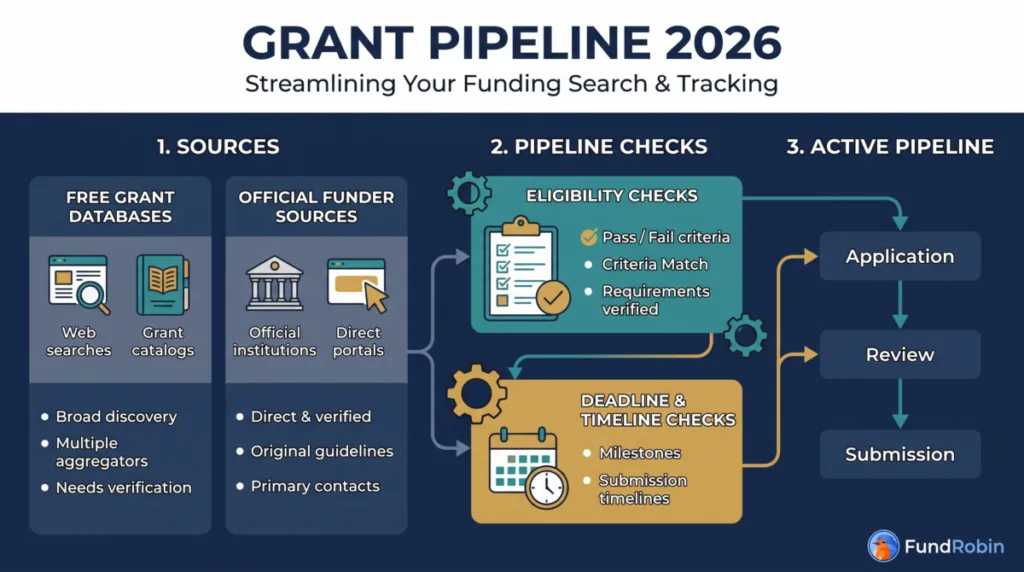
Eight years working across international development and emergency response taught me a hard truth about funding: the organisation with the largest database rarely wins the most grants. During my time coordinating health initiatives, I witnessed firsthand how small, resource-constrained charities burn out their staff by endlessly scrolling through free search portals without a strategic qualification process.
We operate in a challenging environment. According to October 2026 data from federal reporting portals, the compliance burden on grantees has increased, meaning small teams spend more time proving their eligibility and less time actually delivering services. The problem is no longer finding opportunities; the problem is separating the signal from the noise. Free discovery tools provide the raw data, but without a structured ecosystem to evaluate, track, and manage those relationships, that data becomes an administrative liability.
This guide breaks down the reality of building a sustainable funding pipeline today. It moves beyond the tired arguments about which free portal is best and provides a strategic playbook for resource-constrained leaders.
TL;DR: While free databases like Grants.gov and Candid offer essential public data, building a sustainable 2026 grant pipeline requires small nonprofits to integrate these fragmented tools into an ‘Organisation Brain’ that manages both public and private funding relationships without overwhelming small teams.
Table of Contents
- The 2026 Landscape: Free Grant Databases vs. Federal Portals
- Top Free Grant Databases and Search Tools for 2026
- Beyond Discovery: The AI Era of Grant Prospect Research
- Integrating Free Tools into a Sustainable Grant Management Workflow
- The Grant-Readiness Checklist: Solving for Sustainability & 2026 Challenges
- Frequently Asked Questions
The 2026 Landscape: Free Grant Databases vs. Federal Portals
The current funding ecosystem demands efficiency. Small charities face unprecedented research burnout because they rely on fragmented search portals that do not talk to each other. Building a grant-ready ecosystem requires understanding how these tools actually function.
Why the “Free vs. Paid” Database Debate is Flawed in 2026
The industry debate often pits free spreadsheets against expensive software subscriptions. This dichotomy is flawed. Free tools provide raw data; paid tools aggregate it. However, the true cost of free tools lies in the manual effort required to reconcile fragmented information across different tabs and browser windows.
Organisations must recognise that almost half of the dollars donated by individuals tend to come from less than 1% of a given organization’s donor base, according to Kindsight’s analysis. The situation is similar with grants. Finding that 1% requires a unified workflow, not just a bare list of names. A price tag does not dictate success; how your team manages the acquired data does.
Navigating Federal and State Portals
Government funding offers high-value opportunities but comes with severe administrative overhead. Setting up automated alerts on federal portals saves manual searching time, but evaluating the actual requirements takes hours. The difference between federal compliance requirements and foundation ease-of-entry is stark.
State-level portals often represent an untapped resource for smaller nonprofits. They generally feature lower competition and closer geographic alignment. Teams should map their local authority portals before attempting to tackle national federal funds with low probability yields.
Leveraging 990-Based Search Tools
Tax filings provide the unvarnished truth about a foundation’s giving history. Public-facing websites often market broad charitable goals, but Form 990s reveal what they actually fund. This data shows past grantees, average grant sizes, and whether they accept unsolicited applications.
To build a real prospect list, you must start by collecting publicly available data — IRS 990 forms through ProPublica, funder websites, annual reports, and past grantee lists, as noted by Grant Assistant. Open data democratises this information, though you must account for the lag time in 990 reporting—often up to two years behind current giving cycles.
Understanding the Limitations of Public Databases
Public data represents only the visible fraction of total philanthropic giving. Relying entirely on discovery tools leaves organisations blind to the hidden nature of private and invitation-only funding. Many grants are awarded based on existing relationships, trustee networks, and private conversations rather than open web searches.
FundRobin’s own research confirms this invisible pipeline. Seven case-study organisations managed invitation-only or privately shared opportunities alongside public funds, and all seven said a public database alone could not represent their pipeline (September 2026). If you build your pipeline solely on public discovery tools, you forfeit access to a substantial portion of available capital.
Top Free Grant Databases and Search Tools for 2026

A strategic toolkit curates specific free resources based on their best use case. Rather than bouncing between dozens of websites, concentrate on these four foundational pillars of grant discovery.
Candid (Foundation Directory) Free Tier: What You Actually Get
Candid remains the largest repository of foundation data in the US. Their free tier allows basic profile searches, giving you a top-level view of a funder’s existence and assets. According to Candid, maintaining your own free Gold Seal profile builds credibility with these foundations when you eventually apply.
The limitation is depth. The free tier restricts access to detailed giving histories and contact information. Small nonprofits use Candid’s free search to verify a foundation exists, then switch to open 990 tools to mine the actual financial history.
Grants.gov: The Definitive Source for US Federal Funding
For federal opportunities, Grants.gov is the mandatory starting point. It houses the sheer volume of federal data available across all government departments.
The platform has a steep learning curve. Success here requires mastering the workspace features for collaborative applications and understanding the rigid compliance filters. It is not a tool for casual browsing; it requires dedicated resource allocation to navigate the legal jargon.
Grantmakers.io: Mining 990 Tax Data for Funder Trends
When paid software is out of reach, Grantmakers.io (990 Search) serves as the premier low-tech, high-value alternative. It provides 100% free access to machine-readable 990 data.
You can run specific search queries to find exact funding alignment, checking which local charities a foundation previously supported. Cross-referencing this raw financial data with your internal pipeline helps eliminate foundations that claim to support your cause but actually direct all funds elsewhere.
GrantNav (360Giving): The Benchmark for UK Charity Open Data
For UK-based organisations, GrantNav (360Giving) transforms discovery through open data standards. It allows users to search awarded grants by local authority, specific cause, or funder name.
This platform shifts the focus from “who might fund us” to “who is actively funding work like ours in this exact postcode.” Linking this discovery to your overarching UK charity grant funding guide 2026 ensures your applications match regional funding strategies rather than generic national trends.
Beyond Discovery: The AI Era of Grant Prospect Research
The transition from manual database searching to AI-assisted workflows defines 2026 nonprofit operations. However, the sector suffers from immense hype regarding what artificial intelligence actually accomplishes in grant research.
Distinguishing Basic Search from Contextual AI Matching
Basic search relies on exact keyword matches. If you search “youth education,” you miss funders who use terms like “adolescent enrichment.” This limitation leads to frustrating, noisy results.
Smart Matching uses organisation and opportunity context to prioritise fit. FundRobin’s approach to Smart Discovery surfaces relevant opportunities for review by comparing your specific organisational profile against the funder’s criteria. The match rationale supports human judgement; it does not replace it.
Why AI Match Signals Are Not Success Probabilities
No tool can guarantee funding. A critical brand mandate for any responsible technology provider is clarity: match signals indicate alignment based on historical text, not future committee decisions.
AI evaluates whether your mission aligns with the funder’s stated goals. It cannot predict human variables, trustee preferences, or unannounced shifts in funding strategy. Human review remains completely necessary to validate AI-suggested prospects before investing writing time.
Moving from “Discovery” to “Prioritisation”
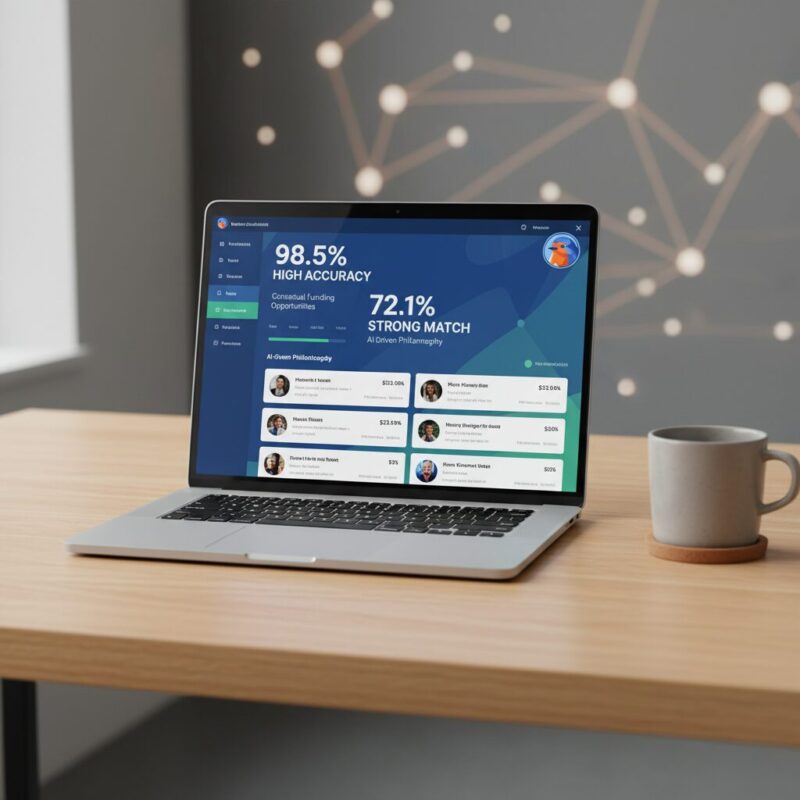
Finding a grant is easy; qualifying it is difficult. You must filter the massive noise of free databases down to a realistic, manageable pipeline.
The conversion reality is steep. Case-study organisations screened a median of roughly 310 funding opportunities per year, shortlisted around 28 and submitted 11 applications — about one submitted application for every 28 opportunities reviewed (24 organisations, September 2026). This data proves you must ruthlessly prioritise the top 10% of matches rather than applying blindly.
Overcoming “Research Burnout” with Grounded AI Workflows
Repetitive data entry destroys team capacity. Writing the same organisational background paragraph for fifty different portals leads directly to burnout.
Grounded AI solves this by working from relevant organisation knowledge, source evidence, and application context. Instead of relying on generic chat memory, a grounded workflow uses your existing, reviewed material to inform new research and drafts. It ensures outputs rely on source provenance rather than invented facts.
Integrating Free Tools into a Sustainable Grant Management Workflow
A spreadsheet full of links is not a management system. Taking raw data from free databases and turning it into a trackable pipeline requires intentional workflow design.
The Threat of Fragmented Data and Manual Reconciliation
Scattering data across Grants.gov, Candid, and local Excel sheets introduces severe operational risk. Lost deadlines occur frequently due to decentralized tracking.
The hidden labour cost of copy-pasting funder criteria from one platform to another is immense. When “free” tools drain your team’s capacity through manual reconciliation, they become the most expensive tools in your stack.
Building the “Organisation Brain”: Centralising Your Reusable Knowledge
To stop rewriting the same proposals, you must build a single source of truth. FundRobin defines the Organisation Library as a human workspace for reusable organisation knowledge and supporting material, including review and source context.
This evolves into the Organisation Brain, which turns reviewed organisation knowledge and relevant evidence into reusable factual context for Robin and proposal work. This governed approach retains source and provenance information, keeping current reviewed knowledge cleanly distinguished from historical or conflicting data.
Tracking Funder Relationships Beyond the Initial Submission
Moving from a transactional “apply and forget” mindset to sustainable relationship building requires ongoing engagement. Effective fundraising is built on funder relationships, which are created by engaging in meaningful conversations about the work your organization does, according to Candid’s senior development manager.
You must log funder feedback and rejection rationales for future improvement. Integrating the best free grant writing management tools for nonprofits 2026 allows you to maintain these relationships over multi-year cycles, using pipeline views to track application progress comprehensively.
Managing Deadlines and Private Opportunities Alongside Public Grants
Your workflow must accommodate the invisible pipeline alongside publicly discovered grants. This means setting up unified calendar features for time-sensitive work across both domains.
Creating custom entries for private, relationship-based funding ensures you maintain a holistic view of total projected revenue. Managing both streams in one place prevents accidental double-booking of restricted project costs.
The Grant-Readiness Checklist: Solving for Sustainability & 2026 Challenges
Searching for grants is pointless if the organisation is not ready to receive them. A good nonprofit fundraising strategy is essentially a blueprint: it defines who your organization is, who you are trying to reach, and how you can connect the two in a real way, notes Chrysalis Services. This checklist defines operational readiness.
Defining the “Rule of 3” for Nonprofit Capacity Planning
To survive high rejection rates, nonprofits use strict capacity mathematics. The Rule of 3 is a pipeline strategy requiring three active, qualified prospects for every one grant you need to win.
If you need to secure funding for a £50,000 project, you must have £150,000 worth of highly qualified grant requests in active development or submission. This rule dictates exactly how much time you must spend in free databases to fill the top of your funnel.
Implementing the “33% Rule” for Funding Diversification
Single-funder dependency creates an existential threat. The 33% Rule is a financial guideline stating no single funding source should exceed 33% of your total revenue.
If a major foundation alters its priorities or a federal grant is cut, an organisation violating this rule faces immediate crisis. Using diverse databases—mixing federal portals with private foundation searches—helps achieve this necessary revenue mix.
Verifying Eligibility and Sub-grantees Before Applying
Discovering a perfect grant means nothing if legal compliance is missing. Due diligence must happen before investing forty hours in writing.
Nine US case-study organisations used FundRobin’s free EIN lookup and 501(c)(3) checker to verify 41 partner, sub-grantee and fiscal-sponsor organisations in a single quarter, replacing manual searches across IRS and third-party sites. Of the 41 partner organisations verified, six required follow-up because public records showed a different legal name or an unconfirmed status; each was resolved by cross-checking the official IRS Tax Exempt Organization Search.
Applying these strict checks to complex applications, like navigating the William Grant Foundation charity funding guide, prevents immediate disqualification.
Navigating Post-Award Compliance and Long-Term Reporting

The grant lifecycle does not end when the cheque clears. Federal grants require rigid financial reporting, while private foundations expect narrative impact updates.
Maintaining the Organisation Brain allows you to rapidly draft accurate reports based on source provenance. It prepares the team for audit readiness without requiring heavy enterprise software, addressing the post-award burden that discovery-only platforms ignore.
Frequently Asked Questions
What is the 33% rule for nonprofits?
The 33% rule is a financial guideline stating that no single revenue source should make up more than 33% of a nonprofit’s total budget. This standard framework mitigates operational risk and prevents single-funder dependency. If an organisation relies on one government grant for 60% of its funding and that program is cut, the charity faces immediate collapse; diversifying across individual donors, varied grants, and earned income protects the mission.
What is the rule of 3 in nonprofit organizations?
The Rule of 3 in nonprofits refers to capacity planning: having at least three active, qualified grant prospects in the pipeline for every one grant you actually need to win. This accounts for typical industry rejection rates and the 1-in-3 win ratio assumption. It forces grant writers to build a robust prospect pipeline rather than relying on hope for a single submitted application.
What are the major challenges nonprofits will face in 2026?
The major challenges include research burnout, high manual effort in fragmented tool reconciliation, and the pressure of rising post-award compliance burdens. As funding becomes more competitive, teams waste countless hours copy-pasting data between disconnected free portals. Sustainable tech solutions that centralise knowledge and automate compliance tracking are necessary to prevent staff attrition.
Free vs paid grant databases comparison 2026
Free databases offer raw, public data like 990 tax forms and federal portals, while paid tools offer aggregated matching and workflow organisation. Free tools demand high manual labor to reconcile data, whereas paid platforms centralise the pipeline. The most sustainable approach for small teams combines free discovery tools with a low-cost internal pipeline system that retains organisational knowledge.
How to evaluate grant prospect research tools for sustainability?
Evaluate tools based on their ability to integrate into your workflow, centralise knowledge, and manage post-award tracking, rather than just their basic search features. Leaders must assess software based on their internal revenue stage and capacity. A tool fails if it identifies hundreds of grants but requires manual data entry to move them into a tracking pipeline.
What is the biggest challenge facing nonprofits today regarding grant discovery?
The biggest challenge is “research burnout” caused by sifting through massive pools of unqualified prospects and manually reconciling data across disconnected free tools. Case-study data reveals organisations must screen roughly 310 funding opportunities just to submit 11 applications. This terrible ratio drains team energy before the actual proposal writing even begins.
Key Takeaways:
- Free grant databases are vital discovery tools, but relying on public data alone misses private or invitation-only opportunities critical for a diversified 2026 pipeline.
- To survive 2026, nonprofits must move beyond basic ‘grant search’ and adopt an ‘Organisation Brain’—a centralized workspace combining free tool data with reviewed, reusable organisational knowledge.
- The grant conversion reality is steep: case-study organisations screen roughly 310 opportunities to shortlist 28 and submit 11, underscoring the critical need for strict ‘Rule of 3’ pipeline planning.
- Verification matters before application. Simple, free tools like EIN lookups save hours of wasted application time by catching legal or status discrepancies early.
- Adopt Grounded AI cautiously: Use AI to draft and contextualise, but rely on source provenance and human review. Never trust an AI ‘match signal’ as a guaranteed probability of winning.
Building a reliable funding pipeline in 2026 requires discipline, not just an internet connection. Prospect researchers use resources such as historical donor data, wealth screening tools, and public records to evaluate prospects’ real estate and stock ownership, philanthropic interest, giving affinities, and more, confirms DonorSearch. Yet, for small charities focused on grants, the real test is turning that data into action. If you hit a wall with national databases, remember that one other way to locate prospective funders is to check the member list of your regional association of grantmakers, as advised by the National Council of Nonprofits.
Ultimately, a database provides raw ingredients; your workflow bakes the cake. By applying the Rule of 3, leveraging open 990 data, and centralising your narrative within an Organisation Brain, your team can escape the cycle of research burnout. FundRobin is the only platform that grounds your grant pipeline strictly in reviewed organisational truth, ensuring your 2026 funding strategy is sustainable, trackable, and built for long-term impact.