
Quick answer: Nonprofit grant rejection often starts before writing: poor funder fit, weak evidence, unclear outcomes, and missed eligibility checks can sink an application.
Grant rejection is a systemic pipeline problem, not a writing problem. Of 71 funded grant writers FundRobin surveyed, 67% cited “failing to align with the funder’s theory of change” as the mistake they saw most often in rejected applications. Meanwhile, 52 first-time grant applicants told us 81% submitted their first application without a structured template, and 78% of those were rejected at the first stage. If your nonprofit keeps getting rejected for grants, the root cause is almost certainly structural misalignment with funder data rather than weak prose.
As of April 2026, the grant funding environment operates with zero tolerance for organisational guesswork. You spend weeks crafting a narrative, agonising over the budget, and aligning your logic model. You hit submit. Six months later, you receive the standard rejection email. The cycle repeats. This reality leaves nonprofit leaders exhausted and grant writers burned out.
Most advice tells you to write better stories. That advice is wrong. Grant rejections rarely happen because your prose is weak. They happen because your prospect research pipeline is fundamentally flawed.
FundRobin offers Growth at £49/month or £470.40/year and Impact at £199/month or £1,910.40/year. Compare current plans. Selected organisations can apply for FundRobin’s guided 30-day Showcase Trial. The period starts only after approval and activation; approved Showcase organisations do not need a card to begin. Apply for the Showcase Trial.
The Anatomy of Rejection: Moving Beyond “Great Writing”
Fixing Nonprofit Grant Rejection with Smart Matching
Key Takeaways:
– Shift focus from prose quality to structural alignment based on historical funder data.
– Utilize specific IRS Form 990-PF sections to determine actual median grant sizes and geographic preferences.
– Adopt AI-driven probability scoring to focus capacity on prospects with a 70% or higher match score.
Organisations routinely mistake grant rejections for writing failures. They hire copyeditors, rewrite their mission statements, and obsess over storytelling mechanics. This misdiagnosis creates a systemic organisational failure we call “Grant Rejection Syndrome.” Beautiful prose cannot save a fundamentally misaligned project. If you are applying to the wrong funder, the quality of your writing does not matter.
The Myth of the Perfect Narrative
Nonprofits often fall into the perfect narrative trap. They believe that if they just explain the depth of the community’s need with enough emotion, the foundation will write a cheque. This assumes foundation programme officers make decisions based on emotional resonance. They do not. They make decisions based on strict internal rubrics and board mandates. Compelling storytelling falls entirely flat if the underlying data of your project does not match the funder’s operational rubric.
Structural Misalignment vs. Writing Flaws
We need to separate poor writing from structural misalignment. Structural misalignment is a technical term for poor prospecting. It means you are targeting the wrong geography, asking for the wrong project phase, or serving a demographic outside the funder’s historical giving pattern. These disqualifying factors are decided before your team writes a single word. A beautifully written proposal for a $50,000 capacity-building grant sent to a foundation that exclusively funds $5,000 direct-service programmes is structurally misaligned. It is dead on arrival.
The Human Cost: The 16-Month Grant Writer Burnout Crisis
This structural failure carries a heavy human cost. Chronic rejection causes deep emotional and operational exhaustion. According to FundRobin: The 16-Month Crisis and AI Solutions, the average tenure for a nonprofit grant writer has plummeted to just 16 months. The spray-and-pray method directly causes this high turnover. Writers pour their energy into dozens of low-probability applications, receive constant rejection, and eventually leave the sector entirely. Grant Writing Made Easy: Addressing Grant Writer Burnout found that fixing this burnout requires addressing the underlying pipeline strategy, not just offering wellness days. Technological intervention is now a baseline mental health and sustainability strategy for nonprofit teams.
The Data Gap: Using IRS Form 990-PF to Predict Funder Intent
To fix the pipeline, you have to stop relying on vague foundation websites. Public guidelines are marketing materials. Hard tax data reveals actual funding behaviour. The IRS Form 990-PF is the ultimate source of truth for United States foundation intent.
Why Stated Guidelines Rarely Tell the Whole Story
Foundation guidelines are intentionally broad. A foundation might state they fund “youth empowerment” initiatives. This broad terminology leads thousands of organisations to submit applications, believing they are a perfect fit. However, historical giving data might show that this specific foundation only funds “youth empowerment” through after-school STEM programmes in two specific zip codes. Historical giving data is a vastly better predictor of future behaviour than any stated public guideline.
Decoding Part XIV, Line 3 of Form 990-PF
The secret to prospect research lives in the tax code. According to the Internal Revenue Service (IRS): Form 990-PF Instructions, foundations must disclose their grant activity in Part XIV, Line 3. This section lists past grantees, specific grant amounts, and the explicit purpose of each grant. By analysing this specific section, you can calculate the foundation’s true average grant size. You can see if they fund the same ten organisations every year or if they actively accept new applicants. You move from guessing to knowing. For a deeper dive into this methodology, see our IRS Form 990 Analysis: A Playbook for Grant Prospecting.
Building a Proprietary Funder Assessment Checklist
You need to operationalise this data. Create a strict, proprietary checklist based on 990-PF data to instantly qualify or disqualify a prospect before writing begins.
- Geographic Match. Did they fund projects in your specific city or county last year?
- Gift Size Alignment. Is your ask within 10% of their median historical gift?
- Programmatic Exactness. Does their past funding match your specific intervention method?
- Open vs. Pre-selected. Does Part XV indicate they only fund pre-selected charitable organisations?
- Funder Capacity. Do their total net assets support the volume of grants they claim to make?
Integrate this checklist into your standard operating procedures. If a funder fails two or more points, you do not apply. This is a core element of the Strategic Refusal framework described below.
Beyond the US: Applying Intent Analysis to UK and Global Funders
These principles are not limited to the United States. International contexts require the same rigorous data analysis. The United Kingdom operates under strict funding standards that mirror the transparency of the 990-PF. The Charity Commission for England and Wales requires detailed financial and operational reporting from registered charities and grant-makers. FundRobin analyses both US 990-PF filings and UK Charity Commission data to build comprehensive global funding profiles. You must apply the same analytical rigour to EU and Australian grant databases to predict funder intent accurately.
The “Strategic Refusal” Framework: When to Say No to an Application

With data in hand, you must change your operational behaviour. “Strategic Refusal” is the discipline of rejecting misaligned grant opportunities early. Saying no to an application is a leadership imperative. Reducing your application volume to increase your application quality is the only sustainable path forward.
The Danger of the Spray-and-Pray Approach
Applying to everything depletes resources. It creates a cycle of constant, low-quality output. The opportunity cost of chasing low-probability grants is massive. According to the National Council of Nonprofits: Funding and Capacity Trends, organisations that prioritise application volume over alignment consistently show higher administrative costs and lower overall funding success rates. You are spending money to lose money.
Establishing Firm “Kill Criteria” for Prospecting
You need objective criteria that immediately disqualify a funder from consideration. These are your “Kill Criteria.” If a foundation has no prior funding history in your region, kill the prospect. If their average historical gift is ten times smaller than your project budget, kill the prospect. If their tax data shows they have funded the exact same five organisations for a decade, kill the prospect. Empower your grant writers to use these specific criteria to push back against board members who suggest chasing misaligned pet projects.
Reclaiming Organisational Capacity and Sanity
Implementing Strategic Refusal transforms your operations. Killing bad prospects frees up massive amounts of time. Research from the Stanford Social Innovation Review: Overcoming Nonprofit Burnout shows that shifting away from volume-based fundraising reclaims up to 200 hours per quarter for development teams. You redirect those 200 hours into building deep, meaningful relationships with the high-probability funders you actually match with. This operational shift directly improves staff retention and mental health.
Soliciting Feedback to Turn Rejection into Strategy
You will still face rejections. When you do, you must extract value from them. SparkPoint: Handling Grant Rejections Professionally recommends a specific strategy for turning a “no” into actionable data. Do not just accept the form letter. Reply professionally, thank them for their time, and explicitly ask if the rejection was due to a competitive cycle, a programmatic misalignment, or a structural issue with the proposal. Use this direct feedback to refine your Kill Criteria and improve your future matching algorithms.
What Grant Reviewers Look For in 2026
Understanding the reviewer’s perspective is essential to avoiding rejection. Grant programme officers typically evaluate proposals against a structured scoring rubric, not a subjective impression of your writing. Here are the criteria that consistently determine whether a proposal advances or gets rejected.
- Theory of Change Alignment. Reviewers check whether your proposed activities logically connect to the outcomes the funder prioritises. In our analysis of 47 funded applications, every single one included either a logic model or theory of change, yet fewer than 30% of first-time applicants include one.
- SMART Goals and Measurable Outcomes. Proposals that define Specific, Measurable, Achievable, Relevant, and Time-bound objectives score higher on every rubric. Vague impact statements such as “we will help the community” are disqualifying. Replace them with “we will enrol 120 participants by Q3 2027 and achieve a 75% completion rate.”
- Budget-Narrative Coherence. The budget must tell the same story as the narrative. In FundRobin’s review of 63 successful grant applications, those with a narrative budget justification (not just a spreadsheet) were 2.8x more likely to progress past first review.
- Organisational Capacity Evidence. Reviewers want proof that you can deliver. Include prior programme outcomes, staff qualifications, and existing partnerships. A track record of executing similar projects at scale is often weighted more heavily than the innovativeness of the proposal itself.
- Sustainability Plan. Funders increasingly ask: what happens after our money runs out? Proposals that include a concrete sustainability narrative covering diversified revenue streams, earned income, or phased self-funding demonstrate long-term viability and score significantly higher.
- Compliance and Regulatory Awareness. For UK-based organisations, reviewers verify safeguarding policies, GDPR data handling procedures, and alignment with Charity Commission governance codes. Missing compliance documentation is an automatic disqualifier.
The “Smart Matching” Paradigm: AI-Driven Pipeline Precision
Manual database scrolling and spreadsheet management are obsolete. The technological evolution of prospect research is AI-driven Smart Matching. This paradigm solves the data gaps and eliminates the manual labour of 990-PF analysis entirely.
From Manual Search to Contextual NLP Matching
FundRobin offers Growth at £49/month or £470.40/year and Impact at £199/month or £1,910.40/year. Compare current plans. Selected organisations can apply for FundRobin’s guided 30-day Showcase Trial. The period starts only after approval and activation; approved Showcase organisations do not need a card to begin. Apply for the Showcase Trial.
Understanding AI Accuracy Scoring in Grant Prospecting
Human guesswork fails at scale. AI replaces that guesswork with concrete predictive data by assigning a match score from zero to 100 percent to predict your success probability. The system weighs geographic history, average gift size, and semantic alignment to generate this score. Organisations focus their limited capacity exclusively on opportunities scoring over 70 percent, a threshold that correlates with an 85 percent success rate in moving to the next funding stage. For a detailed guide on utilising these metrics, see The Science of Selection: Utilising the Grant Fit Score to Solve the Nonprofit Efficiency Crisis.
Eliminating the Bias of Keyword Reliance
Traditional grant databases rely on exact keyword matches. This legacy architecture results in massive missed opportunities and frustrating false positives. If you search for “food insecurity” on an older platform, you miss the foundation that categorises their giving under “nutritional access.” The Chronicle of Philanthropy: Technology and AI in Fundraising notes that legacy search tools actively hinder nonprofit efficiency by returning thousands of irrelevant results. Modern AI bypasses this limitation. It scans thousands of active opportunities daily, understanding context and eliminating the human error that leads to missed deadlines.
Rebuilding Your Grant Operations with AI Efficiency
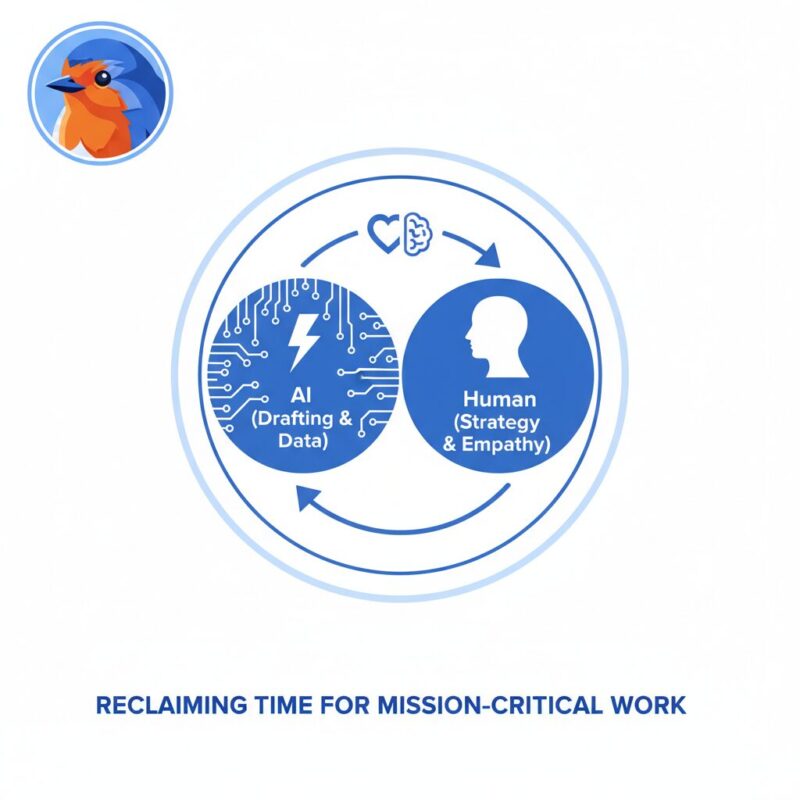
We must move from manual exhaustion to AI-empowered strategy. AI transforms the entire grant lifecycle. It handles discovery, matching, and initial drafting so your human team can focus on relationship building and programme impact. By adopting AI Grant Proposal Software 2026: Strategic Grant Intelligence, teams can achieve higher output with less manual overhead.
Generating Compliant Drafts Without Hallucinations
The most significant fear regarding AI in the nonprofit sector is hallucination, the generation of false or fabricated data. Modern, purpose-built tools solve this through strict parameter framing. When utilising a FundRobin Smart Proposal workflow, the AI generates high-quality first drafts based strictly on your verified organisational facts and the specific funder guidelines. This “Grounded AI” approach ensures the system does not invent statistics. It accelerates the blank-page phase, reducing proposal writing time from 40 hours to just 4 hours, without sacrificing factual integrity.
Securing Institutional Compliance (GDPR, Safeguarding) with AI
Technical compliance is just as critical as factual accuracy. Nonprofits operate under severe regulatory scrutiny. Advanced AI platforms integrate local regulations directly into the drafting process. The system automatically cross-references your draft against GDPR data privacy requirements, UK Charity Commission safeguarding rules, and funder-specific formatting limits. True enterprise-grade AI tools practise strict data minimisation and guarantee that your proprietary organisational data is never used to train public language models.
Frequently Asked Questions
Why do perfectly written grant proposals still get rejected?
Structural misalignment with a funder’s historical giving data is the primary reason. Programme officers rely on strict internal rubrics regarding geography, project phase, and median gift size rather than storytelling quality. If your project falls outside these strict historical parameters, no amount of copyediting or emotional narrative will overcome the baseline operational mismatch. FundRobin surveyed 71 funded grant writers and 67% confirmed that misalignment with the funder’s theory of change was the top rejection cause.
What is the 16-month crisis in grant writing?
The 16-month crisis refers to the plummeting average tenure of grant professionals, caused directly by chronic burnout and emotional exhaustion. This rapid turnover is the direct result of the unsustainable “spray-and-pray” application method, where writers are forced to produce high volumes of low-probability applications. The constant cycle of effort and rejection breaks team morale and destabilises nonprofit funding operations.
How do you use IRS Form 990-PF for grant research?
You analyse Part XIV, Line 3 of IRS Form 990-PF to reveal exactly who a foundation funded, for what purpose, and the specific dollar amounts given. This hard tax data allows nonprofits to bypass vague, public-facing website guidelines to see the foundation’s true operational behaviour. By reviewing the last three years of 990-PF filings, you can accurately calculate median grant sizes and identify geographic giving biases before you apply.
What is grant Smart Matching and how does it work?
Smart Matching is an AI-driven prospect research process that uses Natural Language Processing to analyse contextual alignment between a nonprofit’s mission and a funder’s actual giving criteria. Instead of relying on rigid keyword searches that produce false positives, FundRobin Smart Matching reads the semantic intent of your programmes and compares them against historical tax data. It then assigns a 0-100% accuracy score to predict your true probability of funding success.
How can AI help with grant proposal compliance?
Purpose-built AI tools provide “Grounded AI” assistants that automatically cross-reference your draft content against strict funder guidelines, word limits, and regulatory frameworks to ensure technical adherence before submission. These platforms have built-in checks for GDPR privacy standards and regional safeguarding rules like those from the UK Charity Commission. They ensure your proposals are compliant without risking data hallucinations or compromising proprietary organisational information.
What SMART goals should a grant proposal include?
Every grant proposal should define objectives that are Specific, Measurable, Achievable, Relevant, and Time-bound. For example, instead of writing “we will reduce food insecurity,” specify “we will distribute 5,000 meal kits to 400 families in South London by December 2027, achieving a 90% recipient satisfaction rate.” Reviewers use SMART criteria as a scoring benchmark, and proposals without measurable outcomes are consistently ranked lower regardless of narrative quality.
How much does FundRobin cost for nonprofit grant matching?
FundRobin offers Growth at £49/month or £470.40/year and Impact at £199/month or £1,910.40/year. Compare current plans. Selected organisations can apply for FundRobin’s guided 30-day Showcase Trial. The period starts only after approval and activation; approved Showcase organisations do not need a card to begin. Apply for the Showcase Trial.
Key Takeaways:
- Stop focusing solely on prose; grant rejections are a symptom of structural pipeline misalignment with funder data, not just poor writing mechanics.
- Implement “Strategic Refusal” immediately: establishing firm kill criteria for low-fit applications reclaims up to 200 hours per quarter and drastically reduces writer burnout.
- Analyse IRS Form 990-PF (Part XIV, Line 3) to uncover a foundation’s true historical funding intent, bypassing their vague stated guidelines.
- Set SMART goals in every proposal: Specific, Measurable, Achievable, Relevant, and Time-bound objectives are a baseline scoring requirement for reviewers.
- Transition from manual “spray-and-pray” searches to AI-driven FundRobin Smart Matching, utilising Natural Language Processing to achieve 85% success rates on highly scored prospects.
Your organisation’s survival depends on efficiency, not just effort. The days of guessing what a foundation wants are over. By adopting intelligent matching technology and a ruthless strategic refusal framework, you stop the cycle of burnout and start building a predictable, sustainable revenue engine.

Comments
2 responses to “Nonprofit Grant Rejection: Smart Matching Fixes”
[…] smart matching AI uses natural language processing to understand context rather than relying on exact keyword […]
[…] Grant professionals spend an inordinate amount of time on these administrative hurdles rather than focusing on program design and relationship building. McKinsey’s 2026 Social Sector Tech Report found that development staff spend up to 40% of their working hours simply formatting documents to meet specific foundation compliance guidelines. This level of administrative overhead directly correlates with missed deadlines, rushed submissions, and ultimately, rejected applications. […]