Having navigated funding environments across the nonprofit sector, I have seen firsthand that securing capital for a new building is a completely different discipline than funding a community program. A compelling narrative might win you operational support, but funders backing physical infrastructure demand uncompromising proof of execution. As of October 18, 2026, the landscape for US construction and facility grants requires a profound shift from storytelling to architectural and financial compliance.
Nonprofit leaders often approach capital campaigns with immense passion, only to find their proposals rejected because they lack a permit-ready blueprint or segregated accounting structures. To win these transformational awards, organizations must treat the process not as a simple application, but as an architectural roadmap to audit-proof stewardship.
TL;DR: Secure and manage physical facilities grants for 501(c)(3) nonprofits by proving site control early, segregating restricted capital funds from operating budgets using class tracking, and maintaining permit-ready architectural blueprints. Implement a centralized Organisation Library to track complex compliance benchmarks and multi-year federal reporting requirements.
Defining Grant Readiness: Pre-Qualification and Organizational Stewardship
How to Secure Audit-Proof Capital Grants for Nonprofits
The foundation of capital grant seeking rests entirely on rigorous pre-qualification. While programmatic grants evaluate your methodology and community reach, physical building grants evaluate your site control, financial leverage, and structural feasibility.
The Complexities of Proving ‘Site Control’
Grantmakers will rarely finance construction on a property you might lose next year. To protect their investment from becoming stranded, foundations require non-negotiable proof of site control before they review your architectural plans. This means possessing a clear deed, a finalized purchase agreement, or a long-term, unencumbered lease (often 50 to 99 years).
Nonprofits must secure these legal documents before writing the first sentence of a grant proposal. Without site control, even the most visionary community center remains an unfundable hypothetical.
Navigating the ‘Matching Fund’ Hurdle
Facilities grants frequently act as “last-in” money, designed to close a funding gap rather than initiate a project from zero. Consequently, most capital grants require documented matching funds. The National Fund For Sacred Places stipulates that all grants require a 1:1 cash match.
To clear this hurdle, organizations should secure board commitments, early major donor pledges, or municipal backing. Document these pledges formally, as grant pre-qualification demands written proof of your matched funding capacity.
Smart Discovery: Prioritising the Right US Facility Grants
The second challenge lies in finding the exact infrastructure funds that match your specific building geography and project type.

Filtering specific capital improvement grants from the noise of programmatic funding requires precision. FundRobin customer research repeatedly shows that organizations struggle to find and safely reuse the right material for these specific applications. By using Smart Discovery, teams can search and filter funding opportunities relevant to their profile, cross-referencing their organizational parameters with facility-specific grants.
Among the four case-study organizations running multi-region programs, recording delivery geography and beneficiary location separately roughly halved the number of ineligible applications started over two quarters, from six to two per organization on average (FundRobin case-study programme, September 2026). This geographic targeting is essential when navigating resources like the Regional Grant Funding Guide 2026.
The Paper Trail: Essential Documents for Permit-Ready Construction Applications
Funders do not finance ideas; they finance permit-ready blueprints. Transitioning into the documentation phase requires organizations to assemble a heavy, standardized paper trail proving the project is shovel-ready.
As noted by the Gates Family Foundation, the Guide is a comprehensive resource designed to support nonprofits at every stage of facility expansion.
The Capital Grant Readiness Audit Checklist
A standardized document checklist remains your best defense against compliance errors.
Before submitting a capital proposal, conduct a self-audit to ensure you have:
- Architectural Schematics: 100% completed construction documents.
- Environmental Impact Reports: Completed reviews verifying site safety.
- Verified Contractor Bids: Formal estimates, not back-of-the-napkin guesses.
- Governance Approvals: Signed board resolutions authorizing the capital project.
Navigating ADA, HVAC, and Specialized Infrastructure Funding
Beyond general construction, specialized facility grants target specific compliance upgrades. Funding streams exist exclusively for ADA accessibility retrofitting, energy-efficient HVAC modernizations, or green infrastructure.
Unlocking these specialized funds requires technical assessments, such as formal energy audits or structural engineering reviews. Carving out these specialized infrastructure needs can open additional funding channels to supplement your master building project.
Centralising Evidence in an Organisation Library
Managing this massive paper trail manually often leads to lost site documents and rewritten institutional knowledge. Nonprofits need a centralized knowledge base to make complex applications accurate and scalable.
An Organisation Library serves as the human workspace for reusable organization knowledge. Using FundRobin, the Organisation Brain turns reviewed organization knowledge and relevant evidence into reusable factual context for Robin and proposal work, retaining source, currentness, and provenance information. This ensures your grant team consistently pulls the most recent, approved architectural and legal data.
Mastering Fund Accounting and Restricted Capital Management
Winning a capital grant shifts your responsibility from securing funds to managing intense financial risk. Operational execution depends entirely on strict fund accounting.
Segregating Restricted Capital vs. Operating Budgets
The fundamental rule of non-profit capital accounting is absolute segregation. Restricted construction dollars must remain entirely separate from daily operational funds. If capital money is used—even temporarily—to cover a payroll shortfall, the organization risks severe audit penalties and immediate fund clawbacks.
As CharityTracker points out, commingling is one of the fastest ways to trigger an audit flag.
Actionable Configurations for QuickBooks Class Tracking
To build an audit-proof ledger, leverage your accounting software’s categorization features. Bay Business Group advises that creating a class or sub-customer for each grant allows you to easily track all revenue and expenses specifically related to that grant, ensuring you can generate accurate reports quickly.
In systems like QuickBooks, configure the capital grant as a specific “Project” or “Class.” Tag every single expense, contractor invoice, and permit fee associated with the physical facility strictly to that class. Attach digital receipts directly to the ledger entries to ensure immediate verification during an audit.
Integrating Financial Data with Your Grant Workflow
Financial ledgers must map perfectly to the narrative reports submitted to grantmakers.
When these systems talk to each other, milestone reporting transforms from a panic-inducing scramble into a predictable routine.
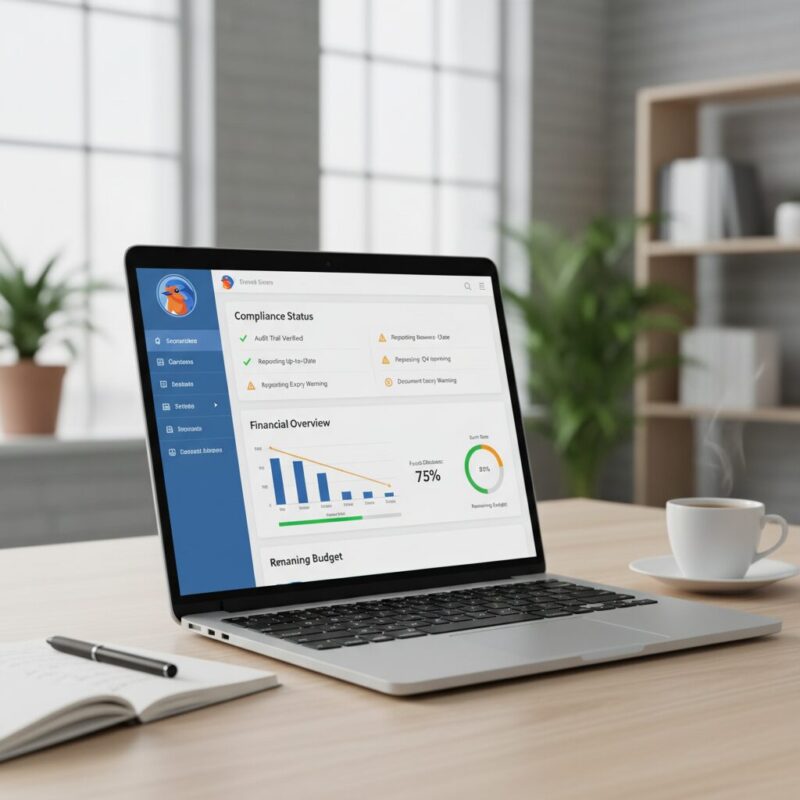
Modern teams use workflow views to keep application progress and financial tracking in one workspace. For organizations modernizing their infrastructure, adopting strategies from the Nonprofit Grant Funding Playbook AI helps streamline this administrative load.
Proactive Compliance: Lifecycle Management from Award to Facility Completion
Compliance begins the moment the award letter is signed. Physical infrastructure projects are multi-year commitments carrying rigorous, often punitive reporting requirements.
Demystifying Federal Compliance (SAM.gov & eCFR Standards)
Federal facility grants introduce heavy regulatory standards compared to simple programmatic funding. Organizations must maintain active SAM.gov registration and an updated Unique Entity ID (UEI).
Furthermore, strict public facility compliance dictates how federal property interests are managed. For federal compliance, an application for a grant under this subpart must be submitted directly to the Secretary at such time and in such form and manner as the Secretary may prescribe. Navigating these extensive rules is essential for teams pursuing major government backing, a topic explored deeply in our US Federal Grants 2026 playbook.
Long-term Facility Maintenance and Post-Award Stipulations
Grant compliance does not end at the ribbon-cutting ceremony. Many funders place liens or stipulations on the facility, dictating its usage for 10 to 20 years post-construction.
Nonprofits must submit long-term reports proving the facility actively serves the funded programmatic purpose. For state-level programs, DASNY notes that prequalification in SFS is a New York State requirement prior to application to VNCP and other State Grant and Contracting opportunities. You must also establish operational reserves to fund the ongoing maintenance of the expanded footprint.
Frequently Asked Questions
What are the eligibility requirements for nonprofit capital grants?
Nonprofits must prove explicit “site control” (through a deed or long-term lease), demonstrate matched funding capacity, and possess permit-ready architectural plans before applying. Without these three pillars, funders will immediately disqualify the application as structurally unfeasible.
How do I manage restricted funds for capital projects?
Use “class tracking” in accounting software like QuickBooks to physically separate restricted capital funds from your general operating budget. This strict ledger segregation prevents accidental commingling of funds, ensuring you pass high-stakes financial audits.
What documents are needed for a construction grant application?
A complete application requires 100% finished architectural blueprints, environmental impact assessments, legal proof of site control, signed board resolutions, and a highly detailed, segregated capital budget. Compiling these in a centralized library prevents submission errors.
How do I track grant compliance effectively?
Establish a centralized pipeline workflow to track strict milestones like contractor bidding, construction phases, and post-award reporting. Using a dedicated grant management workspace ensures critical, time-sensitive benchmarks remain visible across your entire finance and development team.
How to find capital improvement grants for 501(c)(3)s?
Use Smart Discovery tools to search and filter funding opportunities based on your organization’s specific profile. Filtering out generic programmatic grants allows your team to find highly precise capital fits based on geographic delivery and beneficiary location.
Key Takeaways:
- Secure ‘site control’ and architectural blueprints before pursuing large-scale physical facilities grants to meet stringent pre-qualification standards.
- Use ‘class tracking’ in accounting software (e.g., QuickBooks) to segregate restricted capital funds from operating budgets, ensuring you pass high-stakes financial audits.
- Implement a centralised ‘Organisation Library’ to store reusable, reviewed documentation like deeds, board resolutions, and site plans for swift grant generation.
- Treat physical facilities grants as a multi-year lifecycle requiring proactive compliance tracking for state and federal regulations (like SAM.gov and eCFR Part 124).
Building a new facility requires an organization to operate at the peak of its administrative and financial capabilities. By establishing an audit-proof foundation—from initial site control to meticulous restricted fund accounting—your nonprofit transforms a daunting compliance burden into a powerful asset. Prepare your evidence, secure your ledgers, and build the infrastructure your mission deserves.