
In September 2026, finding grants for nonprofits in the USA demands more than just a passing familiarity with Grants.gov. Nonprofit development directors face an unforgiving environment marked by shrinking attention spans, complex reporting requirements, and an administrative burden that crushes institutional momentum. According to the Georgia Center for Nonprofits (GCN) Policy Updates, new federal regulations have escalated compliance risks, leaving many organizations exposed. The traditional approach to securing federal funding—reactive chasing, manual keyword searches, and isolated spreadsheets—is broken. Modernizing this infrastructure requires a strategic shift toward audit-ready systems and grounded AI integration.
TL;DR: US development directors can overcome the 16-month burnout crisis and navigate 2026 SAM.gov regulations by shifting from reactive grant chasing to an audit-ready, AI-augmented infrastructure. Semantic search and compliance-first AI handle complex federal requirements automatically, recovering valuable administrative hours monthly while mitigating legal risks.
Table of Contents
- The State of US Federal Grants in 2026: Navigating the Regulatory Tightrope
- Moving from “Grant Chasing” to an Audit-Ready Infrastructure
- The AI-Augmented Development Office: Efficiency Meets Compliance
- A Phased Implementation Plan for AI in Federal Grant Research
- Filtering Federal Opportunities Through a Mission-First Lens
- Designing Your 2026 Federal Grant Playbook with FundRobin
US Federal Grants 2026: The Audit-Ready Playbook
The State of US Federal Grants in 2026: Navigating the Regulatory Tightrope
The landscape of federal funding has shifted dramatically. Development offices operate under immense pressure, caught between the demand for increased revenue and the weight of administrative compliance.
Overcoming the “16-Month Crisis” and Grant Writer Burnout
The nonprofit sector suffers from a systemic retention problem. Development directors and grant writers frequently burn out and exit their roles within 16 months. When a director leaves, they take the relationship context, the pipeline knowledge, and the institutional memory with them. The new hire spends their first 90 days merely reconstructing the pipeline from scattered emails and neglected shared drives. As detailed in research on Breaking the Grant Writer Burnout Cycle with AI, this constant churn costs organizations hundreds of thousands of dollars in lost momentum and missed opportunities. Burnout is not a personal failure; it is the predictable outcome of forcing highly strategic professionals to perform low-level data entry.
2026 SAM.gov Certification Requirements and Funding Volatility
The regulatory environment has tightened. According to the Georgia Center for Nonprofits (GCN) Policy Updates, 2026 brings specific compliance hurdles, particularly regarding SAM.gov entity validation and proactive IRS status monitoring. Vague certification rules create legal anxiety for boards and executive teams. A single administrative oversight during the SAM.gov renewal process can freeze federal drawdowns, stalling critical community programs. Organizations can no longer afford to treat compliance as an afterthought submitted at the deadline.
Why the Grants.gov Search Experience Needs a Semantic Overhaul
For decades, finding federal grants for nonprofits in the USA meant battling the Grants.gov search bar. Legacy portals rely on exact keyword matches. If a federal agency titles an initiative “Juvenile Delinquency Prevention” and a grant writer searches for “At-Risk Youth Sports,” the opportunity remains hidden. This fundamental flaw in legacy search databases forces professionals to spend hours testing keyword permutations. A semantic overhaul replaces this guesswork with contextual matching—understanding the meaning behind the organization’s mission and pairing it with the intent of the federal funding vehicle.
The Cost of Fragmented Data Across Nonprofit Teams
Grant management cannot exist in a vacuum. Yet, in many organizations, program delivery teams, finance departments, and development offices use entirely different tools. 67 nonprofit development directors told us managing grant deadlines across multiple funders was their single biggest administrative pain point. The resulting data fragmentation means program, finance, and development teams operate in silos, inevitably leading to missed deadlines and non-compliant submissions.

As noted in insights on US Market Capabilities, centralizing this data is the first step toward organizational health.
Moving from “Grant Chasing” to an Audit-Ready Infrastructure
Organizations must transition from reactively applying to whatever funds appear available, to proactively building a compliant, structured, and strategic grant lifecycle system.
What Defines a Proactive, Audit-Ready Grant Lifecycle?
An audit-ready infrastructure treats every grant application as a legal contract from day one. It requires standardized documentation, clear role delegation, and centralized data access. When auditors or federal monitors review a file, they look for a clear trail linking the original proposal to the financial drawdowns and program outcomes. According to the Nonprofit Grant Discovery Compliance Guide 2026, proactive lifecycles embed these checks directly into the discovery and drafting phases, rather than scrambling to compile evidence post-award. When these components align, organizations mitigate risk and establish a foundation for scalable growth.
Mitigating Legal and Financial Exposure in Federal Applications
Federal funds carry strict requirements regarding allowable costs, indirect rates, and procurement standards. Preparing for a Single Audit (formerly OMB Circular A-133) starts before you submit the narrative. Development teams must verify that all IRS 501(c)(3) standards, lobbying limits, and federal debarment rules are documented and monitored. Failing to align the budget narrative with strict federal guidelines exposes the nonprofit to clawbacks—where the government demands the return of misspent funds.
Building a Centralized Institutional Memory
Institutional knowledge should live in a secure, searchable system, not in an employee’s inbox. A centralized library captures approved boilerplate, historical budgets, and past reviewer feedback. When an organization standardizes its “Organisation Brain,” it ensures that funding strategies do not collapse during staff transitions. Research on AI Grant Writing Tools for University Research Administrators demonstrates that teams sharing a verified knowledge base drastically reduce the time spent recreating institutional histories.
Creating a “Go/No-Go” Decision Framework for Federal Opportunities
Not every federal grant is worth the effort. A rigorous “Go/No-Go” framework evaluates organizational capacity against grant requirements before committing resources. Implement these four steps:
- Capacity Assessment: Does the organization have the staff to execute the program and handle the reporting?
- Compliance Verification: Are the SAM.gov and EIN statuses active and free of exclusions?
- Cost-Benefit Calculation: Does the administrative cost of managing the grant exceed the indirect cost recovery allowance?
- Mission Alignment: Does this funding directly serve the core strategic plan, or does it require inventing a new program?
The AI-Augmented Development Office: Efficiency Meets Compliance
Artificial Intelligence offers a lifeline to overwhelmed development teams. However, integrating AI requires distinguishing between consumer-grade chatbots and enterprise-grade infrastructure designed for federal compliance.
Deconstructing the AI Hype: What Actually Works for Nonprofits?
The market is saturated with promises of push-button grant writers. In reality, generic AI models generate fluent but factually hollow text. According to SSIR: Nonprofits Need Grant Writing Infrastructure for Innovation Impact Scale, the sector requires reliable infrastructure to scale impact, not science fiction. What actually works is AI applied to specific, high-friction workflows: semantic opportunity matching, data synthesis, and structuring initial drafts based on approved institutional knowledge.
Automating Discovery: AI Smart Matching vs. Manual Keyword Searches
AI Smart Matching fundamentally alters the research phase. Instead of human operators running keyword queries, Natural Language Processing (NLP) algorithms filter thousands of grants daily. These tools read the full text of Notice of Funding Opportunities (NOFOs), understanding context and implicitly matching requirements against the nonprofit’s profile. As highlighted by the USA Grant Finder capabilities, this approach surfaces obscure federal grants that manual searches routinely miss, providing match rationale labels to support rapid human review.
Streamlining Proposal Generation While Maintaining Human Strategy
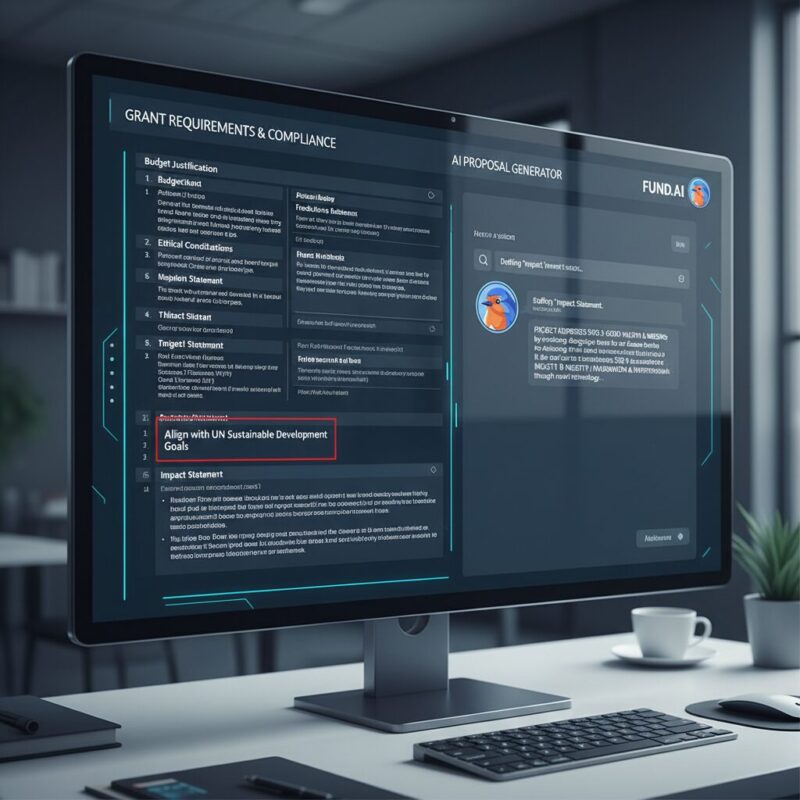
AI excels at the “blank page” problem. By analyzing the federal prompt and drawing from the centralized Organisation Library, AI can significantly accelerate the drafting process. In a recent engagement with a US public university research support office, a 4-person grants team faced a severe bottleneck. They repeatedly typed the same institutional boilerplate for every federal application. By implementing an AI-augmented workspace, they drastically reduced first-draft time and increased submissions from 7 to 12 a year. This frees your team to focus exclusively on narrative nuance and relationship building.
Grounded AI: Eliminating Hallucinations in Federal Compliance
Federal applications demand absolute factual accuracy. Consumer AI models frequently “hallucinate” statistics or invent partnerships to make a narrative sound compelling. Grounded AI helps mitigate this by working from your approved Organisation Brain and relevant source evidence. Furthermore, systems with source provenance show the evidence behind the generated draft. Insights drawn from UK Market Capabilities show that platforms utilizing proven, globally ready models with strict data privacy—ensuring user data never trains public models—are non-negotiable for compliance-first environments.
A Phased Implementation Plan for AI in Federal Grant Research
Resource-constrained nonprofits cannot afford disruptive, all-at-once technology overhauls. Managing change requires a practical, four-phase roadmap to scale capacity securely.
Phase 1: Integrating AI Tools with Legacy Accounting and CRM Systems
Begin by auditing your current data environment. Prepare your internal data for AI integration without overwhelming your IT resources. This means standardizing how you store program metrics, demographic data, and historical budgets. Clean data is the prerequisite for effective AI. Establish clear protocols for how the development CRM will hand off award data to the finance team’s accounting software.
Phase 2: Automating Drudgery (Research, Matching, and First Drafts)
Once the data foundation is solid, deploy AI to handle the heavy lifting of discovery. Implement semantic search tools to build your pipeline automatically. Allow the AI to assist with the first draft of letters of inquiry and standard narrative sections. According to guidance on AI Grant Writing for Nonprofits 2026, automating these specific tasks provides immediate ROI, recovering valuable staff time in the very first month.
Phase 3: Preserving Human Oversight for Strategy and Final Compliance
AI assists with drafts; humans submit grants. Establish strict “human-in-the-loop” workflows. A senior development officer or compliance manager must review every AI-generated proposal against the federal NOFO requirements. The AI provides the raw material, but human review remains required to evaluate strategic tone, partnership dynamics, and legal sign-off before hitting submit on Grants.gov.
Phase 4: Scaling Capacity Without Scaling Headcount
In the final phase, the organization leverages its newly efficient workflows to pursue a higher volume of complex federal grants. Utilizing an AI-augmented infrastructure allows a mid-sized team to punch above its weight class. Instead of hiring three additional grant writers to manage a larger pipeline, the existing team manages the AI tools, acting as editors and strategists rather than typists.
Filtering Federal Opportunities Through a Mission-First Lens
Advanced tracking and analytics ensure that pursued federal grants align strictly with the nonprofit’s core mission, protecting the organization from the long-term damage of misaligned funding.
Aligning Funding with Core Organizational Capacity
The pursuit of high-dollar federal grants often tempts nonprofits to stray from their expertise. An organization specializing in adult literacy should not apply for a youth sports initiative simply because the funding is available. Development directors must use their Go/No-Go framework to interrogate every opportunity. SSIR: Nonprofits Need Grant Writing Infrastructure for Innovation Impact Scale notes that scaling impact requires funding that directly reinforces existing operational strengths.
Avoiding Mission Creep and Restricted Funding Traps
Altering your mission to fit a specific grant is a dangerous trap. This “mission creep” fragments the organization’s focus and stretches staff across disconnected programs. Furthermore, highly restricted federal funding can drain unrestricted reserves if the grant does not adequately cover indirect administrative costs. Spot these traps early by requiring the finance director to review the cost-recovery rules of every NOFO before application development begins.
Leveraging Real-Time Pipeline Tracking and Success Analytics
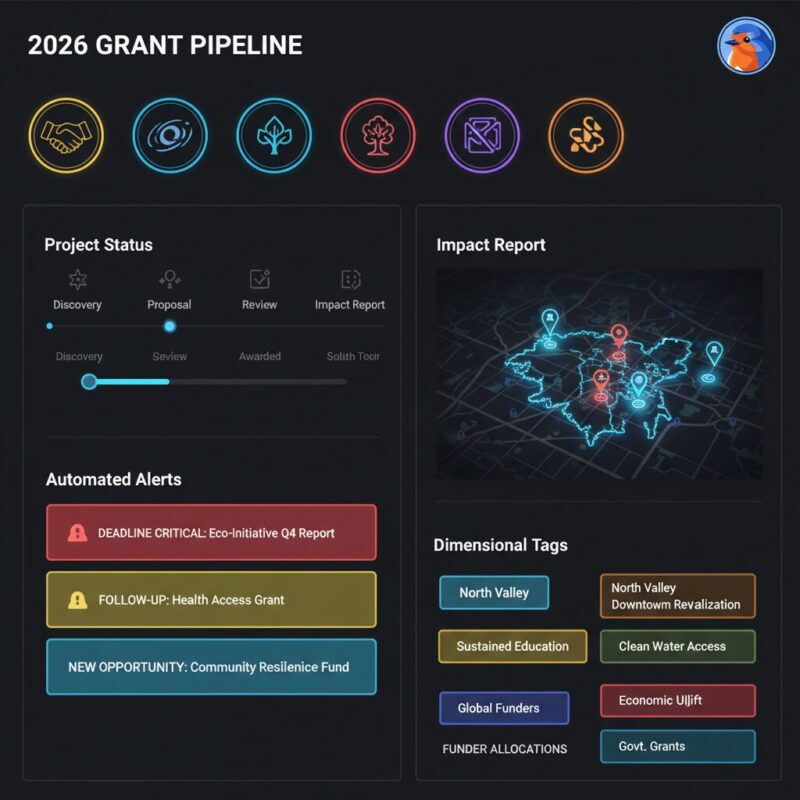
Replace the static spreadsheet with a real-time pipeline and application workflow. A centralized view allows leadership to monitor application status, upcoming deadlines, and award probability across all federal, state, and foundation opportunities. When every team member looks at the same workflow, internal alignment improves, and the risk of a missed deadline drops to zero.
Using Predictive Data to Optimize Long-Term Funding Strategies
Moving beyond reactive grant writing requires looking at the horizon. Use the analytics generated by your grant management software to identify trends. Which federal agencies yield the highest return on investment? What is the average time-to-award? Forecasting funding income based on historical performance enables nonprofits to move from year-to-year survival into sustainable funding strategies and multi-year program planning.

Frequently Asked Questions
What are the main compliance risks for US federal grants in 2026?
Non-compliance with 2026 SAM.gov regulations can lead to rejected applications, frozen drawdowns, and financial clawbacks. The Georgia Center for Nonprofits (GCN) Policy Updates highlight increased scrutiny on entity validation and IRS status. To mitigate these risks, organizations must adopt automated compliance tracking and maintain an audit-ready infrastructure year-round.
How does semantic search improve finding grants for nonprofits in the USA?
Semantic search understands the context of your mission, matching concepts like “at-risk youth” to “disadvantaged teens” even if the exact keywords differ. Traditional portals like Grants.gov rely on exact keyword matches, which frequently hide relevant but obscure federal grants. By analyzing the full text of opportunities, semantic AI surfaces highly relevant funding that manual searches miss.
What is a Go/No-Go decision framework for federal grant opportunities?
A Go/No-Go framework is a 4-step evaluation process: assess organizational capacity, check 2026 SAM.gov eligibility, calculate the true cost of application versus potential award, and align strictly with the core mission. This structured approach prevents teams from wasting hundreds of hours on low-probability or misaligned federal applications.
How can AI reduce nonprofit grant writer burnout?
AI automates the significant time development teams spend on manual discovery and first drafts, directly addressing the 16-month burnout cycle. According to Breaking the Grant Writer Burnout Cycle with AI, transferring data entry and preliminary research to AI frees directors to focus on high-level strategy, partnership development, and relationship building.
Is it safe to use AI for federal grant applications?
Yes, provided users remain responsible for reviewing organisation knowledge and making final submission decisions. Grounded AI can assist with the initial proposal draft based on successful templates and approved institutional knowledge. However, human review remains required to ensure the narrative precisely matches the federal requirements and legal compliance.
How do I integrate AI into my nonprofit development office?
Follow a four-phase approach: Phase 1 is preparing your data and legacy systems. Phase 2 is adopting AI tools to automate discovery and initial drafting. Phase 3 is establishing strict human-in-the-loop review processes. Phase 4 is cross-team data integration, allowing you to scale your application volume without increasing headcount.
Which AI tools are best for federal grant research and compliance?
The best platforms explicitly train their models on successful applications, show their sources via provenance to avoid hallucinations, and practice strict data privacy by never training public models on user data. FundRobin’s contextual grant assistant, Robin, exemplifies this approach, offering a secure, grounded environment designed specifically for the rigorous demands of federal grant compliance.
Key Takeaways:
- Implement a semantic AI discovery engine to replace manual Grants.gov searches, recovering valuable hours for development teams and combating the “16-Month Crisis” of staff turnover.
- Build a proactive, audit-ready infrastructure immediately; reactive “grant chasing” exposes nonprofits to severe legal and financial risks under 2026 SAM.gov certification rules.
- Use a strict 4-step “Go/No-Go” decision framework to evaluate federal opportunities through a mission-first lens, actively preventing mission creep and restricted funding traps.
- Adopt AI in phased increments: automate discovery and assist with first drafts, but maintain human review for strategy, nuance, and final compliance checks.
- Prioritize grounded AI systems that show source provenance and restrict data usage, ensuring organizational intelligence remains secure and factually accurate.
Designing Your 2026 Federal Grant Playbook with FundRobin
Transitioning from reactive administration to proactive strategy requires the right infrastructure. FundRobin provides the precise toolset needed to modernize a nonprofit’s entire grant operation.
Replacing Outdated Search Tools with a Semantic Discovery Engine
FundRobin operates as the immediate upgrade to the legacy Grants.gov experience. By analyzing over 1,200 opportunities daily with context-aware AI, the platform acts as a semantic discovery engine. It provides organization-specific grant discovery and surfaces highly relevant federal, state, and foundation grants that a standard keyword search would miss.
Ensuring US IRS 501(c)(3) and Federal Rule Compliance
Compliance cannot be an afterthought. FundRobin builds verification directly into the workflow. Robin works from your approved Organisation Brain. This helps ensure that every draft aligns with IRS 501(c)(3) standards and specific federal NOFO rules, aiding in reducing the risk of audit failures and financial exposure.
Reclaiming Valuable Hours for Your Mission
The ROI of an AI-augmented office is measured in time returned to the mission. By automating discovery, tracking deadlines in centralized workflow views, and generating grounded first drafts, FundRobin helps turn days of manual proposal writing into hours of high-quality editing and strategic refinement.
Getting Started: From Free Trial to Institutional Transformation
Stop losing institutional memory to burnout and begin building your audit-ready infrastructure today. Eligible, operator-approved organizations can experience the platform firsthand through a guided 30-day Showcase trial. Following the trial, access the complete workflow with the Growth plan at £49.00/month or £470.40/year. Transform your development office from a data-entry hub into a strategic growth engine.
