

Navigating UK charity funding realities requires strategic focus, especially ahead of upcoming fiscal policy adjustments. A July 2026 announcement by HM Treasury and The Rt Hon John Healey MP confirmed that the date of the Budget will be Wednesday 28 October, aiming to move money and power out of Westminster. While the exact policy outcomes remain pending, the directive to achieve more with less is an established reality for the nonprofit sector.
TL;DR: Small nonprofits can navigate impending fiscal pressures ahead of the scheduled 28 October 2026 Budget by adopting a compassionate transformation framework for UK charity funding and AI integration. Utilizing grounded technology to automate SORP impact reporting and grant workflows protects staff capacity, reduces burnout, and reclaims vital hours for mission delivery.
Table of Contents
- The Pre-Budget Landscape of UK Charity Funding in 2026
- Demystifying the 2026 Charities SORP Mandate
- Unpacking the AI-Burnout Paradox in the Charity Sector
- A Digital Equity Roadmap for Teams Under 10 Staff
- Structuring Non-Financial ROI from Digital Innovation
- Governing AI with Integrity: Frameworks for Charity Boards
- Frequently Asked Questions
The Pre-Budget Landscape of UK Charity Funding in 2026
Charities must prepare their operational frameworks now rather than waiting for enacted legislative outcomes. The pressure to modernize increases as teams face a deepening nonprofit starvation cycle—the painful gap between rising service demand and stagnant, restricted funding. This cycle starves organizations of the core investment needed to upgrade operations and protect staff from extreme institutional burnout.

Understanding fundraising resilience means recognizing why generic tech solutions repeatedly fail charities. Off-the-shelf enterprise AI tools lack the specific organizational context required for nuanced grant work. When teams implement generic chatbots, they frequently encounter hallucinations and manual rework, creating more friction than efficiency.
FundRobin advocates for Compassionate Transformation. This framework uses digital tools specifically to protect staff capacity. Instead of adopting a scale-at-any-cost mentality, charities can implement grounded systems that act as a buffer against exhaustion, preserving human energy for the complex relationship work that technology cannot replicate.
Demystifying the 2026 Charities SORP Mandate
Regulatory shifts compel immediate operational changes. From January 2026, the updated Charities SORP introduces three reporting tiers based on charity size, where impact reporting becomes part of the formal framework for organisations with income over £500,000. This mandate requires transforming administrative burdens into rigorous, evidence-based storytelling.
What the New SORP Means for Impact Reporting
The update shifts compliance from simple financial accounting to holistic narrative evidence. Teams must track outcomes in direct context with their organizational aims. Manual tracking cannot sustain this reporting cadence. Evidence reveals a clear capability gap, as the 2025 Charity Digital Skills Report shows 31% of charities are poor at or not engaging with collecting, managing, and using data.
The End of Fragmented Spreadsheets
A recurring buying tension in FundRobin’s customer and market research is the gap between lightweight spreadsheets and expensive or complex grant systems. Smaller teams want stronger discovery and workflow support without adopting enterprise software designed for much larger operations. Fragmented spreadsheets scatter critical beneficiary data, making accurate SORP reporting nearly impossible.
Automating funder reporting fulfills these regulatory requirements while freeing up staff time for frontline delivery. Moving from compliance-driven reporting to integrated digital workflows allows charities to build an institutional memory. A submitted report becomes reusable organizational knowledge for the next UK charity funding bid, bridging the gap between historical compliance and future action.
Unpacking the AI-Burnout Paradox in the Charity Sector
New technology implementations frequently result in higher stress for charity workers. This AI-Burnout Paradox occurs when tools designed for efficiency add severe cognitive load through disorganized interfaces and ungrounded outputs.
When Scale Costs Staff Wellbeing
Pushing small teams to inflate their application volume using generic AI without increasing their capacity to manage the resulting grants creates systemic risk. Organisations are committing resources to AI without a clear governance framework, measurable objectives, or accountability structure. True efficiency protects staff bandwidth. Producing more proposals does not guarantee better outcomes if relationships remain neglected.
Understanding the Input Required Phenomenon
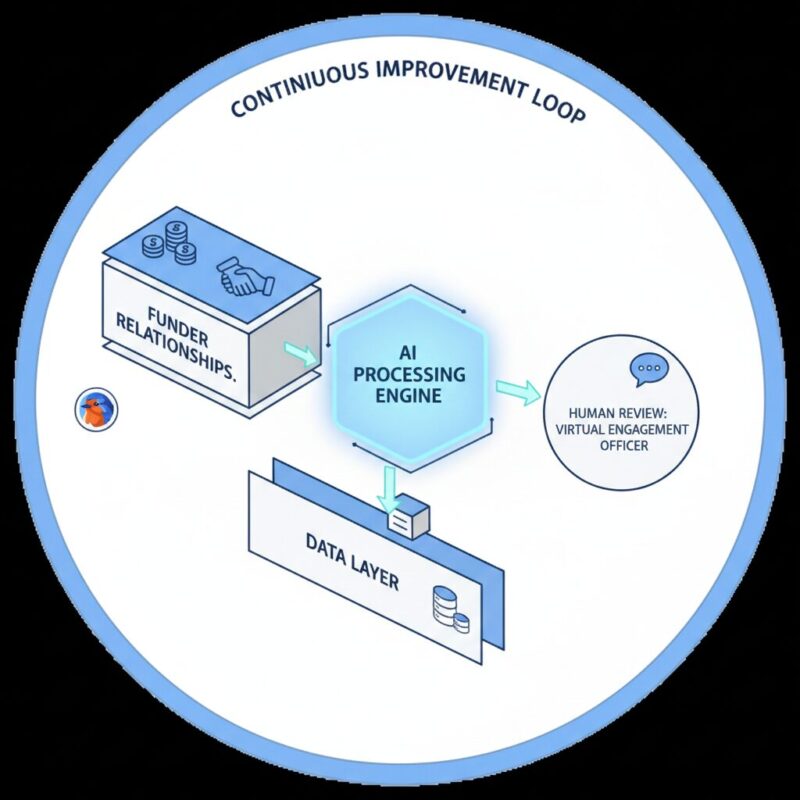
Grant work frequently hits an “Input Required” state—where missing evidence, conflicts, or sensitive manual choices block progress. Generic conversational AI confidently hallucinates answers to fill these gaps, requiring staff to conduct extensive fact-checking. A contextual grant assistant, like FundRobin’s Robin, works strictly within the bounds of verified organizational knowledge. It cleanly surfaces unresolved needs rather than inventing data.
Digital workflows must protect human judgment. Users review knowledge and drafts while maintaining control over final submissions. AI proposes; people preview, refine, and approve.
A Digital Equity Roadmap for Teams Under 10 Staff
Small charities face distinct constraints. In FundRobin’s August 2026 analysis of 225 active organisation profiles with staff-size data, 119—53%—were in the ‘Under 10’ staff band. Additionally, 152 out of 225 active profiles—68%—were classified in the ‘Under $1M’ annual-budget band.
Overcoming the Digital Divide with Low-Cost Pilots
Sector readiness remains a serious obstacle. According to recent sector data, while 76% of UK charities are actively using or experimenting with artificial intelligence, only 44% possess a formal digital strategy. Furthermore, many organisations still face significant internal skills gaps, while external audiences often lack the resources to engage with online services. Small teams overcome this by initiating focused technology pilots rather than massive overhauls.
Building an Organisation Library
Teams can create a central hub for reviewed knowledge by transitioning from scattered files to an Organisation Library. This space serves as the human workspace for source material. Once reviewed, it forms the Organisation Brain, providing reusable factual context for proposals.
Modern platforms democratize access to these features. Smart Discovery capabilities help search and filter funding opportunities relevant to a specific profile, surfacing viable options for review without requiring vast enterprise budgets.
Multiplying Capacity Without Adding Headcount
A UK fractional grant consultant serving five small charity clients moved from five separate spreadsheets and recurring copy-paste to a single playbook per client using reusable approved content and Smart Matching against each client profile. This structured approach scaled capacity from 14 to 22 applications a quarter, reduced new client onboarding from two weeks to four days, and secured four awards won across clients in two quarters.
Structuring Non-Financial ROI from Digital Innovation
Charity leaders measure value beyond immediate monetary returns. Evaluating the true impact of operational software requires analyzing reclaimed time, staff retention, and reporting accuracy.
Tracking Non-Financial Impact
Charities need specific qualitative metrics to assess success, aligning closely with UK grant funding strategies. Essential metrics include data retrieval speed, reporting compliance rates, and time-to-submit capabilities.
In FundRobin’s September 2026 case-study programme, teams that recorded award obligations, reporting dates and evidence sources alongside the original proposal spent a median of 3.5 hours less per reporting cycle reconstructing what had been promised, compared with teams keeping award details in separate documents.
Comparing Operational Capacities and Budgets
Predictable monthly SaaS pricing replaces massive upfront capital expenditure, helping small teams budget confidently. For instance, FundRobin offers clear tiers like the Growth plan at £49.00/month and the Impact plan at £199.00/month. Eligible organisations can also engage in a guided 30-day Showcase Trial following operator approval, allowing them to test the platform’s capacity against their specific grant pipeline.
Governing AI with Integrity: Frameworks for Charity Boards
Trustees often approach AI with skepticism regarding data privacy and cyber threats. A proportionate strategy identifies the use cases that protect your mission without requiring massive capital expenditure.

Demystifying Algorithmic Risk
Algorithmic hallucinations occur when AI models generate plausible but factually incorrect statements. Ungrounded generic AI tools present severe risks for formal grant applications. Implementing Grounded AI mitigates this by restricting the model’s knowledge base entirely to your verified organizational truth.
Creating a Small-Board Governance Template
Charity boards need practical frameworks to fulfill their fiduciary duties. A foundational policy includes three direct steps:
- Define acceptable use cases, strictly limiting AI to drafting and synthesis rather than final strategic decision-making.
- Establish data hygiene rules that dictate exactly what information enters the central knowledge repository. Leaders must prioritise UK GDPR and ICO compliance before adopting any AI tool that handles donor data.
- Mandate review checkpoints, requiring explicit human approval before any generated content is submitted.
Despite the challenges, charities are not rushing blindly into AI; they are approaching it with seriousness and a strong sense of responsibility to beneficiaries and donors. Utilizing visual relationship tools like a Knowledge Graph helps users trace claims back to their source evidence, ensuring source provenance. When Robin suggests a relevant fact in conversation, users utilize the “Save to Library” action to create a review-required candidate. This explicit step guarantees that human oversight remains central to the organization’s intelligence.
Frequently Asked Questions
How does the 2026 Charities SORP affect impact reporting?
The 2026 Charities SORP transitions compliance from simple financial summaries to rigorous, evidence-based narrative impact reporting for organizations over the £500,000 threshold. Manual spreadsheet tracking cannot sustain this new burden, making automated digital workflows essential for mapping outcomes directly to charitable aims without exhausting administrative staff.
What are the risks of AI adoption in the nonprofit sector?
The primary risks of AI adoption include data privacy breaches, algorithmic bias, and the generation of ungrounded hallucinations in grant applications. Charities mitigate these threats by utilizing Grounded AI systems that restrict data generation to verified source provenance, keeping human review central to the workflow.
How can small charities bridge the digital divide?
Small charities bridge the digital divide by initiating focused, low-cost AI pilots and adopting structured governance templates rather than purchasing complex enterprise software. Establishing an Organisation Library centralizes existing knowledge, providing an affordable foundation for scaling operations and improving proposal quality.
What is the ROI of AI in nonprofit operations?
The ROI of AI in nonprofit operations is measured primarily in reclaimed staff hours, increased application capacity, and improved team wellbeing. Evidence shows that unifying award obligations and reporting evidence centrally saves an average of 3.5 hours per reporting cycle by eliminating the need to reconstruct historical data.
Key Takeaways:
- Anticipate shifts in UK charity funding ahead of the scheduled 28 October 2026 Budget without relying on speculative universal funding claims.
- Upgrade systems for the 2026 SORP, which mandates automated, accurate impact reporting over manual spreadsheet tracking.
- Implement a Compassionate Transformation framework where AI serves as a buffer against institutional burnout.
- Expect tangible time savings; structured digital grant workflows save an average of 3.5 hours per reporting cycle.
- Require boards to adopt governance templates to safely integrate Grounded AI that respects source provenance and organizational truth.
Adopting sophisticated tools no longer requires an enterprise budget. Just 14 per cent had scaled AI across three or more functions with a measurable return, but those who do are fundamentally changing how they operate. Currently, only 19 percent of nonprofits with annual budgets above $1 million are using AI tools in a structured way. Small UK charities have an unprecedented opportunity to outmaneuver traditional scaling problems by treating technology as a compassionate partner. By rooting digital adoption in human wellbeing and regulatory readiness, organizations can secure their funding future while protecting the people who drive their mission forward.
