
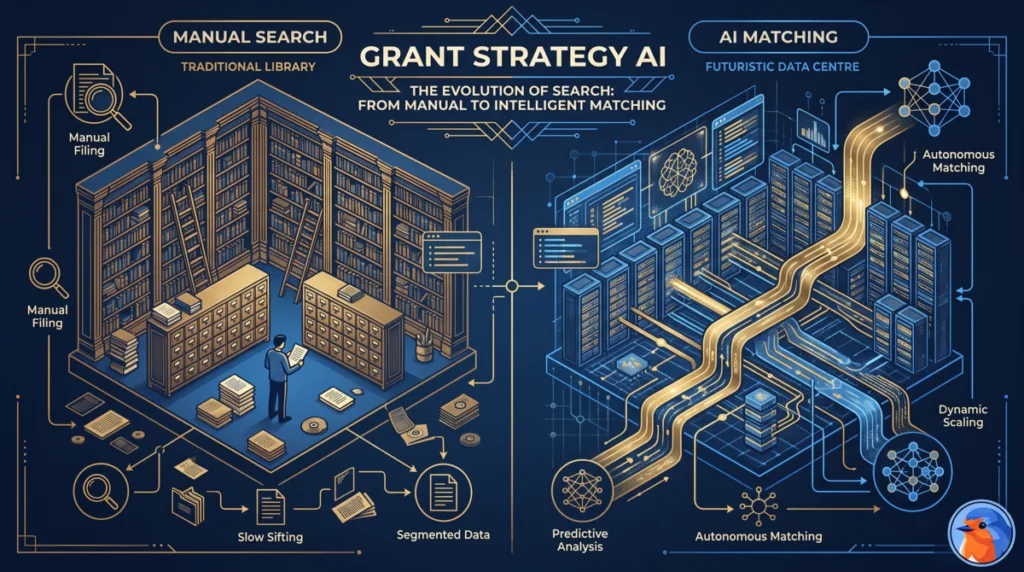
Research conducted throughout 2026 reveals a harsh reality for the UK charity sector: the volume of available funding data has completely outpaced human processing capacity. Development directors and grant managers are drowning in a sea of static directories, spending countless hours manually filtering irrelevant opportunities. This administrative overload is not merely an inconvenience; it is a structural failure that drives talented professionals out of the social sector.
TL;DR: The UK charity sector in 2026 is moving away from static funding directories toward AI-powered grant matching. Platforms like FundRobin act as strategic partners, bridging the AI gap for small nonprofits, reducing manual research time, and preventing grant writer burnout by contextualising organisational knowledge into reusable assets.
Table of Contents
- The Crisis in Grant Seeking
- AI Grant Matching vs. Manual Search
- Shifting to Proactive Research Development
- Building a Grounded AI Workflow
- Human-in-the-Loop Governance
- Measuring the ROI of AI Integration
- Frequently Asked Questions
The Crisis in Grant Seeking: Why Static Directories Are No Longer Enough
The reliance on traditional, manual grant searching creates an unsustainable environment for nonprofit professionals. When highly skilled writers spend their days reading complex eligibility guidelines for grants they ultimately cannot win, motivation plummets.
Understanding the 16-Month Grant Writer Burnout Cycle
Talented staff rarely leave the social sector because they lose passion for the mission. They leave because the administrative machinery exhausts their cognitive capacity. According to FundRobin, grant writer burnout in the nonprofit sector accelerates a debilitating 16-month turnover cycle. This rapid turnover strips charities of their institutional memory and severely disrupts funding momentum.
When a grant writer spends 80 percent of their week acting as a human search engine, the high-level storytelling and relationship-building required to secure major funding suffer. Technological intervention is no longer just a productivity enhancement; it is a critical employee retention strategy.
The Hidden Costs of Manual Grant Discovery
The fundamental flaw of traditional keyword searching is its reliance on exact phrasing rather than contextual intent. A human searching for “youth mental health funding” might miss an opportunity categorised under “adolescent wellbeing interventions.”
FundRobin customer research spanning 240 records indicates the recurring discovery problem is not simply finding more grants, but separating genuinely relevant opportunities from a large volume of possible funding.

Every hour spent reading the guidelines of an incompatible grant carries a severe opportunity cost. That is time lost speaking with funders, refining program design, or auditing past performance.
Charity Excellence and Traditional Funding Finders
Legacy tools and static databases have historically provided immense value to the sector. Traditional databases like the Charity Excellence Funding Finder connect users to global networks of other online funding lists, requiring manual navigation.
While these databases offer a vast foundation of information, they remain passive utilities. They require the user to input the correct Boolean search terms, interpret the results, and manually extract the data into spreadsheets. A directory is a tactical tool. Modern, multi-faceted nonprofits require an active strategic engine that works alongside them.
AI Grant Matching vs. Manual Search: Bridging the “AI Gap” for Lean Teams
The transition from manual directories to AI-powered platforms democratises access to high-level research capabilities. Previously, only large universities and enterprise charities could afford dedicated research development teams. Today, contextual AI agents level the playing field.
Overcoming AI Anxiety for Nonprofits Under £1M
Despite the clear advantages of automation, hesitation remains widespread. A 2024 survey by The Bridgespan Group found that one-third of nonprofit managers listed employee resistance and ethical concerns as primary barriers to AI adoption. This anxiety often stems from a misconception that AI requires complex technical skills or threatens job security.
In reality, modern AI platforms act as user-friendly administrative co-pilots. They do not replace the fundraiser; they replace the spreadsheet. This is particularly vital for smaller organisations. Of 225 active FundRobin organisation profiles with annual-budget data, 152 are classified in the ‘Under $1M’ band. Lean teams are the primary beneficiaries of AI infrastructure, using it as a force multiplier to compete with larger institutions.
However, a concerning divide is forming. According to a 2026 report by Social Current, nonprofits with annual revenues over $1 million are embracing AI at nearly twice the rate of smaller organizations. Overcoming technical anxiety is essential to prevent this AI gap from widening further.
Case Study: How a UK Animal Welfare Charity Reclaimed 5 Hours a Week
The theoretical benefits of AI translate into immediate operational relief for lean teams. Consider a registered UK animal welfare charity with just six staff members and a £310K annual income.
Before adopting AI infrastructure, their team spent five to seven hours a week manually searching funding sites. They lacked a shared pipeline, which resulted in three missed deadlines in a single year.
By implementing FundRobin’s Smart Matching and Organisation Library, the charity transformed its workflow. Their weekly discovery time dropped from 6.5 hours to just 1.5 hours. Within 90 days, they screened 140 opportunities and confidently shortlisted 19. They submitted 11 applications across two quarters, securing two awards, and missed zero deadlines.
The fundraising lead summarized the impact clearly: “We stopped starting every week with a blank search page. The shortlist arrives with reasons, so the time goes on applications that actually fit.”
Shifting from Reactive Data-Entry to Proactive Research Development
Elevating a charity’s operations requires moving beyond reactive software usage to adopt a fundamental change in methodology. Research Development (RD) is a framework typically used by academic institutions to proactively shape a funding calendar rather than reacting to impending deadlines.
Context is King: Managing Complex Organisational Profiles
Simple keyword searches fail modern nonprofits because charitable work is inherently complex and multi-disciplinary. A single organisation might simultaneously deliver programs touching on youth education, mental health, and community sports.
Among 217 active FundRobin organisation profiles with thematic-area data, 209 listed more than one thematic area, averaging 4.2 themes per organisation. AI understands this multi-thematic context far better than rigid search operators. It reads the nuanced guidelines of bodies like the William Grant Foundation and cross-references them against the charity’s complete operational profile.
This level of contextual understanding is why A 2026 FundRobin survey found that 74% of nonprofits cited finding the right grant as their biggest operational challenge. The difficulty lies in matching complex programs to equally complex funder priorities.
Building a Grounded AI Workflow: Find, Know, Draft, Manage
A successful AI implementation follows a structured methodology. FundRobin’s architecture maps directly to the four pillars of grant success: Find, Know, Draft, and Manage. This grounded approach ensures the AI works from approved organisational truth rather than hallucinating generic responses.
Smart Discovery & Matching: Prioritising Fit Over Volume
The “Find” phase relies on Smart Discovery to provide organisation-specific grant filtering. Rather than presenting thousands of raw database entries, Smart Matching compares the organisation’s context with opportunity criteria to prioritise fit.
Crucially, the system provides match rationale. It explains exactly why a specific grant was suggested, supporting human review and decision-making. Research published by H2K Infosys indicates that AI-powered grant discovery software reduces funding research time from dozens of hours to minutes.
The Organisation Library: Turning Past Work into Reusable Context
The “Know” phase stops teams from rewriting the same mission statements repeatedly. The Organisation Library acts as the human workspace for reusable knowledge, storing source context and historical status.
This data feeds the Organisation Brain, which turns reviewed knowledge into reusable factual context. This ensures that any subsequent work is based on verified, up-to-date institutional truth.
Contextual AI Drafting with Robin
During the “Draft” phase, the workflow moves from data storage to active creation. Robin is a contextual grant assistant that works alongside the user. Robin generates editable first drafts using the funder’s exact requirements, project context, and reviewed organisation knowledge.

This human-in-the-loop AI copilot model operates on a preview, refine, and approve workflow. The AI may surface an “Input Required” prompt when facts are missing, keeping the human writer firmly in control of the final narrative.
Pipeline Visibility: Eradicating Missed Deadlines
The “Manage” phase addresses the chaos of siloed spreadsheets. FundRobin provides unified workflow views for tracking grant opportunities and application progress. Keeping all opportunity and application work in one workspace ensures lean teams maintain visibility and avoid the missed deadlines that plague disjointed administrative setups.
Human-in-the-Loop Governance: Implementing Ethical AI Safely
Adopting AI requires clear governance to mitigate risks related to data privacy and factual accuracy. Small charities do not need massive IT departments to implement AI safely; they need practical, enforceable workflows.
Preserving Source Provenance and Institutional Truth
Generic chatbots lack source tracing, making it impossible to verify where a claim originated. Grounded AI platforms solve this through strict source provenance, allowing users to trace an AI-generated fact back to its original approved document.
In FundRobin, chat content and assistant-inferred facts do not automatically become organisational truth. When a suitable fact emerges in a conversation, the system offers an explicit “Save to Library” action. This creates a review-required candidate, ensuring that human oversight governs what enters the Organisation Brain.
Why AI Match Signals Are Not Funding Probability Guarantees
It is vital to manage expectations regarding predictive capabilities. An AI match signal is an indicator of alignment based on written guidelines and organisational data. It is not a funding success probability. Human relationships, nuanced funder priorities, and external competition ultimately dictate award decisions. AI ensures you are applying for the right grants; human strategy ensures you win them.
Measuring the ROI of AI-Integrated Fundraising Strategy
Transitioning to AI infrastructure transforms how a charity measures administrative success. The focus shifts from the sheer volume of grants submitted to the strategic value created by reclaimed time.

According to data from Mewayz, organizations using an integrated suite of modules reduce administrative tasks by an average of 15 hours per week. This allows development teams to redirect their energy toward building funder relationships and tailoring high-quality applications.

As organizations evaluate their digital transformation, access to these tools is becoming standardized. A guided Showcase Trial allows eligible organisations to test the Find, Know, Draft, and Manage workflows. This application-led trial includes operational capacity for three users and five proposal generations, allowing teams to validate the ROI before committing to the standard Growth (£49/month) or Impact (£199/month) plans.
Frequently Asked Questions
What is the best nonprofit strategic planning software?
The best nonprofit strategic planning software connects organisational capacity directly to funding pipelines through integrated Find, Know, Draft, and Manage workflows, rather than merely tracking standalone tasks. According to a 2024 survey commissioned by Unit4 and published by The Turner Agency, 86% of US and UK nonprofit professionals are looking to transform to fully cloud-based enterprise resource planning within two years. Modern platforms support this by turning static planning documents into active, AI-assisted funding strategies.
What does strategy inc actually do?
Strategy defines the ‘why’ and ‘where’ of an organisation’s funding goals, aligning long-term mission objectives with identified capacity and viable grant pipelines. While tactics cover the daily execution of writing applications, a true strategic approach audits past evidence, maps complex thematic areas to funder priorities, and builds a sustainable, proactive research development calendar.
How does strategy differ from tactics?
Strategy defines ‘why’ and ‘where’ an organisation seeks funding based on deep mission alignment and capacity planning, while tactics involve the operational ‘how’ of executing the actual grant application. In modern fundraising, AI takes over the tactical burden of filtering directories and drafting baseline narratives, freeing human professionals to focus on the strategic work of relationship building and program design.
What are the core elements of a strategy?
The core elements of a successful grant strategy include a unified organisational profile, an audited repository of past evidence, a proactively managed funding pipeline, and continuous human-in-the-loop governance. Integrating these pillars allows charities to move away from reactive, deadline-driven panics. For a deeper understanding of aligning these elements, review the UK charity grant funding guide 2026.
What are the benefits of using predictive analytics?
Predictive analytics shifts nonprofits from reactive keyword searching to proactive matching, vastly improving the quality of the application pipeline by filtering out low-fit noise. As noted by Nonprofit Tech for Good in a 2024 report, experts predict grant software will increasingly use artificial intelligence to automate tasks and find the best grants based on an organization’s specific priorities. This targeted approach generates match rationale that directly supports human review.
What is the 80/20 rule for nonprofits?
The 80/20 rule in this context dictates that nonprofits should spend 80% of their time on mission-critical strategy and relationship building, and only 20% on administrative tasks like manual grant searching. Historically, this ratio has been inverted, but AI grant matching automates the administrative burden, making this efficient ratio a realistic standard for lean development teams.
What is the best database software for non-profit organizations?
The best database software in 2026 moves beyond static data storage to act as an active ‘Organisation Brain’ that contextualises past successful applications for immediate future grant matching and drafting. Research from MIT, cited by Grant Assistant, demonstrates that using AI increases productivity and work quality while improving job satisfaction among grant writers. Platforms like FundRobin exemplify this evolution by integrating the database directly into the proposal generation workflow.
What are some important KPIs to measure in fundraising?
Strategic fundraising KPIs have shifted from simple submission volume to metrics like discovery time reduction, shortlist conversion rates, and pipeline velocity with zero missed deadlines. A 2024 report by LeadingAge highlights that 75% of nonprofits believe generative AI has the potential to transform their marketing and fundraising efforts. Tracking how quickly an organisation moves an opportunity from initial discovery to a highly-aligned submitted draft is the most accurate measure of workflow health.
Key Takeaways:
- Implement AI as institutional infrastructure rather than a basic search utility to solve the 16-month grant writer burnout cycle.
- Transition from manual keyword searching to Smart Matching to prioritise opportunity fit and eliminate the noise of irrelevant guidelines.
- Establish an Organisation Library to centralise past evidence, stopping lean teams from rewriting identical mission statements.
- Enforce human-in-the-loop governance by requiring explicit “Save to Library” actions for all AI-generated facts to protect institutional truth.
- Shift KPI tracking away from raw submission counts toward discovery time reduction and pipeline velocity.
Implementing AI into the grant discovery process represents a permanent shift in how the social sector operates. By replacing manual directory searches with contextual, grounded workflows, nonprofits can finally cure administrative burnout and redirect their limited resources toward executing their core mission.
