
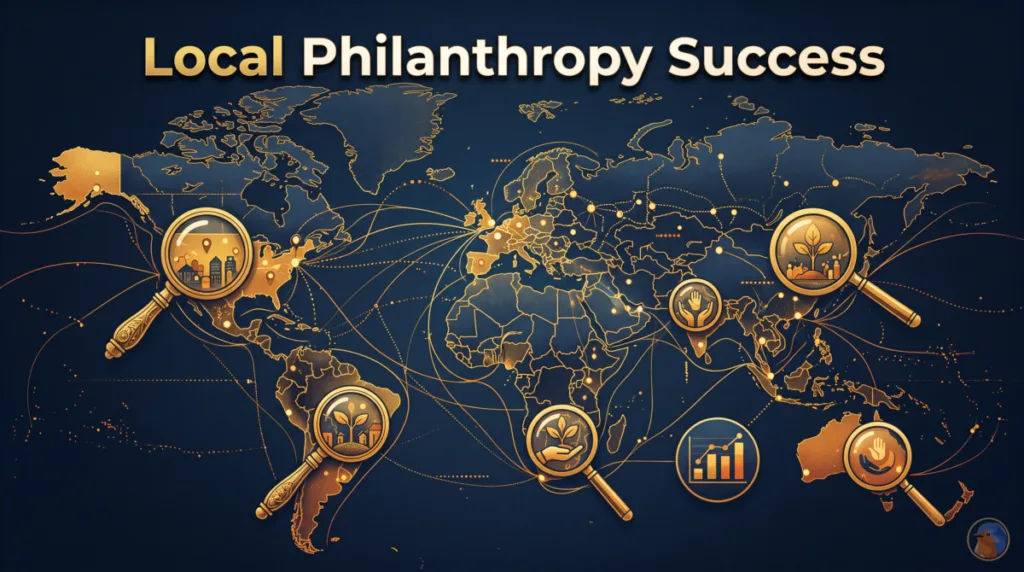
October 2026 shifts in global non-profit strategy reveal a necessary reckoning: the wholesale export of Western fundraising standards to diverse international markets is failing. Global NGOs often default to English-speaking fundraising manuals for efficiency. Sustainable success requires adapting global strategies for actual local cultural resonance.
TL;DR: NGOs must abandon imported donor-centric standards to build localised, community-centric fundraising strategies rooted in regional knowledge. By replacing one-size-fits-all manuals with culturally accurate frameworks and operationalising this data through an ‘Organisation Brain,’ non-profits can reconcile global brand consistency with radical, life-affirming local relevance.
The Anglo-Centric Hegemony in Global Fundraising Trends

The non-profit sector relies heavily on frameworks developed in the United States and the United Kingdom. This creates an Anglo-centric hegemony in global operations. When large NGOs expand into new regions, they typically mandate these familiar playbooks to maintain operational speed. This efficiency comes at the cost of relevance. The tension between local fundraising vs global ideas forces regional directors to choose between appeasing headquarters and connecting with their actual communities.
The Limitations of the ‘Donor-Centric’ Model
Traditional fundraising manuals idolise the donor-centric model. This approach grew out of highly individualistic Western societies. It relies on elevating the individual giver, using messaging that credits a single donor for community outcomes.
Applying these tactics in collectivist societies causes immediate cultural misalignment. Communities that value mutual obligation view individualistic appeals as unnatural or even offensive. The friction between global HQ mandates and local community values is the primary operational pain point for regional fundraising teams today.
How ‘Universal’ Standards Crowd Out Local Philanthropic Wisdom
Imposing global fundraising trends inadvertently erases indigenous giving practices. This is known as the crowding out effect. Traditional mutual aid networks are replaced by transactional, metric-driven fundraising tactics that prioritise short-term revenue over long-term community cohesion.
According to Charity Times, what gets called best practice is often just the dominant culture’s practice, treated as though it were neutral and beyond question. Maintaining local philanthropic wisdom is essential for long-term NGO survival.
Analyzing Rogare’s Fundraising Research on Cultural Misalignment
The academic rigour behind this shift is accelerating. The international fundraising think tank Rogare asks if English-speaking fundraising ideas crowd out local fundraising, launching a project to examine whether practices developed in English-speaking countries are replacing methods better suited to local cultures of philanthropy.
Ignoring local context in favour of global efficiency carries heavy ethical implications. Rogare’s critical research provides a necessary foundation for modern NGOs looking to deconstruct their inherited assumptions and build culturally intelligent operations.
Community-Centric Fundraising vs Donor-Centered Models
When NGOs adopt modern solutions for nonprofits, they must rethink their baseline philosophy. The transactional nature of donor-centric models contrasts sharply with the relationship-first nature of community-centric models. Community-centric philanthropy shifts power back to the local population, treating them as partners rather than passive recipients.
Shifting from Individualism to Collective Giving
Fundraising teams must pivot from appealing to individual egos to mobilising collective community action. Global campaign messaging must be rewritten to resonate with collectivist cultural values.
ImpactFunding notes that collective resource pooling includes traditions like Harambee in Kenya, Ubuntu in South Africa, and Minga in Latin America. Successful collective giving campaigns in emerging economies lean on these established networks rather than importing foreign individualist concepts.
Learning from Indigenous Mutual Aid Networks
Indigenous mutual aid offers a highly effective, sustainable model for local charity success. Modern, mid-sized NGOs can apply these lessons to their daily operations by prioritising trust and unrestricted support.
Research on Thousand Currents shows the mid-sized public foundation provides unrestricted, long-term grants to grassroots organizations in the Global South, privileging trust-based philanthropy over transactional appeals. This case study demonstrates how to scale collective, community-led giving effectively.
Measuring ‘Cultural Vitality’ and Community Trust

Traditional financial return on investment fails to capture the full impact of localised fundraising. International NGOs must quantify the success of community-centric strategies using alternative metrics.
Sweet Grass Consulting observes that Indigenous philanthropy focuses on sovereignty and cultural vitality, preserving traditional culture rather than just tracking immediate financial returns. Measuring long-term community trust provides a far more accurate picture of regional stability and impact.
A Practical Decolonizing Philanthropy Framework for NGOs
NGO leadership needs a step-by-step toolkit to operationalise local autonomy and dismantle colonial fundraising structures. Bridging the gap between academic theory and day-to-day operations requires a phased approach to localising global strategy. Teams can consult a comprehensive nonprofit fundraising strategy guide to structure this transition.
Auditing Your Current Cultural Competence
NGOs must self-assess their cultural awareness to identify areas where global ideas override local needs. A thorough audit reveals blind spots in global strategy rollouts.
The Community Tool Box notes that cultural adaptation may involve language access, disability accommodations, different outreach methods, and changes in who participates in decision-making. Culture is not a fixed set of rules, requiring constant evaluation by leadership.
Building a Cultural Fundraising Matrix
Directors can create a Cultural Fundraising Matrix to score new markets based on community trust, digital maturity, and the local propensity for direct versus collective giving.
Local directors use this matrix to push back against inappropriate global HQ mandates. If a non-English speaking market scores high on collective mutual aid but low on digital individual giving, the regional team has data-backed justification to reject a mandated mass-email campaign.
Reconciling Global Brand with Radical Local Relevance
The tension between brand consistency and cultural resonance is an ongoing challenge. NGOs need frameworks for flexible localisation—knowing exactly what global rules to keep and what to discard.
Relationship-first cultures take precedence over rigid brand guidelines in diverse regions. A logo’s exact placement matters less than communicating respect through locally appropriate channels and phrasing.
Operationalizing Local Autonomy in Your Daily Grant Workflow

Strategic frameworks mean little if they are not embedded in daily operational execution. Capturing local knowledge so it isn’t lost in global systems is the next frontier. The right grant workflow platform empowers lean, local grant-seeking teams to refine their fundraising strategy securely.
Empowering Local Teams with the ‘Organisation Brain’
Local teams often struggle because they are forced to use generic, culturally tone-deaf global templates for their grant applications. The solution is creating a secure repository of authentic local knowledge.
FundRobin’s Organisation Brain addresses this by turning reviewed organisation knowledge and relevant evidence into reusable factual context. The Organisation Library acts as the human workspace for reusable organisation knowledge, ensuring teams always work from culturally verified source material rather than headquarters’ assumptions.
Using Grounded AI for Contextual Accuracy and Provenance
Grounded AI plays a specific role in drafting culturally accurate proposals while maintaining strict source provenance. It works from authorised local organisation knowledge rather than generating unsupported claims.
FundRobin’s contextual grant assistant, Robin, assists in first-draft proposal work by using this specific application context. It retains source, currentness, and provenance information where available, meaning local teams can prove exactly which regional evidence materially informed their generated proposal work. Human review remains a required part of this process.
Tracking Multi-Geographic Focus Success in Grant Seeking
Managing grants across different cultural and geographic zones introduces immense complexity. Local nuance is critical when crossing borders.
FundRobin’s Smart Discovery and Smart Matching surface relevant opportunities and help prioritise fit based on specific geographic constraints. The 213 FundRobin organisation profiles with geographic-focus data listed an average of 3.3 geographic focus entries, with a median of 2. This multi-region reality proves that single-strategy global mandates simply do not map to actual NGO operations.
Frequently Asked Questions
Are English-speaking fundraising ideas crowding out local practices?
Yes, imported Western fundraising norms often erase traditional philanthropic practices in non-English speaking markets. According to Rogare – The Fundraising Think Tank, the international fundraising think tank has launched a project asking whether fundraising ideas developed in English-speaking countries are crowding out practices better suited to local cultures of philanthropy.
What are the core principles of community-centric philanthropy?
The core principles include moving from individual donor worship to collective community empowerment, and prioritising long-term trust over short-term financial ROI. It requires acknowledging systemic inequities and allowing communities to lead on how funds are raised, allocated, and used.
Community-centric fundraising vs donor-centered: What is the main difference?
Donor-centred models cater to the individual giver’s ego and preferences, which is typical in Western contexts. Community-centric models prioritise the collective needs, equity, and indigenous mutual aid traditions of the local population over the individual donor’s feelings.
How can NGOs adapt fundraising strategies for local cultures?
NGOs adapt by auditing their cultural competence, building a Cultural Fundraising Matrix to score trust and digital maturity, and grounding daily grant operations in reviewed local knowledge rather than generic global templates. This shifts power to regional directors.
What is the role of indigenous philanthropy in modern fundraising?
Indigenous mutual aid provides a sustainable, highly trusted model for collective giving. It teaches modern NGOs how to operate through relationship-first, decolonised frameworks rather than relying on transactional, individualistic appeals that lack regional resonance.
Key Takeaways:
- Reject the ‘one-size-fits-all’ donor-centric manual; Western fundraising norms often crowd out effective, traditional local philanthropic wisdom.
- Adopt a ‘Cultural Fundraising Matrix’ to evaluate local markets based on community trust, digital maturity, and mutual aid propensity instead of just financial ROI.
- Operationalise local autonomy by building an ‘Organisation Brain’—a repository of reviewed, culturally accurate knowledge that grounds AI and grant writing in local truth.
- Leverage Grounded AI to draft grant proposals that reconcile global brand consistency with radical local relevance, ensuring source provenance for every culturally specific claim.
To achieve charity success across borders, NGOs must stop treating local cultures as obstacles to global efficiency. By operationalising regional knowledge through smart workflow systems, non-profits can finally leave the Anglo-centric hegemony behind and build fundraising strategies that respect and empower the communities they serve.
