
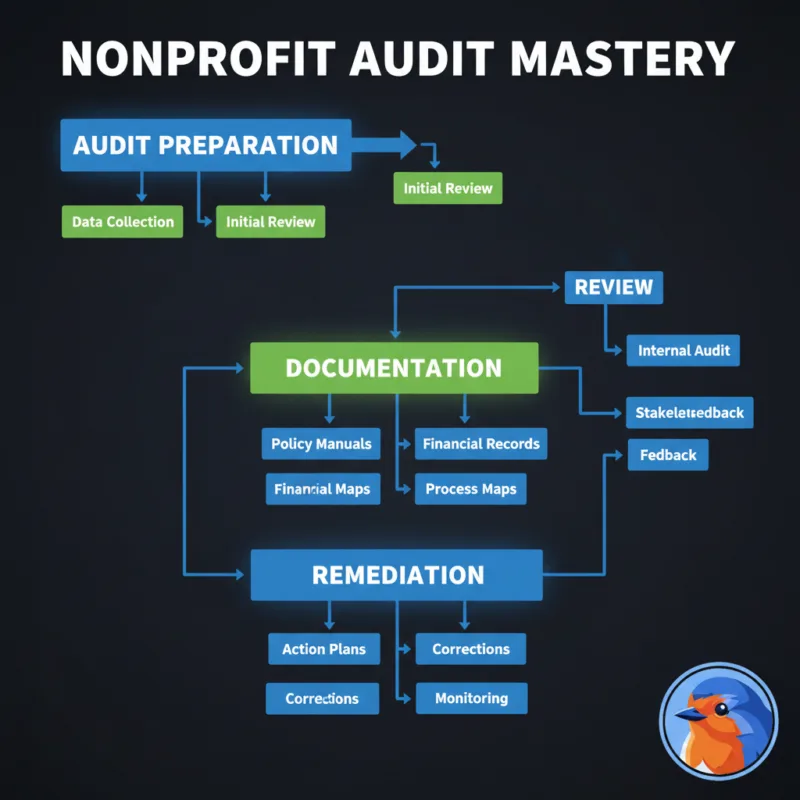
The nonprofit sector bleeds talent over administrative friction. In September 2026, the retention of nonprofit finance professionals continues to hinge on reducing manual audit friction, as teams burn out attempting to reconstruct an entire year of programmatic delivery in a three-week window. The annual audit is often treated as a compliance panic—a necessary evil characterized by missing receipts, frantic emails, and defensive posturing.
Finance professionals do not quit because the accounting math is difficult. They leave because the archaeology required to find basic evidence is exhausting. Transforming this process requires a fundamental shift in perspective. An audit is not merely a tax requirement; when managed correctly, it becomes a strategic asset that proves organizational maturity to major funders.
TL;DR: Transform your annual nonprofit audit from a reactive scramble into a strategic asset for building donor trust and grant readiness. Nonprofits achieve this by implementing continuous compliance workflows, centralizing evidence into a single source of truth, and leveraging transparent financial outcomes to secure larger institutional funding.
Table of Contents
- From Chaos to Control: Transitioning to Year-Round Audit Readiness
- Demystifying Disclosure: Legal Requirements and Financial Reporting
- The Strategic Dividend: Leveraging Audit Outcomes for Donor Trust
- Mitigating Audit Burnout: Systems and Staffing for Sustainable Compliance
- Frequently Asked Questions
- Actionable Next Steps: Preparing for Your Next Nonprofit Audit
Nonprofit Audit Mastery: Compliance as a Strategic Asset
From Chaos to Control: Transitioning to Year-Round Audit Readiness
The year-end audit should never operate as an organizational surprise or a forensic archaeology expedition.

Transitioning away from a reactive model requires embedding audit-ready documentation into daily grant workflows. According to BDO: Audit Readiness for Nonprofits, successful organizations implement continuous compliance by closing their books fully on a monthly basis rather than waiting for year-end. This approach stops the bleeding of historical context. When a program manager leaves in July, their June delivery metrics and associated expenditures are already reconciled, verified, and locked in the system.
It is critical to distinguish between financial audits and programmatic audits. A financial audit strictly verifies that the numbers reported match the actual bank statements and generally accepted accounting principles. A programmatic audit evaluates whether the funds were spent specifically on the impact promised to the funder. Nonprofits frequently fail the latter because finance and program teams operate in distinct software silos.
BDO found that establishing a dedicated audit committee separate from the standard finance committee provides independent oversight that catches these programmatic gaps early. This committee should meet quarterly to review the alignment between grant proposals and actual expenditure, ensuring the organization remains audit-ready 365 days a year.
Demystifying Disclosure: Legal Requirements and Financial Reporting
Nonprofit leaders frequently conflate public transparency with a loss of donor privacy. Understanding the exact boundaries of legal disclosure allows organizations to confidently navigate public reporting without alienating high-net-worth supporters.
The core of US nonprofit transparency relies on public disclosure filings. According to Jitasa’s Ultimate Guide, the IRS requires that 501c3 organizations make their Form 990 available for public inspection. This document provides a comprehensive overview of financial health, executive compensation, and governance practices. However, transparency has legal limits. Schedule B, the section detailing specific donor names and addresses, is redacted from the public copy to protect contributor anonymity.
Before entering an audit, organizations must ensure their foundational public profile is accurate. You can verify your current public tax-exempt status using a 501c3 checker. Additionally, multi-state operators must check their solicitation compliance across jurisdictions using a state filing search.
Board members also need a clear understanding of the 33 1/3% public support test. Jitasa notes that this IRS rule dictates whether an entity maintains its status as a public charity or defaults to a private foundation. Failing this test triggers severe tax implications. Passing it requires a diversified funding base, which is why an audit proving financial competence is necessary to attract varied institutional grants.
The Strategic Dividend: Leveraging Audit Outcomes for Donor Trust
Financial transparency acts as a direct lever for organizational growth.

Organizations that treat their audit purely as a regulatory checkbox miss an enormous storytelling opportunity. Major grantmakers assess risk before they assess impact. An independent audit is the ultimate risk-mitigation document for a cautious funder.
Research from Nature shows that financial transparency has a measurable, positive impact on donor trust and organizational performance. Organizations that proactively share their audited financial statements and detailed impact reports secure institutional funding at significantly higher rates than those that obscure their financials. The data proves that trust scales with verified openness.
This principle applies even when an audit returns “qualified” findings. A qualified opinion means the auditor found specific areas where records were incomplete or deviated from standard practices. Instead of hiding this, strategic leaders use it to build trust. Present the findings to major donors alongside a concrete, 90-day corrective action plan. This demonstrates competent governance and strong grant readiness. You can then integrate this narrative of continuous improvement directly into your case for support, proving to funders that your leadership team manages adversity professionally.
According to Nature’s findings, donors penalize organizations for opaque communication much more harshly than they penalize them for openly managed operational mistakes.
Mitigating Audit Burnout: Systems and Staffing for Sustainable Compliance
The primary cause of audit burnout is fragmented evidence. In most organizations, the finance team lives in accounting software, the program team lives in spreadsheets, and the development team lives in a CRM. When auditors ask for proof that restricted funds were spent correctly, staff spend hours manually cross-referencing these disconnected systems.
Consolidating evidence into a single source of truth fundamentally changes this dynamic. When information lives in an Organisation Brain, team members can reconstruct past programmatic promises without starting from scratch.

FundRobin’s September 2026 case-study programme measured the direct time impact of centralized grant management. Teams that recorded award obligations, reporting dates, and evidence sources alongside the original proposal spent a median of 3.5 hours less per reporting cycle reconstructing what had been promised.
In one specific case (CS3), a 45-staff international NGO managing food security programmes across Kenya and Nepal completely reformed its pipeline. By holding their geography and delivery criteria in structured, reviewed profiles rather than free text, they dropped their avoidable ineligible applications from six to two on average over two quarters, while scaling their screening to 480 opportunities a year.
This kind of efficiency is only possible when organizational knowledge is governed. A visual Knowledge Graph over the Organisation Brain allows teams to trace the direct connections between a funded proposal, the program evidence, and the financial receipt. BDO confirms that investing in systems that automatically link programmatic outputs to financial data is the single most effective way to reduce the staff hours required for audit preparation.
Frequently Asked Questions
How to audit a non-profit organization?
Assemble a finance committee, reconcile all accounts, gather the past year’s documentation, and select an independent CPA to begin the audit. Once these foundational steps are complete, the CPA will test internal controls, review transactions, and issue an opinion on the financial statements. Jitasa’s methodology stresses that success depends entirely on year-round preparation rather than waiting until the auditor arrives to locate receipts.
What are the 5 C’s of auditing?
The 5 C’s are Conditions, Criteria, Cause, Consequence, and Corrective Action. Auditors use this framework to assess findings: they document the current state (Condition), compare it to regulations (Criteria), determine why a discrepancy happened (Cause), evaluate the financial risk (Consequence), and recommend how leadership should fix it (Corrective Action).
How to measure the success of a nonprofit organization?
Combine audited financial statements with specific mission-driven KPIs, such as cost-per-outcome and beneficiary reach. A clean financial audit only proves that funds were accounted for; true organizational success is measured by proving those legally compliant funds actually delivered the promised impact to the community, according to Nature’s research on nonprofit performance.
What is the 33% rule for nonprofits?
The 33 1/3% rule is an IRS public support test requiring a nonprofit to receive at least one-third of its financial support from the general public, government units, or other public charities. Failing this test for consecutive years results in the organization being reclassified as a private foundation, which carries stricter tax regulations and operating limitations.
Do 501c3 organizations need to disclose their financials?
Yes. 501c3 organizations must make their Form 990 available for public inspection upon request and generally post it online. This document discloses total revenue, functional expenses, executive compensation, and governance policies, acting as the primary vehicle for public transparency.
Can you provide some examples of nonprofit financial statements?
The four primary nonprofit financial statements are the Statement of Financial Position (equivalent to a balance sheet), the Statement of Activities (income statement), the Statement of Functional Expenses (breaking down costs into program, management, and fundraising), and the Statement of Cash Flows.
Do 501c3 organizations need to disclose donors?
No, public disclosure of individual donors is generally not required for 501c3 public charities. While organizations must report major donors to the IRS on Schedule B of Form 990, BDO confirms that this specific schedule is redacted from the public-facing version of the document to legally protect donor privacy.
Key Takeaways:
- Implement continuous, monthly compliance reviews to prevent year-end staff burnout and reduce reporting preparation time by up to 3.5 hours per cycle.
- Understand that Form 990 requires public financial transparency, but individual donor privacy remains legally protected through Schedule B redactions.
- Present qualified audit findings to major donors alongside a 90-day corrective action plan to actively build trust rather than trigger skepticism.
- Establish a single source of truth for organizational knowledge to stop the loss of programmatic context when staff members turn over.
Actionable Next Steps: Preparing for Your Next Nonprofit Audit
Transitioning from reactive panic to strategic readiness requires immediate, structured action.
First, assess your current financial governance gap. Identify exactly where documentation falls through the cracks between program delivery and the finance office. Usually, this occurs when program managers buy supplies but fail to attach the restricted grant code to the receipt.
Second, consolidate your foundational data. Stop relying on individual employee hard drives and private inboxes. Establish a clear, governed review process for all incoming evidence so that historical context is never lost, even if your entire development team turns over.
Third, explore holistic platforms that support both programmatic grant tracking and financial compliance. To evaluate your current baseline and streamline your operations, explore our free tools directory.
A well-executed audit does more than keep the IRS happy. It proves your organization has the operational maturity, resilience, and discipline required to scale its mission and handle major institutional funding.
