
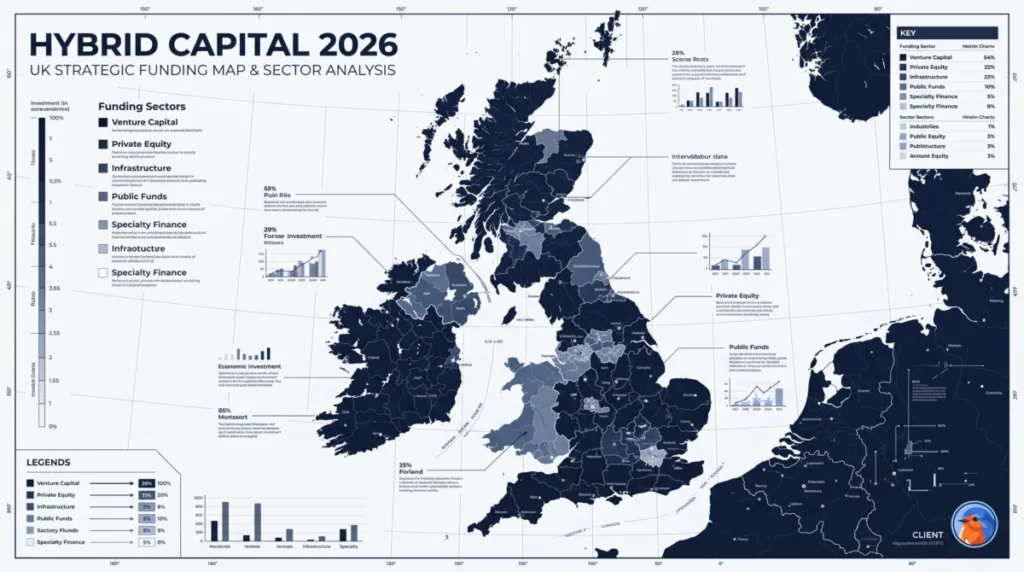
In October 2026, the structural fragility of the third sector is fully exposed. Chief Executives and Finance Directors face a relentless tension between escalating service demands and shrinking philanthropic resource pools. The era of surviving purely on rolling, restricted grants is functionally obsolete. To protect front-line teams from burnout and ensure long-term mission delivery, charities must adopt a sophisticated financial strategy that replaces reactive scrambling with structured capital resilience.
TL;DR: UK charities must abandon pure grant dependency in 2026. Transitioning to a hybrid capital stack—blending traditional grants with repayable social finance—protects mission delivery. Integrating grounded AI platforms like FundRobin eliminates manual discovery waste, securing financial stability and reducing trauma-informed burnout among front-line staff.
Table of Contents
- The 2026 UK Charity Funding Crisis: Volatility, Burnout, and the 200-Fold Surge
- Defining the ‘New Capital Stack’ for UK Charities
- The Rise of Social Investment and Blended Finance
- When is social investment the right option for a charity?
- Operational Resilience: Optimizing Traditional UK Charity Funding with AI
- Human Capital Sustainability: Reducing Burnout Through Financial Stability
- Implementing Your 2026 Capital Transition Strategy
- Frequently Asked Questions (FAQ)
The 2026 UK Charity Funding Crisis: Volatility, Burnout, and the 200-Fold Surge
The current funding landscape requires extreme operational endurance. The supply-demand imbalance in traditional philanthropic grants has generated application surges far beyond historical norms. Highly competitive national funds routinely process hundreds of applications for single-digit award slots, forcing charity staff to dedicate massive resource blocks to speculative bid writing.
Simultaneously, local authority budgets remain tightly constrained. According to the Spending Review 2025, total departmental budgets will grow by 2.3% across the period, and the government is providing an additional £3.4 billion of grant funding for local government in 2028-29 compared to 2024-25, equating to a 3.1% average annual real terms increase in core spending power. While this baseline increase provides a floor, it does not match the compounding inflationary pressures and the escalating volume of complex social needs that charities currently handle.
This continuous financial stress directly degrades human capital. Front-line service delivery teams experience severe, trauma-informed burnout when organizational survival relies on month-to-month cash flow management. When staff operate under the threat of program closure due to a single rejected application, their capacity to deliver high-quality, empathetic care diminishes. Reversing this burnout requires organizations to transition from crisis management to genuine resilience. Charities must restructure their income models, accepting that grant dependency is a financial vulnerability that directly harms the workforce.
Defining the ‘New Capital Stack’ for UK Charities
To decouple mission impact from market volatility, charities must transition to a hybrid capital stack. This framework treats organizational funding as a diversified portfolio containing restricted philanthropic grants, unrestricted earned income, and repayable social finance.
The central mechanism governing this transition is the 33% Revenue Diversification Rule. The methodology dictates that no single volatile source should ever account for more than one-third of your operational revenue. Relying entirely on one government grant means your charity can collapse overnight if priorities change.
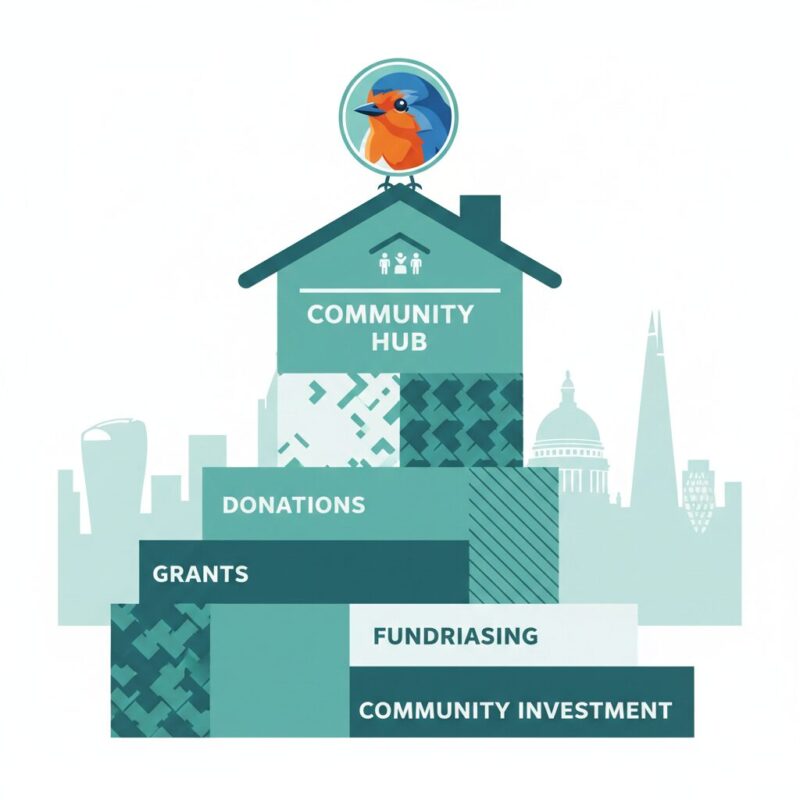
A resilient target model divides income streams into three robust pillars:
- 33% from traditional trust and foundation grants: This capital supports core administrative costs and highly specific project deliverables. These funds are often slower-moving but provide necessary bedrock capital for non-revenue-generating activities.
- 33% from public fundraising or donations: This provides unrestricted capital that organizations can deploy dynamically to address immediate service gaps or pilot untested programs.
- 33% from earned income or impact partnerships: This segment includes fee-for-service contracts, social enterprise operations, or repayable social finance designed to scale proven interventions.
This deliberate defense ensures that a rejected proposal or an ended grant cycle does not halt core operations. Building this capital stack forces the board and the executive team to stop viewing funding as a passive reception of charity, and instead treat it as active, strategic capital management.
The Rise of Social Investment and Blended Finance
As traditional grant models reach capacity limits, the sector is heavily adopting alternative financial instruments. Crowd funding, peer-to-peer lending and other forms of social finance are new models of funding which can make resources available to drive impact.
What is blended finance? Blended finance pools high-risk philanthropic or development capital with commercial finance to lower the risk for private investors, ensuring that community missions receive scale-up funding. It emphasised how blended finance is essential for mobilising significant investment by de-risking opportunities through guarantees. This mechanism allows charities to launch large-scale projects without relying entirely on non-repayable grants.
What does 2026 have in store for social investment? The year is defined by a shift toward climate initiatives and unified funder action. Key priorities include energy and climate finance, collaboration over competition, and the recognition that impact-first and blended finance are critical to scale. Funders recognize that fragmented, competitive bidding wastes capital, pushing them toward collaborative endowment strategies. For example, six UK charities pooled financial resources to launch a £50m endowments investing challenge focused on young people’s concerns. The organisations behind the initiative include The Blagrave Trust, The Children’s Society, and the Joseph Rowntree Foundation.

How can blended finance help fund climate action? This structure pools low-interest loans with non-repayable grants to finance extensive physical infrastructure projects, such as community energy grids or housing retrofits, which can be used to fund climate action and sustainable development goals. The upfront capital requirements for environmental retrofits generally exceed standard grant limits, making blended finance the only viable avenue for rapid implementation.
When is social investment the right option for a charity?
Social investment is the right option when a charity has a reliable earned income stream, requires upfront capital to scale a proven intervention, and possesses the operational maturity to manage debt. Social investment means deploying capital with the expectation of both a social return and some degree of financial return. It does not replace emergency funding; it acts as growth capital.
Before taking on repayable finance, leadership must conduct a rigid internal readiness assessment. This involves examining the stability of existing contracts, forecasting fee-for-service revenue, and evaluating the board’s risk appetite.
Organizations evaluating this path can look to established transition frameworks. For instance, Comic Relief piloted a “beyond grants” programme, a new way to tackle the cliff edge that can appear for organisations that are reaching the end of a traditional three-year funding round. This initiative mixes elements of grant, repayable grant, loan, and support to facilitate smoother transitions into new income streams. Similarly, the Emmaus Fund utilizes an innovative social investment model that provides low-cost loans to federation members. When their social enterprises generate profit, the loans are repaid so the capital can be recycled to open new sites.
Navigating this space also requires understanding regional dynamics. Organizations should factor in how local council funding and devolution impact financial options, as localized investment hubs increasingly manage regional social investment capital.
Operational Resilience: Optimizing Traditional UK Charity Funding with AI
Diversifying revenue streams takes years. In the immediate term, charities must relentlessly optimize the one-third of their capital stack dedicated to traditional grants. The current method of manually scouring fragmented databases and writing repetitive proposals from scratch creates profound administrative bloat, stripping hours away from actual service delivery.
This is where AI integration becomes a structural necessity rather than a technological novelty. FundRobin is an AI-powered grant discovery platform dedicated to the UK social impact sector. Instead of generic search engines, FundRobin utilizes Smart Discovery to surface relevant opportunities based on specific organizational context. This approach prioritizes opportunity fit, eliminating the wasted effort of applying for misaligned funds.
To ensure compliance and authenticity, FundRobin relies on an ‘Organisation Brain’—a secure, reusable context repository built from reviewed charity knowledge. When users interact with the system, they retain total control over source provenance. The AI acts as a contextual assistant (Robin), drawing only from authorized organizational and funder data. Suitable organization facts can be explicitly saved to the Library, meaning the tool augments human intelligence rather than bypassing it.
Adopting modern operational tools requires pricing pragmatism. At £49.00/month for the Growth tier, or £199.00/month for the Impact tier, the platform replaces the cost of manual database searching with geometric precision. By automating discovery and centralizing knowledge, charities reclaim the time necessary to build the high-level impact partnerships required for their wider capital stack.
Human Capital Sustainability: Reducing Burnout Through Financial Stability
Financial strategy is fundamentally a human resources issue. Operating on fragile, short-term grants forces leadership to issue redundancy notices at the end of every funding cycle, deeply damaging staff morale. Trauma-informed service delivery requires practitioners to provide stable, consistent environments for vulnerable populations; they cannot do this if their own employment is perpetually threatened by market shocks.
When organizations secure long-term, diverse funding, they buy the stability required to effect systemic change. Consistent funding for the big vision provides the glue holding a collaboration together and enables partners to raise their heads above the day-to-day work of meeting immediate need. A prime example is the Mind and Rethink ‘Time to Change’ campaign, which secured over £40m from the Big Lottery Fund, Comic Relief, and the Department of Health to transform public attitudes toward mental health. That scale of impact demands the long-term security provided by robust capital planning.
Charities must also realize that funders conduct extensive due diligence on organizational health. Aligning your charity’s media strategy with funder expectations demonstrates the operational maturity needed to attract social investment. By projecting stability, transparency, and a clear path toward the 33% diversification rule, charities reassure investors that their capital will generate sustained impact rather than merely keeping the lights on for another six months.
Implementing Your 2026 Capital Transition Strategy
Transitioning an established charity from complete grant dependency to a resilient hybrid model requires deliberate, phased execution. Executive leaders must map out a multi-year transition architecture.
Phase 1: Auditing the Pipeline and Calculating Dependency
Begin by calculating your pure-grant dependency ratio. Analyze the past three financial years to determine exactly what percentage of operating costs rely on restricted trust and foundation grants. If this number exceeds 75%, immediate intervention is required to diversify revenue sources before existing cycles end.
Phase 2: Centralizing Knowledge to Streamline Traditional Bids
Before building new revenue streams, you must minimize the administrative cost of your existing grant pipeline. Consolidate your past proposals, impact reports, and historical data into a secure Organisation Library. Utilizing tools like FundRobin ensures your team spends minimal hours on discovery and drafting, freeing up senior staff to explore complex social finance options.
Phase 3: Educating the Board and Phasing Pilots
Boards accustomed to traditional philanthropy often resist the concept of taking on debt or launching commercial ventures. Executives must educate trustees on the realities of the 2026 funding environment, emphasizing that safe, slow grant strategies now carry immense risk. Launch small-scale earned income pilots to build a track record before seeking substantial blended finance.
Phase 4: Establishing Metrics for the 33% Rule
Set hard KPIs to track progress against the 33% Revenue Diversification Rule. As you enter 2026, charities face new SORP narrative reporting requirements, which will demand greater transparency regarding financial sustainability and operational risks. Demonstrating steady progress toward a balanced capital stack will become a core component of future compliance and investor confidence.
Frequently Asked Questions (FAQ)
What is blended finance?
Blended finance uses philanthropic or development capital to mobilize commercial finance, reducing the risk for private investors while ensuring mission delivery. Social impact investors use a range of innovative financial tools to support social enterprises and charities who would otherwise struggle to access the finance. By providing a first-loss guarantee or concessionary grant, institutional funders make it viable for commercial banks to lend to charities for large-scale infrastructure and growth projects.
What does 2026 have in store for social investment?
In 2026, social investment shifts from niche enterprise models to mainstream charity adoption, driven by reduced traditional grant availability and stringent SORP reporting standards. The sector is moving rapidly toward collaborative funding environments, recognizing that pooling capital is necessary to tackle systemic issues effectively. Funders are prioritizing energy and climate resilience, explicitly demanding that charities demonstrate long-term financial agility.
How can blended finance help fund climate action?
Blended finance pools high-risk philanthropic grants with low-interest loans to scale physical infrastructure and community energy projects that combat climate change. Environmental retrofits for charity-owned buildings or green community transport fleets require massive upfront capital that standard grants rarely cover. By mixing capital types, charities access the volume of funding necessary to execute meaningful carbon-reduction strategies without destabilizing their cash reserves.
When is social investment the right option for a charity?
Social investment is the right option when a charity has a reliable earned income stream, needs upfront capital for scaling, and wants to decouple from restricted grant cycles. It is inappropriate for funding daily operational deficits or crisis interventions. Charities must first audit their fee-for-service contracts or enterprise profits to ensure they can confidently service the interest and capital repayments required by the investment vehicle.
How can AI improve UK charity funding discovery?
While AI cannot guarantee funding, grounded AI tools like FundRobin help charities use their existing ‘Organisation Brain’ to discover precise matches and draft initial applications faster, freeing staff for relationship building. By relying on source provenance and organization-specific filtering, these systems eliminate the wasted administrative hours spent pursuing misaligned grants, allowing human teams to focus on strategy and final submission reviews.

What is the 33% revenue diversification rule for nonprofits?
The 33% rule is a strategic benchmark suggesting charities should secure no more than a third of their operating budget from a single highly volatile source, such as restricted grants. The model advises balancing revenue across three pillars: traditional grants, unrestricted public fundraising, and earned income or impact partnerships. This structure protects the core mission from sudden market shocks or shifts in government funding priorities.
Key Takeaways:
- The 2026 ‘Hybrid Resilience Mandate’ requires UK charities to transition from precarious grant-dependency to a robust ‘capital stack’ blending traditional grants, earned income, and repayable social investment.
- Implementing the ‘33% Revenue Diversification Rule’ acts as a safeguard, decoupling your core mission impact from market volatility and unpredictable grant cycles.
- Addressing human capital sustainability is critical; reducing financial uncertainty directly lowers ‘trauma-informed’ burnout among front-line service delivery staff.
- Operational resilience demands adopting Grounded AI (like FundRobin) to transform repetitive administrative burdens into streamlined ‘Smart Discovery’, reclaiming hundreds of hours for strategic work.
- With the upcoming SORP 2026 narrative reporting requirements, charities must demonstrate sophisticated financial agility, making early adoption of blended finance a competitive advantage.
- Integrating transparent, cost-effective tools (e.g., FundRobin’s £49/mo Growth plan) provides an immediate ROI by centralizing your ‘Organisation Brain’ and improving proposal source provenance.
To survive the constraints of 2026, UK charities must aggressively rewire their financial architecture. Passive reliance on a dwindling supply of traditional grants guarantees operational instability and severe staff burnout. Executive teams must audit their pure-grant dependency today, implement the 33% diversification rule, and leverage precision tools to eliminate administrative waste. Adopting this hybrid capital mandate is the only method to secure your organization’s future and execute your mission at scale.
